The leveler connection depends on a supported lip and a vehicle that stays in position. Verify the combined equipment/cargo load, trailer floor and restraint before crossing, then monitor changes until the departure release.
This is reference content written and revised with AI. It has not been verified or approved by a professional. Review by a suitably qualified professional and required site authorization are necessary before use.
Stop conditions first
Do not cross with unverified vehicle restraint, insufficient lip support, damaged trailer floor, unstable leveler, changing gap/height or failed signal/communication. Block access from both sides and do not adjust the lip by hand.
1. US legal and technical basis
General-industry dock loading: OSHA 1910.26 covers dockboard load capability, applicable run-off protection and transport-vehicle movement prevention. Powered-industrial-truck operations also require 1910.178 review, including training, trailer support and floor condition. Alternative restraint use must meet applicable requirements and conditions, not merely show a green light.
| Reference | Use and limit |
|---|---|
| OSHA 29 CFR 1910.26 | Dockboard maximum intended load, applicable edge run-off design and transport-vehicle movement prevention. Portable-dockboard clauses are distinct from this installed-leveler scope. |
| OSHA 29 CFR 1910.178 | Relevant loading provisions: brakes/movement prevention, uncoupled-trailer support, floor checks and trained powered-industrial-truck operation; actual application requires review. |
| OSHA mechanical dock restraint directive | Conditional enforcement guidance on mechanical restraint alternatives to wheel chocks; not blanket permission for every device or vehicle. |
| OSHA State Plans | Federal baseline and State Plan coverage reviewed. Confirm the applicable state program and employer coverage; this edition does not establish nationwide compliance. |
Determine whether Federal OSHA or an applicable State Plan governs the employer and work. Standards incorporated into a regulation must be read in their legally applicable edition. Other NFPA/ANSI guidance and manufacturer instructions have distinct roles; they are not automatically federal law.
2. Scope and required inputs
Included
Operate an installed pit-style dock leveler to transfer goods between a compatible vehicle and warehouse with an appropriately selected handling device.
Separate assessment
Installation, repair or entry below the leveler, portable dockboards, liftgates, unstable-vehicle recovery and operator qualification assessment require separate procedures.
| Input | Evidence needed |
|---|---|
| Match combination | Leveler and load limits; Floor condition; Vehicle height/width; Lip-support criteria |
| Secure vehicle | Brake/restraint state; Device compatibility; Trailer support; Driver communication |
| Connect leveler | Lip contact/support; Deck seating; Angle and gap; Signal and restraint state |
| Release and hand over | Departure communication; Restraint-release record; Dock defect status; Receiving owner and action |
Selected public official provisions were checked on October 12, 2026. This is not a complete legal audit. No actual equipment manual, site measurements, engineering calculations, product certification or professional technical approval was supplied. Full paid NFPA/ANSI standards and state/local amendments were not reviewed. Check actual equipment, jurisdiction and project requirements before use.
Select task-appropriate eye, hand, foot, skin and hearing protection from the exposure assessment. Where respiratory protection is necessary, use the applicable respiratory-protection program; PPE does not replace isolation, guarding, support or ventilation.
3. Eight-stage JSA
| Job stage | Hazards and effects | Failure factors | Controls | Site verification | P | S | R | A |
|---|---|---|---|---|---|---|---|---|
| 1. Match combination | 1. Leveler overload2. Trailer-floor collapse3. Unsafe slope4. Lip support failure | 1. Cargo weight only counted2. Floor damaged3. Height unsuitable4. Vehicle mismatch | 1. Check combined intended load2. Inspect trailer floor3. Match operating geometry4. Verify model/vehicle compatibility | 1. Leveler and load limits2. Floor condition3. Vehicle height/width4. Lip-support criteria | ||||
| 2. Secure vehicle | 1. Early departure2. Trailer creep3. Uncoupled-trailer tip4. Conflicting signals | 1. Brake treated as full restraint2. Device not engaged3. Support missing4. Driver not briefed | 1. Apply movement prevention2. Verify actual restraint3. Assess trailer support4. Agree departure authority | 1. Brake/restraint state2. Device compatibility3. Trailer support4. Driver communication | ||||
| 3. Clear dock zone | 1. Dock-edge fall2. Crush in mechanism3. Pedestrian collision4. Falling load | 1. Opening unguarded2. People below/front3. Traffic mixed4. Load obstructs view | 1. Control exposed edge2. Clear operating envelope3. Separate pedestrians4. Provide lighting and route | 1. Dock/ground boundaries2. People clear3. Traffic route4. Lighting and load view | ||||
| 4. Connect leveler | 1. Lip disengagement2. Platform pinch3. Unsupported crossing4. Equipment movement | 1. Lip support inadequate2. Person on moving deck3. Angle/gap ignored4. Sequence changed | 1. Operate from designated position2. Keep deck clear during movement3. Verify lip and geometry4. Follow actual operating sequence | 1. Lip contact/support2. Deck seating3. Angle and gap4. Signal and restraint state | ||||
| 5. Transfer goods | 1. Vehicle moves2. Load falls3. Equipment runs off4. Floor fails | 1. Connection change ignored2. Load unstable3. Edge travel4. Floor deterioration | 1. Follow designated path/speed2. Monitor restraint and lip3. Keep load stable4. Watch floor and vehicle change | 1. Route and equipment load2. Physical connection3. Load stability4. Trailer floor/state | ||||
| 6. Hold changes | 1. Reentry onto unsafe bridge2. Hand crush at lip3. Under-deck crush4. Repeated loss of support | 1. Green light trusted2. Lip moved by hand3. Worker goes below4. Height change ignored | 1. Stop both approaches2. Restrict leveler movement3. Refer fault to maintenance4. Reassess vehicle and connection | 1. Change/time/location2. Traffic exclusion3. Fault and isolation request4. Restored support evidence | ||||
| 7. Stow and protect | 1. Worker left in trailer2. Vehicle catches lip3. Dock-edge fall4. Handling-device damage | 1. Interior not swept2. Driver departs early3. Edge left open4. Equipment still crossing | 1. Confirm people/equipment clear2. Stow per instructions3. Restore edge control4. Keep vehicle secured until release | 1. Trailer sweep2. Lip/deck stored state3. Edge protection4. Vehicle still restrained | ||||
| 8. Release and hand over | 1. Ambiguous departure2. Faulty dock reused3. Restraint released early4. Missed follow-up | 1. Driver guesses signal2. Defect not marked3. Wrong release authority4. Record incomplete | 1. Use designated release signal2. Confirm planned restraint release3. Mark defective dock unavailable4. Transfer follow-up ownership | 1. Departure communication2. Restraint-release record3. Dock defect status4. Receiving owner and action |
Actual risk assessments, measurements, checks, approvals and signatures have not been performed. Keep unverified fields blank and link the actual site records. P/S/R/A mean likelihood, severity, site-method risk and site-defined acceptance/authorization; a score cannot waive a required control.
4. Failure mechanisms and hypothetical case
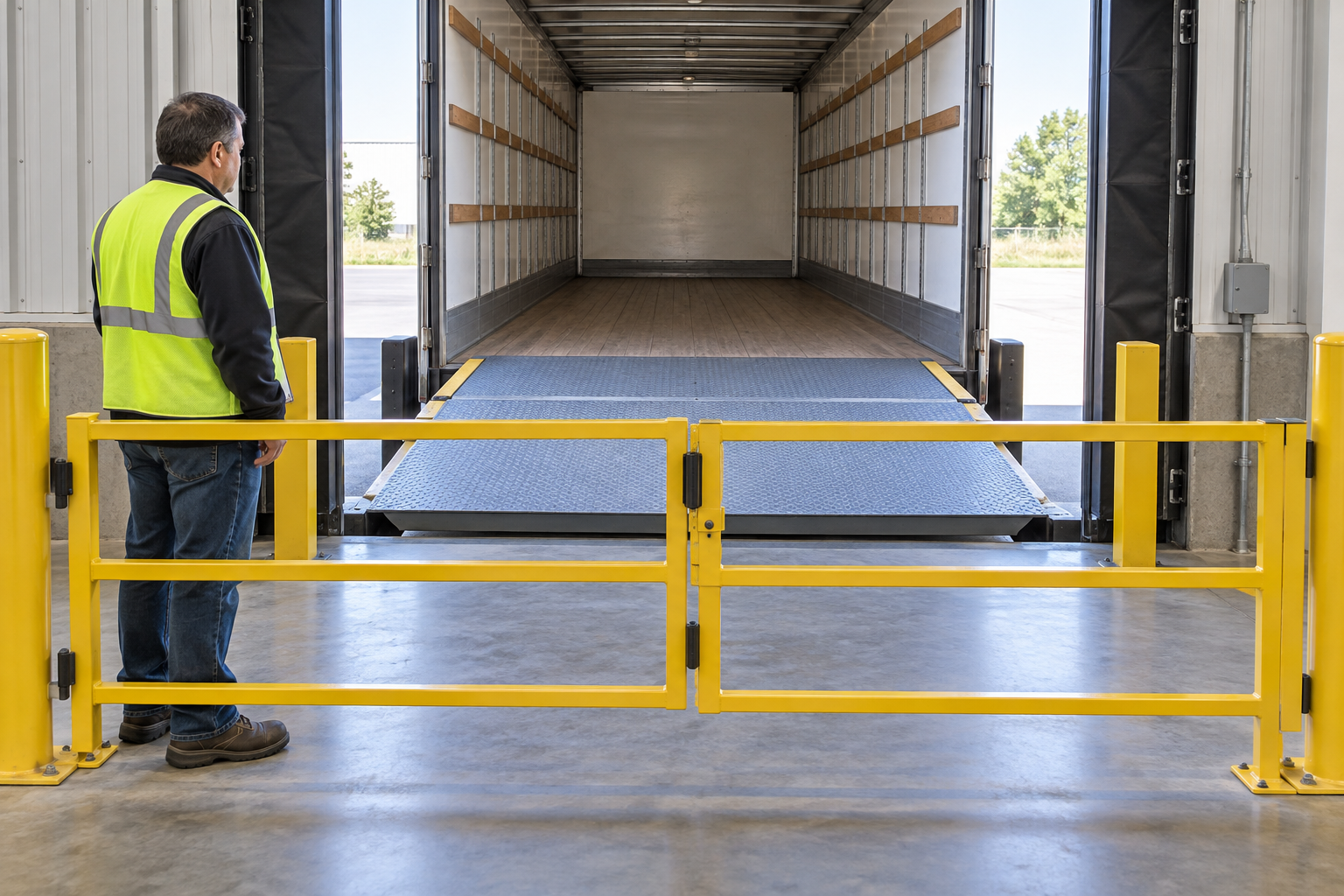
The retained illustration is an AI-generated educational image from the Korean source. It is not an actual incident photograph, approved drawing, equipment certification or proof that the depicted arrangement is safe.
The intended load includes the handling equipment and cargo under the actual model operating conditions. A leveler capacity label does not establish trailer-floor strength, suitable lip support or safe geometry.
Trailer position and height can change while loading. A first successful crossing and a green signal do not establish continued support. Check actual restraint engagement and compatibility and monitor the physical connection.
Where powered industrial trucks are used, review the brake/chocking provisions and any accepted mechanical restraint arrangement against applicable OSHA conditions. Disconnected trailers may need support against upending; driver agreement alone is not physical restraint.
Departure follows a deliberate sequence: people and handling devices clear, leveler stored and dock edge controlled, then restraint release and an unambiguous driver signal from the designated person.
Hypothetical decision example
Hypothetical example: the dock signal remains green but the truck-to-dock gap grows and lip support decreases during unloading. The crew stops both approaches and holds work until restraint, connection and signal faults are resolved.
The example is fictional; no incident, measurement, inspection or approval is asserted.
Task flow: Match combination → Secure vehicle → Clear dock zone → Connect leveler → Transfer goods → Hold changes → Stow and protect → Release and hand over
5. Hold and proceed decisions
| Condition | Action | Evidence | Proceed when |
|---|---|---|---|
| Restraint uncertain | Hold crossing and verify compatibility | Actual engagement, brake/restraint procedure | Vehicle secured |
| Lip support changes | Stop traffic from both sides | Position, support and signal review | Connection restored |
| Trailer floor damaged | Reject entry pending assessment | Floor/load-capacity evidence | Floor accepted |
| Departure requested | Clear people, stow leveler, release deliberately | Final sweep and assigned driver signal | Sequence complete |
Similar observation, different conclusion
| Observation | Supported conclusion | What remains unresolved |
|---|---|---|
| Green dock light | One signal state is present | Actual restraint and lip support still need checks |
| First load crossed | That crossing completed | Later height, load and support can change |
6. Roles and supervision
| Role | Responsibility |
|---|---|
| Work supervisor | Coordinate match combination, affected operations, stop signals and stage transitions. |
| Technical/equipment reviewer | Verify Leveler and load limits, Floor condition, actual instructions and unresolved technical limits. |
| Task crew | Apply the stated controls, report changes and keep actual checks and signatures factual. |
| Inspector/test lead | Connect Change/time/location, Traffic exclusion to the required acceptance criteria. |
| Receiving authority | Accept the recorded restrictions, Dock defect status, Receiving owner and action, and follow-up ownership. |
These are responsibility examples, not invented statutory credentials. Verify actual competence, training and authority for the assigned work.
Supervision and handover controls
| Stage | Management controls | Evidence |
|---|---|---|
| Plan review | 1. Assign technical owner2. Close task-specific questions3. Check combined intended load | 1. Leveler and load limits2. Floor condition3. Lip-support criteria |
| Competence | 1. Verify required competence2. Assign stop authority3. Apply movement prevention | 1. Brake/restraint state2. Training and task briefing3. Driver communication |
| Prestart evidence | 1. Inspect actual equipment2. Link evidence to this stage3. Operate from designated position | 1. Lip contact/support2. Deck seating3. Signal and restraint state |
| Change control | 1. Stop and secure the area2. Review affected controls3. Confirm people/equipment clear | 1. Trailer sweep2. Lip/deck stored state3. Vehicle still restrained |
| Shift handover | 1. Identify remaining restrictions2. Confirm receiving responsibility3. Use designated release signal | 1. Departure communication2. Restraint-release record3. Receiving owner and action |
| Closeout | 1. Record defect disposition2. Archive factual evidence3. Use designated release signal | 1. Departure communication2. Restraint-release record3. Receiving owner and action |
7. Hold points and record quality
| Hold point | Evidence before release | Actual record |
|---|---|---|
| HP-0 Start | Operate an installed pit-style dock leveler to transfer goods between a compatible vehicle and warehouse with an appropriately selected handling device. | |
| HP-1 Secure vehicle | Brake/restraint state; Device compatibility; Trailer support; Driver communication | |
| HP-2 Connect leveler | Lip contact/support; Deck seating; Angle and gap; Signal and restraint state | |
| HP-3 Stow and protect | Trailer sweep; Lip/deck stored state; Edge protection; Vehicle still restrained | |
| HP-4 Release and hand over | Departure communication; Restraint-release record; Dock defect status; Receiving owner and action |
Hold points are internal evidence gates. They do not establish that a statutory permit exists or has been approved. Recheck affected gates after changes, faults and shift handover.
Record comparison - hypothetical templates
The 16 boxes below identify record elements, not completed checks or approvals. They are static symbols. Link equipment/location, date, actual findings and the separate record reference; preserve unresolved items.
| Record | Insufficient entry | Required record elements |
|---|---|---|
| Match combination | "Checked" without supporting facts | □ Leveler and load limits□ Floor condition□ Vehicle height/width□ Lip-support criteria |
| Clear dock zone | "Checked" without supporting facts | □ Dock/ground boundaries□ People clear□ Traffic route□ Lighting and load view |
| Transfer goods | "Checked" without supporting facts | □ Route and equipment load□ Physical connection□ Load stability□ Trailer floor/state |
| Stow and protect | "Checked" without supporting facts | □ Trailer sweep□ Lip/deck stored state□ Edge protection□ Vehicle still restrained |
8. Pre-work checks and emergency response
| Check required | Result | Checker/action |
|---|---|---|
| Match combination: Leveler and load limits | ||
| Secure vehicle: Brake/restraint state | ||
| Clear dock zone: Dock/ground boundaries | ||
| Connect leveler: Lip contact/support | ||
| Transfer goods: Route and equipment load | ||
| Hold changes: Change/time/location | ||
| Stow and protect: Trailer sweep | ||
| Release and hand over: Departure communication |
Stop work
Do not cross with unverified vehicle restraint, insufficient lip support, damaged trailer floor, unstable leveler, changing gap/height or failed signal/communication. Block access from both sides and do not adjust the lip by hand.
Emergency response
Stop traffic on both sides of the dock and tell the driver to remain secured. Keep people off a leveler with lost lip support and out from beneath the deck or trailer. Do not try to catch a load, adjust the lip by hand or move the vehicle as an improvised rescue. Call 911 for a fall, crushing injury or collapse and provide dock, vehicle, load and restraint information; use the planned stabilized recovery response.
9. Official sources and review limits
Official public-source check: October 12, 2026. The review concerns the selected passages described below, not endorsement of this article.
| Official source | Checked scope and limit |
|---|---|
| OSHA 29 CFR 1910.26 | Dockboard maximum intended load, applicable edge run-off design and transport-vehicle movement prevention. Portable-dockboard clauses are distinct from this installed-leveler scope. |
| OSHA 29 CFR 1910.178 | Relevant loading provisions: brakes/movement prevention, uncoupled-trailer support, floor checks and trained powered-industrial-truck operation; actual application requires review. |
| OSHA mechanical dock restraint directive | Conditional enforcement guidance on mechanical restraint alternatives to wheel chocks; not blanket permission for every device or vehicle. |
| OSHA State Plans | Federal baseline and State Plan coverage reviewed. Confirm the applicable state program and employer coverage; this edition does not establish nationwide compliance. |
Selected public official provisions were checked on October 12, 2026. This is not a complete legal audit. No actual equipment manual, site measurements, engineering calculations, product certification or professional technical approval was supplied. Full paid NFPA/ANSI standards and state/local amendments were not reviewed. Check actual equipment, jurisdiction and project requirements before use.
This is reference content written and revised with AI. It has not been verified or approved by a professional. Review by a suitably qualified professional and required site authorization are necessary before use.
10. PDF use and frequently asked questions
PDF A summarizes core controls; B emphasizes technical failures; C covers supervision, records and handover. Each uses six stages from or aligned with the eight-stage body. All actual risk, measurement, check and signature fields are blank. Use a separate linked record where more space is needed.
Is the parking brake enough?
Apply the actual vehicle-movement prevention requirements and approved site restraint procedure. Check physical engagement, not just the driver statement.
How much lip overlap is required?
Use the actual leveler instructions and compatible vehicle geometry; this JSA supplies no all-model overlap dimension.
May a worker hold or reposition the lip?
No. Exclude access and transfer faults to the isolated, mechanically supported maintenance procedure.
Who releases the driver?
The site-designated person after verifying people/equipment clearance, stored leveler, edge control and the planned restraint-release sequence.
Has a professional approved this JSA?
This is reference content written and revised with AI. It has not been verified or approved by a professional. Review by a suitably qualified professional and required site authorization are necessary before use.
11. Authorship and revision history
This is reference content written and revised with AI. It has not been verified or approved by a professional. Review by a suitably qualified professional and required site authorization are necessary before use.
| Date/version | Editorial history | Technical approval |
|---|---|---|
| 2026-09-25 | Korean source retained as an unchanged snapshot; source ID 8c814ec6-ef08-4c64-8b34-acc7682aabd6 | Not asserted |
| 2026-10-12 / US v1.0 | US localization: Retains the Korean source combined-load and changing-lip-support case, two-sided exclusion, no under-leveler entry and final departure sequence. Uses US dockboard and powered-industrial-truck requirements; identifies conditional restraint guidance without claiming every restraint replaces chocks. | Not performed |
Source topic: https://smartjsabridge.com/ko/case-study/jsa-dock-leveler-loading
Content group: jsa-dock-leveler-loading