Confirm whether the proposed heater may be used before planning ignition. A curing temperature, normal oxygen reading or absence of odor does not establish a safe atmosphere or legal permission to operate.
This is reference content written and revised with AI. It has not been verified or approved by a professional. Review by a suitably qualified professional and required site authorization are necessary before use.
Stop conditions first
Do not ignite solid-fuel salamanders in buildings or on scaffolds. Hold any unresolved equipment/location classification. Evacuate and prevent entry for gas alarms, suspected CO symptoms, ventilation loss or failed communication; do not reenter to operate a shutdown control.
1. US legal and technical basis
Construction temporary heat: OSHA 1926.154(d) prohibits solid-fuel salamanders in buildings and on scaffolds. A ventilation plan or gas reading cannot waive that prohibition. A competent person must assess confined-space applicability under 1926.1203; do not automatically classify every curing enclosure as a permit space.
| Reference | Use and limit |
|---|---|
| OSHA 29 CFR 1926.154 | Temporary-heating ventilation, mounting/clearance and paragraph (d) solid-fuel salamander prohibition. Read applicable clearance clauses and actual listed-equipment approval; no universal clearance is supplied. |
| OSHA 29 CFR 1926.1203 | Competent-person identification of construction confined/permit spaces and prevention of unauthorized entry; full permit/rescue program needs separate site development. |
| CDC NIOSH Carbon Monoxide Hazards at Work | Public prevention guidance: combustion sources, accumulation, substitution, monitoring and emergency response. NIOSH recommendations are not OSHA permissible exposure limits or universal entry criteria. |
| OSHA State Plans | Federal baseline and State Plan coverage reviewed. Confirm the applicable state program and employer coverage; this edition does not establish nationwide compliance. |
Determine whether Federal OSHA or an applicable State Plan governs the employer and work. Standards incorporated into a regulation must be read in their legally applicable edition. Other NFPA/ANSI guidance and manufacturer instructions have distinct roles; they are not automatically federal law.
2. Scope and required inputs
Included
Review a proposed solid-fuel concrete-curing heat source, reject prohibited arrangements, select a suitable alternative and plan monitoring, shutdown and post-heating access. Conditional operation applies only to equipment and locations determined permissible by the responsible site reviewers.
Separate assessment
Ignition of prohibited solid-fuel salamanders, improvised fuels/accelerants, unplanned entry or refueling, and unprotected rescue are excluded. Detailed ignition instructions are not supplied. Alternative electric/indirect heat needs its own equipment, fire and curing assessment.
| Input | Evidence needed |
|---|---|
| Decide eligibility | Heater and location; Prohibition decision; Alternative heat plan; Space/rescue assessment |
| Plan installation | Heat-source layout; Mounting suitability; Clearance basis; Access and escape route |
| Release permitted setup | Eligibility review; Ventilation and monitoring; Equipment instructions; People and observer record |
| Cool and transfer | Smolder/temperature state; Ash handling status; Current gas/ventilation; Access-release record |
Selected public official provisions were checked on October 12, 2026. This is not a complete legal audit. No actual equipment manual, site measurements, engineering calculations, product certification or professional technical approval was supplied. Full paid NFPA/ANSI standards and state/local amendments were not reviewed. Check actual equipment, jurisdiction and project requirements before use.
Select task-appropriate eye, hand, foot, skin and hearing protection from the exposure assessment. Where respiratory protection is necessary, use the applicable respiratory-protection program; PPE does not replace isolation, guarding, support or ventilation.
3. Eight-stage JSA
| Job stage | Hazards and effects | Failure factors | Controls | Site verification | P | S | R | A |
|---|---|---|---|---|---|---|---|---|
| 1. Decide eligibility | 1. CO poisoning2. Prohibited heater use3. Enclosure fire4. Rescuer exposure | 1. Indoor salamander proposed2. Heater type uncertain3. Alternative not assessed4. Space not evaluated | 1. Reject prohibited arrangement2. Resolve equipment/location scope3. Select safer suitable heat4. Assess space and rescue needs | 1. Heater and location2. Prohibition decision3. Alternative heat plan4. Space/rescue assessment | ||||
| 2. Plan installation | 1. Exhaust reentry2. Heater overturning3. Tarp ignition4. Blocked evacuation | 1. Exhaust near intake2. Base unsuitable3. Clearance ignored4. Enclosure closes exit | 1. Review exhaust and intake2. Use suitable stable mounting3. Meet applicable clearances4. Keep escape and boundaries | 1. Heat-source layout2. Mounting suitability3. Clearance basis4. Access and escape route | ||||
| 3. Check instruments | 1. CO undetected2. Oxygen hazard missed3. Ventilation failure4. Electrical fire | 1. Wrong sensors2. Tests/calibration absent3. Alarm not verified4. Alternative power damaged | 1. Match sensors to hazards2. Verify instrument function3. Test ventilation and alarm4. Inspect electrical/fire controls | 1. Sensor and range2. Function/calibration evidence3. Ventilation/alarm test4. Power and fire readiness | ||||
| 4. Release permitted setup | 1. Unlawful ignition2. Unexpected exposure3. Flash fire4. Unauthorized entry | 1. Prohibition unresolved2. Ventilation not running3. Improvised accelerant4. People unaccounted | 1. Confirm permissible setup2. Start required controls first3. Follow actual approved instructions4. Exclude unnecessary people | 1. Eligibility review2. Ventilation and monitoring3. Equipment instructions4. People and observer record | ||||
| 5. Monitor curing | 1. CO buildup2. Oxygen depletion3. Heat damage4. Refueling exposure | 1. Temperature only watched2. Ventilation reduced3. Covering shifts4. Worker enters alone | 1. Monitor from safe outside point2. Track gas and ventilation3. Maintain fire boundaries4. Prevent unplanned entry | 1. Gas and oxygen record2. Airflow/enclosure state3. Cure and fire condition4. Access/refueling status | ||||
| 6. Review changes | 1. Stale entry evidence2. Unobserved collapse3. Combined exhaust exposure4. Delayed escape | 1. Old readings reused2. Observer absent3. Other trade adds engine4. Communication lost | 1. Prefer nonentry methods2. Reassess changed conditions3. Coordinate all heat/exhaust sources4. Maintain entry and response controls | 1. Change and time2. Current atmosphere3. Other equipment state4. Observer/communications | ||||
| 7. Respond to alarm | 1. Loss of consciousness2. Rescuer poisoning3. Reexposure at shutdown4. Fire escalation | 1. Alarm ignored2. Unprotected rescue3. Internal shutdown attempted4. Responders uninformed | 1. Evacuate and prevent entry2. Call 911 with gas hazards3. Use safe external controls only4. Use prepared rescue response | 1. Person accountability2. Alarm/symptom location3. External safe state4. Responder hazard briefing | ||||
| 8. Cool and transfer | 1. Smoldering CO2. Hot-ash fire3. Cleaner exposure4. Early access | 1. No flame means safe2. Wrong ash container3. Ventilation stopped early4. Release unrecorded | 1. Verify residual combustion/heat2. Use approved ash handling3. Maintain ventilation and testing4. Release access on evidence | 1. Smolder/temperature state2. Ash handling status3. Current gas/ventilation4. Access-release record |
Actual risk assessments, measurements, checks, approvals and signatures have not been performed. Keep unverified fields blank and link the actual site records. P/S/R/A mean likelihood, severity, site-method risk and site-defined acceptance/authorization; a score cannot waive a required control.
4. Failure mechanisms and hypothetical case
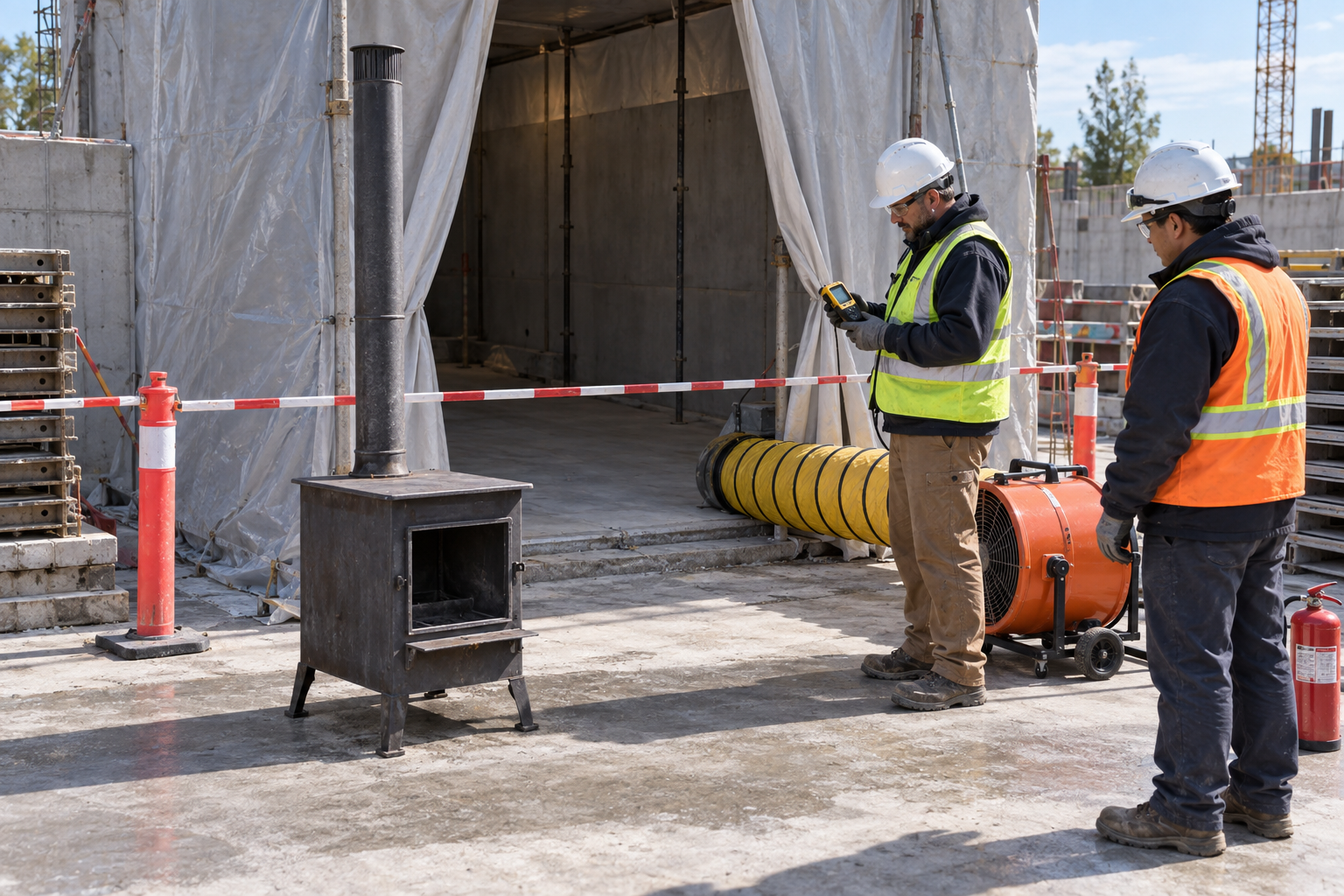
The retained illustration is an AI-generated educational image from the Korean source. It is not an actual incident photograph, approved drawing, equipment certification or proof that the depicted arrangement is safe.
Start with substitution and the prohibition check. An older interpretation or a successful gas test is not a blanket waiver. The actual heater design, exhaust arrangement, enclosure and applicable jurisdiction must be reviewed; unresolved solid-fuel proposals remain on hold.
CO and oxygen are different measurements. Suitable oxygen does not prove CO is absent, and warmth or lack of odor proves neither. The monitoring plan must address actual contaminants, instrument function and representative locations.
Changing tarps or reducing ventilation changes combustion and accumulation conditions. Do not reuse a pre-change reading as current entry evidence. A permitted alternative must still meet applicable mounting, clearance, fire and ventilation requirements.
No visible flame does not mean that smoldering, hot ash or CO generation has ended. Maintain controls through cooling and cleanup. Dust masks do not protect against CO; rescue requires the planned trained and equipped response.
Hypothetical decision example
Hypothetical example: a crew proposes a charcoal curing salamander inside a roofed building and plans to close tarp gaps to retain heat. The first decision is to reject the prohibited heat arrangement; gas measurements cannot authorize it. For a permitted alternative, later enclosure changes still trigger reassessment.
The example is fictional; no incident, measurement, inspection or approval is asserted.
Task flow: Decide eligibility → Plan installation → Check instruments → Release permitted setup → Monitor curing → Review changes → Respond to alarm → Cool and transfer
5. Hold and proceed decisions
| Condition | Action | Evidence | Proceed when |
|---|---|---|---|
| Solid-fuel salamander indoors | Reject use and select alternative | Heater type, location and 1926.154(d) | Permissible heat selected |
| Ventilation changes | Hold entry and reassess | Current gas, airflow and enclosure record | Current conditions accepted |
| Alarm or symptoms | Evacuate; call emergency help | People count and hazard information | Response plan activated |
| Flame gone | Maintain cooling/access controls | Smoldering, ash, gas and ventilation checks | Release criteria met |
Similar observation, different conclusion
| Observation | Supported conclusion | What remains unresolved |
|---|---|---|
| Cure temperature met | Concrete heating target may be met | Air quality and lawful heater use unresolved |
| Oxygen acceptable | One atmospheric parameter checked | CO and other hazards require separate assessment |
6. Roles and supervision
| Role | Responsibility |
|---|---|
| Work supervisor | Coordinate decide eligibility, affected operations, stop signals and stage transitions. |
| Technical/equipment reviewer | Verify Heater and location, Prohibition decision, actual instructions and unresolved technical limits. |
| Task crew | Apply the stated controls, report changes and keep actual checks and signatures factual. |
| Inspector/test lead | Connect Change and time, Current atmosphere to the required acceptance criteria. |
| Receiving authority | Accept the recorded restrictions, Current gas/ventilation, Access-release record, and follow-up ownership. |
These are responsibility examples, not invented statutory credentials. Verify actual competence, training and authority for the assigned work.
Supervision and handover controls
| Stage | Management controls | Evidence |
|---|---|---|
| Plan review | 1. Assign technical owner2. Close task-specific questions3. Reject prohibited arrangement | 1. Heater and location2. Prohibition decision3. Space/rescue assessment |
| Competence | 1. Verify required competence2. Assign stop authority3. Review exhaust and intake | 1. Heat-source layout2. Training and task briefing3. Access and escape route |
| Prestart evidence | 1. Inspect actual equipment2. Link evidence to this stage3. Confirm permissible setup | 1. Eligibility review2. Ventilation and monitoring3. People and observer record |
| Change control | 1. Stop and secure the area2. Review affected controls3. Evacuate and prevent entry | 1. Person accountability2. Alarm/symptom location3. Responder hazard briefing |
| Shift handover | 1. Identify remaining restrictions2. Confirm receiving responsibility3. Verify residual combustion/heat | 1. Smolder/temperature state2. Ash handling status3. Access-release record |
| Closeout | 1. Record defect disposition2. Archive factual evidence3. Verify residual combustion/heat | 1. Smolder/temperature state2. Ash handling status3. Access-release record |
7. Hold points and record quality
| Hold point | Evidence before release | Actual record |
|---|---|---|
| HP-0 Start | Review a proposed solid-fuel concrete-curing heat source, reject prohibited arrangements, select a suitable alternative and plan monitoring, shutdown and post-heating access. Conditional operation applies only to equipment and locations determined permissible by the responsible site reviewers. | |
| HP-1 Plan installation | Heat-source layout; Mounting suitability; Clearance basis; Access and escape route | |
| HP-2 Release permitted setup | Eligibility review; Ventilation and monitoring; Equipment instructions; People and observer record | |
| HP-3 Respond to alarm | Person accountability; Alarm/symptom location; External safe state; Responder hazard briefing | |
| HP-4 Cool and transfer | Smolder/temperature state; Ash handling status; Current gas/ventilation; Access-release record |
Hold points are internal evidence gates. They do not establish that a statutory permit exists or has been approved. Recheck affected gates after changes, faults and shift handover.
Record comparison - hypothetical templates
The 16 boxes below identify record elements, not completed checks or approvals. They are static symbols. Link equipment/location, date, actual findings and the separate record reference; preserve unresolved items.
| Record | Insufficient entry | Required record elements |
|---|---|---|
| Decide eligibility | "Checked" without supporting facts | □ Heater and location□ Prohibition decision□ Alternative heat plan□ Space/rescue assessment |
| Check instruments | "Checked" without supporting facts | □ Sensor and range□ Function/calibration evidence□ Ventilation/alarm test□ Power and fire readiness |
| Monitor curing | "Checked" without supporting facts | □ Gas and oxygen record□ Airflow/enclosure state□ Cure and fire condition□ Access/refueling status |
| Respond to alarm | "Checked" without supporting facts | □ Person accountability□ Alarm/symptom location□ External safe state□ Responder hazard briefing |
8. Pre-work checks and emergency response
| Check required | Result | Checker/action |
|---|---|---|
| Decide eligibility: Heater and location | ||
| Plan installation: Heat-source layout | ||
| Check instruments: Sensor and range | ||
| Release permitted setup: Eligibility review | ||
| Monitor curing: Gas and oxygen record | ||
| Review changes: Change and time | ||
| Respond to alarm: Person accountability | ||
| Cool and transfer: Smolder/temperature state |
Stop work
Do not ignite solid-fuel salamanders in buildings or on scaffolds. Hold any unresolved equipment/location classification. Evacuate and prevent entry for gas alarms, suspected CO symptoms, ventilation loss or failed communication; do not reenter to operate a shutdown control.
Emergency response
Evacuate to uncontaminated air, account for people and call 911 with the possible CO, oxygen and fire hazards. Do not reenter for shutdown or rescue. Use only safe external shutdown arrangements and the prepared trained/equipped rescue response. Do not use dust masks or an unverified cartridge respirator as CO rescue protection.
9. Official sources and review limits
Official public-source check: October 12, 2026. The review concerns the selected passages described below, not endorsement of this article.
| Official source | Checked scope and limit |
|---|---|
| OSHA 29 CFR 1926.154 | Temporary-heating ventilation, mounting/clearance and paragraph (d) solid-fuel salamander prohibition. Read applicable clearance clauses and actual listed-equipment approval; no universal clearance is supplied. |
| OSHA 29 CFR 1926.1203 | Competent-person identification of construction confined/permit spaces and prevention of unauthorized entry; full permit/rescue program needs separate site development. |
| CDC NIOSH Carbon Monoxide Hazards at Work | Public prevention guidance: combustion sources, accumulation, substitution, monitoring and emergency response. NIOSH recommendations are not OSHA permissible exposure limits or universal entry criteria. |
| OSHA State Plans | Federal baseline and State Plan coverage reviewed. Confirm the applicable state program and employer coverage; this edition does not establish nationwide compliance. |
Selected public official provisions were checked on October 12, 2026. This is not a complete legal audit. No actual equipment manual, site measurements, engineering calculations, product certification or professional technical approval was supplied. Full paid NFPA/ANSI standards and state/local amendments were not reviewed. Check actual equipment, jurisdiction and project requirements before use.
This is reference content written and revised with AI. It has not been verified or approved by a professional. Review by a suitably qualified professional and required site authorization are necessary before use.
10. PDF use and frequently asked questions
PDF A summarizes core controls; B emphasizes technical failures; C covers supervision, records and handover. Each uses six stages from or aligned with the eight-stage body. All actual risk, measurement, check and signature fields are blank. Use a separate linked record where more space is needed.
Can monitoring authorize a solid-fuel salamander indoors?
No. OSHA 1926.154(d) prohibits solid-fuel salamanders in buildings and on scaffolds. Choose a permissible alternative.
Is every curing enclosure a permit-required space?
No. A competent person must identify confined and permit spaces from the actual configuration and hazards under the construction rule.
May ventilation stop when the flame disappears?
Not while smoldering, heat or gas hazards remain. Follow the shutdown, cooling, monitoring and access-release plan.
Can a dust mask be used for rescue?
No. Keep unprotected people out and call 911 with the CO and enclosure hazards; use the planned trained rescue service.
Has a professional approved this JSA?
This is reference content written and revised with AI. It has not been verified or approved by a professional. Review by a suitably qualified professional and required site authorization are necessary before use.
11. Authorship and revision history
This is reference content written and revised with AI. It has not been verified or approved by a professional. Review by a suitably qualified professional and required site authorization are necessary before use.
| Date/version | Editorial history | Technical approval |
|---|---|---|
| 2026-09-19 | Korean source retained as an unchanged snapshot; source ID 54cfac24-dc9a-474e-a8d8-287260bf29fb | Not asserted |
| 2026-10-12 / US v1.0 | US localization: Changes the Korean solid-fuel ignition premise to a US prohibition/eligibility and substitution review under 1926.154(d). Retains separate CO/oxygen assessment, enclosure-change hold, external monitoring, no unprotected rescue and smoldering/ash handover. No numerical exposure value is invented or treated as universal entry permission. | Not performed |
Source topic: https://smartjsabridge.com/ko/case-study/jsa-curingheater-ignition
Content group: jsa-curingheater-ignition