Crane-supported stability and bedding-supported stability are different states. Verify full intended bearing, restraint and joint condition before removing rigging tension.
This reference material was written and revised with AI. It has not been verified or approved by a professional. Review by a suitably qualified professional and required site approval are necessary before field use.
Stop before proceeding
Stop the affected operation for box cracking, settlement, rising water, unsafe joint access or movement during backfill. Keep people clear of suspended or unstable units and reassess excavation access.
1. Legal and technical scope
Construction excavation: assess 1926.651/.652, rigging under 1926.251 and applicable crane rules. Evaluate confined-space entry separately under Subpart AA within its scope; excavation work regulated by Subpart P is excluded by 1926.1201, but an installed culvert interior requires its own classification. This is not a site entry permit or structural design.
Confirm whether federal OSHA or an OSHA-approved State Plan covers this employer and worksite; state requirements and public-sector coverage can differ. Apply the task-specific provisions and limitations identified above.
| Basis | Application |
|---|---|
| OSHA 29 CFR 1926.651 | Excavation utilities, water, access and competent-person inspection. |
| OSHA 29 CFR 1926.652 | Excavation protective-system requirements. |
| OSHA 29 CFR 1926.251 | Rigging identification, inspection and load limits. |
| OSHA 29 CFR 1926.1201 | Construction confined-space scope and exclusions. |
| OSHA 29 CFR 1926.1203 | Identify and evaluate construction confined spaces and permit-space hazards within scope. |
| OSHA State Plans | Official overview of federal and State Plan jurisdiction and differing public-sector coverage, checked 2026-10-12. Individual state rules require a site-specific check. |
2. Scope and required inputs
Included scope
Receive precast culvert boxes, inspect excavation and bedding, lift, set, align and join units, inspect, backfill and release the completed crossing.
Separate assessment
Cast-in-place work, diversion of operating waterways, internal entry and pressure testing need separate plans. Never use the inside of a suspended box as an alignment position.
| Input | Evidence needed |
|---|---|
| Plan installation | Weight and radius; Utility survey; Bedding design; Cover and vehicle loads. |
| Inspect box | Box ID and weight; Crack inspection; Insert condition; Rigging capacity. |
| Align and release | Line and gap; Full bearing; Seal condition; Rigging release criteria. |
| Open and handoff | Cover and strength; Joint acceptance; As-built locations; Traffic authorization. |
No site measurements, equipment manuals for the actual installation, inspection records or signed technical approvals were supplied. Confirm the applicable requirements and actual product instructions before use; record each criterion with its units, source and equipment or work-area ID.
3. Eight-stage JSA
| Job stage | Hazards and effects | Failure factors | Technical and procedural controls | Site verification | P | S | R | A |
|---|---|---|---|---|---|---|---|---|
| 1. Plan installation | 1. Crane overload2. Utility strike3. Excavation collapse4. Traffic overload | 1. Unknown box weight2. Unlocated services3. No staged support4. Final load assumed | 1. Match box and crane2. Locate utilities3. Plan excavation stages4. Define traffic limits | 1. Weight and radius2. Utility survey3. Bedding design4. Cover and vehicle loads | ||||
| 2. Prepare bedding | 1. Cave-in burial2. Box settlement3. Ground loss4. Water inflow | 1. Disturbed foundation2. Uneven bedding3. Uncontrolled pumping4. Drainage failure | 1. Protect excavation2. Inspect bearing level3. Monitor soil loss4. Maintain planned drainage | 1. Protective system2. Bedding elevation3. Water and ground4. Safe access | ||||
| 3. Inspect box | 1. Lift insert failure2. Stored box overturn3. Cracked concrete4. Rigging release | 1. Damaged unit used2. Poor storage supports3. Wrong lift points4. Unmatched lifting gear | 1. Inspect box condition2. Use stable supports3. Match designated inserts4. Verify rigging setup | 1. Box ID and weight2. Crack inspection3. Insert condition4. Rigging capacity | ||||
| 4. Lift and set | 1. Swinging load2. Crushed worker3. Load rotation4. Crane overload | 1. Balance unchecked2. Person below box3. Center offset4. Radius increases | 1. Check balance low2. Exclude suspended zone3. Control load guidance4. Monitor lift radius | 1. People clear2. Crane support3. Lift chart and radius4. Signal and balance | ||||
| 5. Align and release | 1. Joint crush2. Box movement3. Seal damage4. Box tilting | 1. Hand in joint2. Early rigging release3. Forced fit4. Partial bedding contact | 1. Use alignment tools2. Check stable support3. Inspect joint seal4. Release by planned steps | 1. Line and gap2. Full bearing3. Seal condition4. Rigging release criteria | ||||
| 6. Inspect exterior | 1. Confined-space harm2. Open-edge fall3. Worker isolation4. Unexpected inflow | 1. Entry assumed safe2. Missing edge protection3. No communication4. Water source missed | 1. Prefer non-entry inspection2. Evaluate any entry3. Separate lifting and entry4. Control inflow paths | 1. Space classification2. Access and atmosphere3. Joint inspection4. Communication plan | ||||
| 7. Backfill evenly | 1. Lateral box movement2. Equipment overload3. Joint damage4. Uneven soil pressure | 1. One-sided fill2. Insufficient cover3. Heavy compactor early4. Uncontrolled lift height | 1. Follow staged backfill2. Restrict equipment loads3. Monitor joint movement4. Apply approved compaction | 1. Both-side elevations2. Equipment limits3. Movement and cracks4. Lift and density records | ||||
| 8. Open and handoff | 1. Premature crossing failure2. Hidden leakage3. Maintenance entry harm4. Wrong vehicle loading | 1. Cover alone accepted2. Defects concealed3. No entry restrictions4. Limits not passed on | 1. Verify structural release2. Record joint defects3. Transfer access hazards4. Maintain traffic limits | 1. Cover and strength2. Joint acceptance3. As-built locations4. Traffic authorization |
P = likelihood; S = severity; R = risk under the site method; A = the site-defined acceptance/authorization decision. Complete only after actual assessment. Blank cells and checklist prompts are not completed inspections.
4. Fictional scenario and failure mechanisms
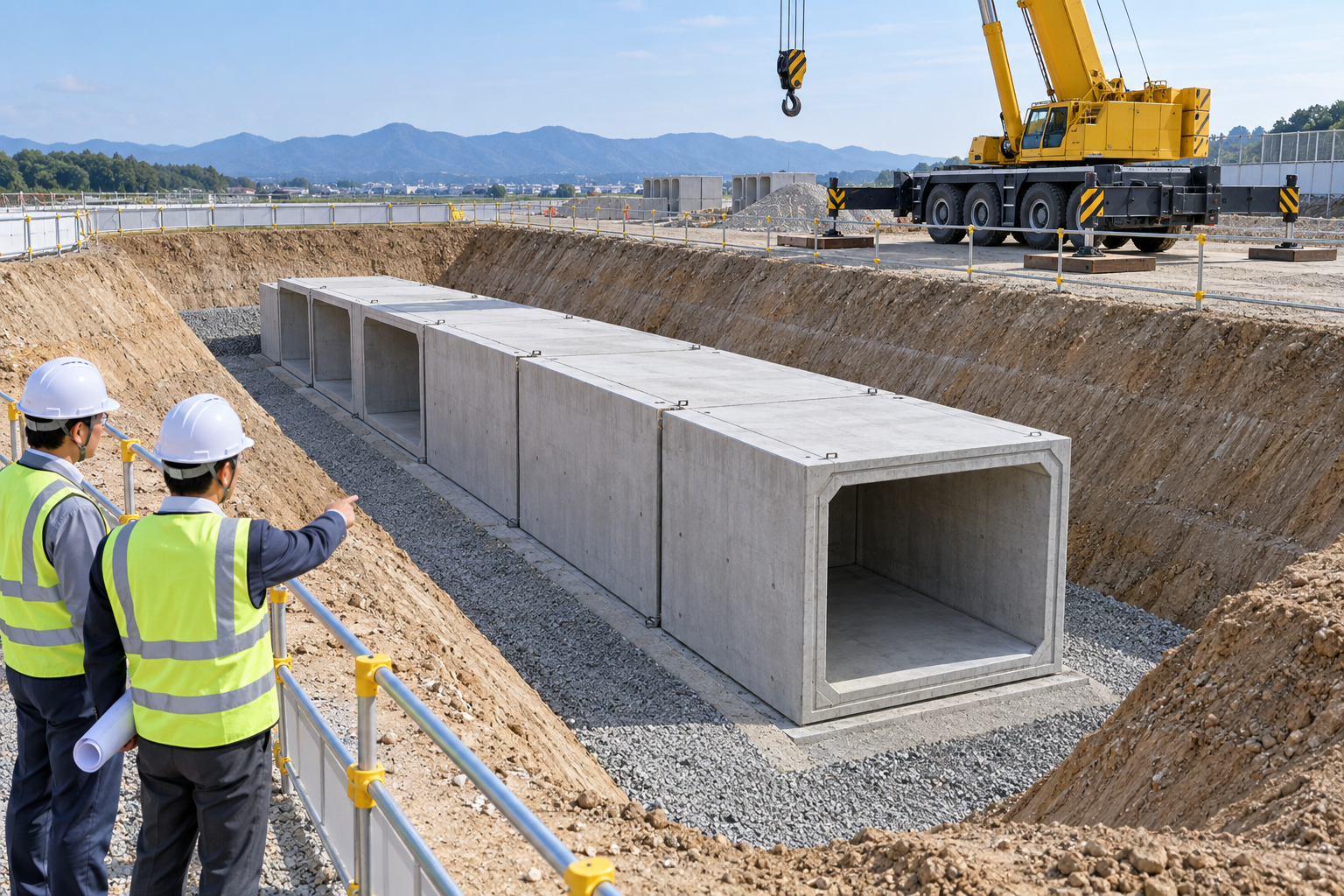
Retained AI-generated educational illustration from the source edition; not a real incident photograph, approved installation drawing or evidence of equipment suitability.
The scenario and record comparisons are fictional teaching examples, not records of real incidents, measurements, inspections, signatures or approvals.
| Item | Fictional scenario |
|---|---|
| Initial | A box has touched the bedding while the next joint is aligned. |
| Change | One bearing area is uncertain, but the crew plans to release the hook and use a hand in the gap. |
| Failure | Removal of crane support transfers load to an incomplete bedding contact. |
| Outcome | The box can tilt or slide and crush a worker or damage the joint. |
| Barrier | Hold release, exclude the gap and verify bearing, alignment and the planned load-transfer sequence; assess backfill and traffic separately. |
Why the controls matter
Crane-supported stability and bedding-supported stability are different states. Verify full intended bearing, restraint and joint condition before removing rigging tension.
Closing a joint moves a heavy box and compresses a seal. Keep hands and bodies outside the load path; use the specified alignment equipment rather than touching the gap.
One-sided backfill and nearby compactors impose temporary asymmetric loads. Finished-structure capacity does not prove the unfinished stage is ready for equipment. Verify fill sequence, cover, strength and vehicle load before opening the crossing.
Decision sequence
| Step | Decision |
|---|---|
| Known | One bearing area is uncertain, but the crew plans to release the hook and use a hand in the gap. |
| Unknown | Actual condition, extent of damage and suitability of line and gap, full bearing remain to be established. |
| Hold | Removal of crane support transfers load to an incomplete bedding contact. |
| Evidence | Link line and gap, full bearing, seal condition, rigging release criteria, both-side elevations, equipment limits to the affected equipment or work area. |
| Next | Hold release, exclude the gap and verify bearing, alignment and the planned load-transfer sequence; assess backfill and traffic separately. |
5. Conditional decisions and common errors
| Condition | Action | Evidence | Proceed when |
|---|---|---|---|
| Bearing unclear | Hold rigging release | Bedding and support inspection | Stable bearing verified |
| Joint binds | Investigate without bodily access | Line, gap and seal record | Alignment corrected |
| Water increases | Reassess excavation and drainage | Ground and inflow inspection | Excavation stable |
| Traffic requested | Check structural opening criteria | Cover, strength and vehicle load | Traffic conditions met |
Similar appearance, different evidence
The scenario and record comparisons are fictional teaching examples, not records of real incidents, measurements, inspections, signatures or approvals.
| Comparison | Supported decision | Insufficient basis |
|---|---|---|
| Condition | Bedding and support inspection | Bearing unclear has not been resolved. |
| Evidence | Ground and inflow inspection | A photograph or a completed-looking task without the relevant inspection record. |
| Release | Traffic conditions met | Completion of one step does not release the excluded tasks in section 2. |
6. Roles and responsibilities
| Role | Responsibility |
|---|---|
| Work supervisor | Assign the task boundary, stop authority, interfaces and emergency communication for precast box culvert installation. |
| Technical lead | Confirm Weight and radius; Utility survey; Bedding design; Cover and vehicle loads. Resolve design and manufacturer limits before work. |
| Authorized crew | Apply Box ID and weight; Crack inspection; Insert condition; Rigging capacity. Stop when the working arrangement changes. |
| Inspector / receiving lead | Review Line and gap; Full bearing; Seal condition; Rigging release criteria. Transfer Cover and strength; Joint acceptance; As-built locations; Traffic authorization. |
Role labels allocate responsibilities; they do not confer a legal qualification. Verify the competence, training and authority required for the actual task.
Record and handoff perspective
| Stage | Record controls | Verification |
|---|---|---|
| Plan installation | 1. Record weight and radius2. Record utility survey3. Record bedding design | 1. Utility survey2. Bedding design3. Cover and vehicle loads |
| Inspect box | 1. Record box id and weight2. Record crack inspection3. Record insert condition | 1. Crack inspection2. Insert condition3. Rigging capacity |
| Lift and set | 1. Record people clear2. Record crane support3. Record lift chart and radius | 1. Crane support2. Lift chart and radius3. Signal and balance |
| Align and release | 1. Record line and gap2. Record full bearing3. Record seal condition | 1. Full bearing2. Seal condition3. Rigging release criteria |
| Backfill evenly | 1. Record both-side elevations2. Record equipment limits3. Record movement and cracks | 1. Equipment limits2. Movement and cracks3. Lift and density records |
| Open and handoff | 1. Record cover and strength2. Record joint acceptance3. Record as-built locations | 1. Joint acceptance2. As-built locations3. Traffic authorization |
7. Hold points and record comparison
| Hold point | Evidence before release | Actual record |
|---|---|---|
| HP-0 Start | Receive precast culvert boxes, inspect excavation and bedding, lift, set, align and join units, inspect, backfill and release the completed crossing. | |
| HP-1 Prepare bedding | Protective system; Bedding elevation; Water and ground; Safe access | |
| HP-2 Lift and set | People clear; Crane support; Lift chart and radius; Signal and balance | |
| HP-3 Align and release | Line and gap; Full bearing; Seal condition; Rigging release criteria | |
| HP-4 Open and handoff | Cover and strength; Joint acceptance; As-built locations; Traffic authorization |
These are internal hold points, not issued permits. Recheck affected points after a change, fault or shift handoff; link the actual approval record.
Record comparison
The scenario and record comparisons are fictional teaching examples, not records of real incidents, measurements, inspections, signatures or approvals.
The boxes are static record prompts, not interactive or saved approvals. A tick does not establish suitability or permission to restart. Record the evidence, person, time and unresolved issues; retain the change history.
| Record | Insufficient | Record checklist |
|---|---|---|
| Plan installation | "Checked" without target, criteria or result | □ Weight and radius□ Utility survey□ Bedding design□ Cover and vehicle loads |
| Inspect box | "Checked" without target, criteria or result | □ Box ID and weight□ Crack inspection□ Insert condition□ Rigging capacity |
| Align and release | "Checked" without target, criteria or result | □ Line and gap□ Full bearing□ Seal condition□ Rigging release criteria |
| Open and handoff | "Checked" without target, criteria or result | □ Cover and strength□ Joint acceptance□ As-built locations□ Traffic authorization |
8. Site checklist and emergency response
| Check | Result | Person / action |
|---|---|---|
| □ Plan installation: Weight and radius | ||
| □ Prepare bedding: Protective system | ||
| □ Inspect box: Box ID and weight | ||
| □ Lift and set: People clear | ||
| □ Align and release: Line and gap | ||
| □ Inspect exterior: Space classification | ||
| □ Backfill evenly: Both-side elevations | ||
| □ Open and handoff: Cover and strength | ||
| □ Emergency access and handoff restrictions |
Stop work
Stop the affected operation for box cracking, settlement, rising water, unsafe joint access or movement during backfill. Keep people clear of suspended or unstable units and reassess excavation access.
Emergency response
Stop from a safe location, exclude people from the affected danger zone and activate the site emergency plan. Call 911 for injury or immediate danger. Do not enter an unstable, energized or confined danger area for an improvised rescue; trained responders must control the specific energy and access hazards.
9. Sources and review limits
Public-source review: 2026-10-12. Official regulation pages and specific technical references are distinguished below; no agency or manufacturer has approved this content.
| Source | Reviewed scope and limitation |
|---|---|
| OSHA 29 CFR 1926.651 | Excavation utilities, water, access and competent-person inspection. |
| OSHA 29 CFR 1926.652 | Excavation protective-system requirements. |
| OSHA 29 CFR 1926.251 | Rigging identification, inspection and load limits. |
| OSHA 29 CFR 1926.1201 | Construction confined-space scope and exclusions. |
| OSHA 29 CFR 1926.1203 | Identify and evaluate construction confined spaces and permit-space hazards within scope. |
| OSHA State Plans | Official overview of federal and State Plan jurisdiction and differing public-sector coverage, checked 2026-10-12. Individual state rules require a site-specific check. |
No site measurements, equipment manuals for the actual installation, inspection records or signed technical approvals were supplied. Confirm the applicable requirements and actual product instructions before use; record each criterion with its units, source and equipment or work-area ID.
10. PDF guidance and FAQ
PDF A covers basic task controls; B focuses on technical failures; C covers supervision, records and handover. The article has eight stages with four items per main cell; each PDF has six key stages with three items per main cell. P/S/R/A, measurements, confirmations and signatures remain blank for actual site assessment.
Content group
jsa-culvert-installation
May rigging be removed when the box touches ground?
Only after the planned bearing, restraint and stability conditions are verified.
Can hands guide the closing joint?
Keep the body out of the moving joint; use the specified alignment method.
Can one side be backfilled first to save time?
Use the approved staged sequence to control asymmetric soil and compaction loads.
Does a large culvert interior avoid entry assessment?
No. Evaluate access, atmosphere, inflow and other hazards under the applicable space classification.
Has a professional approved this JSA?
This reference material was written and revised with AI. It has not been verified or approved by a professional. Review by a suitably qualified professional and required site approval are necessary before field use.
11. Revision history and authorship
This reference material was written and revised with AI. It has not been verified or approved by a professional. Review by a suitably qualified professional and required site approval are necessary before field use.
Korean source created 2026-09-19. This US edition adapts the Korean source; earlier editorial revisions do not constitute professional approval of this edition.
| Date | Edition | Change | Review status |
|---|---|---|---|
| 2026-10-12 | 1.0 | US localization: preserve task judgments; replace Korean legal applicability with scoped US references. | AI editorial and output checks; no professional technical approval. |