A small package can draw a hand into a conveyor nip point. Coordinate upstream feed with downstream collection, and transfer jams requiring danger-zone access to the authorized isolation and maintenance process.
This is reference content written and revised with AI. It has not been verified or approved by a professional. Review by a suitably qualified professional and required site authorization are necessary before use.
Stop conditions first
Stop feed for damaged guards, failed emergency stops, unreachable safe handling positions, leaking or damaged packages, repeated accumulation or uncontrolled discharge. Do not reach into a jam after pressing a stop button.
1. US legal and technical basis
General-industry fixed conveyor operation. OSHA 1910.212 addresses machine guarding and 1910.147 applies to covered hazardous-energy servicing. Construction conveyors require a separate 1926.555 review.
| Reference | Use and limit |
|---|---|
| OSHA 29 CFR 1910.212 | Guarding against points of operation, in-running nip points, rotating parts and other machine hazards. |
| OSHA 29 CFR 1910.147 | Covered servicing requires hazardous-energy control; stop buttons and selector switches are not isolating devices. Evaluate all linked and stored energy. |
| OSHA State Plans | Federal baseline and State Plan coverage reviewed. Confirm the applicable state program and employer coverage; this edition does not establish nationwide compliance. |
Determine whether Federal OSHA or an applicable State Plan governs the employer and work. Standards incorporated into a regulation must be read in their legally applicable edition. Other NFPA/ANSI guidance and manufacturer instructions have distinct roles; they are not automatically federal law.
2. Scope and required inputs
Included
Normal feeding, sorting and collection of permitted packages from designated operator positions on a fixed indoor horizontal belt or powered roller conveyor.
Separate assessment
Guard removal, hazardous-area jam clearing, maintenance, inclined/mobile/gravity conveyors, hazardous bulk materials and entry into automated sorters are outside this operating scope.
| Input | Evidence needed |
|---|---|
| Match line and goods | Line and package ID; Linked/stop-zone map; Load and size limits; Package condition |
| Inspect safeguards | Guard condition; Stop location/test; Clothing and reach limits; Interlock state |
| Start trial flow | Ready signals; Direction and sequence; Joint/guide passage; Downstream capacity |
| Close and transfer | Shutdown and power state; Residual package map; Unresolved defect; Receiving owner and time |
Selected public official provisions were checked on October 12, 2026. This is not a complete legal audit. No actual equipment manual, site measurements, engineering calculations, product certification or professional technical approval was supplied. Full paid NFPA/ANSI standards and state/local amendments were not reviewed. Check actual equipment, jurisdiction and project requirements before use.
Select task-appropriate eye, hand, foot, skin and hearing protection from the exposure assessment. Where respiratory protection is necessary, use the applicable respiratory-protection program; PPE does not replace isolation, guarding, support or ventilation.
3. Eight-stage JSA
| Job stage | Hazards and effects | Failure factors | Controls | Site verification | P | S | R | A |
|---|---|---|---|---|---|---|---|---|
| 1. Match line and goods | 1. Falling package2. Linked-machine movement3. Overloaded conveyor4. Leaking contents | 1. Package limits missing2. Stop zone misunderstood3. Load rating unknown4. Damaged pack accepted | 1. Match permitted packages2. Map linked equipment3. Verify operating limits4. Separate damaged goods | 1. Line and package ID2. Linked/stop-zone map3. Load and size limits4. Package condition | ||||
| 2. Inspect safeguards | 1. Hand drawn into nip2. Delayed emergency stop3. Clothing entanglement4. Guard bypass exposure | 1. Guard missing2. Stop access blocked3. Loose clothing4. Interlock defeated | 1. Inspect nip-point guards2. Test stop by procedure3. Secure clothing and hair4. Prohibit safeguard bypass | 1. Guard condition2. Stop location/test3. Clothing and reach limits4. Interlock state | ||||
| 3. Prepare discharge | 1. Repetitive strain2. Falling boxes3. Blocked walkway4. Overreaching | 1. Work height unsuitable2. Container full3. Waste in route4. Sorting reach too long | 1. Set safe work position2. Provide collection capacity3. Keep routes clear4. Use suitable handling aids | 1. Height and hand position2. Container space3. Walkway condition4. Staffing and rate | ||||
| 4. Start trial flow | 1. Person struck2. Wrong-direction movement3. Package snags joint4. Sudden pileup | 1. No startup warning2. Sequence wrong3. Guide gap unsuitable4. Downstream not ready | 1. Confirm people clear2. Follow startup sequence3. Observe trial from safe position4. Confirm discharge ready | 1. Ready signals2. Direction and sequence3. Joint/guide passage4. Downstream capacity | ||||
| 5. Feed and sort | 1. Nip-point injury2. Back strain3. Package fall4. Glove entanglement | 1. Chasing dropped item2. Twisting under rate pressure3. Unstable package4. Hands cross safe boundary | 1. Handle only at safe positions2. Balance feed and collection3. Separate unsuitable packages4. Keep hands outside nips | 1. Hand/reach boundary2. Rate and workload3. Package stability4. Clothing and protection | ||||
| 6. Watch accumulation | 1. Collision cascade2. Falling contents3. Overload4. Blocked escape | 1. Discharge delay ignored2. Crushed packs refed3. Supply continues4. Overflow covers route | 1. Stop feed at buildup2. Isolate damaged packages3. Coordinate upstream stop4. Maintain clear escape | 1. Accumulation location2. Package damage/leak3. Upstream/downstream state4. Recovery capacity | ||||
| 7. Hold jam | 1. Stored-load release2. Unexpected restart3. Hand entrapment4. Repeat failure | 1. Stop mistaken for isolation2. Box pulled under pressure3. Linked drive overlooked4. Cause not corrected | 1. Restrict danger-zone access2. Transfer to authorized isolation3. Control stored package forces4. Verify cause and guard repair | 1. Jam and energy map2. Isolation/force control3. Repair and safeguards4. Restart trial evidence | ||||
| 8. Close and transfer | 1. Residual package moves2. Defective line reused3. Repeated jam4. Uninformed next shift | 1. Shutdown order changed2. Fault not marked3. Cause log absent4. Remaining goods unknown | 1. Follow shutdown sequence2. Identify held equipment3. Transfer recurring-jam record4. Confirm residual goods state | 1. Shutdown and power state2. Residual package map3. Unresolved defect4. Receiving owner and time |
Actual risk assessments, measurements, checks, approvals and signatures have not been performed. Keep unverified fields blank and link the actual site records. P/S/R/A mean likelihood, severity, site-method risk and site-defined acceptance/authorization; a score cannot waive a required control.
4. Failure mechanisms and hypothetical case
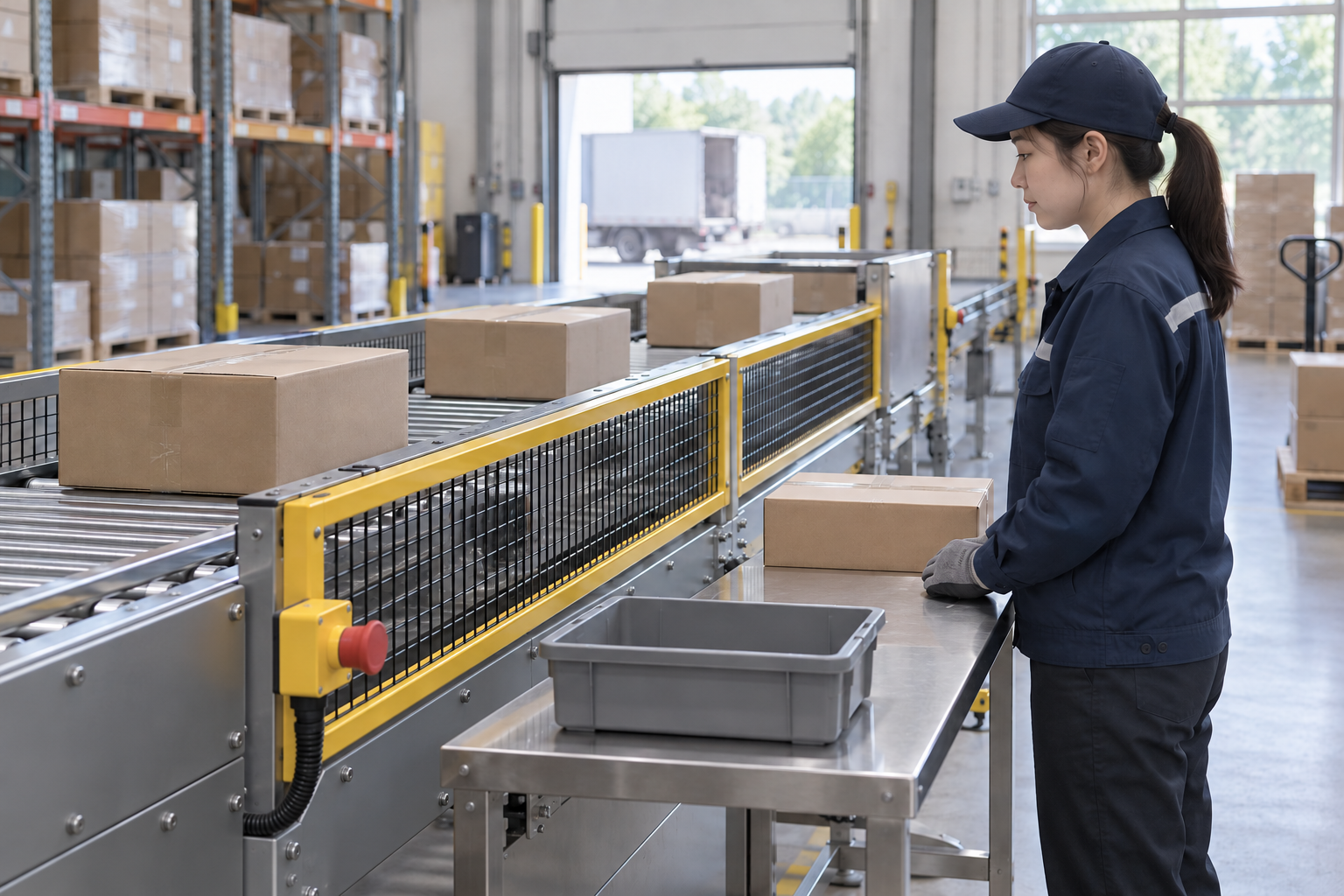
The retained illustration is an AI-generated educational image from the Korean source. It is not an actual incident photograph, approved drawing, equipment certification or proof that the depicted arrangement is safe.
A stopped local belt can still be affected by linked machinery, stored pneumatic energy or the pressure of accumulated packages. A stop button is not an energy-isolating device.
Discharge capacity is an input condition. A container change or sorting delay can produce a downstream jam while the feeder operates normally. Stop supply before workers compensate by reaching, climbing or forcing packages.
Gloves, loose clothing and jewelry can be caught at in-running nips. PPE is not a substitute for guards, designed reach limits and a safe work position. Use designated crossings; do not step over or ride conveyors.
Hypothetical decision example
Hypothetical example: boxes overlap at a sorting point. The local emergency stop is pressed, but upstream rollers remain loaded and another zone is moving. A worker plans to pull out the front box by hand.
The example is fictional; no incident, measurement, inspection or approval is asserted.
Task flow: Match line and goods → Inspect safeguards → Prepare discharge → Start trial flow → Feed and sort → Watch accumulation → Hold jam → Close and transfer
5. Hold and proceed decisions
| Condition | Action | Evidence | Proceed when |
|---|---|---|---|
| Boxes overlap | Stop feed and restrict access | Upstream/downstream state and jam location | Flow cause resolved |
| Reach into nip needed | Transfer to isolated maintenance | All energy sources and stored package forces | Access controlled |
| Stop device fails | Remove affected operation from service | Device repair and functional test | Stop function restored |
| Restart proposed | Check guards and downstream capacity | Cause correction and controlled trial | Trial accepted |
Similar observation, different conclusion
| Observation | Supported conclusion | What remains unresolved |
|---|---|---|
| Belt looks stopped | Visible motion ceased locally | Linked motion and stored forces remain unverified |
| Box passes again | One package cleared | Recurring cause and guarding still need review |
6. Roles and supervision
| Role | Responsibility |
|---|---|
| Work supervisor | Coordinate match line and goods, affected operations, stop signals and stage transitions. |
| Technical/equipment reviewer | Verify Line and package ID, Linked/stop-zone map, actual instructions and unresolved technical limits. |
| Task crew | Apply the stated controls, report changes and keep actual checks and signatures factual. |
| Inspector/test lead | Connect Accumulation location, Package damage/leak to the required acceptance criteria. |
| Receiving authority | Accept the recorded restrictions, Unresolved defect, Receiving owner and time, and follow-up ownership. |
These are responsibility examples, not invented statutory credentials. Verify actual competence, training and authority for the assigned work.
Supervision and handover controls
| Stage | Management controls | Evidence |
|---|---|---|
| Plan review | 1. Assign technical owner2. Close task-specific questions3. Match permitted packages | 1. Line and package ID2. Linked/stop-zone map3. Package condition |
| Competence | 1. Verify required competence2. Assign stop authority3. Inspect nip-point guards | 1. Guard condition2. Training and task briefing3. Interlock state |
| Prestart evidence | 1. Inspect actual equipment2. Link evidence to this stage3. Confirm people clear | 1. Ready signals2. Direction and sequence3. Downstream capacity |
| Change control | 1. Stop and secure the area2. Review affected controls3. Restrict danger-zone access | 1. Jam and energy map2. Isolation/force control3. Restart trial evidence |
| Shift handover | 1. Identify remaining restrictions2. Confirm receiving responsibility3. Follow shutdown sequence | 1. Shutdown and power state2. Residual package map3. Receiving owner and time |
| Closeout | 1. Record defect disposition2. Archive factual evidence3. Follow shutdown sequence | 1. Shutdown and power state2. Residual package map3. Receiving owner and time |
7. Hold points and record quality
| Hold point | Evidence before release | Actual record |
|---|---|---|
| HP-0 Start | Normal feeding, sorting and collection of permitted packages from designated operator positions on a fixed indoor horizontal belt or powered roller conveyor. | |
| HP-1 Inspect safeguards | Guard condition; Stop location/test; Clothing and reach limits; Interlock state | |
| HP-2 Start trial flow | Ready signals; Direction and sequence; Joint/guide passage; Downstream capacity | |
| HP-3 Hold jam | Jam and energy map; Isolation/force control; Repair and safeguards; Restart trial evidence | |
| HP-4 Close and transfer | Shutdown and power state; Residual package map; Unresolved defect; Receiving owner and time |
Hold points are internal evidence gates. They do not establish that a statutory permit exists or has been approved. Recheck affected gates after changes, faults and shift handover.
Record comparison - hypothetical templates
The 16 boxes below identify record elements, not completed checks or approvals. They are static symbols. Link equipment/location, date, actual findings and the separate record reference; preserve unresolved items.
| Record | Insufficient entry | Required record elements |
|---|---|---|
| Match line and goods | "Checked" without supporting facts | □ Line and package ID□ Linked/stop-zone map□ Load and size limits□ Package condition |
| Prepare discharge | "Checked" without supporting facts | □ Height and hand position□ Container space□ Walkway condition□ Staffing and rate |
| Feed and sort | "Checked" without supporting facts | □ Hand/reach boundary□ Rate and workload□ Package stability□ Clothing and protection |
| Hold jam | "Checked" without supporting facts | □ Jam and energy map□ Isolation/force control□ Repair and safeguards□ Restart trial evidence |
8. Pre-work checks and emergency response
| Check required | Result | Checker/action |
|---|---|---|
| Match line and goods: Line and package ID | ||
| Inspect safeguards: Guard condition | ||
| Prepare discharge: Height and hand position | ||
| Start trial flow: Ready signals | ||
| Feed and sort: Hand/reach boundary | ||
| Watch accumulation: Accumulation location | ||
| Hold jam: Jam and energy map | ||
| Close and transfer: Shutdown and power state |
Stop work
Stop feed for damaged guards, failed emergency stops, unreachable safe handling positions, leaking or damaged packages, repeated accumulation or uncontrolled discharge. Do not reach into a jam after pressing a stop button.
Emergency response
Use the accessible emergency stop and stop upstream feed from safe positions. Keep hands out of nip points and prevent other zones from restarting. Authorized personnel must control linked drives and stored package forces before rescue access. Call 911 for entrapment or serious injury and give the line, jam location and energy information. Do not pull a trapped person or package against the mechanism or bypass guarding.
9. Official sources and review limits
Official public-source check: October 12, 2026. The review concerns the selected passages described below, not endorsement of this article.
| Official source | Checked scope and limit |
|---|---|
| OSHA 29 CFR 1910.212 | Guarding against points of operation, in-running nip points, rotating parts and other machine hazards. |
| OSHA 29 CFR 1910.147 | Covered servicing requires hazardous-energy control; stop buttons and selector switches are not isolating devices. Evaluate all linked and stored energy. |
| OSHA State Plans | Federal baseline and State Plan coverage reviewed. Confirm the applicable state program and employer coverage; this edition does not establish nationwide compliance. |
Selected public official provisions were checked on October 12, 2026. This is not a complete legal audit. No actual equipment manual, site measurements, engineering calculations, product certification or professional technical approval was supplied. Full paid NFPA/ANSI standards and state/local amendments were not reviewed. Check actual equipment, jurisdiction and project requirements before use.
This is reference content written and revised with AI. It has not been verified or approved by a professional. Review by a suitably qualified professional and required site authorization are necessary before use.
10. PDF use and frequently asked questions
PDF A summarizes core controls; B emphasizes technical failures; C covers supervision, records and handover. Each uses six stages from or aligned with the eight-stage body. All actual risk, measurement, check and signature fields are blank. Use a separate linked record where more space is needed.
May I pull out a small box?
Only normal handling within the designed safe operator zone is included. Danger-zone access needs the applicable isolation and servicing procedure.
Does an emergency stop permit cleaning?
No. Identify and control all hazardous energy and verify the safe state before servicing access.
Can gloves protect a hand near rollers?
They cannot replace guarding and may add entanglement risk. Keep hands and clothing outside the hazardous reach boundary.
What should repeated jams record?
Line, location, package, time, upstream/downstream state, cause correction, guard restoration and restart responsibility.
Has a professional approved this JSA?
This is reference content written and revised with AI. It has not been verified or approved by a professional. Review by a suitably qualified professional and required site authorization are necessary before use.
11. Authorship and revision history
This is reference content written and revised with AI. It has not been verified or approved by a professional. Review by a suitably qualified professional and required site authorization are necessary before use.
| Date/version | Editorial history | Technical approval |
|---|---|---|
| 2026-10-03 | Korean source retained as an unchanged snapshot; source ID aba14916-5756-4e94-a292-794fba6f6cb2 | Not asserted |
| 2026-10-12 / US v1.0 | US localization: Preserves normal-operation versus jam-servicing boundary, local-stop/stored-package-force example and downstream-capacity logic. Replaces Canadian/Korean legal assumptions with US machine guarding and hazardous-energy applicability. | Not performed |
Source topic: https://smartjsabridge.com/ko/case-study/jsa-conveyor-package-sorting
Content group: jsa-conveyor-package-sorting