The motor can be off while belt tension, a suspended take-up or material on an incline still drives movement. Identify and restrain each energy path before removing a guard or support.
This reference material was written and revised with AI. It has not been verified or approved by a professional. Review by a suitably qualified professional and required site approval are necessary before field use.
Stop before proceeding
Do not remove guards until start sources, take-up, belt and material movement are controlled. Stop the test for support movement, tension change, rubbing, mistracking or lost signals; re-isolate before approaching.
1. Legal and technical scope
General-industry servicing: 1910.147 covers hazardous-energy control and temporary testing transitions; 1910.212 covers machinery guarding. For construction conveyors, assess 1926.555 including repair lockout/tagging. Do not classify all conveyor work as construction or treat a stop button as isolation.
Confirm whether federal OSHA or an OSHA-approved State Plan covers this employer and worksite; state requirements and public-sector coverage can differ. Apply the task-specific provisions and limitations identified above.
| Basis | Application |
|---|---|
| OSHA 29 CFR 1910.147 | Stored-energy restraint, isolation verification and the f(1) testing/positioning transition. |
| OSHA 29 CFR 1910.212 | General machine guarding, including nip and rotating-part hazards. |
| OSHA 29 CFR 1926.555 | Construction conveyor safeguards and repair lockout/tagging requirements. |
| OSHA State Plans | Official overview of federal and State Plan jurisdiction and differing public-sector coverage, checked 2026-10-12. Individual state rules require a site-specific check. |
2. Scope and required inputs
Included scope
Repair an isolated belt-conveyor drive, replace rollers, restore alignment and guarding, conduct a controlled test and return the system to operations. Include take-up, inclined loads and connected equipment.
Separate assessment
Live hand tracking, jam clearing while running, uncontrolled counterweight release, belt splicing and structural or take-up redesign are separate tasks; this plan does not authorize bypassed-guard testing.
| Input | Evidence needed |
|---|---|
| Map energy | Drive and interlock list; Take-up arrangement; Incline and material; Control boundaries. |
| Remove guards | Removal sequence; Hand protection; Part type and weight; Work platform. |
| Replace roller | Belt support stability; Shaft and brackets; Handling load; Body position. |
| Transfer to operations | Guard and stop results; Tool and scrap removal; Open defects; Operations release. |
No site measurements, equipment manuals for the actual installation, inspection records or signed technical approvals were supplied. Confirm the applicable requirements and actual product instructions before use; record each criterion with its units, source and equipment or work-area ID.
3. Eight-stage JSA
| Job stage | Hazards and effects | Failure factors | Technical and procedural controls | Site verification | P | S | R | A |
|---|---|---|---|---|---|---|---|---|
| 1. Map energy | 1. Unexpected belt start2. Counterweight fall3. Inclined load movement4. Linked-machine crush | 1. Upstream source missed2. Take-up unknown3. Material left loaded4. Remote control missed | 1. Map all energy sources2. Assess tension and gravity3. Control residual loads4. Coordinate linked equipment | 1. Drive and interlock list2. Take-up arrangement3. Incline and material4. Control boundaries | ||||
| 2. Stop and restrain | 1. Startup entrapment2. Belt rollback3. Tension release4. Pressure returns | 1. Stop-only access2. No belt restraint3. Unplanned take-up release4. Pressure not verified | 1. Isolate drive sources2. Restrain belt movement3. Support counterweight4. Verify stored energy | 1. Lock and try checks2. Rollback restraint3. Mechanical support4. Residual energy state | ||||
| 3. Remove guards | 1. Dropped guard2. Sharp-edge cuts3. Wrong replacement4. Falling tools | 1. Unsupported cover2. Damaged edges3. Part not matched4. Poor access | 1. Support guard removal2. Protect sharp edges3. Match replacement parts4. Organize tool access | 1. Removal sequence2. Hand protection3. Part type and weight4. Work platform | ||||
| 4. Dismantle drive | 1. Heavy part falls2. Shaft pinch3. Oil contact4. Belt tension shift | 1. Bolts removed early2. Hand alignment3. No fluid container4. Belt assumed slack | 1. Support drive first2. Use removal tools3. Collect fluids safely4. Recheck belt restraint | 1. Lifting support rating2. Pinch-zone clearance3. Fluid controls4. Tension and support | ||||
| 5. Replace roller | 1. Belt sag crush2. Roller release3. Handling strain4. Finger pinch | 1. No belt support2. Missing retainer3. Heavy manual lift4. Hands under belt | 1. Support belt as planned2. Complete retainers3. Use handling aids4. Keep hands clear | 1. Belt support stability2. Shaft and brackets3. Handling load4. Body position | ||||
| 6. Restore guards | 1. Belt derailment2. Rotating-part contact3. Tool ejection4. Drive overload | 1. Wrong alignment2. Missing guard3. Tools left inside4. Unapproved tension | 1. Set specified alignment2. Restore full guarding3. Remove loose tools4. Use manufacturer settings | 1. Alignment and tension2. Access guards3. Tool inventory4. Assembly inspection | ||||
| 7. Test and stop | 1. Test entrapment2. Wrong linked start3. Worker remains inside4. Fault repeats | 1. Live hand adjustment2. Test control confused3. No clearance check4. Cause unresolved | 1. Clear the danger zone2. Coordinate linked tests3. Re-isolate before entry4. Correct fault cause | 1. Signals and boundaries2. Test scope and control3. Personnel clearance4. Re-isolation record | ||||
| 8. Transfer to operations | 1. Incomplete guarding2. Tool drawn into belt3. Defect hidden4. Wrong shift action | 1. Guards unchecked2. Debris remains3. Test not transferred4. Owner unclear | 1. Check guards and stops2. Clear work area3. Record repair and test4. Transfer to operations | 1. Guard and stop results2. Tool and scrap removal3. Open defects4. Operations release |
P = likelihood; S = severity; R = risk under the site method; A = the site-defined acceptance/authorization decision. Complete only after actual assessment. Blank cells and checklist prompts are not completed inspections.
4. Fictional scenario and failure mechanisms
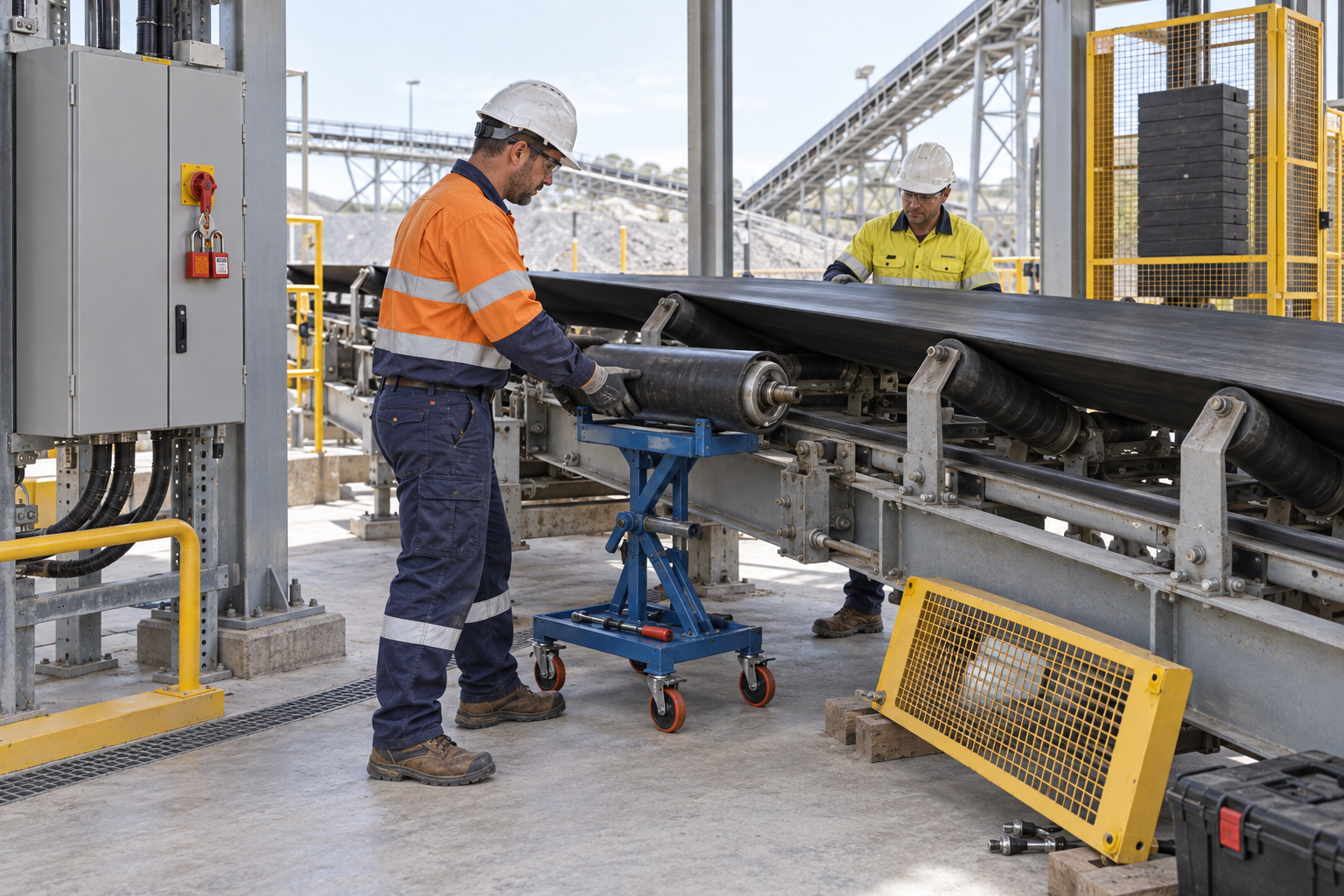
Retained AI-generated educational illustration from the source edition; not a real incident photograph, approved installation drawing or evidence of equipment suitability.
The scenario and record comparisons are fictional teaching examples, not records of real incidents, measurements, inspections, signatures or approvals.
| Item | Fictional scenario |
|---|---|
| Initial | A stopped conveyor is prepared for roller replacement. |
| Change | The counterweight and inclined load remain uncontrolled as roller bolts are loosened. |
| Failure | Gravity and belt tension move through the changed support path. |
| Outcome | The belt or roller can move and crush hands or drop parts. |
| Barrier | Verify isolation, belt and counterweight restraints and component support before the planned disassembly step. |
Why the controls matter
The motor can be off while belt tension, a suspended take-up or material on an incline still drives movement. Identify and restrain each energy path before removing a guard or support.
A roller carries load that will move elsewhere when the roller is removed. Support the belt and component before disconnecting bolts; select the actual manufacturer restraint and unloading sequence.
Testing changes the energy state. Clear people and tools, restore safeguards and control the test; before re-entry, deenergize and reapply the required isolation and restraints. Never push a running belt by hand to correct tracking.
Decision sequence
| Step | Decision |
|---|---|
| Known | The counterweight and inclined load remain uncontrolled as roller bolts are loosened. |
| Unknown | Actual condition, extent of damage and suitability of belt support stability, shaft and brackets remain to be established. |
| Hold | Gravity and belt tension move through the changed support path. |
| Evidence | Link belt support stability, shaft and brackets, handling load, body position, signals and boundaries, test scope and control to the affected equipment or work area. |
| Next | Verify isolation, belt and counterweight restraints and component support before the planned disassembly step. |
5. Conditional decisions and common errors
| Condition | Action | Evidence | Proceed when |
|---|---|---|---|
| Before access | Control all energy paths | Locks, take-up and belt restraints | Isolation verified |
| Roller removal | Support transferred loads | Support and disassembly plan | Load path stable |
| Before test | Restore guards and clear people | Assembly and clearance checks | Test zone secured |
| Tracking fault | Stop and re-isolate | Tracking, tension and fault record | Isolation reapplied |
Similar appearance, different evidence
The scenario and record comparisons are fictional teaching examples, not records of real incidents, measurements, inspections, signatures or approvals.
| Comparison | Supported decision | Insufficient basis |
|---|---|---|
| Condition | Locks, take-up and belt restraints | Before access has not been resolved. |
| Evidence | Assembly and clearance checks | A photograph or a completed-looking task without the relevant inspection record. |
| Release | Isolation reapplied | Completion of one step does not release the excluded tasks in section 2. |
6. Roles and responsibilities
| Role | Responsibility |
|---|---|
| Work supervisor | Assign the task boundary, stop authority, interfaces and emergency communication for conveyor drive repair and roller replacement. |
| Technical lead | Confirm Drive and interlock list; Take-up arrangement; Incline and material; Control boundaries. Resolve design and manufacturer limits before work. |
| Authorized crew | Apply Removal sequence; Hand protection; Part type and weight; Work platform. Stop when the working arrangement changes. |
| Inspector / receiving lead | Review Belt support stability; Shaft and brackets; Handling load; Body position. Transfer Guard and stop results; Tool and scrap removal; Open defects; Operations release. |
Role labels allocate responsibilities; they do not confer a legal qualification. Verify the competence, training and authority required for the actual task.
Record and handoff perspective
| Stage | Record controls | Verification |
|---|---|---|
| Map energy | 1. Record drive and interlock list2. Record take-up arrangement3. Record incline and material | 1. Take-up arrangement2. Incline and material3. Control boundaries |
| Remove guards | 1. Record removal sequence2. Record hand protection3. Record part type and weight | 1. Hand protection2. Part type and weight3. Work platform |
| Dismantle drive | 1. Record lifting support rating2. Record pinch-zone clearance3. Record fluid controls | 1. Pinch-zone clearance2. Fluid controls3. Tension and support |
| Replace roller | 1. Record belt support stability2. Record shaft and brackets3. Record handling load | 1. Shaft and brackets2. Handling load3. Body position |
| Test and stop | 1. Record signals and boundaries2. Record test scope and control3. Record personnel clearance | 1. Test scope and control2. Personnel clearance3. Re-isolation record |
| Transfer to operations | 1. Record guard and stop results2. Record tool and scrap removal3. Record open defects | 1. Tool and scrap removal2. Open defects3. Operations release |
7. Hold points and record comparison
| Hold point | Evidence before release | Actual record |
|---|---|---|
| HP-0 Start | Repair an isolated belt-conveyor drive, replace rollers, restore alignment and guarding, conduct a controlled test and return the system to operations. Include take-up, inclined loads and connected equipment. | |
| HP-1 Stop and restrain | Lock and try checks; Rollback restraint; Mechanical support; Residual energy state | |
| HP-2 Dismantle drive | Lifting support rating; Pinch-zone clearance; Fluid controls; Tension and support | |
| HP-3 Restore guards | Alignment and tension; Access guards; Tool inventory; Assembly inspection | |
| HP-4 Transfer to operations | Guard and stop results; Tool and scrap removal; Open defects; Operations release |
These are internal hold points, not issued permits. Recheck affected points after a change, fault or shift handoff; link the actual approval record.
Record comparison
The scenario and record comparisons are fictional teaching examples, not records of real incidents, measurements, inspections, signatures or approvals.
The boxes are static record prompts, not interactive or saved approvals. A tick does not establish suitability or permission to restart. Record the evidence, person, time and unresolved issues; retain the change history.
| Record | Insufficient | Record checklist |
|---|---|---|
| Map energy | "Checked" without target, criteria or result | □ Drive and interlock list□ Take-up arrangement□ Incline and material□ Control boundaries |
| Remove guards | "Checked" without target, criteria or result | □ Removal sequence□ Hand protection□ Part type and weight□ Work platform |
| Replace roller | "Checked" without target, criteria or result | □ Belt support stability□ Shaft and brackets□ Handling load□ Body position |
| Transfer to operations | "Checked" without target, criteria or result | □ Guard and stop results□ Tool and scrap removal□ Open defects□ Operations release |
8. Site checklist and emergency response
| Check | Result | Person / action |
|---|---|---|
| □ Map energy: Drive and interlock list | ||
| □ Stop and restrain: Lock and try checks | ||
| □ Remove guards: Removal sequence | ||
| □ Dismantle drive: Lifting support rating | ||
| □ Replace roller: Belt support stability | ||
| □ Restore guards: Alignment and tension | ||
| □ Test and stop: Signals and boundaries | ||
| □ Transfer to operations: Guard and stop results | ||
| □ Emergency access and handoff restrictions |
Stop work
Do not remove guards until start sources, take-up, belt and material movement are controlled. Stop the test for support movement, tension change, rubbing, mistracking or lost signals; re-isolate before approaching.
Emergency response
Stop from a safe location, exclude people from the affected danger zone and activate the site emergency plan. Call 911 for injury or immediate danger. Do not enter an unstable, energized or confined danger area for an improvised rescue; trained responders must control the specific energy and access hazards.
9. Sources and review limits
Public-source review: 2026-10-12. Official regulation pages and specific technical references are distinguished below; no agency or manufacturer has approved this content.
| Source | Reviewed scope and limitation |
|---|---|
| OSHA 29 CFR 1910.147 | Stored-energy restraint, isolation verification and the f(1) testing/positioning transition. |
| OSHA 29 CFR 1910.212 | General machine guarding, including nip and rotating-part hazards. |
| OSHA 29 CFR 1926.555 | Construction conveyor safeguards and repair lockout/tagging requirements. |
| OSHA State Plans | Official overview of federal and State Plan jurisdiction and differing public-sector coverage, checked 2026-10-12. Individual state rules require a site-specific check. |
No site measurements, equipment manuals for the actual installation, inspection records or signed technical approvals were supplied. Confirm the applicable requirements and actual product instructions before use; record each criterion with its units, source and equipment or work-area ID.
10. PDF guidance and FAQ
PDF A covers basic task controls; B focuses on technical failures; C covers supervision, records and handover. The article has eight stages with four items per main cell; each PDF has six key stages with three items per main cell. P/S/R/A, measurements, confirmations and signatures remain blank for actual site assessment.
Content group
jsa-conveyor-maintenance
Is motor-off enough to remove a roller?
No. Control remote starts, belt tension, take-up gravity and inclined loads.
Can a running belt be pushed back into line?
No. Stop, isolate and investigate alignment or tension using the specified method.
Can the counterweight simply be lowered?
Use the actual restraint and unloading procedure; an improvised release can move the belt or crush people.
What changes when entering after a test?
The energized test state must return to verified isolation, stored-energy control and mechanical restraint before access.
Has a professional approved this JSA?
This reference material was written and revised with AI. It has not been verified or approved by a professional. Review by a suitably qualified professional and required site approval are necessary before field use.
11. Revision history and authorship
This reference material was written and revised with AI. It has not been verified or approved by a professional. Review by a suitably qualified professional and required site approval are necessary before field use.
Korean source created 2026-09-19. This US edition adapts the Korean source; earlier editorial revisions do not constitute professional approval of this edition.
| Date | Edition | Change | Review status |
|---|---|---|---|
| 2026-10-12 | 1.0 | US localization: preserve task judgments; replace Korean legal applicability with scoped US references. | AI editorial and output checks; no professional technical approval. |