Finishing readiness and structural load capacity are separate decisions. Verify both before moving the trowel onto a slab, then control machine reaction, wet electrical connections and access near slab edges.
This is reference content written and revised with AI. It has not been verified or approved by a professional. Review by a suitably qualified professional and required site authorization are necessary before use.
Stop conditions first
Stop for unverified slab/support capacity, damaged guards or stop control, unpredictable reaction, cables near the rotor, electrical defects, edge exposure or loss of a safe walking surface. Never tie down an operator-presence control.
1. US legal and technical basis
Construction concrete finishing. OSHA 1926.701(a) requires a construction-load capability determination based on information from a person qualified in structural design. Apply construction tool and electrical rules; do not automatically apply general-industry 1910.147 to construction.
| Reference | Use and limit |
|---|---|
| OSHA 29 CFR 1926.701 | Paragraph (a), construction loads and qualified structural-design information. |
| OSHA 29 CFR 1926.302 | Construction electric power-tool grounding/double-insulation and safe handling provisions; actual equipment instructions remain necessary. |
| OSHA 29 CFR 1926.404 | Paragraph (b)(1), construction ground-fault protection and assured equipment grounding conductor program, including inspections/testing where that program is used. |
| CDC NIOSH Carbon Monoxide Hazards at Work | Public prevention guidance: combustion sources, accumulation, substitution, monitoring and emergency response. NIOSH recommendations are not OSHA permissible exposure limits or universal entry criteria. |
| OSHA State Plans | Federal baseline and State Plan coverage reviewed. Confirm the applicable state program and employer coverage; this edition does not establish nationwide compliance. |
Determine whether Federal OSHA or an applicable State Plan governs the employer and work. Standards incorporated into a regulation must be read in their legally applicable edition. Other NFPA/ANSI guidance and manufacturer instructions have distinct roles; they are not automatically federal law.
2. Scope and required inputs
Included
Walk-behind electric power-trowel finishing of a prepared concrete slab, with the specified blade or pan, guards and operator-stop system.
Separate assessment
Concrete placing/pumping, ride-on trowels, hardened-concrete grinding, combustion engines indoors and structural repair require separate plans.
| Input | Evidence needed |
|---|---|
| Plan slab access | Load-capacity evidence; Slab/support status; Machine and blade type; Adjacent exhaust sources |
| Move and supply | Lift method; Supply and lead checks; Cable route; Access and handling plan |
| Trial surface | Surface condition; Trial path and boundary; Cable clearance; Control response |
| Transfer curing | Equipment and lead count; Cure/access boundary; Load restrictions; Receiving trade and owner |
Selected public official provisions were checked on October 12, 2026. This is not a complete legal audit. No actual equipment manual, site measurements, engineering calculations, product certification or professional technical approval was supplied. Full paid NFPA/ANSI standards and state/local amendments were not reviewed. Check actual equipment, jurisdiction and project requirements before use.
Select task-appropriate eye, hand, foot, skin and hearing protection from the exposure assessment. Where respiratory protection is necessary, use the applicable respiratory-protection program; PPE does not replace isolation, guarding, support or ventilation.
3. Eight-stage JSA
| Job stage | Hazards and effects | Failure factors | Controls | Site verification | P | S | R | A |
|---|---|---|---|---|---|---|---|---|
| 1. Plan slab access | 1. Slab overload2. Edge fall3. Wrong machine load4. CO exposure | 1. Surface hardness trusted2. Support status unknown3. Ride-on substituted4. Nearby engine ignored | 1. Verify structural capacity2. Retain edge protection3. Match specified equipment4. Assess combustion sources | 1. Load-capacity evidence2. Slab/support status3. Machine and blade type4. Adjacent exhaust sources | ||||
| 2. Move and supply | 1. Dropped trowel2. Electric shock3. Cable entanglement4. Overexertion | 1. Wrong lift points2. Wet damaged connector3. Cord crosses rotor path4. Machine dragged by lead | 1. Use designated lift points2. Inspect power protection3. Route and protect cable4. Use suitable handling aids | 1. Lift method2. Supply and lead checks3. Cable route4. Access and handling plan | ||||
| 3. Inspect controls | 1. Rotating-blade contact2. Cement skin burns3. Hearing exposure4. Uncontrolled operation | 1. Guard damaged2. Wet cement in boots3. Protection absent4. Stop control bypassed | 1. Inspect guard and blades2. Use cement-resistant protection3. Assess noise control4. Test operator-stop function | 1. Guard/blade condition2. Skin and wash protection3. Noise controls4. Stop-function result | ||||
| 4. Trial surface | 1. Sudden handle reaction2. Edge approach3. Person struck4. Rotor snags cable | 1. Stiffness differs2. Trial too near edge3. Zone occupied4. Cable follows machine | 1. Trial in controlled zone2. Check surface response3. Keep people and leads clear4. Stop abnormal reaction | 1. Surface condition2. Trial path and boundary3. Cable clearance4. Control response | ||||
| 5. Finish passes | 1. Handle kick2. Blade contact3. Fatigue error4. Electric shock | 1. Machine forced2. People enter zone3. Grip fatigue ignored4. Connector in slurry | 1. Follow controlled path2. Maintain exclusion zone3. Pause for fatigue/change4. Keep connections protected | 1. Pass and surface state2. People and cable clearance3. Operator condition4. Connection dryness | ||||
| 6. Stop and inspect | 1. Cement burn2. Unexpected restart3. Missed blade damage4. Unsafe shift takeover | 1. Contamination left on skin2. Machine left powered3. Impact unreported4. Condition not passed on | 1. Stop and secure machine2. Wash cement contamination3. Inspect reported defects4. Brief receiving operator | 1. Skin/boot condition2. Safe parked state3. Damage report4. Shift limitations | ||||
| 7. Clean or change blade | 1. Coasting-blade cut2. Tilted-machine crush3. Unexpected energization4. Manual handling strain | 1. Standstill assumed2. Support unstable3. Plug reconnected4. Machine lifted alone | 1. Isolate and prevent reconnection2. Verify full standstill3. Secure gravity support4. Use approved handling method | 1. Isolation control2. Rotor standstill3. Tilt support4. Blade/change procedure | ||||
| 8. Transfer curing | 1. Early traffic damage2. Slab overload3. Edge fall4. Trip on equipment | 1. Cure area reopened2. Load limits omitted3. Guardrail removed4. Leads abandoned | 1. Remove equipment safely2. Protect curing area3. Transfer load/access limits4. Retain edge protection | 1. Equipment and lead count2. Cure/access boundary3. Load restrictions4. Receiving trade and owner |
Actual risk assessments, measurements, checks, approvals and signatures have not been performed. Keep unverified fields blank and link the actual site records. P/S/R/A mean likelihood, severity, site-method risk and site-defined acceptance/authorization; a score cannot waive a required control.
4. Failure mechanisms and hypothetical case
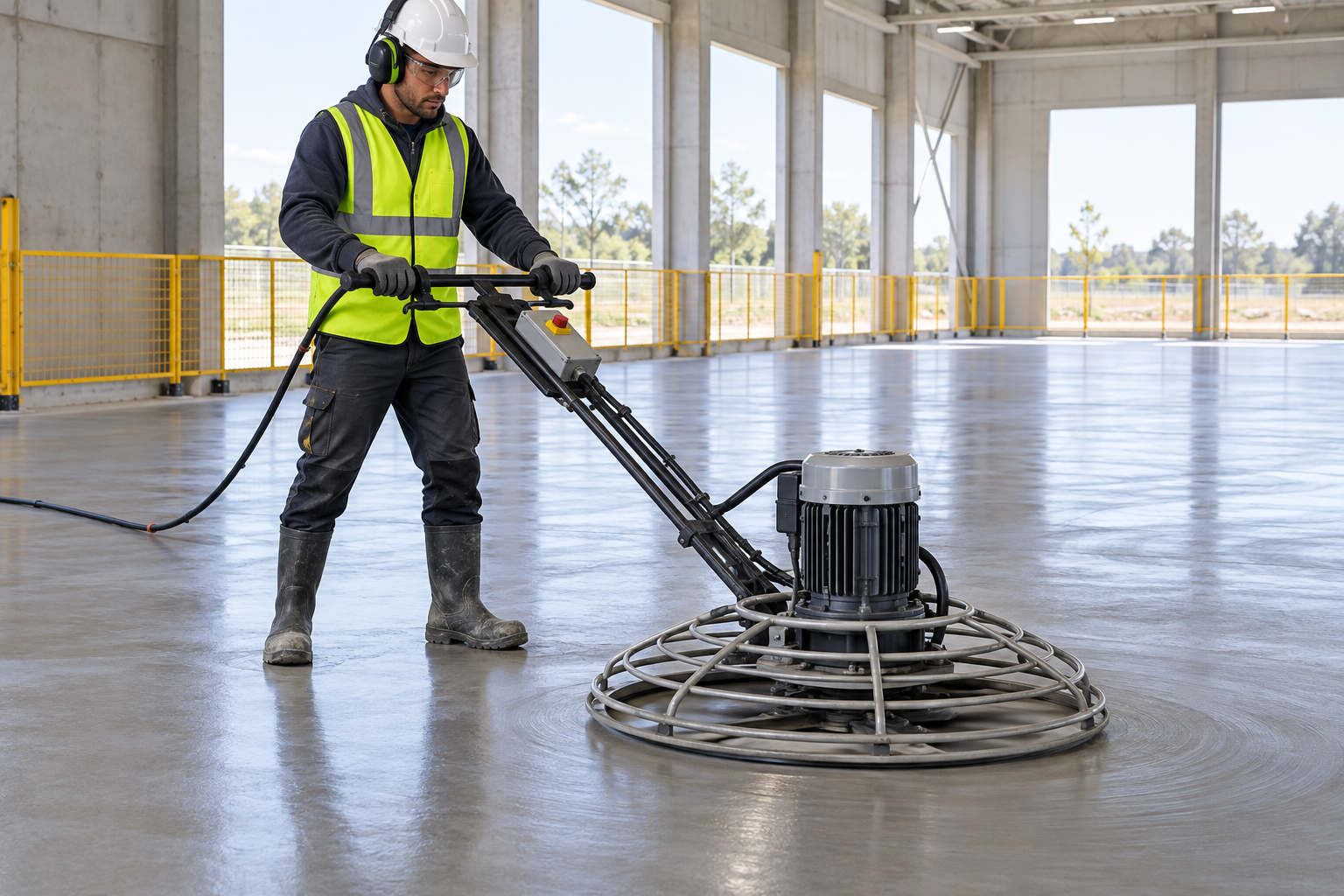
The retained illustration is an AI-generated educational image from the Korean source. It is not an actual incident photograph, approved drawing, equipment certification or proof that the depicted arrangement is safe.
Surface stiffness determines finishing behavior; it does not prove the slab or temporary supports can carry the equipment and crew. A ride-on substitution changes the load assessment.
Different surface resistance can turn or kick the handle. Keep a planned path and recovery space, and stop to reassess changing concrete condition instead of forcing the machine or defeating its stop control.
Use the applicable construction ground-fault protection arrangement under 1926.404(b)(1): specified GFCIs or a compliant assured equipment grounding conductor program, according to the provision and actual supply. Neither permits damaged cords or wet, unsuitable connectors.
Blades coast after power is removed. Maintenance also needs prevention of reconnection, verified standstill and secure support against gravity movement when tilted. Electric equipment avoids local engine exhaust, but does not remove CO from other nearby combustion sources.
Hypothetical decision example
Hypothetical example: the slab varies in stiffness and the handle kicks while a supply cable lies near the rotor. A worker suggests tying down the stop control to finish before the concrete sets. Work stops for surface, route and equipment review.
The example is fictional; no incident, measurement, inspection or approval is asserted.
Task flow: Plan slab access → Move and supply → Inspect controls → Trial surface → Finish passes → Stop and inspect → Clean or change blade → Transfer curing
5. Hold and proceed decisions
| Condition | Action | Evidence | Proceed when |
|---|---|---|---|
| Slab strength unknown | Hold machine access | Structural-load determination and support status | Load accepted |
| Handle kicks | Stop and reassess surface/path | Concrete condition and machine setup | Control restored |
| Cord damaged | Disconnect safely and remove from service | Repair/replacement and protection checks | Supply acceptable |
| Blade cleaning | Isolate and wait for standstill | Reconnection prevention and tilt support | Motion controlled |
Similar observation, different conclusion
| Observation | Supported conclusion | What remains unresolved |
|---|---|---|
| Surface ready to finish | Finishing consistency assessed | Structural loading still needs confirmation |
| Plug removed | Power source separated | Coasting and gravity remain to be controlled |
6. Roles and supervision
| Role | Responsibility |
|---|---|
| Work supervisor | Coordinate plan slab access, affected operations, stop signals and stage transitions. |
| Technical/equipment reviewer | Verify Load-capacity evidence, Slab/support status, actual instructions and unresolved technical limits. |
| Task crew | Apply the stated controls, report changes and keep actual checks and signatures factual. |
| Inspector/test lead | Connect Skin/boot condition, Safe parked state to the required acceptance criteria. |
| Receiving authority | Accept the recorded restrictions, Load restrictions, Receiving trade and owner, and follow-up ownership. |
These are responsibility examples, not invented statutory credentials. Verify actual competence, training and authority for the assigned work.
Supervision and handover controls
| Stage | Management controls | Evidence |
|---|---|---|
| Plan review | 1. Assign technical owner2. Close task-specific questions3. Verify structural capacity | 1. Load-capacity evidence2. Slab/support status3. Adjacent exhaust sources |
| Competence | 1. Verify required competence2. Assign stop authority3. Use designated lift points | 1. Lift method2. Training and task briefing3. Access and handling plan |
| Prestart evidence | 1. Inspect actual equipment2. Link evidence to this stage3. Trial in controlled zone | 1. Surface condition2. Trial path and boundary3. Control response |
| Change control | 1. Stop and secure the area2. Review affected controls3. Isolate and prevent reconnection | 1. Isolation control2. Rotor standstill3. Blade/change procedure |
| Shift handover | 1. Identify remaining restrictions2. Confirm receiving responsibility3. Remove equipment safely | 1. Equipment and lead count2. Cure/access boundary3. Receiving trade and owner |
| Closeout | 1. Record defect disposition2. Archive factual evidence3. Remove equipment safely | 1. Equipment and lead count2. Cure/access boundary3. Receiving trade and owner |
7. Hold points and record quality
| Hold point | Evidence before release | Actual record |
|---|---|---|
| HP-0 Start | Walk-behind electric power-trowel finishing of a prepared concrete slab, with the specified blade or pan, guards and operator-stop system. | |
| HP-1 Move and supply | Lift method; Supply and lead checks; Cable route; Access and handling plan | |
| HP-2 Trial surface | Surface condition; Trial path and boundary; Cable clearance; Control response | |
| HP-3 Clean or change blade | Isolation control; Rotor standstill; Tilt support; Blade/change procedure | |
| HP-4 Transfer curing | Equipment and lead count; Cure/access boundary; Load restrictions; Receiving trade and owner |
Hold points are internal evidence gates. They do not establish that a statutory permit exists or has been approved. Recheck affected gates after changes, faults and shift handover.
Record comparison - hypothetical templates
The 16 boxes below identify record elements, not completed checks or approvals. They are static symbols. Link equipment/location, date, actual findings and the separate record reference; preserve unresolved items.
| Record | Insufficient entry | Required record elements |
|---|---|---|
| Plan slab access | "Checked" without supporting facts | □ Load-capacity evidence□ Slab/support status□ Machine and blade type□ Adjacent exhaust sources |
| Inspect controls | "Checked" without supporting facts | □ Guard/blade condition□ Skin and wash protection□ Noise controls□ Stop-function result |
| Finish passes | "Checked" without supporting facts | □ Pass and surface state□ People and cable clearance□ Operator condition□ Connection dryness |
| Clean or change blade | "Checked" without supporting facts | □ Isolation control□ Rotor standstill□ Tilt support□ Blade/change procedure |
8. Pre-work checks and emergency response
| Check required | Result | Checker/action |
|---|---|---|
| Plan slab access: Load-capacity evidence | ||
| Move and supply: Lift method | ||
| Inspect controls: Guard/blade condition | ||
| Trial surface: Surface condition | ||
| Finish passes: Pass and surface state | ||
| Stop and inspect: Skin/boot condition | ||
| Clean or change blade: Isolation control | ||
| Transfer curing: Equipment and lead count |
Stop work
Stop for unverified slab/support capacity, damaged guards or stop control, unpredictable reaction, cables near the rotor, electrical defects, edge exposure or loss of a safe walking surface. Never tie down an operator-presence control.
Emergency response
Stop the trowel from a safe position and keep people outside the rotor and handle-reaction area. Do not touch a person or machine involved in an electrical incident until the electrical source is safely controlled. For wet-cement skin or eye exposure, use the prepared washing facilities and product SDS response. Call 911 for serious injury; provide slab/support, electrical and machine information. Keep edge protection and prevent premature restart.
9. Official sources and review limits
Official public-source check: October 12, 2026. The review concerns the selected passages described below, not endorsement of this article.
| Official source | Checked scope and limit |
|---|---|
| OSHA 29 CFR 1926.701 | Paragraph (a), construction loads and qualified structural-design information. |
| OSHA 29 CFR 1926.302 | Construction electric power-tool grounding/double-insulation and safe handling provisions; actual equipment instructions remain necessary. |
| OSHA 29 CFR 1926.404 | Paragraph (b)(1), construction ground-fault protection and assured equipment grounding conductor program, including inspections/testing where that program is used. |
| CDC NIOSH Carbon Monoxide Hazards at Work | Public prevention guidance: combustion sources, accumulation, substitution, monitoring and emergency response. NIOSH recommendations are not OSHA permissible exposure limits or universal entry criteria. |
| OSHA State Plans | Federal baseline and State Plan coverage reviewed. Confirm the applicable state program and employer coverage; this edition does not establish nationwide compliance. |
Selected public official provisions were checked on October 12, 2026. This is not a complete legal audit. No actual equipment manual, site measurements, engineering calculations, product certification or professional technical approval was supplied. Full paid NFPA/ANSI standards and state/local amendments were not reviewed. Check actual equipment, jurisdiction and project requirements before use.
This is reference content written and revised with AI. It has not been verified or approved by a professional. Review by a suitably qualified professional and required site authorization are necessary before use.
10. PDF use and frequently asked questions
PDF A summarizes core controls; B emphasizes technical failures; C covers supervision, records and handover. Each uses six stages from or aligned with the eight-stage body. All actual risk, measurement, check and signature fields are blank. Use a separate linked record where more space is needed.
Can I tie down the handle stop?
No. Remove a machine with a defective stop control from service and retain the designed protection.
Is a hard surface enough to carry the machine?
No. Verify structural capacity for the equipment, crew and any temporary support arrangement.
Can I substitute a gasoline trowel indoors?
That changes the scope and adds serious CO risk. Use suitable electric alternatives and assess all nearby combustion sources.
Can blades be cleaned immediately after unplugging?
Wait for complete standstill and control reconnection and gravity movement before access.
Has a professional approved this JSA?
This is reference content written and revised with AI. It has not been verified or approved by a professional. Review by a suitably qualified professional and required site authorization are necessary before use.
11. Authorship and revision history
This is reference content written and revised with AI. It has not been verified or approved by a professional. Review by a suitably qualified professional and required site authorization are necessary before use.
| Date/version | Editorial history | Technical approval |
|---|---|---|
| 2026-09-19 | Korean source retained as an unchanged snapshot; source ID fc688caa-b6a3-4be7-8061-c6428b773196 | Not asserted |
| 2026-10-12 / US v1.0 | US localization: Retains the Korean source electric walk-behind scope, uneven-stiffness reaction example, wet-cement protection, coasting/gravity and curing handover. Distinguishes US structural-load verification from surface readiness and accurately states the construction electrical-protection alternatives. | Not performed |
Source topic: https://smartjsabridge.com/ko/case-study/jsa-concrete-troweling
Content group: jsa-concrete-troweling