A closed inlet valve does not isolate downstream stored air. Identify the outlet, bypass and drain connections before treating the filter bowl as safe to open.
This is reference content written and revised with AI. It has not been verified or approved by a professional. Review by a suitably qualified professional and required site authorization are necessary before use.
Stop conditions first
Hold opening for unknown connections, blocked drain, unverified pressure, reaccumulation, damaged housing, wrong parts or uncertain locking engagement. Do not tighten a leaking pressurized bowl.
1. US legal and technical basis
General-industry servicing under applicable OSHA 1910.147 energy control. Filter pressure classification, installation and air-quality obligations depend on actual equipment and use.
| Reference | Use and limit |
|---|---|
| OSHA 29 CFR 1910.147 | Selected isolation, residual-energy, reaccumulation and verification provisions for covered general-industry servicing. |
| Parker OIL-X user guide | Selected printed pages 9-13, maintenance, depressurization, element/seal/locking and startup. Cover identifies 07/21 revision and internal copyright 2019; model-specific examples only. |
| OSHA State Plans | Federal baseline and State Plan coverage reviewed. Confirm the applicable state program and employer coverage; this edition does not establish nationwide compliance. |
Determine whether Federal OSHA or an applicable State Plan governs the employer and work. Standards incorporated into a regulation must be read in their legally applicable edition. Other NFPA/ANSI guidance and manufacturer instructions have distinct roles; they are not automatically federal law.
2. Scope and required inputs
Included
Replace the specified element and seals in an industrial compressed-air filter that can be isolated, safely drained and verified depressurized.
Separate assessment
Pressurized replacement, housing repair, oxygen/fuel-gas service, breathing-air certification, receiver entry and dryer-media changes require separate review.
| Input | Evidence needed |
|---|---|
| Identify filter and parts | Filter/model ID; Flow/use requirement; Element/seal numbers; Affected users |
| Isolate all paths | Boundary drawing; Valve/lock state; Stored downstream air; Drain connection |
| Open and inspect | Bowl/support condition; Residual fluid state; Threads/housing inspection; Waste containment |
| Record and transfer | Part/service history; Quality/restrictions; Waste record; Receiver and next service |
Selected public official provisions were checked on October 14, 2026. This is not a complete legal audit. No actual equipment manual, site measurements, engineering calculations, product certification or professional technical approval was supplied. Full paid NFPA/ANSI standards and state/local amendments were not reviewed. Check actual equipment, jurisdiction and project requirements before use.
Select task-appropriate eye, hand, foot, skin and hearing protection from the exposure assessment. Where respiratory protection is necessary, use the applicable respiratory-protection program; PPE does not replace isolation, guarding, support or ventilation.
3. Eight-stage JSA
| Job stage | Hazards and effects | Failure factors | Controls | Site verification | P | S | R | A |
|---|---|---|---|---|---|---|---|---|
| 1. Identify filter and parts | 1. Wrong housing opened2. Contaminated air3. Wrong element4. Unexpected process effect | 1. ID unclear2. Grade mismatched3. Flow direction missed4. Users not notified | 1. Match filter and diagram2. Confirm required grade3. Verify part and seals4. Coordinate supply outage | 1. Filter/model ID2. Flow/use requirement3. Element/seal numbers4. Affected users | ||||
| 2. Isolate all paths | 1. Downstream backfeed2. Bypass pressure3. Restart supply4. Drain-system return | 1. Inlet only closed2. Bypass untraced3. Lock absent4. Shared drain unknown | 1. Trace outlet and bypass2. Isolate complete boundary3. Prevent restart4. Assess connected drains | 1. Boundary drawing2. Valve/lock state3. Stored downstream air4. Drain connection | ||||
| 3. Drain and verify | 1. Bowl pressure release2. Condensate exposure3. Reaccumulation4. Noise injury | 1. Silence trusted2. Drain blocked3. Valve passing4. Discharge uncontrolled | 1. Use safe drain route2. Verify housing pressure3. Monitor possible return4. Control discharge exposure | 1. Drain communication2. Verification method3. Pressure/time checks4. Collection/PPE | ||||
| 4. Open and inspect | 1. Bowl drops2. Residual spray3. Thread damage4. Contamination contact | 1. Bowl unsupported2. Safe state assumed3. Wrong tool4. Waste handling absent | 1. Support bowl before release2. Reconfirm safe boundary3. Use model opening tools4. Collect contaminated parts | 1. Bowl/support condition2. Residual fluid state3. Threads/housing inspection4. Waste containment | ||||
| 5. Replace and assemble | 1. Internal bypass2. Seal failure3. Bowl separation4. Drain malfunction | 1. Element unseated2. Seal wrong/damaged3. Lock not aligned4. Drain omitted | 1. Seat specified element2. Install specified seals3. Verify full locking detail4. Restore correct drain | 1. Grade/direction/seating2. Seal condition3. Thread/lock engagement4. Drain assembly | ||||
| 6. Repressurize and test | 1. Pressure shock2. Air leak3. Sudden discharge4. Unqualified air supplied | 1. Valve opened rapidly2. Assembly defect3. Drain wrongly routed4. Quality check omitted | 1. Use model startup sequence2. Check leaks from safe position3. Verify drain function4. Confirm required quality | 1. Startup pressure trend2. Leak-test record3. Drain operation4. Use-specific release | ||||
| 7. Hold abnormal result | 1. Repeated leak2. Pressurized adjustment3. Wrong part reused4. Fault recurrence | 1. Leak tightened live2. Only alarm reset3. Part mismatch ignored4. Cause undocumented | 1. Isolate before correction2. Depressurize and verify3. Resolve assembly cause4. Repeat affected checks | 1. Fault and isolation2. Parts/lock recheck3. Corrected test result4. Restart authority | ||||
| 8. Record and transfer | 1. Missed service interval2. Unresolved quality issue3. Waste exposure4. User confusion | 1. Date omitted2. Quality inferred3. Condensate dumped4. Handover absent | 1. Record exact parts/date2. Transfer quality evidence3. Dispose by site procedure4. Brief supply receiver | 1. Part/service history2. Quality/restrictions3. Waste record4. Receiver and next service |
Actual risk assessments, measurements, checks, approvals and signatures have not been performed. Keep unverified fields blank and link the actual site records. P/S/R/A mean likelihood, severity, site-method risk and site-defined acceptance/authorization; a score cannot waive a required control.
4. Failure mechanisms and hypothetical case
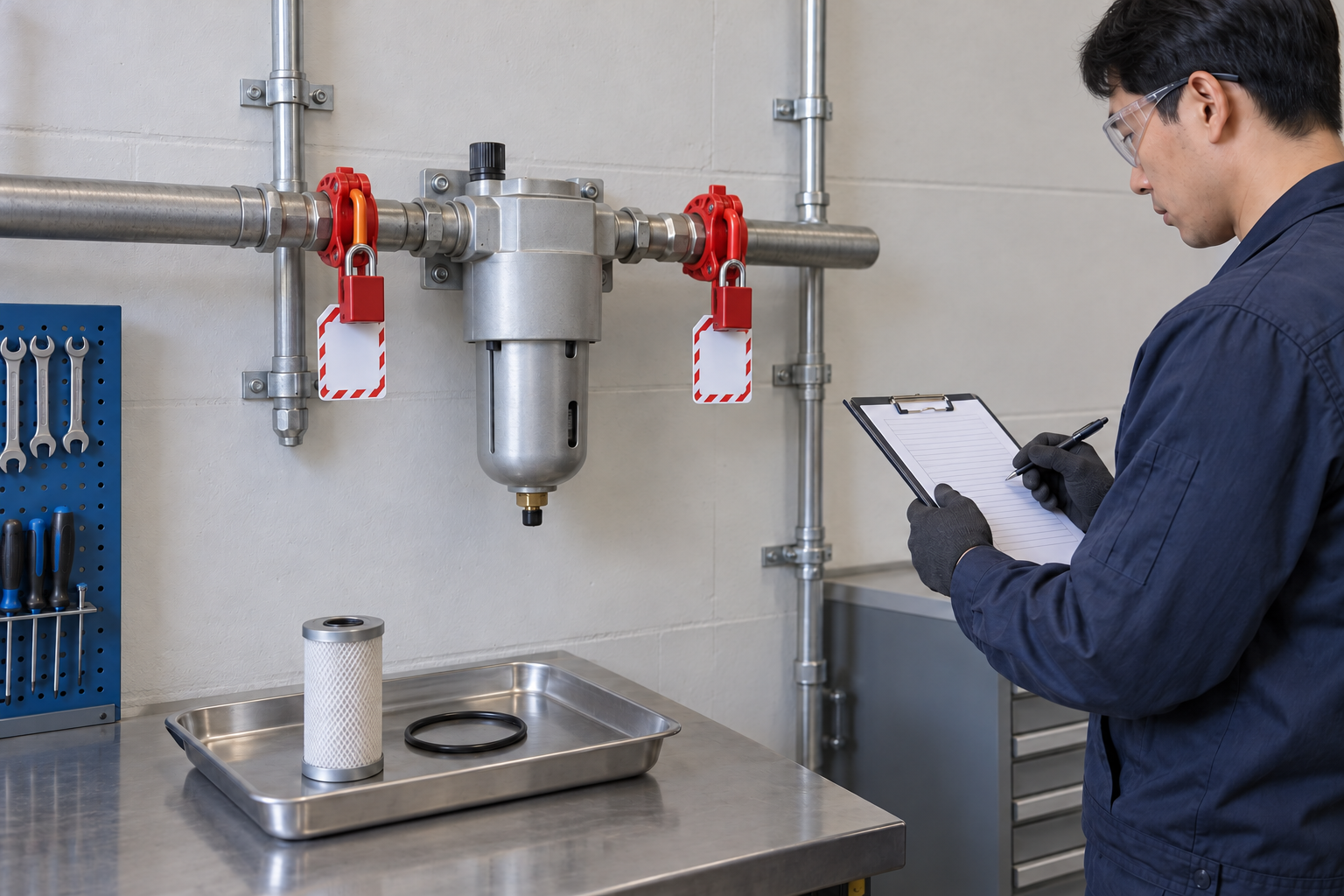
The retained illustration is an AI-generated educational image from the retained source edition. It is not an actual incident photograph, approved drawing, equipment certification or proof that the depicted arrangement is safe.
The outlet header or bypass can feed the housing after inlet closure. Trace the complete boundary and verify depressurization at the actual housing by the approved method. Silence at a drain is not proof that the path is open or pressure cannot return.
An element of similar size can have the wrong grade, direction or seal interface. Match exact parts and inspect seating; internal bypass can remain even when the housing does not leak externally.
Use the actual model sequence for threads, seals, locking alignment and gradual repressurization. Parker OIL-X guidance illustrates these checks; its rotations, waiting times and replacement intervals are not universal.
Low differential pressure does not establish remaining service life or required air quality. Link operating history, element type and any required downstream quality testing to the return decision.
Hypothetical decision example
Hypothetical example: the inlet is closed and drain noise ends, but the outlet remains connected to a common header and the bypass is unknown. Keep the bowl closed and resolve the boundary, drain communication and reaccumulation risk before any opening.
The example is fictional; no incident, measurement, inspection or approval is asserted.
Task flow: Identify filter and parts → Isolate all paths → Drain and verify → Open and inspect → Replace and assemble → Repressurize and test → Hold abnormal result → Record and transfer
5. Hold and proceed decisions
| Condition | Action | Evidence | Proceed when |
|---|---|---|---|
| Drain becomes silent | Hold; verify pressure path | Drain and housing verification | Safe state established |
| Part differs | Hold assembly | Model/grade/seal match | Exact part confirmed |
| Bowl lock unclear | Keep depressurized | Thread/seal/lock inspection | Engagement verified |
| Leak on test | Isolate and depressurize | Cause and corrected assembly | Retest accepted |
Similar observation, different conclusion
| Observation | Supported conclusion | What remains unresolved |
|---|---|---|
| Inlet closed | One supply path closed | Outlet/bypass backfeed unresolved |
| Low pressure drop | Measured differential is low | Element life and quality unproved |
6. Roles and supervision
| Role | Responsibility |
|---|---|
| Work supervisor | Coordinate identify filter and parts, affected operations, stop signals and stage transitions. |
| Technical/equipment reviewer | Verify Filter/model ID, Flow/use requirement, actual instructions and unresolved technical limits. |
| Task crew | Apply the stated controls, report changes and keep actual checks and signatures factual. |
| Inspector/test lead | Connect Startup pressure trend, Leak-test record to the required acceptance criteria. |
| Receiving authority | Accept the recorded restrictions, Waste record, Receiver and next service, and follow-up ownership. |
These are responsibility examples, not invented statutory credentials. Verify actual competence, training and authority for the assigned work.
Supervision and handover controls
| Stage | Management controls | Evidence |
|---|---|---|
| Plan review | 1. Assign technical owner2. Close task-specific questions3. Match filter and diagram | 1. Filter/model ID2. Flow/use requirement3. Affected users |
| Competence | 1. Verify required competence2. Assign stop authority3. Trace outlet and bypass | 1. Boundary drawing2. Training and task briefing3. Drain connection |
| Prestart evidence | 1. Inspect actual equipment2. Link evidence to this stage3. Support bowl before release | 1. Bowl/support condition2. Residual fluid state3. Waste containment |
| Change control | 1. Stop and secure the area2. Review affected controls3. Isolate before correction | 1. Fault and isolation2. Parts/lock recheck3. Restart authority |
| Shift handover | 1. Identify remaining restrictions2. Confirm receiving responsibility3. Record exact parts/date | 1. Part/service history2. Quality/restrictions3. Receiver and next service |
| Closeout | 1. Record defect disposition2. Archive factual evidence3. Record exact parts/date | 1. Part/service history2. Quality/restrictions3. Receiver and next service |
7. Hold points and record quality
| Hold point | Evidence before release | Actual record |
|---|---|---|
| HP-0 Start | Replace the specified element and seals in an industrial compressed-air filter that can be isolated, safely drained and verified depressurized. | |
| HP-1 Isolate all paths | Boundary drawing; Valve/lock state; Stored downstream air; Drain connection | |
| HP-2 Open and inspect | Bowl/support condition; Residual fluid state; Threads/housing inspection; Waste containment | |
| HP-3 Hold abnormal result | Fault and isolation; Parts/lock recheck; Corrected test result; Restart authority | |
| HP-4 Record and transfer | Part/service history; Quality/restrictions; Waste record; Receiver and next service |
Hold points are internal evidence gates. They do not establish that a statutory permit exists or has been approved. Recheck affected gates after changes, faults and shift handover.
Record comparison - hypothetical templates
The 16 boxes below identify record elements, not completed checks or approvals. They are static symbols. Link equipment/location, date, actual findings and the separate record reference; preserve unresolved items.
| Record | Insufficient entry | Required record elements |
|---|---|---|
| Identify filter and parts | "Checked" without supporting facts | □ Filter/model ID□ Flow/use requirement□ Element/seal numbers□ Affected users |
| Drain and verify | "Checked" without supporting facts | □ Drain communication□ Verification method□ Pressure/time checks□ Collection/PPE |
| Replace and assemble | "Checked" without supporting facts | □ Grade/direction/seating□ Seal condition□ Thread/lock engagement□ Drain assembly |
| Hold abnormal result | "Checked" without supporting facts | □ Fault and isolation□ Parts/lock recheck□ Corrected test result□ Restart authority |
8. Pre-work checks and emergency response
| Check required | Result | Checker/action |
|---|---|---|
| Identify filter and parts: Filter/model ID | ||
| Isolate all paths: Boundary drawing | ||
| Drain and verify: Drain communication | ||
| Open and inspect: Bowl/support condition | ||
| Replace and assemble: Grade/direction/seating | ||
| Repressurize and test: Startup pressure trend | ||
| Hold abnormal result: Fault and isolation | ||
| Record and transfer: Part/service history |
Stop work
Hold opening for unknown connections, blocked drain, unverified pressure, reaccumulation, damaged housing, wrong parts or uncertain locking engagement. Do not tighten a leaking pressurized bowl.
Emergency response
Withdraw from any bowl, fitting or air-release path. Isolate from a safe position when possible, restrict access and activate site emergency response. Do not grasp a whipping connection or approach damaged pressurized parts. For serious injury, call 911 and provide pressure, fluid/condensate and equipment information; recovery requires verified isolation.
9. Official sources and review limits
Official public-source check: October 14, 2026. The review concerns the selected passages described below, not endorsement of this article.
| Official source | Checked scope and limit |
|---|---|
| OSHA 29 CFR 1910.147 | Selected isolation, residual-energy, reaccumulation and verification provisions for covered general-industry servicing. |
| Parker OIL-X user guide | Selected printed pages 9-13, maintenance, depressurization, element/seal/locking and startup. Cover identifies 07/21 revision and internal copyright 2019; model-specific examples only. |
| OSHA State Plans | Federal baseline and State Plan coverage reviewed. Confirm the applicable state program and employer coverage; this edition does not establish nationwide compliance. |
Selected public official provisions were checked on October 14, 2026. This is not a complete legal audit. No actual equipment manual, site measurements, engineering calculations, product certification or professional technical approval was supplied. Full paid NFPA/ANSI standards and state/local amendments were not reviewed. Check actual equipment, jurisdiction and project requirements before use.
This is reference content written and revised with AI. It has not been verified or approved by a professional. Review by a suitably qualified professional and required site authorization are necessary before use.
10. PDF use and frequently asked questions
PDF A summarizes core controls; B emphasizes technical failures; C covers supervision, records and handover. Each uses six stages from or aligned with the eight-stage body. All actual risk, measurement, check and signature fields are blank. Use a separate linked record where more space is needed.
May the bowl be loosened to test pressure?
No. Verify the prescribed safe state before opening.
Is a matching outside size enough?
No. Match model, grade, flow direction, seals and seating.
Can every filter use the same replacement interval?
Use the element type and actual manufacturer/operating conditions.
Does a leak-free housing certify air quality?
No. Apply the downstream use-specific quality checks separately.
Has a professional approved this JSA?
This is reference content written and revised with AI. It has not been verified or approved by a professional. Review by a suitably qualified professional and required site authorization are necessary before use.
11. Authorship and revision history
This is reference content written and revised with AI. It has not been verified or approved by a professional. Review by a suitably qualified professional and required site authorization are necessary before use.
| Date/version | Editorial history | Technical approval |
|---|---|---|
| September 23, 2026 / Korean v1.0 | Korean source: initial article, evidence, hypothetical decisions and body/PDF editorial checks. | Professional technical approval not performed |
| October 14, 2026 / US v1.0 | US localization: Retains common-header backfeed and silent-drain hold. Separates mechanical assembly, differential pressure and downstream quality; no model-specific interval or tightening recipe generalized. | Not performed |
Source topic: https://smartjsabridge.com/ko/case-study/jsa-compressed-air-filter-element
Content group: jsa-compressed-air-filter-element