Product storage temperature is not a worker exposure limit. Check escape, communications, floor condition and the entry/exit roster before cold-room picking; count people separately from goods.
This is reference content written and revised with AI. It has not been verified or approved by a professional. Review by a suitably qualified professional and required site authorization are necessary before use.
Stop conditions first
Do not enter with a failed inside release, failed communications, blocked exit, uncontrolled ice, refrigerant alarm or unexplained symptoms. Stop for numbness, wet clothing, confusion or delayed return; use the emergency plan without an improvised rescue entry.
1. US legal and technical basis
General-industry refrigerated warehousing. OSHA 1910.36(d)(1) addresses inside opening of exit doors; OSHA cold-stress guidance supports hazard assessment but is not a dedicated federal cold-exposure time standard.
| Reference | Use and limit |
|---|---|
| OSHA 29 CFR 1910.36 | Paragraph (d)(1): employees must be able to open exit doors from inside without keys, tools or special knowledge. |
| OSHA Cold Stress | Guidance on cold exposure, dry protective clothing, warm breaks, training and monitoring. OSHA states it has no specific cold-environment standard; recognized serious hazards may fall under the General Duty Clause. |
| OSHA Warehousing Hazards and Solutions | Cold-storage guidance addresses inside release, cold conditions and icy floors. |
| OSHA State Plans | Federal baseline and State Plan coverage reviewed. Confirm the applicable state program and employer coverage; this edition does not establish nationwide compliance. |
Determine whether Federal OSHA or an applicable State Plan governs the employer and work. Standards incorporated into a regulation must be read in their legally applicable edition. Other NFPA/ANSI guidance and manufacturer instructions have distinct roles; they are not automatically federal law.
2. Scope and required inputs
Included
Routine entry to a walk-in refrigerated or freezer room to select packaged goods at ground-reachable shelves and move them with a manual cart.
Separate assessment
Blast freezing, oxygen-reduced rooms, dry ice or cryogens, refrigerant leaks/repairs, simultaneous forklift traffic, elevated picking and rescue entry need separate assessment.
| Input | Evidence needed |
|---|---|
| Plan picking | Room and temperature; Exposure and clothing plan; Load and cart; Contact and return plan |
| Test escape | Release condition; Receiver test; Light condition; Alarm response |
| Enter and notify | Entry roster; Expected return; Cart position; Exit path |
| Close and transfer | Final person count; Goods/order status; Door and floor defects; Receiving person and action |
Selected public official provisions were checked on October 12, 2026. This is not a complete legal audit. No actual equipment manual, site measurements, engineering calculations, product certification or professional technical approval was supplied. Full paid NFPA/ANSI standards and state/local amendments were not reviewed. Check actual equipment, jurisdiction and project requirements before use.
Select task-appropriate eye, hand, foot, skin and hearing protection from the exposure assessment. Where respiratory protection is necessary, use the applicable respiratory-protection program; PPE does not replace isolation, guarding, support or ventilation.
3. Eight-stage JSA
| Job stage | Hazards and effects | Failure factors | Controls | Site verification | P | S | R | A |
|---|---|---|---|---|---|---|---|---|
| 1. Plan picking | 1. Cold stress2. Overexertion3. Unsuitable cargo4. Delayed assistance | 1. Product limit used for people2. Dwell plan absent3. Load too heavy4. Outside contact missing | 1. Assess actual cold exposure2. Plan warm breaks3. Match cart and load4. Assign outside contact | 1. Room and temperature2. Exposure and clothing plan3. Load and cart4. Contact and return plan | ||||
| 2. Test escape | 1. Entrapment2. Communication failure3. Darkness4. Delayed warning | 1. Release frozen2. Phone assumed working3. Light defective4. Alarm not tested | 1. Test inside release safely2. Test actual communication3. Verify lighting4. Confirm response to alarm | 1. Release condition2. Receiver test3. Light condition4. Alarm response | ||||
| 3. Prepare route | 1. Ice slip2. Cart runaway3. Blocked doorway4. Cold hand injury | 1. Meltwater refreezes2. Wheels unsuitable3. Goods in exit4. Gloves wet | 1. Remove or isolate ice2. Inspect cart control3. Clear escape route4. Use dry suitable clothing | 1. Floor and drainage2. Wheel and brake state3. Doorway clearance4. Gloves and footwear | ||||
| 4. Enter and notify | 1. Unrecorded person2. Cold overexposure3. Door collision4. Blocked retreat | 1. Entry not announced2. Return time absent3. Cart spans opening4. Route changes | 1. Record each entrant2. Agree return check3. Keep door area clear4. Confirm exit route | 1. Entry roster2. Expected return3. Cart position4. Exit path | ||||
| 5. Pick goods | 1. Falling package2. Back strain3. Hand numbness4. Cold wet clothing | 1. High shelf reached2. Load held awkwardly3. Symptoms ignored4. Clothing gets wet | 1. Stay within ground reach2. Use stable manageable loads3. Stop for cold symptoms4. Replace wet clothing | 1. Shelf and reach2. Load stability3. Worker condition4. Clothing condition | ||||
| 6. Exit and count | 1. Worker left inside2. Repeat cold exposure3. Cart strikes person4. Door obstructed | 1. Goods count used for people2. Warm break skipped3. Exit congested4. Cart left at door | 1. Confirm each actual exit2. Take planned warm recovery3. Control cart route4. Leave escape clear | 1. Actual exit roster2. Warm recovery check3. Cart and load position4. Doorway condition | ||||
| 7. Respond to delay | 1. Hidden incapacitation2. Rescuer exposure3. Refrigerant exposure4. Delayed help | 1. No overdue action2. Blind reentry3. Alarm ignored4. Contact lost | 1. Activate response plan2. Prevent unplanned rescue entry3. Exclude alarm area4. Call trained assistance | 1. Missing person and time2. Last contact3. Alarm and hazard state4. Responder information | ||||
| 8. Close and transfer | 1. Defective door reused2. Unknown remaining person3. Repeat icing4. Missed restrictions | 1. Roster not reconciled2. Fault only verbal3. Drainage issue omitted4. Next shift uninformed | 1. Reconcile people separately2. Mark defective equipment3. Record icing source4. Transfer unresolved holds | 1. Final person count2. Goods/order status3. Door and floor defects4. Receiving person and action |
Actual risk assessments, measurements, checks, approvals and signatures have not been performed. Keep unverified fields blank and link the actual site records. P/S/R/A mean likelihood, severity, site-method risk and site-defined acceptance/authorization; a score cannot waive a required control.
4. Failure mechanisms and hypothetical case
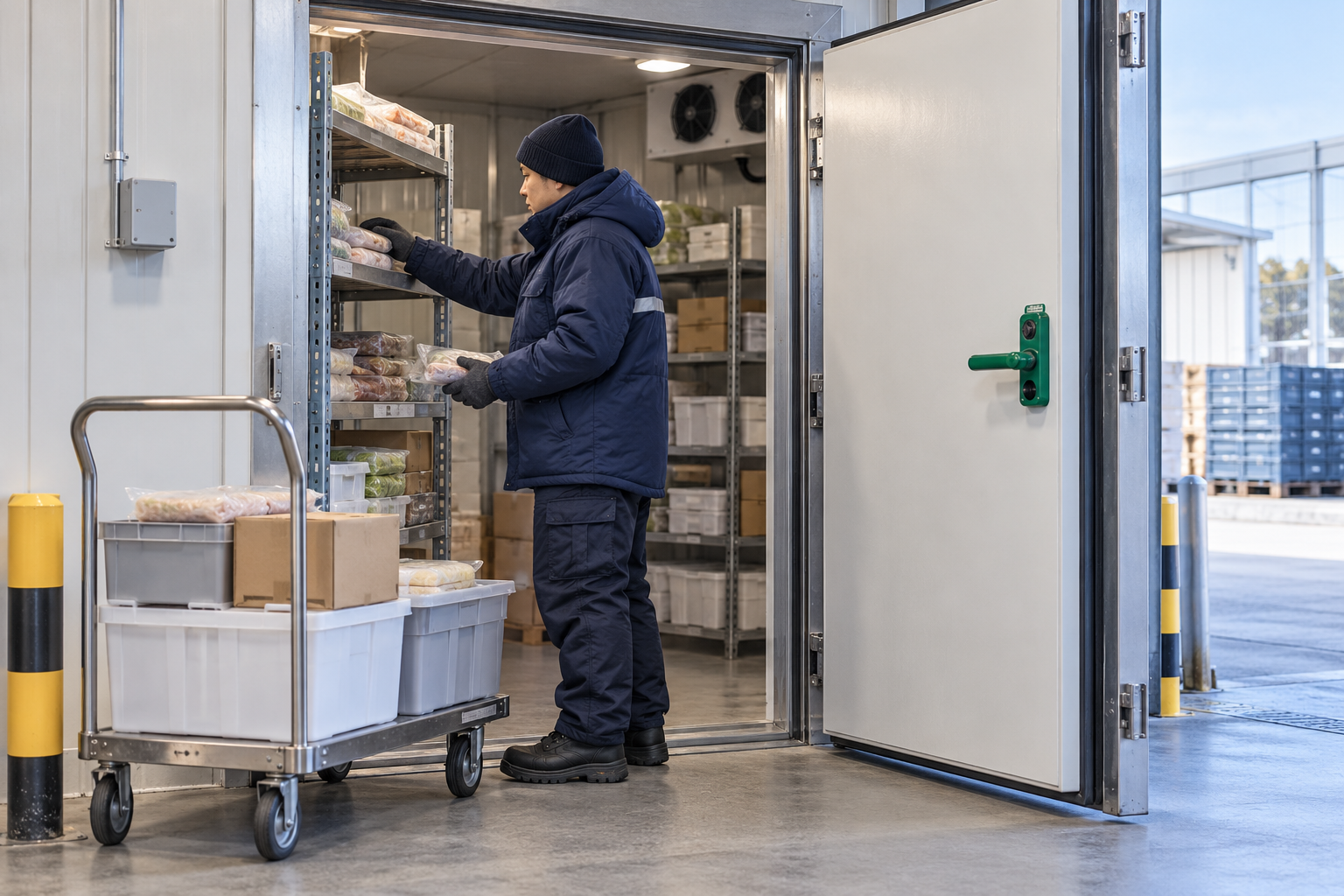
The retained illustration is an AI-generated educational image from the Korean source. It is not an actual incident photograph, approved drawing, equipment certification or proof that the depicted arrangement is safe.
Air temperature, air movement, workload, clothing, wetness and individual condition affect cold exposure. Set task-specific warming breaks and observation arrangements; no universal safe number of minutes is supplied.
Test the internal release without risking entrapment and prove communication with the actual outside receiver. A propped door or untested alarm does not repair a defective escape arrangement.
Order completion and a matching item count say nothing about who remains inside. Record entry, expected return, actual exit and an outside contact, with a clear response to an overdue worker.
Hypothetical decision example
Hypothetical example: a cart blocks part of the doorway and the order quantity matches the pick list. A coworker is still inside, but the outside worker assumes everyone has left because the goods count is complete.
The example is fictional; no incident, measurement, inspection or approval is asserted.
Task flow: Plan picking → Test escape → Prepare route → Enter and notify → Pick goods → Exit and count → Respond to delay → Close and transfer
5. Hold and proceed decisions
| Condition | Action | Evidence | Proceed when |
|---|---|---|---|
| Release fails | Keep room out of use for entry | Inside-release test and repair record | Escape restored |
| Cold symptoms | Exit to warm safe area; assess assistance | Symptoms, clothing and exposure conditions | Condition assessed |
| Overdue worker | Activate agreed response; prevent blind entry | Roster, contact attempts and hazards | People accounted for |
| Order complete | Confirm every person has exited | Actual person-by-person exit record | Roster reconciled |
Similar observation, different conclusion
| Observation | Supported conclusion | What remains unresolved |
|---|---|---|
| Goods count matches | Order quantity is reconciled | Worker exit remains unverified |
| Storage temperature correct | Product condition may be acceptable | Worker exposure and escape still need review |
6. Roles and supervision
| Role | Responsibility |
|---|---|
| Work supervisor | Coordinate plan picking, affected operations, stop signals and stage transitions. |
| Technical/equipment reviewer | Verify Room and temperature, Exposure and clothing plan, actual instructions and unresolved technical limits. |
| Task crew | Apply the stated controls, report changes and keep actual checks and signatures factual. |
| Inspector/test lead | Connect Actual exit roster, Warm recovery check to the required acceptance criteria. |
| Receiving authority | Accept the recorded restrictions, Door and floor defects, Receiving person and action, and follow-up ownership. |
These are responsibility examples, not invented statutory credentials. Verify actual competence, training and authority for the assigned work.
Supervision and handover controls
| Stage | Management controls | Evidence |
|---|---|---|
| Plan review | 1. Assign technical owner2. Close task-specific questions3. Assess actual cold exposure | 1. Room and temperature2. Exposure and clothing plan3. Contact and return plan |
| Competence | 1. Verify required competence2. Assign stop authority3. Test inside release safely | 1. Release condition2. Training and task briefing3. Alarm response |
| Prestart evidence | 1. Inspect actual equipment2. Link evidence to this stage3. Record each entrant | 1. Entry roster2. Expected return3. Exit path |
| Change control | 1. Stop and secure the area2. Review affected controls3. Activate response plan | 1. Missing person and time2. Last contact3. Responder information |
| Shift handover | 1. Identify remaining restrictions2. Confirm receiving responsibility3. Reconcile people separately | 1. Final person count2. Goods/order status3. Receiving person and action |
| Closeout | 1. Record defect disposition2. Archive factual evidence3. Reconcile people separately | 1. Final person count2. Goods/order status3. Receiving person and action |
7. Hold points and record quality
| Hold point | Evidence before release | Actual record |
|---|---|---|
| HP-0 Start | Routine entry to a walk-in refrigerated or freezer room to select packaged goods at ground-reachable shelves and move them with a manual cart. | |
| HP-1 Test escape | Release condition; Receiver test; Light condition; Alarm response | |
| HP-2 Enter and notify | Entry roster; Expected return; Cart position; Exit path | |
| HP-3 Respond to delay | Missing person and time; Last contact; Alarm and hazard state; Responder information | |
| HP-4 Close and transfer | Final person count; Goods/order status; Door and floor defects; Receiving person and action |
Hold points are internal evidence gates. They do not establish that a statutory permit exists or has been approved. Recheck affected gates after changes, faults and shift handover.
Record comparison - hypothetical templates
The 16 boxes below identify record elements, not completed checks or approvals. They are static symbols. Link equipment/location, date, actual findings and the separate record reference; preserve unresolved items.
| Record | Insufficient entry | Required record elements |
|---|---|---|
| Plan picking | "Checked" without supporting facts | □ Room and temperature□ Exposure and clothing plan□ Load and cart□ Contact and return plan |
| Prepare route | "Checked" without supporting facts | □ Floor and drainage□ Wheel and brake state□ Doorway clearance□ Gloves and footwear |
| Pick goods | "Checked" without supporting facts | □ Shelf and reach□ Load stability□ Worker condition□ Clothing condition |
| Respond to delay | "Checked" without supporting facts | □ Missing person and time□ Last contact□ Alarm and hazard state□ Responder information |
8. Pre-work checks and emergency response
| Check required | Result | Checker/action |
|---|---|---|
| Plan picking: Room and temperature | ||
| Test escape: Release condition | ||
| Prepare route: Floor and drainage | ||
| Enter and notify: Entry roster | ||
| Pick goods: Shelf and reach | ||
| Exit and count: Actual exit roster | ||
| Respond to delay: Missing person and time | ||
| Close and transfer: Final person count |
Stop work
Do not enter with a failed inside release, failed communications, blocked exit, uncontrolled ice, refrigerant alarm or unexplained symptoms. Stop for numbness, wet clothing, confusion or delayed return; use the emergency plan without an improvised rescue entry.
Emergency response
For overdue contact, cold symptoms, entrapment or a refrigerant alarm, activate the agreed room-specific response and account for every person. Move an affected worker to a warm safe area when this can be done without entering an uncontrolled hazard. Call 911 for serious symptoms or a missing/incapacitated worker. Do not enter a suspected refrigerant or oxygen-deficient atmosphere for an improvised rescue; provide responders the room, last contact, door-release and alarm information.
9. Official sources and review limits
Official public-source check: October 12, 2026. The review concerns the selected passages described below, not endorsement of this article.
| Official source | Checked scope and limit |
|---|---|
| OSHA 29 CFR 1910.36 | Paragraph (d)(1): employees must be able to open exit doors from inside without keys, tools or special knowledge. |
| OSHA Cold Stress | Guidance on cold exposure, dry protective clothing, warm breaks, training and monitoring. OSHA states it has no specific cold-environment standard; recognized serious hazards may fall under the General Duty Clause. |
| OSHA Warehousing Hazards and Solutions | Cold-storage guidance addresses inside release, cold conditions and icy floors. |
| OSHA State Plans | Federal baseline and State Plan coverage reviewed. Confirm the applicable state program and employer coverage; this edition does not establish nationwide compliance. |
Selected public official provisions were checked on October 12, 2026. This is not a complete legal audit. No actual equipment manual, site measurements, engineering calculations, product certification or professional technical approval was supplied. Full paid NFPA/ANSI standards and state/local amendments were not reviewed. Check actual equipment, jurisdiction and project requirements before use.
This is reference content written and revised with AI. It has not been verified or approved by a professional. Review by a suitably qualified professional and required site authorization are necessary before use.
10. PDF use and frequently asked questions
PDF A summarizes core controls; B emphasizes technical failures; C covers supervision, records and handover. Each uses six stages from or aligned with the eight-stage body. All actual risk, measurement, check and signature fields are blank. Use a separate linked record where more space is needed.
How many minutes are safe inside?
There is no universal time in this JSA. Assess actual conditions, clothing, workload and worker factors and set warming and monitoring arrangements.
Can I wedge open a defective door?
Do not use a wedge as a substitute for reliable escape. Hold entry and have the release repaired and tested.
Does a phone signal outside prove communication?
No. Test communication from the actual working location to the assigned receiver.
Does finishing the order close the roster?
No. Confirm the actual exit of every worker independently of the goods count.
Has a professional approved this JSA?
This is reference content written and revised with AI. It has not been verified or approved by a professional. Review by a suitably qualified professional and required site authorization are necessary before use.
11. Authorship and revision history
This is reference content written and revised with AI. It has not been verified or approved by a professional. Review by a suitably qualified professional and required site authorization are necessary before use.
| Date/version | Editorial history | Technical approval |
|---|---|---|
| 2026-10-04 | Korean source retained as an unchanged snapshot; source ID 90f074ef-193c-4815-8714-54e10c37cca0 | Not asserted |
| 2026-10-12 / US v1.0 | US localization: Preserves the Korean source ground-level manual-cart scope, door-release and communications checks, cold/wet clothing controls and separate goods/person accountability case. Uses US exit-route requirements and identifies cold-stress recommendations as guidance. | Not performed |
Source topic: https://smartjsabridge.com/ko/case-study/jsa-cold-room-goods-handling
Content group: jsa-cold-room-goods-handling