An extinguished arc does not stop a gas leak. CO2 is nonflammable but can accumulate and harm workers; an oxygen reading alone is not a CO2 exposure assessment.
This reference material was written and revised with AI. It has not been verified or approved by a professional. Review by a suitably qualified professional and required site approval are necessary before field use.
Stop before proceeding
Stop for suspected gas leakage, ineffective ventilation or fume capture, damaged insulation, abnormal wire feed or a WPS deviation. Restrict any area with an unverified atmosphere; arc-off is not clearance to enter.
1. Legal and technical scope
General-industry welding: review 1910.252 for fire prevention and ventilation; construction welding uses applicable 1926.352/.353 provisions. Covered feeder servicing requires hazardous-energy control. NIOSH health guidance is a technical exposure reference, not an OSHA permission to work at an IDLH concentration.
Confirm whether federal OSHA or an OSHA-approved State Plan covers this employer and worksite; state requirements and public-sector coverage can differ. Apply the task-specific provisions and limitations identified above.
| Basis | Application |
|---|---|
| OSHA 29 CFR 1910.252 | Welding fire prevention and ventilation; applicable workplace conditions must be evaluated. |
| OSHA 29 CFR 1926.352 | Construction hot-work fire controls. |
| OSHA 29 CFR 1926.353 | Construction welding ventilation and protection. |
| OSHA 29 CFR 1910.147 | Covered servicing of powered wire-feed equipment. |
| NIOSH Carbon dioxide IDLH | CO2 inhalation effects and IDLH background; oxygen testing alone does not characterize CO2 exposure. No IDLH value used as a restart limit. |
| OSHA State Plans | Official overview of federal and State Plan jurisdiction and differing public-sector coverage, checked 2026-10-12. Individual state rules require a site-specific check. |
2. Scope and required inputs
Included scope
Prepare cylinders, wire feed, electrical equipment and workpieces for semiautomatic GMAW using carbon dioxide shielding gas; weld, stop, inspect and hand over affected joints.
Separate assessment
Confined-space welding, robotic cells, gas-system modification and internal power-source repair require separate plans. CO2 is an active shielding gas; this is not an inert-gas-only process.
| Input | Evidence needed |
|---|---|
| Plan gas and weld | SDS and monitoring; Joint and WPS; Fume control plan; Supply shutoff point. |
| Check gas and feed | Gas compatibility; Leak test result; Feed guard and isolation; Wire path. |
| Weld and monitor | Hood and screen; Wire feed direction; Gas and consumables; Weld parameters. |
| Close and handoff | Supply and torch state; Fire-watch completion; Joint acceptance; Equipment restrictions. |
No site measurements, equipment manuals for the actual installation, inspection records or signed technical approvals were supplied. Confirm the applicable requirements and actual product instructions before use; record each criterion with its units, source and equipment or work-area ID.
3. Eight-stage JSA
| Job stage | Hazards and effects | Failure factors | Technical and procedural controls | Site verification | P | S | R | A |
|---|---|---|---|---|---|---|---|---|
| 1. Plan gas and weld | 1. CO2 exposure2. Wrong weld conditions3. Coating fumes4. Delayed fire response | 1. Gas risk misunderstood2. WPS mismatch3. Unknown base material4. No watch assigned | 1. Assess gas environment2. Match gas and wire3. Identify coatings4. Assign fire response | 1. SDS and monitoring2. Joint and WPS3. Fume control plan4. Supply shutoff point | ||||
| 2. Arrange work | 1. Cylinder overturn2. Hose damage3. Arc-light exposure4. Workpiece movement | 1. Unsecured cylinder2. Heat on hose3. Missing screens4. Poor fixture support | 1. Secure cylinders upright2. Protect hoses and leads3. Screen the arc area4. Support workpieces | 1. Cylinder restraint2. Hose routing3. Screens and access4. Fixture condition | ||||
| 3. Check gas and feed | 1. CO2 accumulation2. Pressure release3. Wire-roll pinch4. Wire puncture | 1. Leaking connection2. Wrong regulator3. Live roll adjustment4. Torch aimed at person | 1. Inspect gas connections2. Use correct regulator3. Isolate feed servicing4. Control torch direction | 1. Gas compatibility2. Leak test result3. Feed guard and isolation4. Wire path | ||||
| 4. Check electrical | 1. Electric shock2. Hot return joint3. Workpiece overturn4. Fire and fumes | 1. Damaged torch2. Poor return contact3. Missing clamps4. Combustible residue | 1. Inspect insulation2. Secure return path3. Clamp workpiece4. Control coating hazards | 1. Leads and grounding2. Return connection3. Workholding4. Hot-work conditions | ||||
| 5. Weld and monitor | 1. Arc injury2. Fume inhalation3. Wire injury4. Defective joint | 1. Screen moved2. Hood misplaced3. Unsafe torch direction4. Wrong gas setting | 1. Maintain arc screens2. Capture fumes3. Keep wire clear4. Follow qualified WPS | 1. Hood and screen2. Wire feed direction3. Gas and consumables4. Weld parameters | ||||
| 6. Stop and inspect | 1. Residual gas leak2. Hot-metal burn3. Smoldering fire4. Unaccepted weld | 1. Valve left open2. Unsafe torch storage3. Fire check omitted4. Defects ignored | 1. Follow gas shutdown2. Park torch safely3. Check heat paths4. Inspect affected joints | 1. Valve and pressure2. Torch and leads3. Fire-watch closure4. Weld inspection | ||||
| 7. Hold abnormalities | 1. Gas exposure2. Feed entrapment3. Repeated weld fault4. Missed affected joints | 1. Arc-off assumption2. No feed isolation3. Repair-only restart4. Stop point unrecorded | 1. Restrict gas area2. Isolate feed adjustment3. Recheck air and setup4. Mark affected welds | 1. Leak and atmosphere2. Drive isolation3. Repair and restart4. Joint IDs and limits | ||||
| 8. Close and handoff | 1. Later gas release2. Residual heat3. Unchecked weld used4. Damaged tool reused | 1. Supply not closed2. Hidden sparks missed3. Hold status absent4. Fault not transferred | 1. Close gas and power2. Check exposed areas3. Link joint inspections4. Tag defective equipment | 1. Supply and torch state2. Fire-watch completion3. Joint acceptance4. Equipment restrictions |
P = likelihood; S = severity; R = risk under the site method; A = the site-defined acceptance/authorization decision. Complete only after actual assessment. Blank cells and checklist prompts are not completed inspections.
4. Fictional scenario and failure mechanisms
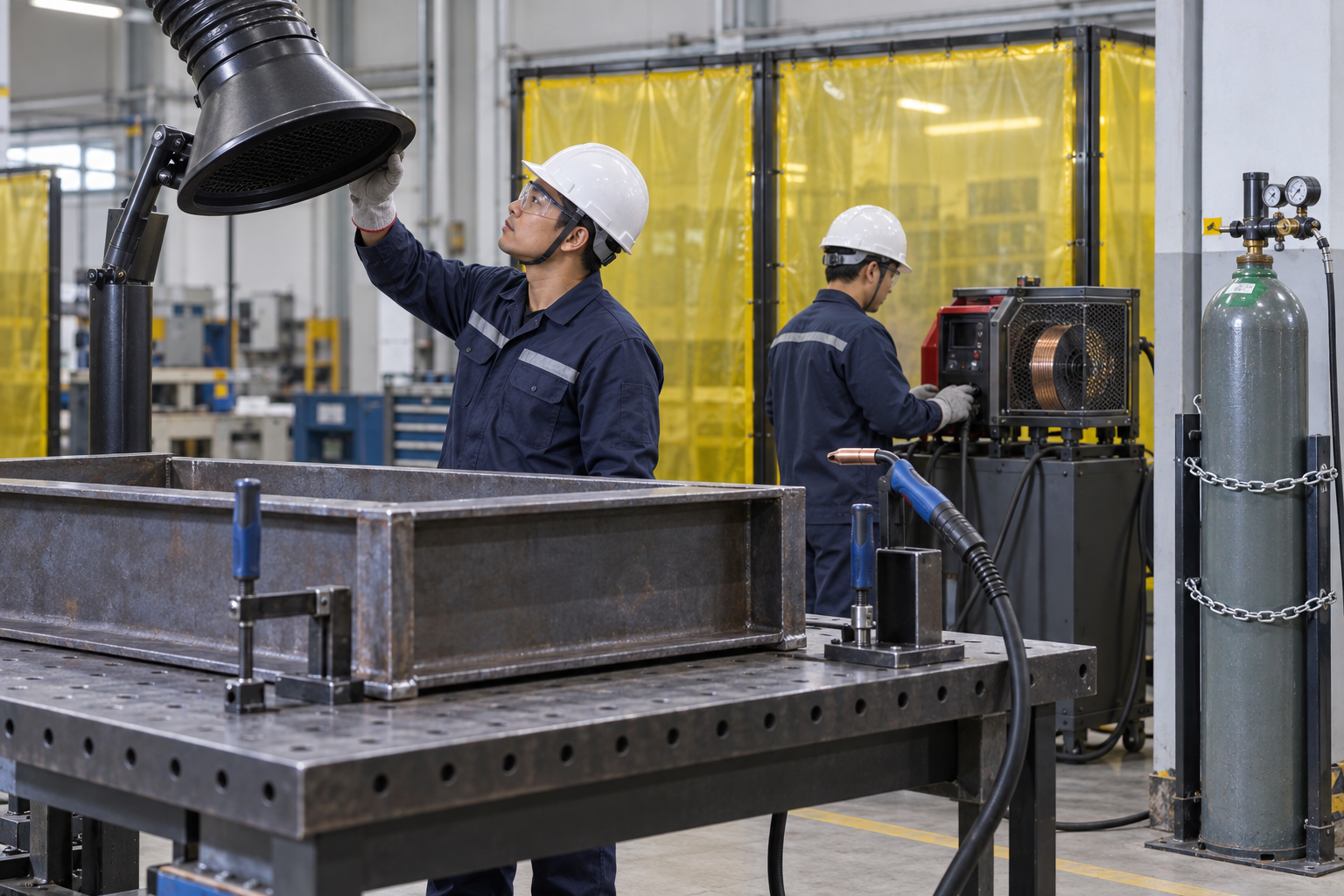
Retained AI-generated educational illustration from the source edition; not a real incident photograph, approved installation drawing or evidence of equipment suitability.
The scenario and record comparisons are fictional teaching examples, not records of real incidents, measurements, inspections, signatures or approvals.
| Item | Fictional scenario |
|---|---|
| Initial | The arc is off during a break, but the cylinder and hose remain connected. |
| Change | A leak is suspected near a low work area. |
| Failure | The crew assumes nonflammable CO2 and a stopped arc mean the area is safe. |
| Outcome | Gas accumulation and harmful exposure can remain despite no visible welding fumes. |
| Barrier | Restrict entry, shut the supply from a safe position and verify the repaired system, ventilation and required atmosphere measurements before restart. |
Why the controls matter
An extinguished arc does not stop a gas leak. CO2 is nonflammable but can accumulate and harm workers; an oxygen reading alone is not a CO2 exposure assessment.
A functioning fume hood and an acceptable gas environment are different checks. Select measurement targets, locations and instruments for the actual gas and ventilation arrangement, including low areas.
Wire-feed rolls can pinch and wire can puncture while the arc is off. Isolate the feed system before covered adjustment, control torch direction, and evaluate already-welded joints separately after a gas-system defect.
Decision sequence
| Step | Decision |
|---|---|
| Known | A leak is suspected near a low work area. |
| Unknown | Actual condition, extent of damage and suitability of hood and screen, wire feed direction remain to be established. |
| Hold | The crew assumes nonflammable CO2 and a stopped arc mean the area is safe. |
| Evidence | Link hood and screen, wire feed direction, gas and consumables, weld parameters, leak and atmosphere, drive isolation to the affected equipment or work area. |
| Next | Restrict entry, shut the supply from a safe position and verify the repaired system, ventilation and required atmosphere measurements before restart. |
5. Conditional decisions and common errors
| Condition | Action | Evidence | Proceed when |
|---|---|---|---|
| Suspected leak | Stop and restrict access | Supply isolation and leak test | Leak controlled |
| Air unknown | Assess CO2 and oxygen as needed | Instrument, location and results | Air criteria met |
| Feed fault | Isolate before adjustment | Energy and guard verification | Feeder restored |
| Gas repaired | Review environment and affected joints | Measurements and weld IDs | Restart scope released |
Similar appearance, different evidence
The scenario and record comparisons are fictional teaching examples, not records of real incidents, measurements, inspections, signatures or approvals.
| Comparison | Supported decision | Insufficient basis |
|---|---|---|
| Condition | Supply isolation and leak test | Suspected leak has not been resolved. |
| Evidence | Energy and guard verification | A photograph or a completed-looking task without the relevant inspection record. |
| Release | Restart scope released | Completion of one step does not release the excluded tasks in section 2. |
6. Roles and responsibilities
| Role | Responsibility |
|---|---|
| Work supervisor | Assign the task boundary, stop authority, interfaces and emergency communication for co2-shielded gmaw welding. |
| Technical lead | Confirm SDS and monitoring; Joint and WPS; Fume control plan; Supply shutoff point. Resolve design and manufacturer limits before work. |
| Authorized crew | Apply Gas compatibility; Leak test result; Feed guard and isolation; Wire path. Stop when the working arrangement changes. |
| Inspector / receiving lead | Review Hood and screen; Wire feed direction; Gas and consumables; Weld parameters. Transfer Supply and torch state; Fire-watch completion; Joint acceptance; Equipment restrictions. |
Role labels allocate responsibilities; they do not confer a legal qualification. Verify the competence, training and authority required for the actual task.
Record and handoff perspective
| Stage | Record controls | Verification |
|---|---|---|
| Plan gas and weld | 1. Record sds and monitoring2. Record joint and wps3. Record fume control plan | 1. Joint and WPS2. Fume control plan3. Supply shutoff point |
| Check gas and feed | 1. Record gas compatibility2. Record leak test result3. Record feed guard and isolation | 1. Leak test result2. Feed guard and isolation3. Wire path |
| Check electrical | 1. Record leads and grounding2. Record return connection3. Record workholding | 1. Return connection2. Workholding3. Hot-work conditions |
| Weld and monitor | 1. Record hood and screen2. Record wire feed direction3. Record gas and consumables | 1. Wire feed direction2. Gas and consumables3. Weld parameters |
| Hold abnormalities | 1. Record leak and atmosphere2. Record drive isolation3. Record repair and restart | 1. Drive isolation2. Repair and restart3. Joint IDs and limits |
| Close and handoff | 1. Record supply and torch state2. Record fire-watch completion3. Record joint acceptance | 1. Fire-watch completion2. Joint acceptance3. Equipment restrictions |
7. Hold points and record comparison
| Hold point | Evidence before release | Actual record |
|---|---|---|
| HP-0 Start | Prepare cylinders, wire feed, electrical equipment and workpieces for semiautomatic GMAW using carbon dioxide shielding gas; weld, stop, inspect and hand over affected joints. | |
| HP-1 Check gas and feed | Gas compatibility; Leak test result; Feed guard and isolation; Wire path | |
| HP-2 Check electrical | Leads and grounding; Return connection; Workholding; Hot-work conditions | |
| HP-3 Weld and monitor | Hood and screen; Wire feed direction; Gas and consumables; Weld parameters | |
| HP-4 Close and handoff | Supply and torch state; Fire-watch completion; Joint acceptance; Equipment restrictions |
These are internal hold points, not issued permits. Recheck affected points after a change, fault or shift handoff; link the actual approval record.
Record comparison
The scenario and record comparisons are fictional teaching examples, not records of real incidents, measurements, inspections, signatures or approvals.
The boxes are static record prompts, not interactive or saved approvals. A tick does not establish suitability or permission to restart. Record the evidence, person, time and unresolved issues; retain the change history.
| Record | Insufficient | Record checklist |
|---|---|---|
| Plan gas and weld | "Checked" without target, criteria or result | □ SDS and monitoring□ Joint and WPS□ Fume control plan□ Supply shutoff point |
| Check gas and feed | "Checked" without target, criteria or result | □ Gas compatibility□ Leak test result□ Feed guard and isolation□ Wire path |
| Weld and monitor | "Checked" without target, criteria or result | □ Hood and screen□ Wire feed direction□ Gas and consumables□ Weld parameters |
| Close and handoff | "Checked" without target, criteria or result | □ Supply and torch state□ Fire-watch completion□ Joint acceptance□ Equipment restrictions |
8. Site checklist and emergency response
| Check | Result | Person / action |
|---|---|---|
| □ Plan gas and weld: SDS and monitoring | ||
| □ Arrange work: Cylinder restraint | ||
| □ Check gas and feed: Gas compatibility | ||
| □ Check electrical: Leads and grounding | ||
| □ Weld and monitor: Hood and screen | ||
| □ Stop and inspect: Valve and pressure | ||
| □ Hold abnormalities: Leak and atmosphere | ||
| □ Close and handoff: Supply and torch state | ||
| □ Emergency access and handoff restrictions |
Stop work
Stop for suspected gas leakage, ineffective ventilation or fume capture, damaged insulation, abnormal wire feed or a WPS deviation. Restrict any area with an unverified atmosphere; arc-off is not clearance to enter.
Emergency response
Stop from a safe location, exclude people from the affected danger zone and activate the site emergency plan. Call 911 for injury or immediate danger. Do not enter an unstable, energized or confined danger area for an improvised rescue; trained responders must control the specific energy and access hazards.
9. Sources and review limits
Public-source review: 2026-10-12. Official regulation pages and specific technical references are distinguished below; no agency or manufacturer has approved this content.
| Source | Reviewed scope and limitation |
|---|---|
| OSHA 29 CFR 1910.252 | Welding fire prevention and ventilation; applicable workplace conditions must be evaluated. |
| OSHA 29 CFR 1926.352 | Construction hot-work fire controls. |
| OSHA 29 CFR 1926.353 | Construction welding ventilation and protection. |
| OSHA 29 CFR 1910.147 | Covered servicing of powered wire-feed equipment. |
| NIOSH Carbon dioxide IDLH | CO2 inhalation effects and IDLH background; oxygen testing alone does not characterize CO2 exposure. No IDLH value used as a restart limit. |
| OSHA State Plans | Official overview of federal and State Plan jurisdiction and differing public-sector coverage, checked 2026-10-12. Individual state rules require a site-specific check. |
No site measurements, equipment manuals for the actual installation, inspection records or signed technical approvals were supplied. Confirm the applicable requirements and actual product instructions before use; record each criterion with its units, source and equipment or work-area ID.
10. PDF guidance and FAQ
PDF A covers basic task controls; B focuses on technical failures; C covers supervision, records and handover. The article has eight stages with four items per main cell; each PDF has six key stages with three items per main cell. P/S/R/A, measurements, confirmations and signatures remain blank for actual site assessment.
Content group
jsa-co2-gmaw
Does nonflammable CO2 eliminate ventilation needs?
No. Assess CO2 accumulation and welding fumes separately.
Does normal oxygen prove acceptable CO2?
No. Choose gas-specific monitoring and exposure criteria for the actual conditions.
Can feed rolls be adjusted with the arc off?
Arc-off does not establish feeder isolation. Follow the applicable servicing procedure.
Does replacing a hose authorize restart?
Verify leak control, the work-area atmosphere and welding conditions; identify joints affected by the defect.
Has a professional approved this JSA?
This reference material was written and revised with AI. It has not been verified or approved by a professional. Review by a suitably qualified professional and required site approval are necessary before field use.
11. Revision history and authorship
This reference material was written and revised with AI. It has not been verified or approved by a professional. Review by a suitably qualified professional and required site approval are necessary before field use.
Korean source created 2026-09-20. This US edition adapts the Korean source; earlier editorial revisions do not constitute professional approval of this edition.
| Date | Edition | Change | Review status |
|---|---|---|---|
| 2026-10-12 | 1.0 | US localization: preserve task judgments; replace Korean legal applicability with scoped US references. | AI editorial and output checks; no professional technical approval. |