Keep continuous stable support from releasing the transport restraint through erection and final fixing. Standing upright does not establish resistance to overturning; define when each restraint may be removed.
This reference material was written and revised with AI. It has not been verified or approved by a professional. Review by a suitably qualified professional and required site approval are necessary before field use.
Stop before proceeding
Stop if restraint to release, upper fixing unknown, new hole requested. Keep the affected operation on hold until the listed evidence and proceed conditions are satisfied; a low risk score does not release missing safeguards.
1. Legal and technical scope
Treat new-room installation as construction. Apply relevant 1926 material-handling, access, tool and fall-protection provisions to the actual means of work. OSHA 1926.250 addresses material storage; scaffold access uses 1926.451. The PortaFab FabLine instructions are a product-specific example, not proof that another wall or its host structure is suitable.
Confirm whether federal OSHA or an OSHA-approved State Plan covers this employer and worksite; state requirements and public-sector coverage can differ. Apply the task-specific provisions and limitations identified above.
| Basis | Application |
|---|---|
| OSHA 29 CFR 1926.250 | Stable material storage and clear access. |
| OSHA 29 CFR 1926.451 | Applicable scaffold design and protected access. |
| PortaFab FabLine Batten 2000 | Receiving, track/support interfaces and wall-panel/post assembly reviewed 2026-10-13; product dimensions and fasteners are not generic design values. |
| OSHA State Plans | Official overview of federal and State Plan jurisdiction and differing public-sector coverage, checked 2026-10-13. Individual state rules require a site-specific check. |
2. Scope and required inputs
Included scope
Install identified wall panels in a new nonoperating cleanroom, using suitable transport and erection aids and the approved track, post and joint system.
Separate assessment
Ceiling panels, walkable ceilings, exterior cladding, operating cleanroom contamination controls, major field cutting, electrical connections and performance certification are separate scopes.
| Input | Evidence needed |
|---|---|
| Review panel layout | Panel dimensions; Weight and orientation; Drawing revision; Host and openings. |
| Prepare track support | Track and host; Fastener specification; Access and exclusion; Brace release criteria. |
| Fasten joints | Post and track joints; Fastener installation; Panel position; Support maintained. |
| Protect and handoff | Track and joint records; Defect and receiver; Access condition; Use limitations. |
No site measurements, equipment manuals for the actual installation, inspection records or signed technical approvals were supplied. Confirm the applicable requirements and actual product instructions before use; record each criterion with its units, source and equipment or work-area ID.
3. Eight-stage JSA
| Job stage | Hazards and effects | Failure factors | Technical and procedural controls | Site verification | P | S | R | A |
|---|---|---|---|---|---|---|---|---|
| 1. Review panel layout | 1. Wrong panel2. Blocked exit3. Unsupported wall4. Handling overload | 1. ID mismatch2. Opening omitted3. Host unverified4. Weight unknown | 1. Match layout and IDs2. Plan exits and openings3. Verify support interface4. Check handling load | 1. Panel dimensions2. Weight and orientation3. Drawing revision4. Host and openings | ||||
| 2. Receive and move | 1. Panel overturns2. Hand crush3. Skin cut4. Cart collision | 1. Restraint released2. Grip unsuitable3. Sharp edge exposed4. Turn space absent | 1. Use rated restrained cart2. Plan grips and aids3. Protect sharp edges4. Clear complete route | 1. Cart and restraint2. Panel condition3. Route and turning4. Handling crew | ||||
| 3. Prepare track support | 1. Track releases2. Hidden-service strike3. Falling tool4. Unstable temporary state | 1. Wrong anchors2. Substrate unknown3. Poor access4. Brace omitted | 1. Verify substrate and fixings2. Locate services3. Provide protected access4. Prepare temporary support | 1. Track and host2. Fastener specification3. Access and exclusion4. Brace release criteria | ||||
| 4. Raise and align | 1. Panel falls2. Finger pinch3. Aid loses grip4. Worker overreaches | 1. Cart released early2. Hands in joint3. Aid unsuitable4. Access inadequate | 1. Maintain support transition2. Use alignment aids3. Check lifting compatibility4. Use suitable work platform | 1. Continuous restraint2. Aid and surface3. Alignment clearances4. Upper access | ||||
| 5. Fasten joints | 1. Panel tips2. Tool slip3. Wrong connection4. Dropped fitting | 1. Brace moved early2. Bit mismatch3. Parts mixed4. Loose overhead hardware | 1. Retain temporary stability2. Use specified tools3. Match system components4. Control tools and parts | 1. Post and track joints2. Fastener installation3. Panel position4. Support maintained | ||||
| 6. Inspect and seal | 1. Hidden loose joint2. Chemical exposure3. Sharp trim4. False performance claim | 1. Seal covers defect2. SDS ignored3. Edge unfinished4. Appearance accepted | 1. Inspect before concealment2. Use suitable sealant controls3. Finish exposed edges4. Separate performance testing | 1. Connection inspection2. Sealant and SDS3. Surface finish4. Open defects | ||||
| 7. Control changes | 1. Wall destabilized2. Services overloaded3. Panel damaged4. People exposed | 1. Brace moved2. Hole unapproved3. Cart strikes wall4. Work status unclear | 1. Hold unsupported changes2. Review new attachments3. Protect completed panels4. Mark incomplete bays | 1. Change description2. Support reassessment3. Impact inspection4. Bay restriction | ||||
| 8. Protect and handoff | 1. Premature use2. Unrecorded defect3. Exit obstruction4. Ceiling misuse | 1. Release assumed2. Fixing record absent3. Packing remains4. Wall scope confused | 1. Record installation release2. Transfer open items3. Clear access4. State loading restrictions | 1. Track and joint records2. Defect and receiver3. Access condition4. Use limitations |
P = likelihood; S = severity; R = risk under the site method; A = the site-defined acceptance/authorization decision. Complete only after actual assessment. Blank cells and checklist prompts are not completed inspections.
4. Fictional scenario and failure mechanisms
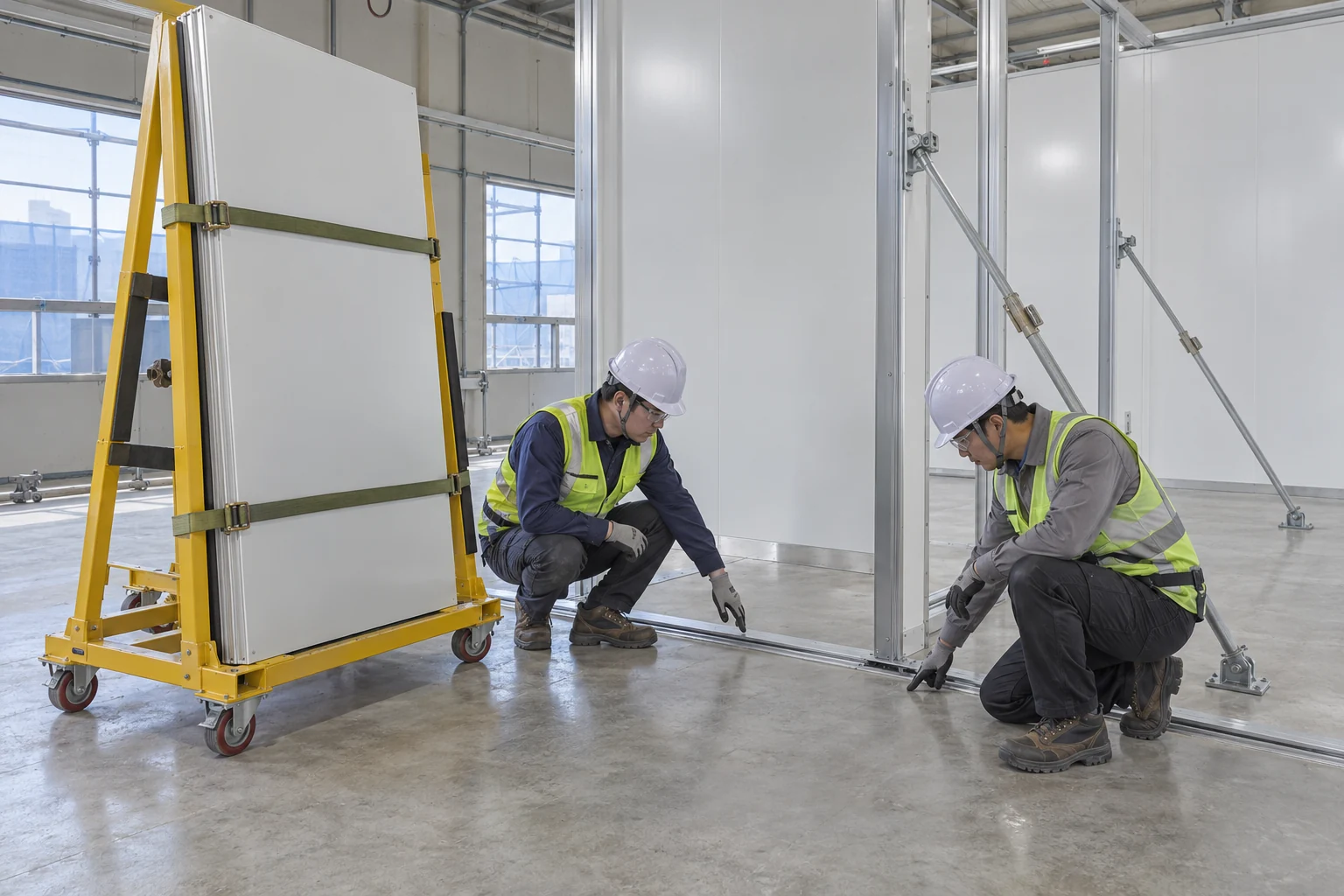
Retained AI-generated educational illustration from the source edition; not a real incident photograph, approved installation drawing or evidence of equipment suitability.
The scenario and record comparisons are fictional teaching examples, not records of real incidents, measurements, inspections, signatures or approvals.
| Item | Fictional scenario |
|---|---|
| Initial | A panel stands on temporary bracing. |
| Change | The crew wants to move a brace to remove the transport cart. |
| Failure | Upper connection acceptance is missing. |
| Outcome | The panel can overturn while appearing vertical. |
| Barrier | Hold brace release, verify permanent fixings and establish the required support before moving the cart. |
Why the controls matter
Keep continuous stable support from releasing the transport restraint through erection and final fixing. Standing upright does not establish resistance to overturning; define when each restraint may be removed.
Wall connections do not establish ceiling capacity. Do not walk on panels or suspend services from them without a separate approved design.
A neat seal does not prove the track, post or fasteners are secure. Inspect those connections before concealment; later drilling or removal is a controlled change. Installation checks are separate from cleanroom performance testing.
Decision sequence
| Step | Decision |
|---|---|
| Known | The crew wants to move a brace to remove the transport cart. |
| Unknown | Actual condition, extent of damage and suitability of post and track joints, fastener installation remain to be established. |
| Hold | Upper connection acceptance is missing. |
| Evidence | Link post and track joints, fastener installation, panel position, support maintained, change description, support reassessment to the affected equipment or work area. |
| Next | Hold brace release, verify permanent fixings and establish the required support before moving the cart. |
5. Conditional decisions and common errors
| Condition | Action | Evidence | Proceed when |
|---|---|---|---|
| Restraint to release | Hold handling | Continuous support plan | Next support secured |
| Upper fixing unknown | Retain brace | Drawing and installed joint | Fixings accepted |
| New hole requested | Hold alteration | System and service review | Change approved |
| Seal complete | Inspect support separately | Track post and joint record | Installation accepted |
Similar appearance, different evidence
The scenario and record comparisons are fictional teaching examples, not records of real incidents, measurements, inspections, signatures or approvals.
| Comparison | Supported decision | Insufficient basis |
|---|---|---|
| Condition | Continuous support plan | Restraint to release has not been resolved. |
| Evidence | System and service review | A photograph or a completed-looking task without the relevant inspection record. |
| Release | Installation accepted | Completion of one step does not release the excluded tasks in section 2. |
6. Roles and responsibilities
| Role | Responsibility |
|---|---|
| Work supervisor | Assign the task boundary, stop authority, interfaces and emergency communication for cleanroom wall panel handling and installation. |
| Technical lead | Confirm Panel dimensions; Weight and orientation; Drawing revision; Host and openings. Resolve design and manufacturer limits before work. |
| Authorized crew | Apply Track and host; Fastener specification; Access and exclusion; Brace release criteria. Stop when the working arrangement changes. |
| Inspector / receiving lead | Review Post and track joints; Fastener installation; Panel position; Support maintained. Transfer Track and joint records; Defect and receiver; Access condition; Use limitations. |
Role labels allocate responsibilities; they do not confer a legal qualification. Verify the competence, training and authority required for the actual task.
Record and handoff perspective
| Stage | Record controls | Verification |
|---|---|---|
| Review panel layout | 1. Record panel dimensions2. Record weight and orientation3. Record drawing revision | 1. Weight and orientation2. Drawing revision3. Host and openings |
| Prepare track support | 1. Record track and host2. Record fastener specification3. Record access and exclusion | 1. Fastener specification2. Access and exclusion3. Brace release criteria |
| Raise and align | 1. Record continuous restraint2. Record aid and surface3. Record alignment clearances | 1. Aid and surface2. Alignment clearances3. Upper access |
| Fasten joints | 1. Record post and track joints2. Record fastener installation3. Record panel position | 1. Fastener installation2. Panel position3. Support maintained |
| Control changes | 1. Record change description2. Record support reassessment3. Record impact inspection | 1. Support reassessment2. Impact inspection3. Bay restriction |
| Protect and handoff | 1. Record track and joint records2. Record defect and receiver3. Record access condition | 1. Defect and receiver2. Access condition3. Use limitations |
7. Hold points and record comparison
| Hold point | Evidence before release | Actual record |
|---|---|---|
| HP-0 Start | Install identified wall panels in a new nonoperating cleanroom, using suitable transport and erection aids and the approved track, post and joint system. | |
| HP-1 Receive and move | Cart and restraint; Panel condition; Route and turning; Handling crew | |
| HP-2 Prepare track support | Track and host; Fastener specification; Access and exclusion; Brace release criteria | |
| HP-3 Fasten joints | Post and track joints; Fastener installation; Panel position; Support maintained | |
| HP-4 Protect and handoff | Track and joint records; Defect and receiver; Access condition; Use limitations |
These are internal hold points, not issued permits. Recheck affected points after a change, fault or shift handoff; link the actual approval record.
Record comparison
The scenario and record comparisons are fictional teaching examples, not records of real incidents, measurements, inspections, signatures or approvals.
The boxes are static record prompts, not interactive or saved approvals. A tick does not establish suitability or permission to restart. Record the evidence, person, time and unresolved issues; retain the change history.
| Record | Insufficient | Record checklist |
|---|---|---|
| Review panel layout | "Checked" without target, criteria or result | □ Panel dimensions□ Weight and orientation□ Drawing revision□ Host and openings |
| Prepare track support | "Checked" without target, criteria or result | □ Track and host□ Fastener specification□ Access and exclusion□ Brace release criteria |
| Fasten joints | "Checked" without target, criteria or result | □ Post and track joints□ Fastener installation□ Panel position□ Support maintained |
| Protect and handoff | "Checked" without target, criteria or result | □ Track and joint records□ Defect and receiver□ Access condition□ Use limitations |
8. Site checklist and emergency response
| Check | Result | Person / action |
|---|---|---|
| □ Review panel layout: Panel dimensions | ||
| □ Receive and move: Cart and restraint | ||
| □ Prepare track support: Track and host | ||
| □ Raise and align: Continuous restraint | ||
| □ Fasten joints: Post and track joints | ||
| □ Inspect and seal: Connection inspection | ||
| □ Control changes: Change description | ||
| □ Protect and handoff: Track and joint records | ||
| □ Emergency access and handoff restrictions |
Stop work
Stop if restraint to release, upper fixing unknown, new hole requested. Keep the affected operation on hold until the listed evidence and proceed conditions are satisfied; a low risk score does not release missing safeguards.
Emergency response
Stop from a safe location, exclude people from the affected danger zone and activate the site emergency plan. Call 911 for injury or immediate danger. Do not enter an unstable, energized or confined danger area for an improvised rescue; trained responders must control the specific energy and access hazards.
9. Sources and review limits
Public-source review: 2026-10-14. Official regulation pages and specific technical references are distinguished below; no agency or manufacturer has approved this content.
| Source | Reviewed scope and limitation |
|---|---|
| OSHA 29 CFR 1926.250 | Stable material storage and clear access. |
| OSHA 29 CFR 1926.451 | Applicable scaffold design and protected access. |
| PortaFab FabLine Batten 2000 | Receiving, track/support interfaces and wall-panel/post assembly reviewed 2026-10-13; product dimensions and fasteners are not generic design values. |
| OSHA State Plans | Official overview of federal and State Plan jurisdiction and differing public-sector coverage, checked 2026-10-13. Individual state rules require a site-specific check. |
No site measurements, equipment manuals for the actual installation, inspection records or signed technical approvals were supplied. Confirm the applicable requirements and actual product instructions before use; record each criterion with its units, source and equipment or work-area ID.
10. PDF guidance and FAQ
PDF A covers basic task controls; B focuses on technical failures; C covers supervision, records and handover. The article has eight stages with four items per main cell; each PDF has six key stages with three items per main cell. P/S/R/A, measurements, confirmations and signatures remain blank for actual site assessment.
Content group
jsa-cleanroom-wall-panel-installation
Does a vertical panel need restraint?
Yes, until the approved system provides the required stability.
Can wall panels support ceiling access?
Only under a separately verified design; this scope does not authorize it.
Does sealant complete acceptance?
No. Check structural connections and required performance separately.
Can a brace move to clear a cart?
Only after the specified replacement support or release conditions are verified.
Has a professional approved this JSA?
This reference material was written and revised with AI. It has not been verified or approved by a professional. Review by a suitably qualified professional and required site approval are necessary before field use.
11. Revision history and authorship
This reference material was written and revised with AI. It has not been verified or approved by a professional. Review by a suitably qualified professional and required site approval are necessary before field use.
Korean source created 2026-10-08. This US edition adapts the Korean source; earlier editorial revisions do not constitute professional approval of this edition.
| Date | Edition | Change | Review status |
|---|---|---|---|
| 2026-10-08 | Korean source v1.0 | Source editorial publication or revision; retained as provenance of the Korean edition. | Editorial record only; no professional approval of this US edition. |
| 2026-10-14 | 1.0 | US localization: preserve task judgments; replace Korean legal applicability with scoped US references. | AI editorial and output checks; no professional technical approval. |