Mortar trapped inside a glove or boot maintains wet alkaline contact even when the outside PPE appears intact. Lack of pain is not evidence that skin is unharmed. Stop, remove contamination safely and use the product/site washing and medical-response procedure promptly.
This is reference content written and revised with AI. It has not been verified or approved by a professional. Review by a suitably qualified professional and site authorization are required before use.
Stop before starting
Do not begin with uncertain product/mix, unstable bags or container, defective mixer or wet electrical connections. Stop for heavy dust, paddle jam or vibration, mortar inside PPE, unstable access or wall material detachment.
1. Legal and technical scope
| Basis | Scope and limits |
|---|---|
| OSHA Portland cement guidance | Official guidance on wet-cement burns, dermatitis and exposure prevention; no site-specific medical finding. |
| OSHA 1926.1153 | Construction silica scope, task control/exposure assessment and housekeeping. Do not assume a Table 1 category for every mixing operation. |
| OSHA 1926.302 | Applicable portable electric-tool requirements; actual equipment and supply protection need review. |
This is a US construction task. Evaluate applicable Part 1926 equipment, electrical, access and PPE requirements and the State Plan. Where respirable crystalline silica exposure is covered, 1926.1153 requires the applicable control approach; ordinary mortar mixing is not automatically a listed Table 1 task. OSHA Portland-cement guidance explains skin protection and prompt treatment but is not a completed exposure assessment. Product mix proportions and working times come from the actual manufacturer.
2. Scope and required inputs
Included work
Small-batch mixing of specified cement mortar with a suitable portable paddle mixer and hand application to a new indoor wall, followed by curing and inspection handover. Verify container stability, power protection and a suitable work platform.
Separate assessment
Power-troweled floors, mortar pumping/spraying, drum-mixer entry, grinding unknown existing coatings, suspended exterior work and structural repair design need separate assessment.
| Required input | Evidence to obtain |
|---|---|
| Match wall and mix | Wall and product ID; Substrate acceptance; Mix and SDS; Emergency wash |
| Prepare materials | Bag and route; Stack stability; Supply condition; Container restraint |
| Open and load | Opening method; Pour height/order; Dust controls; Eye and hand protection |
| Mix mortar | Paddle and grip; Container security; Splash and supply; Mix condition |
No actual equipment model, SDS, site measurements, design calculations or authorization record was supplied. Product-specific limits and methods must be verified before use. Federal OSHA is a baseline within its scope; determine the applicable State Plan and local requirements. Manufacturer guidance is not government approval; an incorporated standard differs from voluntary guidance. No nationwide-compliance or expert-approval claim is made.
3. Eight-stage JSA
| Job stage | Hazards and effects | Failure factors | Technical and procedural controls | Site verification | P | S | R | A |
|---|---|---|---|---|---|---|---|---|
| 1. Match wall and mix | 1. Plaster detachment2. Alkaline contact3. Dust exposure4. Wrong repair scope | 1. Wrong product2. Unknown substrate3. SDS unavailable4. Old coating disturbed | 1. Match wall and product2. Check substrate condition3. Obtain SDS and wash plan4. Keep excluded tasks separate | 1. Wall and product ID2. Substrate acceptance3. Mix and SDS4. Emergency wash | ||||
| 2. Prepare materials | 1. Handling strain2. Falling bags3. Electric shock4. Container movement | 1. Heavy solo lifting2. Unstable stack3. Wet connections4. Loose container | 1. Use handling aids2. Spread stored loads3. Protect power supply4. Secure compatible container | 1. Bag and route2. Stack stability3. Supply condition4. Container restraint | ||||
| 3. Open and load | 1. Dust inhalation2. Eye irritation3. Knife cuts4. Spilled powder | 1. High drop height2. Rapid dumping3. Hand in cut path4. Bags shaken empty | 1. Use low loading height2. Follow loading sequence3. Cut away from hands4. Control dust at source | 1. Opening method2. Pour height/order3. Dust controls4. Eye and hand protection | ||||
| 4. Mix mortar | 1. Paddle entanglement2. Reaction force3. Mortar splash4. Electrical injury | 1. Tool inserted live2. Poor grip3. Container unsupported4. Water near supply | 1. Use specified grip2. Keep tools out of bowl3. Stabilize container4. Isolate before clearing | 1. Paddle and grip2. Container security3. Splash and supply4. Mix condition | ||||
| 5. Apply to wall | 1. Skin burn2. Eye contact3. Platform fall4. Muscle strain | 1. Contaminated PPE2. Splash near face3. Overreaching4. Excess load carried | 1. Prevent skin contact2. Address contamination3. Use stable access4. Adjust reach and loads | 1. Gloves/boots and skin2. Eye protection3. Platform and posture4. Application condition | ||||
| 6. Cure and inspect | 1. Loose plaster falls2. Cracking3. Slip injury4. Premature loading | 1. Curing ignored2. Mix limits exceeded3. Wet floor open4. Wall struck early | 1. Follow product curing2. Restrict affected access3. Inspect adhesion safely4. Record defects | 1. Environment/time2. Curing conditions3. Cracks and adhesion4. Inspection outcome | ||||
| 7. Hold abnormality | 1. Ongoing skin injury2. Repeated mixer fault3. Unsafe restart4. Hidden bad mix | 1. Waiting for pain2. Jam cleared live3. Defect bypassed4. Added water unapproved | 1. End exposure promptly2. Isolate mixer3. Correct and recheck4. Segregate affected batch | 1. Contamination details2. Washing/medical response3. Repair and recheck4. Batch disposition | ||||
| 8. Clean and handover | 1. Residual rotation2. Alkaline exposure3. Dust release4. Wastewater escape | 1. Connected cleanup2. Dirty gloves retained3. Dry residue swept4. Drain disposal assumed | 1. Isolate before cleaning2. Use compatible protection3. Control residue dust4. Use approved waste route | 1. Power/tool state2. Clean PPE and tools3. Waste handling4. Curing limits/recipient |
P = likelihood; S = severity; R = risk under the site method; A = site-defined acceptance/authorization. These actual assessment cells are blank. A low score never overrides a missing safeguard or a legal or manufacturer restriction.
4. Fictional scenario and failure mechanisms
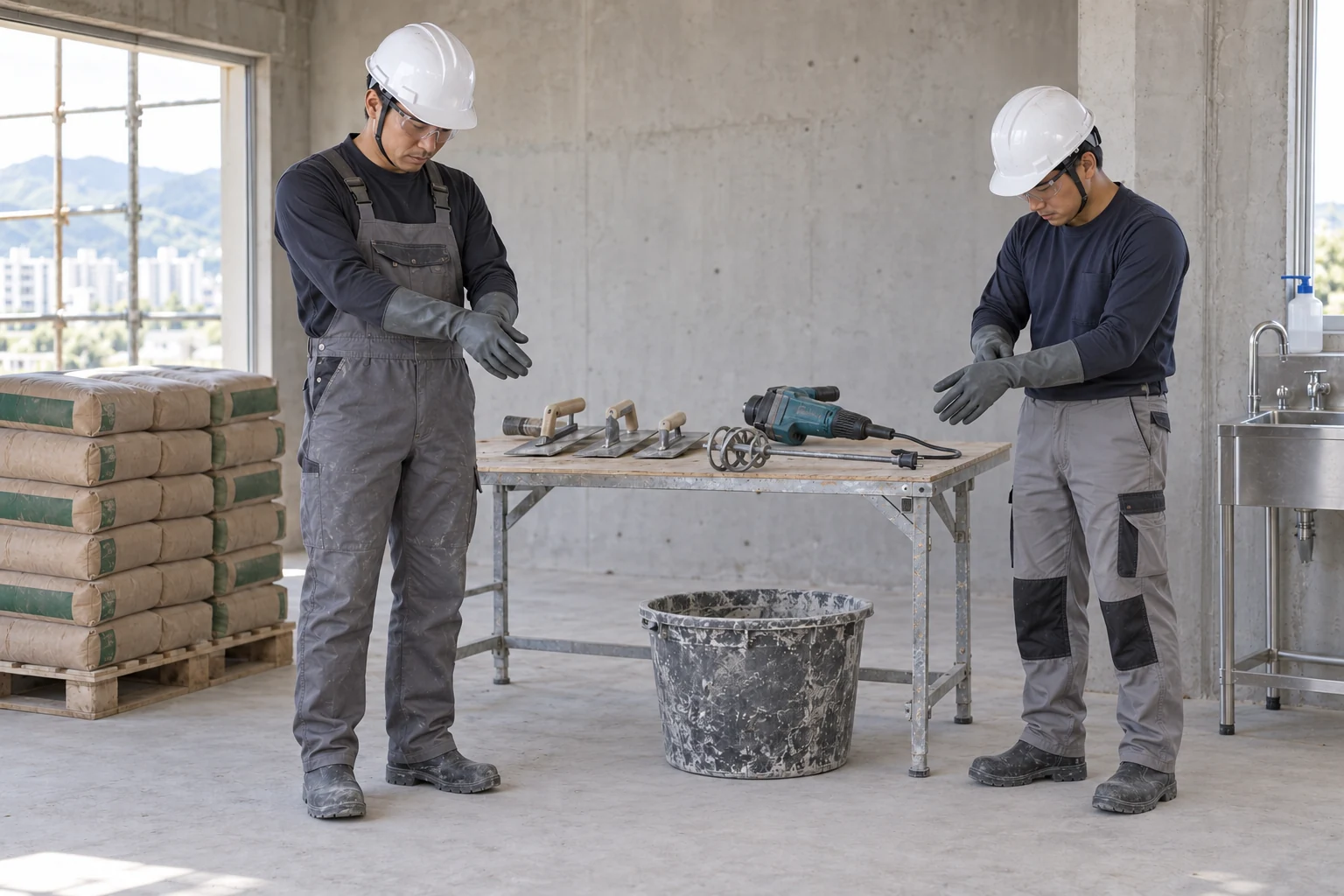
This illustration provides educational context. It is not an actual incident photograph or evidence of equipment suitability; any AI-generated depiction is illustrative only.
The scenario and record comparisons are fictional teaching examples, not records of real incidents, measurements, inspections, signatures or approvals.
| Stage | Fictional situation |
|---|---|
| Initial situation | A fictional plasterer is finishing an indoor wall. |
| Changed condition | Wet mortar enters a boot but causes no immediate pain. |
| Failure path | Continuing work keeps alkaline material against the skin. |
| Possible outcome | Possible delayed chemical injury; no real diagnosis or exposure duration is asserted. |
| Prevention barrier | Stop application, address contamination promptly and assess skin/PPE and the work method before any return. |
Failure mechanisms
Mortar trapped inside a glove or boot maintains wet alkaline contact even when the outside PPE appears intact. Lack of pain is not evidence that skin is unharmed. Stop, remove contamination safely and use the product/site washing and medical-response procedure promptly.
A switched-off paddle may still coast and can restart. Do not insert hands or a trowel to release lumps while connected. Confirm the full stop, power separation and restart control before intervention; use a stable container and the required grip to resist reaction.
Adding water to restore workability can change an assessed mix and its performance. Record product, batch time and environment and follow permitted mixing/reworking times. Segregate suspect material and affected wall areas rather than hiding a defect with another coat.
Work sequence: Match wall and mix → Prepare materials → Open and load → Mix mortar → Apply to wall → Cure and inspect → Hold abnormality → Clean and handover. This is a teaching flow, not a device drawing or a complete operating procedure.
5. Conditional decisions and common errors
| Situation | Required action | Evidence | Proceed when |
|---|---|---|---|
| Mortar inside PPE | Stop and remove exposure safely | SDS response and skin assessment | Exposure controlled; fitness checked |
| Paddle jam | Stop, isolate and wait | Isolation and defect inspection | Mixer safe for restart |
| Mix past usable time | Segregate; review product limits | Batch time and instructions | Material accepted |
| Platform unstable | Keep off; correct access | Support and platform inspection | Stable access verified |
Similar observations, different decisions
The scenario and record comparisons are fictional teaching examples, not records of real incidents, measurements, inspections, signatures or approvals.
| Observation | Insufficient conclusion | Required distinction |
|---|---|---|
| No pain | No immediate symptom | Does not exclude cement injury |
| Switch off | Control stopped | Verify coast-down and isolation |
| Mix still spreads | Feels workable | Product time limits still apply |
6. Roles and responsibilities
| Role | Responsibility |
|---|---|
| Work supervisor | Confirm wall and product id and the task scope, resources, interfaces and stop authority. |
| Qualified technical reviewer | Review bag and route, model limits, compatibility and unresolved technical conditions within assigned competence. |
| Work crew | Apply the listed controls, report changes and stop when evidence or safeguards are missing. |
| Inspector / assessor | Record actual gloves/boots and skin and other relevant checks; do not mark unverified conditions as accepted. |
| Handover authority | Reconcile power/tool state, restrictions and outstanding actions before the next task. Role labels do not establish a legal credential. |
Supervision and handover focus
| Stage | Management action | Evidence |
|---|---|---|
| Match wall and mix | 1. Record wall and product id2. Record substrate acceptance3. Record mix and sds | 1. Wall and product ID2. Substrate acceptance3. Mix and SDS |
| Prepare materials | 1. Record bag and route2. Record stack stability3. Record supply condition | 1. Bag and route2. Stack stability3. Supply condition |
| Mix mortar | 1. Record paddle and grip2. Record container security3. Record splash and supply | 1. Paddle and grip2. Container security3. Splash and supply |
| Apply to wall | 1. Record gloves/boots and skin2. Record eye protection3. Record platform and posture | 1. Gloves/boots and skin2. Eye protection3. Platform and posture |
| Hold abnormality | 1. Record contamination details2. Record washing/medical response3. Record repair and recheck | 1. Contamination details2. Washing/medical response3. Repair and recheck |
| Clean and handover | 1. Record power/tool state2. Record clean ppe and tools3. Record waste handling | 1. Power/tool state2. Clean PPE and tools3. Waste handling |
7. Hold points and record comparison
| Hold point | Evidence before release | Actual approval |
|---|---|---|
| HP-0 Scope | Small-batch mixing of specified cement mortar with a suitable portable paddle mixer and hand application to a new indoor wall, followed by curing and inspection handover. Verify container stability, power protection and a suitable work platform. | |
| HP-1 Prepare materials | Bag and route; Stack stability; Supply condition; Container restraint | |
| HP-2 Mix mortar | Paddle and grip; Container security; Splash and supply; Mix condition | |
| HP-3 Hold abnormality | Contamination details; Washing/medical response; Repair and recheck; Batch disposition | |
| HP-4 Clean and handover | Power/tool state; Clean PPE and tools; Waste handling; Curing limits/recipient |
Hold points are internal project checks. They are not universal statutory permits and do not grant work permission. Reassess after defects, changed conditions and shift changes.
Record comparison
The scenario and record comparisons are fictional teaching examples, not records of real incidents, measurements, inspections, signatures or approvals.
The boxes are static record prompts, not interactive or saved approvals. A tick does not establish suitability or permission to restart. Record the evidence, person, time and unresolved issues; retain the change history.
| Record | Insufficient record | Record checklist |
|---|---|---|
| Match wall and mix | Only marked “OK” | □ Wall and product ID□ Substrate acceptance□ Mix and SDS□ Emergency wash |
| Mix mortar | Only marked “OK” | □ Paddle and grip□ Container security□ Splash and supply□ Mix condition |
| Hold abnormality | Only marked “OK” | □ Contamination details□ Washing/medical response□ Repair and recheck□ Batch disposition |
| Clean and handover | Only marked “OK” | □ Power/tool state□ Clean PPE and tools□ Waste handling□ Curing limits/recipient |
8. Site checklist and emergency response
| Site check | Actual result | Person / action |
|---|---|---|
| Match wall and mix: Wall and product ID; Substrate acceptance; Mix and SDS; Emergency wash | ||
| Prepare materials: Bag and route; Stack stability; Supply condition; Container restraint | ||
| Open and load: Opening method; Pour height/order; Dust controls; Eye and hand protection | ||
| Mix mortar: Paddle and grip; Container security; Splash and supply; Mix condition | ||
| Apply to wall: Gloves/boots and skin; Eye protection; Platform and posture; Application condition | ||
| Cure and inspect: Environment/time; Curing conditions; Cracks and adhesion; Inspection outcome | ||
| Hold abnormality: Contamination details; Washing/medical response; Repair and recheck; Batch disposition | ||
| Clean and handover: Power/tool state; Clean PPE and tools; Waste handling; Curing limits/recipient |
Stop work
Do not begin with uncertain product/mix, unstable bags or container, defective mixer or wet electrical connections. Stop for heavy dust, paddle jam or vibration, mortar inside PPE, unstable access or wall material detachment.
Emergency response
Stop exposure and follow the actual SDS washing instructions without waiting for pain. Seek medical evaluation for wet-cement skin problems or eye exposure and urgent help for severe injury. Isolate electrical hazards from a safe location; do not enter wet energized areas or touch moving paddles.
9. Sources and review limits
Public-source access/review: 2026-10-12.
| Official source | Reviewed scope and limits |
|---|---|
| OSHA Portland cement guidance | Official guidance on wet-cement burns, dermatitis and exposure prevention; no site-specific medical finding. |
| OSHA 1926.1153 | Construction silica scope, task control/exposure assessment and housekeeping. Do not assume a Table 1 category for every mixing operation. |
| OSHA 1926.302 | Applicable portable electric-tool requirements; actual equipment and supply protection need review. |
No actual equipment model, SDS, site measurements, design calculations or authorization record was supplied. Product-specific limits and methods must be verified before use. Federal OSHA is a baseline within its scope; determine the applicable State Plan and local requirements. Manufacturer guidance is not government approval; an incorporated standard differs from voluntary guidance. No nationwide-compliance or expert-approval claim is made.
10. PDF guidance and FAQ
PDF A covers basic task controls; B focuses on technical failures; C covers supervision, records and handover. P/S/R/A, measurements, confirmations and signatures remain blank for actual site assessment.
PDFs are complementary six-stage extracts. Apply all eight body stages and the actual equipment/site procedure.
Should work continue when mortar inside a boot does not hurt?
No. End contact promptly and follow the SDS/site washing and medical-response procedure.
Can a trowel clear a running paddle?
No. Wait for complete stop and isolate power against restart before the approved clearing procedure.
May water be added whenever mortar stiffens?
Only if the actual product permits the specific reworking method within its limits; record batch and timing.
Does wet mixing eliminate silica assessment?
No. Bag opening, loading and cleanup can create exposure. Determine the applicable control approach for the actual task.
Has a professional verified or approved this document?
No. Public sources and editorial, layout and consistency checks were reviewed using AI. No site inspection or professional technical approval has been performed. Obtain appropriate professional review before use.
11. Revision history and authorship
This is reference content written and revised with AI. It has not been verified or approved by a professional. Review by a suitably qualified professional and site authorization are required before use.
| Date | Version | Change | Review status |
|---|---|---|---|
| 2026-10-12 | US 1.0 | New US edition from assigned Korean source; task decisions, records and PDFs localized. | AI editorial review; no professional technical approval |
Korean edition revision dates: 2026-03-02, 2026-08-01, 2026-10-08. US v1.0 adapts the earlier edition to United States requirements and terminology.
Site reviewers must add their actual qualifications, scope, date and approval only after the review occurs.