Two-handed trimming of reachable hedges from stable ground using a battery hedge trimmer suited to the vegetation. Confirm the actual tool model, battery, guards, controls, reach and cutting limits before work.
Stop for hidden wire or electrical hazards, unstable footing, loss of two-hand control, excessive reach, blade jams, abnormal vibration, impact damage or unsuitable wet conditions.
Reference content written and revised with AI. It has not been verified or approved by a professional. Review by a suitably qualified professional and site approval are required before use.
1. Legal and technical scope
Routine landscape maintenance is generally reviewed under general-industry requirements; construction activities require the applicable Part 1926 tool, PPE and electrical provisions. OSHA 1910.242(a) assigns responsibility for safe tool condition. Product instructions define the specific trimmer controls, battery handling, transport and clearing sequence; they are not a nationwide certification of this JSA.
Determine Federal OSHA or the applicable OSHA-approved State Plan, including public/private employer coverage. State Plans must be at least as effective and can impose different or additional requirements. The actual activity determines construction versus general-industry scope. Manufacturer instructions, consensus standards, project design and site approvals have distinct roles; this page is not a finding of nationwide compliance.
| Basis | Application and limits |
|---|---|
| OSHA 1910.242 | General requirements for safe hand and portable powered-tool condition. |
| Makita XHU02Z instruction manual | Official indexed safety excerpts reviewed on guards, footing, battery removal after impact, clearing and transport. Full-PDF opening failed; no full-manual review claimed. Model example only; no universal branch capacity inferred. |
2. Scope and required inputs
Included: Two-handed trimming of reachable hedges from stable ground using a battery hedge trimmer suited to the vegetation. Confirm the actual tool model, battery, guards, controls, reach and cutting limits before work.
Separate review: Ladders, roofs, climbing, pole trimmers, tree felling, large branch removal, energized-line work and blade replacement or internal servicing require separate methods. This sheet does not authorize cutting hidden wiring or metal fences.
| Input | Required evidence |
|---|---|
| Survey hedge | Hidden-object survey; Electrical hazard review; Ground and route check; Bystander exclusion |
| Set working position | Reach without stretching; Stable dry footing; Clear movement path; Separation maintained |
| Trim hedge | Intended hand positions; Branch size and condition; Blade clearance; Grip and footing stable |
| Clean and store | Blade and cover condition; Battery storage conditions; Defect status recorded; Next-user handover |
Confirm the model cutting limit, permitted weather, battery compatibility and comfortable two-hand reach. Select eye, hand, foot and hearing protection for the actual tool and site exposure. Gloves do not make contact with a moving blade safe. Record the applicable model instructions.
3. Eight-stage JSA
P = likelihood; S = severity; R = risk under the site method; A = acceptance or authorization as defined by the site. Leave these blank until actual assessment and control verification. A low score does not override a legal requirement, product limit or unreleased hold point.
| Job stage | Hazards and effects | Failure factors | Required controls | Site verification | P | S | R | A |
|---|---|---|---|---|---|---|---|---|
| 1. Survey hedge | 1. Hidden-wire contact2. Flying hard fragments3. Trips and falls4. Bystander laceration | 1. Fence wire concealed2. Debris inside hedge3. Uneven ground ignored4. Public path uncontrolled | 1. Inspect hedge before cutting2. Identify nearby services3. Clear stable footing4. Separate the cutting area | 1. Hidden-object survey2. Electrical hazard review3. Ground and route check4. Bystander exclusion | ||||
| 2. Inspect isolated tool | 1. Unexpected blade motion2. Blade fracture3. Battery burn4. Loss of control | 1. Battery left installed2. Blade damage overlooked3. Battery housing damaged4. Guard or handle loose | 1. Remove battery to inspect2. Check blade and fasteners3. Reject damaged batteries4. Check guards and handles | 1. Battery removed2. Blade and guard condition3. Battery compatibility4. Handle security | ||||
| 3. Set working position | 1. Overreach injury2. Slip into blade3. Thrown branch strike4. Contact with helper | 1. Wrong access method2. Wet footing accepted3. No escape clearance4. Helper holds vegetation | 1. Work from stable ground2. Keep both hands available3. Use suitable reach method4. Keep helpers outside range | 1. Reach without stretching2. Stable dry footing3. Clear movement path4. Separation maintained | ||||
| 4. Check controls | 1. Uncommanded motion2. Failure to stop3. Unexpected start4. Cut during testing | 1. Switch tied down2. Stop response defective3. Hands near blade4. Test area occupied | 1. Test per model instructions2. Reject defective controls3. Keep blade clear4. Brief start and stop signals | 1. Interlocks function2. Blade stops as specified3. Safe test location4. No switch bypass | ||||
| 5. Trim hedge | 1. Hand laceration2. Tool kick or jam3. Flying cuttings4. Fatigue loss of grip | 1. One-hand operation2. Oversize branch forced3. Blade near hard object4. Awkward prolonged posture | 1. Keep two-hand grip2. Respect cutting limits3. Cut clear of obstructions4. Adjust work and rest pace | 1. Intended hand positions2. Branch size and condition3. Blade clearance4. Grip and footing stable | ||||
| 6. Move or pause | 1. Contact with moving teeth2. Trip while carrying3. Accidental restart4. Unattended tool access | 1. Blade still coasting2. Tool carried by blade3. Battery remains active4. Tool left within reach | 1. Stop and wait completely2. Use designated carry grip3. Remove battery for relocation4. Fit blade cover for transport | 1. Complete blade stop2. Battery removed3. Covered transport state4. Secure resting location | ||||
| 7. Clear jam or impact | 1. Sudden blade movement2. Springing branch strike3. Sharp-edge laceration4. Damaged blade reuse | 1. Trigger release treated safe2. Stored branch force ignored3. Bare hand reaches teeth4. Impact not inspected | 1. Stop and remove battery2. Control trapped vegetation3. Use safe clearing method4. Inspect before return to use | 1. Isolation verified2. Branch tension addressed3. Blade damage assessment4. Repair and function record | ||||
| 8. Clean and store | 1. Cut from stationary teeth2. Battery short circuit3. Next-user injury4. Corrosion or tool damage | 1. Unsafe hand cleaning2. Loose metal at terminals3. Defect not reported4. Wet storage used | 1. Clean with battery removed2. Protect battery terminals3. Tag and report defects4. Cover and store dry | 1. Blade and cover condition2. Battery storage conditions3. Defect status recorded4. Next-user handover |
4. Hypothetical scenario and failure mechanisms
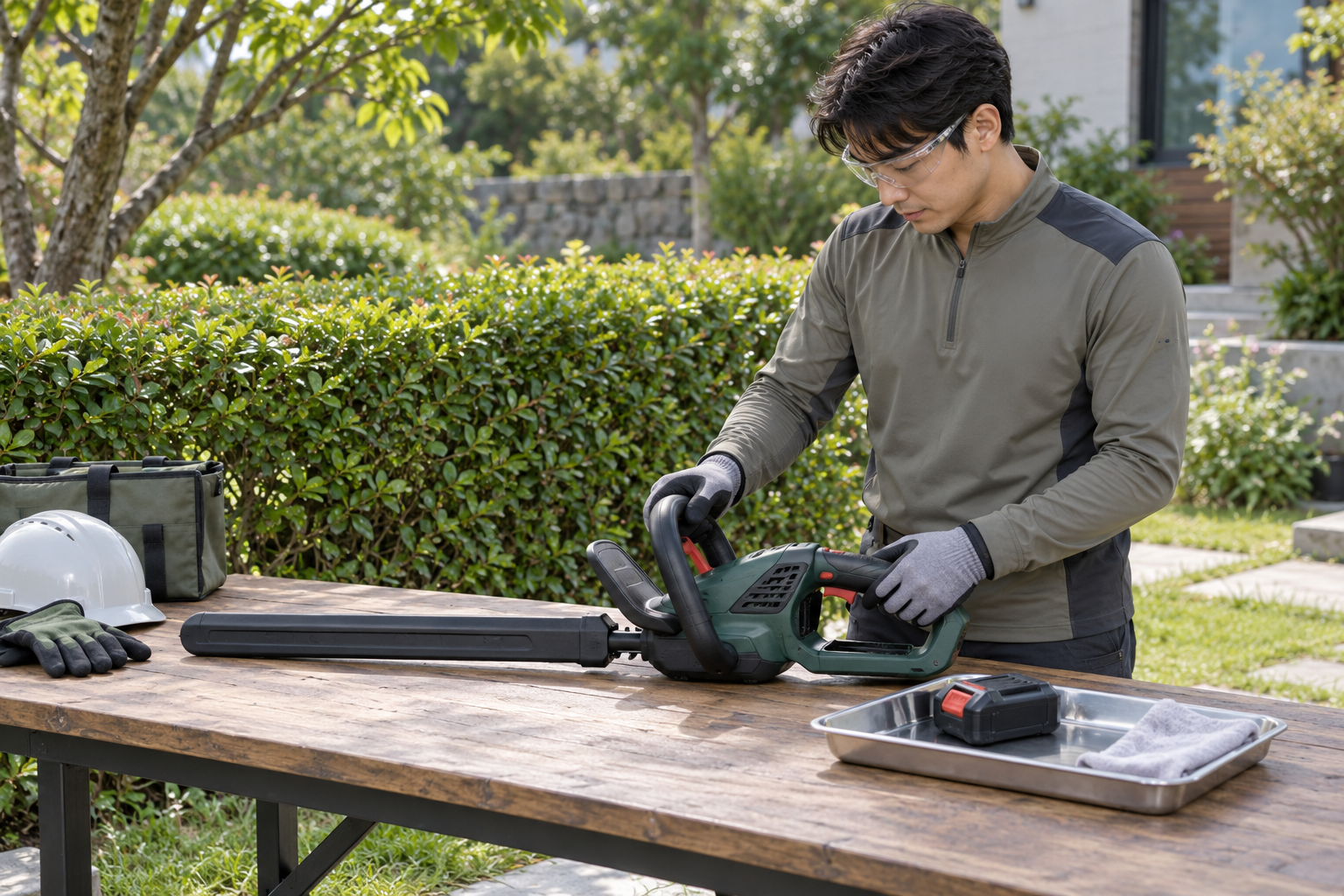 Retained source illustration: an AI-generated educational concept, not a real incident photograph or evidence of equipment suitability.
The following scenario, comparisons and example records are hypothetical teaching material. They do not reproduce actual incidents, measurements, signatures or approvals.
| Item | Hypothetical situation |
|---|---|
| Initial state | A worker trims the top of a hedge from the ground. |
| Change | A thick branch lies beyond comfortable reach, and the worker proposes pulling it with one hand while running the trimmer with the other. |
| Failure path | Loss of two-hand control places the free hand near moving teeth; forced cutting can jam the blade or destabilize the worker. |
| Possible harm | The worker could suffer a laceration, fall or be struck by springing vegetation. |
| Barrier | Stop, remove the battery before manual intervention, and choose a suitable reach and branch-cutting method. Do not improvise a platform or bypass a switch. |
The safe cutting envelope depends on the actual blade and vegetation, not just whether a branch fits between teeth. Dense or spring-loaded vegetation can move unexpectedly. Maintain a stable stance and both intended hand positions.
A hedge can conceal fence wire, service wiring, stakes and debris. Survey before cutting and stop when a hidden obstruction is found. Gloves do not protect against a moving powered blade or electrical contact.
Releasing the trigger does not instantly make the teeth safe. Wait for complete stop and remove the battery before clearing a jam, checking damage or cleaning. Stored force in a bent branch can remain after electrical energy is removed.
After a hard-object impact, remove the tool from use until the blade, guard and controls have been checked and any damage corrected under the model instructions. A brief successful restart alone does not prove the blade is sound.
| Decision | Reason and evidence |
|---|---|
| Known facts | A thick branch lies beyond comfortable reach, and the worker proposes pulling it with one hand while running the trimmer with the other. |
| Unresolved | Loss of two-hand control places the free hand near moving teeth; forced cutting can jam the blade or destabilize the worker. |
| Hold reason | Stop for hidden wire or electrical hazards, unstable footing, loss of two-hand control, excessive reach, blade jams, abnormal vibration, impact damage or unsuitable wet conditions. |
| Evidence needed | Intended hand positions; Branch size and condition; Blade clearance; Grip and footing stable. |
| Next decision | Stop, remove the battery before manual intervention, and choose a suitable reach and branch-cutting method. Do not improvise a platform or bypass a switch. |
5. Conditional decisions and common errors
| Condition | Action | Evidence | Proceed when |
|---|---|---|---|
| Hidden wire | Stop cutting; identify the obstruction and services. | Survey and service isolation evidence. | Cutting envelope clear. |
| Overreach | Stop and select a suitable access or cutting method. | Ground, reach and branch assessment. | Stable two-hand position. |
| Jam or impact | Stop, remove battery and inspect before clearing/reuse. | Blade condition and trapped-force assessment. | Cause resolved; blade sound. |
| Wet footing | Suspend affected work and reassess conditions. | Ground condition and model use limits. | Secure footing within limits. |
| Comparison | Situation A | Situation B |
|---|---|---|
| Stopped blade | Battery removed and trapped branch force considered before clearing. | Trigger released but the battery remains fitted and accidental restart is possible. |
| Reachable branch | Stable ground and both hands remain in their intended positions. | A worker stretches, pulls vegetation with one hand or stands on an improvised support. |
6. Roles and responsibilities
| Role | Responsibility |
|---|---|
| Work supervisor | Confirm scope, task sequence, exclusion and stop authority. Coordinate survey hedge with affected operations. |
| Technical reviewer | Resolve the actual design and equipment limits: Hidden-object survey; Electrical hazard review; Ground and route check; Bystander exclusion. |
| Work crew | Perform set working position using the approved procedure; report any mismatch before proceeding. |
| Inspector / assessor | Verify Complete blade stop; Battery removed; Covered transport state; Secure resting location. Record what was actually checked and what remains unresolved. |
| Release / receiving authority | Confirm Blade and cover condition; Battery storage conditions; Defect status recorded; Next-user handover. Transfer restrictions and the next permitted stage. |
These are responsibility examples, not invented statutory credentials. Meet the actual training, competent-person, qualified-person and licensing requirements for the assigned work. Anyone may raise a hazard and request a stop; only the designated authority may release the affected stage after evidence is reviewed.
7. Hold points and record comparison
| Hold point | Evidence before release | Confirmation / approval |
|---|---|---|
| HP-0 Start | Scope, jurisdiction, equipment identity, responsible people and emergency arrangements. | |
| HP-1 Inspect isolated tool | Battery removed; Blade and guard condition; Battery compatibility; Handle security | |
| HP-2 Check controls | Interlocks function; Blade stops as specified; Safe test location; No switch bypass | |
| HP-3 Move or pause | Complete blade stop; Battery removed; Covered transport state; Secure resting location | |
| HP-4 Clean and store | Blade and cover condition; Battery storage conditions; Defect status recorded; Next-user handover |
Hold points are internal evidence gates. They do not replace statutory permits or actual signatures. Recheck affected gates after a change, abnormal event or shift transfer. The blank record must identify the evidence, person, time, limits and release scope.
| Record | Insufficient record | Record checklist |
|---|---|---|
| Survey | Hedge looks clear | □ Hidden-object survey□ Electrical hazard review□ Ground and route check□ Bystander exclusion |
| Tool | Battery charged | □ Battery removed□ Blade and guard condition□ Battery compatibility□ Handle security |
| Cutting | Can reach it | □ Intended hand positions□ Branch size and condition□ Blade clearance□ Grip and footing stable |
| Jam | Tool restarted | □ Isolation verified□ Branch tension addressed□ Blade damage assessment□ Repair and function record |
The □ boxes are static prompts, not saved or interactive approvals. Each checks one record element. A tick alone does not establish suitability or permission to restart. Link equipment IDs and supporting records; retain unresolved matters and the earlier record when conditions change.
8. Site checklist and emergency response
| Check item | Result | Person / action |
|---|---|---|
| Hidden-object survey | ||
| Battery removed | ||
| Reach without stretching | ||
| Interlocks function | ||
| Intended hand positions | ||
| Complete blade stop | ||
| Isolation verified | ||
| Blade and cover condition | ||
| Emergency arrangements and unresolved restrictions communicated |
Stop work: Stop for hidden wire or electrical hazards, unstable footing, loss of two-hand control, excessive reach, blade jams, abnormal vibration, impact damage or unsuitable wet conditions.
Emergency response: Stop the tool and remove the battery when safe. Keep the blade still and prevent further contact. Activate the site first-aid plan and call 911 for serious bleeding or injury. For contact with electrical wiring, keep people away until the supply is made safe by authorized personnel; do not touch an energized tool or casualty.
9. Sources and review limits
Official-source review date: October 12, 2026. The following review is limited to the public provisions or selected manufacturer material identified below. It does not establish that any authority approved this article or the actual installation.
- OSHA 1910.242: General requirements for safe hand and portable powered-tool condition.
- Makita XHU02Z instruction manual: Official indexed safety excerpts reviewed on guards, footing, battery removal after impact, clearing and transport. Full-PDF opening failed; no full-manual review claimed. Model example only; no universal branch capacity inferred.
- OSHA State Plans: jurisdiction and coverage overview; identify the actual state program before use.
Paid consensus standards and site-specific calculations, manuals, inspection records and product certificates were not independently obtained or verified unless specifically identified. Korean legal citations remain in the preserved Korean source as source history; they are not represented as US legal duties.
10. PDF guidance and FAQ
PDF A covers basic task controls; B examines technical failures; C focuses on supervision, evidence and handover. Each has six rows and three items per main cell. They are complementary extracts: apply all eight body stages and the applicable site procedure. An omitted stage is not permission to omit its controls. PDF HP-0 through HP-4 are worksheet labels; match the event, evidence and authority rather than assuming they match another permit by number.
P/S/R/A, actual measurements, confirmations and signatures remain blank. The PDFs are uncompleted reference worksheets, not issued work permits.
Content group ID: jsa-battery-hedge-trimmer
Can I hold a branch with one hand while cutting?
No. Maintain the intended two-hand grip and keep other people outside the blade range. Stop and choose a different method for inaccessible or oversized branches.
Is releasing the trigger enough before clearing a jam?
Wait for complete stop and remove the battery before touching the blade area. Also control any stored force in the vegetation.
Does a water-resistant product label authorize wet use?
No general permission follows from the label. Check the exact model instructions and actual footing, weather and electrical hazards.
Has a professional verified or approved this document?
No. This is AI-assisted reference material. Editorial and layout checks are not a physical inspection or professional technical approval. Obtain qualified professional review and required site approval before use.
11. Revision history and authorship
Reference content written and revised with AI. It has not been verified or approved by a professional. Review by a suitably qualified professional and site approval are required before use.
This system has not physically inspected the equipment, structures, ground, atmosphere or worksite. The document does not replace legal advice, manufacturer procedures, engineering design, inspection certificates, qualification evidence, the site risk assessment or an actual work permit.
Before use, a suitably qualified and authorized person must review the actual equipment, loads, methods, protection, inspection and emergency arrangements and resolve open issues. Record the real reviewer, organization, qualifications, delegated authority, reviewed documents, date, signature, exclusions and conditions of approval separately.
| Date | Version | Change | Review status |
|---|---|---|---|
| 2026-09-26 | 1.0 | Korean source revision retained in the source snapshot. | Historical editorial status; not US professional approval. |
| 2026-10-12 | US 1.0 | US localization of the assigned Korean source; task reasoning, educational image and history retained; US scope and sources reviewed. | AI-assisted editorial work; professional approval not performed. |