Battery power does not remove blade thrust, flying stones or thrown wire. A guard must match the selected attachment, not merely be present. Inspect the ground before cutting and reassess when previously hidden material appears.
This is reference content written and revised with AI. It has not been verified or approved by a professional. Review by a suitably qualified professional and site authorization are required before use.
Stop before starting
Do not start with defective attachments, fasteners, guard, battery or access control. Stop for a person entering the zone, hard-object impact, abnormal vibration or wrapped grass. Wait for full stop and safely remove the battery before inspection.
1. Legal and technical scope
| Basis | Scope and limits |
|---|---|
| OSHA landscape standards | Official index distinguishes applicable general-industry and construction provisions. It is not a product manual or a fixed bystander-distance specification. |
Ordinary landscape maintenance generally uses applicable general-industry rules; landscaping performed as construction needs its construction requirements. Resolve task classification and State Plan jurisdiction. OSHA landscaping guidance identifies equipment and PPE hazards but does not establish a universal brushcutter stand-off distance. Use the actual US model manual for attachment, exclusion, battery and control requirements.
2. Scope and required inputs
Included work
Trained operators cutting grass on inspected level ground with the manufacturer-approved cutting attachment, guard and harness. Maintain two-hand control and a controlled bystander boundary.
Separate assessment
Steep slopes, waterways, live-road traffic interfaces, tree felling, unapproved chain attachments, unidentified buried hazards and engine-powered machines need separate planning.
| Required input | Evidence to obtain |
|---|---|
| Survey ground | Ground condition; Stone and wire locations; Public movement; Boundary plan |
| Inspect tool | Battery removed; Attachment rating; Fastener condition; Battery and latch |
| Set protection | Guard identity; Harness and release; Handle security; Hearing and eye PPE |
| Clear and start | Clearance per manual; Boundary controller; Head clearance; Stop test |
No actual equipment model, SDS, site measurements, design calculations or authorization record was supplied. Product-specific limits and methods must be verified before use. Federal OSHA is a baseline within its scope; determine the applicable State Plan and local requirements. Manufacturer guidance is not government approval; an incorporated standard differs from voluntary guidance. No nationwide-compliance or expert-approval claim is made.
3. Eight-stage JSA
| Job stage | Hazards and effects | Failure factors | Technical and procedural controls | Site verification | P | S | R | A |
|---|---|---|---|---|---|---|---|---|
| 1. Survey ground | 1. Thrown stones2. Wire strike3. Bystander injury4. Footing loss | 1. Hidden debris2. Unmapped route3. Open boundary4. Uneven surface | 1. Inspect ground2. Remove loose debris3. Separate public route4. Mark work boundary | 1. Ground condition2. Stone and wire locations3. Public movement4. Boundary plan | ||||
| 2. Inspect tool | 1. Unexpected rotation2. Blade release3. Battery failure4. Cut injury | 1. Battery attached2. Loose fastener3. Damaged pack4. Uncovered blade | 1. Remove battery safely2. Match approved blade3. Inspect pack and latch4. Handle stopped blade | 1. Battery removed2. Attachment rating3. Fastener condition4. Battery and latch | ||||
| 3. Set protection | 1. Flying fragments2. Blade thrust3. Loss of control4. Noise exposure | 1. Wrong guard2. Poor harness balance3. Loose handle4. Wrong PPE | 1. Fit matching guard2. Adjust approved harness3. Check two-hand grip4. Select eye/face protection | 1. Guard identity2. Harness and release3. Handle security4. Hearing and eye PPE | ||||
| 4. Clear and start | 1. Bystander strike2. Starting contact3. Tool movement4. Delayed stop | 1. Zone unchecked2. Blade on obstacle3. Poor stance4. Stop control faulty | 1. Clear specified zone2. Keep attachment clear3. Use stable stance4. Check stop function | 1. Clearance per manual2. Boundary controller3. Head clearance4. Stop test | ||||
| 5. Cut grass | 1. Blade thrust2. Laceration3. Thrown debris4. Fatigue | 1. Hard-object contact2. Excessive swing3. New hidden wire4. Poor footing | 1. Use permitted cutting zone2. Keep both hands3. Watch advancing ground4. Pause when control slips | 1. Obstacle changes2. Blade contact3. People and vibration4. Grip and footing | ||||
| 6. Move or wait | 1. Coasting blade2. Unattended start3. Trip injury4. Blade contact | 1. Moving while spinning2. Battery left active3. Cluttered route4. Head near legs | 1. Wait for full stop2. Control restart3. Use safe carry method4. Recheck next area | 1. Blade stopped2. Battery/standby state3. Carry route4. Next boundary | ||||
| 7. Hold impact | 1. Damaged blade throws2. Wire entanglement3. Unexpected restart4. Repeat collision | 1. Stop treated as proof2. Grass pulled live3. Damage ignored4. Wire location lost | 1. Stop and remove battery2. Inspect blade and guard3. Replace rejected parts4. Recheck obstacle area | 1. Impact location2. Head and fasteners3. Replacement evidence4. Controlled retest | ||||
| 8. Clean and handover | 1. Exposed edge2. Battery damage3. Unsafe charging4. Hazard passed on | 1. No blade cover2. Pack fault ignored3. Wrong charger4. Impact omitted | 1. Clean with battery removed2. Protect blade for storage3. Use specified charging4. Record incomplete areas | 1. Cover and storage2. Pack condition3. Charger instructions4. Defects and work limits |
P = likelihood; S = severity; R = risk under the site method; A = site-defined acceptance/authorization. These actual assessment cells are blank. A low score never overrides a missing safeguard or a legal or manufacturer restriction.
4. Fictional scenario and failure mechanisms
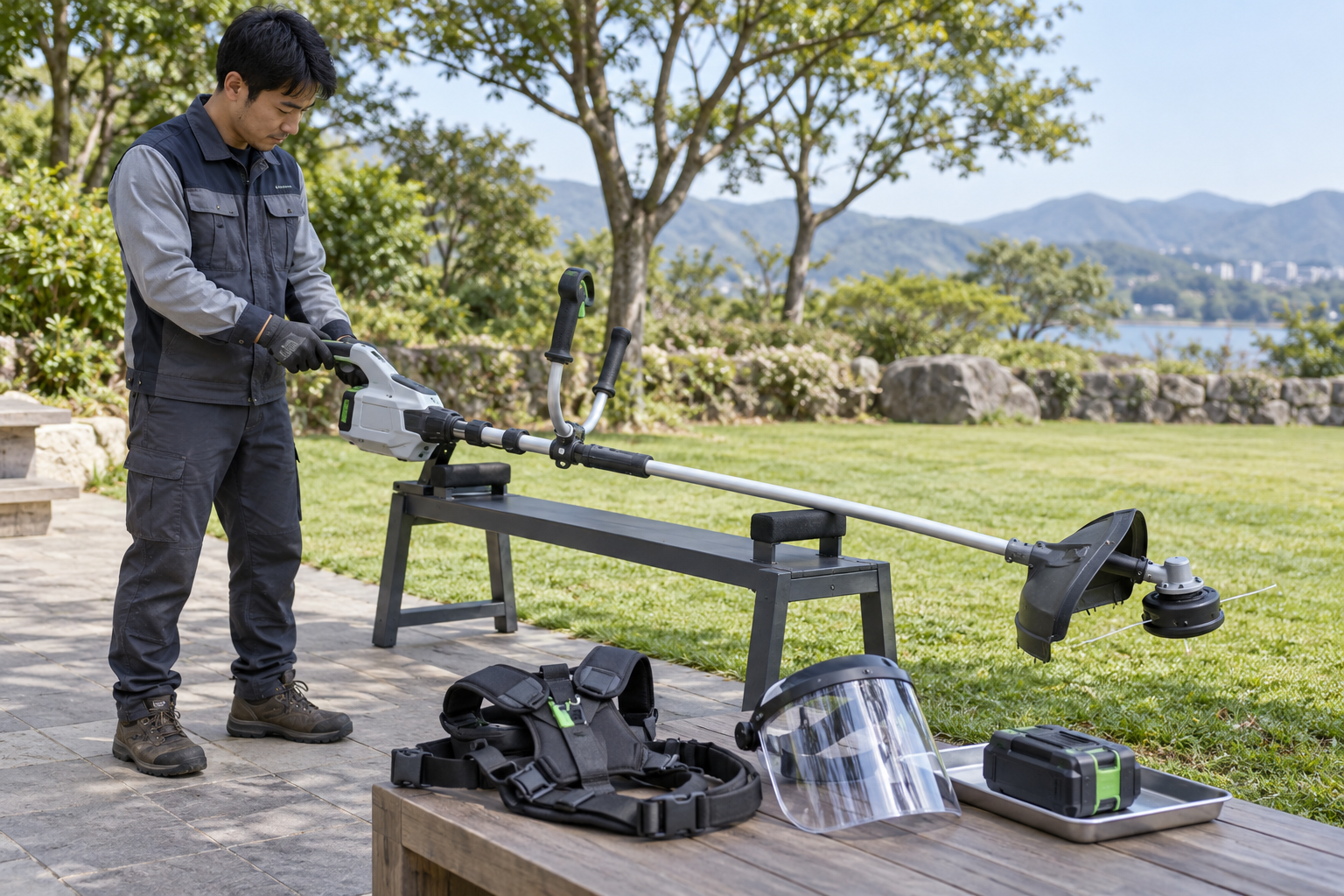
This illustration provides educational context. It is not an actual incident photograph or evidence of equipment suitability; any AI-generated depiction is illustrative only.
The scenario and record comparisons are fictional teaching examples, not records of real incidents, measurements, inspections, signatures or approvals.
| Stage | Fictional situation |
|---|---|
| Initial situation | A fictional operator cuts a level verge inside a marked work area. |
| Changed condition | The blade strikes hidden wire and the fitted automatic stop activates. |
| Failure path | Immediate restarting can throw damaged blade material or wire still wrapped around the head. |
| Possible outcome | Possible laceration or bystander impact; no actual accident or tested distance is asserted. |
| Prevention barrier | Keep the area clear, stop and remove the battery, inspect the attachment and obstacle, then conduct the prescribed controlled check. |
Failure mechanisms
Battery power does not remove blade thrust, flying stones or thrown wire. A guard must match the selected attachment, not merely be present. Inspect the ground before cutting and reassess when previously hidden material appears.
Automatic stopping on a sudden speed change, where fitted, is not proof that the blade survived an impact or that the obstacle is gone. Record the contact location, wait for complete stop, remove the battery by the approved method and inspect before any restart.
The harness balances the tool but does not replace two-hand control and footing. Learn its emergency release without exposure to the moving attachment. Stop the blade before relocation and secure against restart before clearing wrapped grass or cleaning.
Work sequence: Survey ground → Inspect tool → Set protection → Clear and start → Cut grass → Move or wait → Hold impact → Clean and handover. This is a teaching flow, not a device drawing or a complete operating procedure.
5. Conditional decisions and common errors
| Situation | Required action | Evidence | Proceed when |
|---|---|---|---|
| Hidden wire found | Stop cutting and secure tool | Ground survey and wire removal | Obstacle controlled |
| Blade impact | Do not immediately restart | Blade, fastener and guard check | Attachment accepted |
| Person approaches | Stop and maintain boundary | Clear zone and communication | Bystander zone clear |
| Wrapped grass | Wait for stop; remove battery | Isolation and head inspection | Safe condition verified |
Similar observations, different decisions
The scenario and record comparisons are fictional teaching examples, not records of real incidents, measurements, inspections, signatures or approvals.
| Observation | Insufficient conclusion | Required distinction |
|---|---|---|
| Guard fitted | Any guard will work | Match guard to attachment |
| Automatic stop | Impact damage eliminated | Inspect tool and obstacle |
| Low grass | Ground is fully clear | New hidden obstacles may appear |
6. Roles and responsibilities
| Role | Responsibility |
|---|---|
| Work supervisor | Confirm ground condition and the task scope, resources, interfaces and stop authority. |
| Qualified technical reviewer | Review battery removed, model limits, compatibility and unresolved technical conditions within assigned competence. |
| Work crew | Apply the listed controls, report changes and stop when evidence or safeguards are missing. |
| Inspector / assessor | Record actual obstacle changes and other relevant checks; do not mark unverified conditions as accepted. |
| Handover authority | Reconcile cover and storage, restrictions and outstanding actions before the next task. Role labels do not establish a legal credential. |
Supervision and handover focus
| Stage | Management action | Evidence |
|---|---|---|
| Survey ground | 1. Record ground condition2. Record stone and wire locations3. Record public movement | 1. Ground condition2. Stone and wire locations3. Public movement |
| Inspect tool | 1. Record battery removed2. Record attachment rating3. Record fastener condition | 1. Battery removed2. Attachment rating3. Fastener condition |
| Clear and start | 1. Record clearance per manual2. Record boundary controller3. Record head clearance | 1. Clearance per manual2. Boundary controller3. Head clearance |
| Cut grass | 1. Record obstacle changes2. Record blade contact3. Record people and vibration | 1. Obstacle changes2. Blade contact3. People and vibration |
| Hold impact | 1. Record impact location2. Record head and fasteners3. Record replacement evidence | 1. Impact location2. Head and fasteners3. Replacement evidence |
| Clean and handover | 1. Record cover and storage2. Record pack condition3. Record charger instructions | 1. Cover and storage2. Pack condition3. Charger instructions |
7. Hold points and record comparison
| Hold point | Evidence before release | Actual approval |
|---|---|---|
| HP-0 Scope | Trained operators cutting grass on inspected level ground with the manufacturer-approved cutting attachment, guard and harness. Maintain two-hand control and a controlled bystander boundary. | |
| HP-1 Inspect tool | Battery removed; Attachment rating; Fastener condition; Battery and latch | |
| HP-2 Clear and start | Clearance per manual; Boundary controller; Head clearance; Stop test | |
| HP-3 Hold impact | Impact location; Head and fasteners; Replacement evidence; Controlled retest | |
| HP-4 Clean and handover | Cover and storage; Pack condition; Charger instructions; Defects and work limits |
Hold points are internal project checks. They are not universal statutory permits and do not grant work permission. Reassess after defects, changed conditions and shift changes.
Record comparison
The scenario and record comparisons are fictional teaching examples, not records of real incidents, measurements, inspections, signatures or approvals.
The boxes are static record prompts, not interactive or saved approvals. A tick does not establish suitability or permission to restart. Record the evidence, person, time and unresolved issues; retain the change history.
| Record | Insufficient record | Record checklist |
|---|---|---|
| Survey ground | Only marked “OK” | □ Ground condition□ Stone and wire locations□ Public movement□ Boundary plan |
| Clear and start | Only marked “OK” | □ Clearance per manual□ Boundary controller□ Head clearance□ Stop test |
| Hold impact | Only marked “OK” | □ Impact location□ Head and fasteners□ Replacement evidence□ Controlled retest |
| Clean and handover | Only marked “OK” | □ Cover and storage□ Pack condition□ Charger instructions□ Defects and work limits |
8. Site checklist and emergency response
| Site check | Actual result | Person / action |
|---|---|---|
| Survey ground: Ground condition; Stone and wire locations; Public movement; Boundary plan | ||
| Inspect tool: Battery removed; Attachment rating; Fastener condition; Battery and latch | ||
| Set protection: Guard identity; Harness and release; Handle security; Hearing and eye PPE | ||
| Clear and start: Clearance per manual; Boundary controller; Head clearance; Stop test | ||
| Cut grass: Obstacle changes; Blade contact; People and vibration; Grip and footing | ||
| Move or wait: Blade stopped; Battery/standby state; Carry route; Next boundary | ||
| Hold impact: Impact location; Head and fasteners; Replacement evidence; Controlled retest | ||
| Clean and handover: Cover and storage; Pack condition; Charger instructions; Defects and work limits |
Stop work
Do not start with defective attachments, fasteners, guard, battery or access control. Stop for a person entering the zone, hard-object impact, abnormal vibration or wrapped grass. Wait for full stop and safely remove the battery before inspection.
Emergency response
Stop the tool without approaching the blade and secure the area. Obtain emergency assistance for serious injury. For a hot, damaged or smoking battery, withdraw and use the manufacturer/site battery emergency plan; do not handle or charge a failing pack.
9. Sources and review limits
Public-source access/review: 2026-10-12.
| Official source | Reviewed scope and limits |
|---|---|
| OSHA landscape standards | Official index distinguishes applicable general-industry and construction provisions. It is not a product manual or a fixed bystander-distance specification. |
No actual equipment model, SDS, site measurements, design calculations or authorization record was supplied. Product-specific limits and methods must be verified before use. Federal OSHA is a baseline within its scope; determine the applicable State Plan and local requirements. Manufacturer guidance is not government approval; an incorporated standard differs from voluntary guidance. No nationwide-compliance or expert-approval claim is made.
10. PDF guidance and FAQ
PDF A covers basic task controls; B focuses on technical failures; C covers supervision, records and handover. P/S/R/A, measurements, confirmations and signatures remain blank for actual site assessment.
PDFs are complementary six-stage extracts. Apply all eight body stages and the actual equipment/site procedure.
Does battery power prevent kickback?
No. Blade contact and reaction remain; use the correct attachment, controlled cutting zone and two-hand grip.
Does an automatic stop permit immediate restart?
No. Identify the impact or entanglement and inspect after full stop and safe battery removal.
Can the tool move between areas while coasting?
Stop the attachment completely and follow the transport/standby procedure before moving or leaving it.
Which bystander distance applies?
Use the actual machine and attachment instructions with the site assessment. This article does not invent one distance for every tool.
Has a professional verified or approved this document?
No. Public sources and editorial, layout and consistency checks were reviewed using AI. No site inspection or professional technical approval has been performed. Obtain appropriate professional review before use.
11. Revision history and authorship
This is reference content written and revised with AI. It has not been verified or approved by a professional. Review by a suitably qualified professional and site authorization are required before use.
| Date | Version | Change | Review status |
|---|---|---|---|
| 2026-10-12 | US 1.0 | New US edition from assigned Korean source; task decisions, records and PDFs localized. | AI editorial review; no professional technical approval |
Korean edition revision dates: 2026-03-02, 2026-08-01, 2026-09-26. US v1.0 adapts the earlier edition to United States requirements and terminology.
Site reviewers must add their actual qualifications, scope, date and approval only after the review occurs.