Automatic feeding removes neither feed-roll nip points nor access through the discharge opening. Treat collection beyond a guard boundary as a change of task.
This reference material was written and revised with AI. It has not been verified or approved by a professional. Review by a suitably qualified professional and required site approval are necessary before field use.
Stop before proceeding
Stop production for an unverified guard, interlock or stop function, double feeding, discharge blockage, abnormal stroke, noise or vibration. Do not enter the danger zone on the strength of a stop command.
1. Legal and technical scope
General-industry mechanical press production: 1910.217 applies within its scope; 1910.212 addresses general machine guarding and 1910.147 applies to covered servicing. The minor-servicing exception is conditional, not automatic permission to reach into a jam. Presence-sensing devices under 1910.217(c)(3)(iii) are not permitted on full-revolution clutch machines.
Confirm whether federal OSHA or an OSHA-approved State Plan covers this employer and worksite; state requirements and public-sector coverage can differ. Apply the task-specific provisions and limitations identified above.
| Basis | Application |
|---|---|
| OSHA 29 CFR 1910.217 | Scope, clutch distinctions and point-of-operation safeguarding, including c(3)(iii) restrictions. |
| OSHA 29 CFR 1910.212 | Guarding of machine hazards beyond the die area. |
| OSHA 29 CFR 1910.147 | Servicing scope, narrow exceptions and hazardous-energy control; normal production and servicing are distinguished. |
| OSHA State Plans | Official overview of federal and State Plan jurisdiction and differing public-sector coverage, checked 2026-10-12. Individual state rules require a site-specific check. |
2. Scope and required inputs
Included scope
Monitor normal sheet-metal production from outside the safeguarded press, feed and discharge zones after tooling, setup and safeguarding have been validated; collect parts only at the designed external collection point.
Separate assessment
Manual hand feeding, coil loading, threading, die changes, adjustments, clearing jams, safeguarding design and hydraulic presses are separate tasks.
| Input | Evidence needed |
|---|---|
| Receive setup | Machine and die IDs; Material specification; Setup status; Open restrictions. |
| Check safeguards | Guard test record; Clutch and stop data; Interlocks and locks; Defect disposition. |
| Monitor forming | Feed alignment; Cycle and vibration; Discharge flow; Exposure controls. |
| End and handoff | Stop and guard state; Product hold IDs; Pending repairs; Receiving person. |
No site measurements, equipment manuals for the actual installation, inspection records or signed technical approvals were supplied. Confirm the applicable requirements and actual product instructions before use; record each criterion with its units, source and equipment or work-area ID.
3. Eight-stage JSA
| Job stage | Hazards and effects | Failure factors | Technical and procedural controls | Site verification | P | S | R | A |
|---|---|---|---|---|---|---|---|---|
| 1. Receive setup | 1. Wrong tooling2. Unexpected stroke3. Part ejection4. Unsafe production | 1. Wrong material2. Setup incomplete3. Fault not reported4. Unverified guards | 1. Match die and stock2. Confirm setup release3. Read fault restrictions4. Check validation record | 1. Machine and die IDs2. Material specification3. Setup status4. Open restrictions | ||||
| 2. Clear area | 1. Feed entanglement2. Discharge trapping3. Scrap trips4. Bystander contact | 1. Access gaps2. Collection inside guard3. Overflowing bins4. Uncontrolled boundary | 1. Define hazard boundary2. Use external collection3. Clear scrap route4. Exclude bystanders | 1. Feed and die perimeter2. Collection position3. Bin capacity4. Access control | ||||
| 3. Check safeguards | 1. Crushing at die2. Residual movement3. Feed-roll injury4. Unexpected repeat stroke | 1. Interlock bypass2. Wrong stopping assumption3. Guard gap4. Faulty stop control | 1. Use validated guards2. Check clutch suitability3. Inspect access paths4. Perform specified checks | 1. Guard test record2. Clutch and stop data3. Interlocks and locks4. Defect disposition | ||||
| 4. Select and start | 1. Automatic restart2. Person inside zone3. Wrong stroke mode4. Tool left in press | 1. Mode misselection2. No clearance check3. Unauthorized reset4. Setup tool retained | 1. Select approved mode2. Clear complete zone3. Control reset authority4. Follow start procedure | 1. Mode selection2. Personnel clearance3. Tools removed4. Start authorization | ||||
| 5. Monitor forming | 1. Double-feed ejection2. Crushed hand3. Unexpected stroke4. Noise exposure | 1. Skewed stock2. Hand correction3. Ignored abnormal cycle4. Exposure uncontrolled | 1. Watch outside guards2. Stop on feed faults3. Do not reach inside4. Control noise exposure | 1. Feed alignment2. Cycle and vibration3. Discharge flow4. Exposure controls | ||||
| 6. Collect parts | 1. Sharp-edge cuts2. Outlet entrapment3. Dropped bin4. Hot-part burn | 1. Reach past guard2. Scrap blockage3. Overfilled container4. Unknown temperature | 1. Use external pickup2. Hold blocked discharge3. Limit bin loading4. Select handling PPE | 1. Edges and temperature2. Guard boundary3. Bin condition4. Handling route | ||||
| 7. Hold jams | 1. Unexpected start2. Stored-energy release3. Repeat malfunction4. Crushing in recovery | 1. Stop mistaken for isolation2. Residual slide motion3. Cause not corrected4. Premature reset | 1. Stop and restrict access2. Use authorized isolation3. Correct fault cause4. Verify safe restart | 1. Fault location2. Energy verification3. Repair and tests4. Restart authority | ||||
| 8. End and handoff | 1. Faulty restart2. Mixed product3. Sharp scrap4. Unsafe next shift | 1. Verbal-only handover2. Rejected parts unmarked3. Cleanup omitted4. Restrictions lost | 1. Use shutdown sequence2. Identify held product3. Clear safe work area4. Transfer machine limits | 1. Stop and guard state2. Product hold IDs3. Pending repairs4. Receiving person |
P = likelihood; S = severity; R = risk under the site method; A = the site-defined acceptance/authorization decision. Complete only after actual assessment. Blank cells and checklist prompts are not completed inspections.
4. Fictional scenario and failure mechanisms
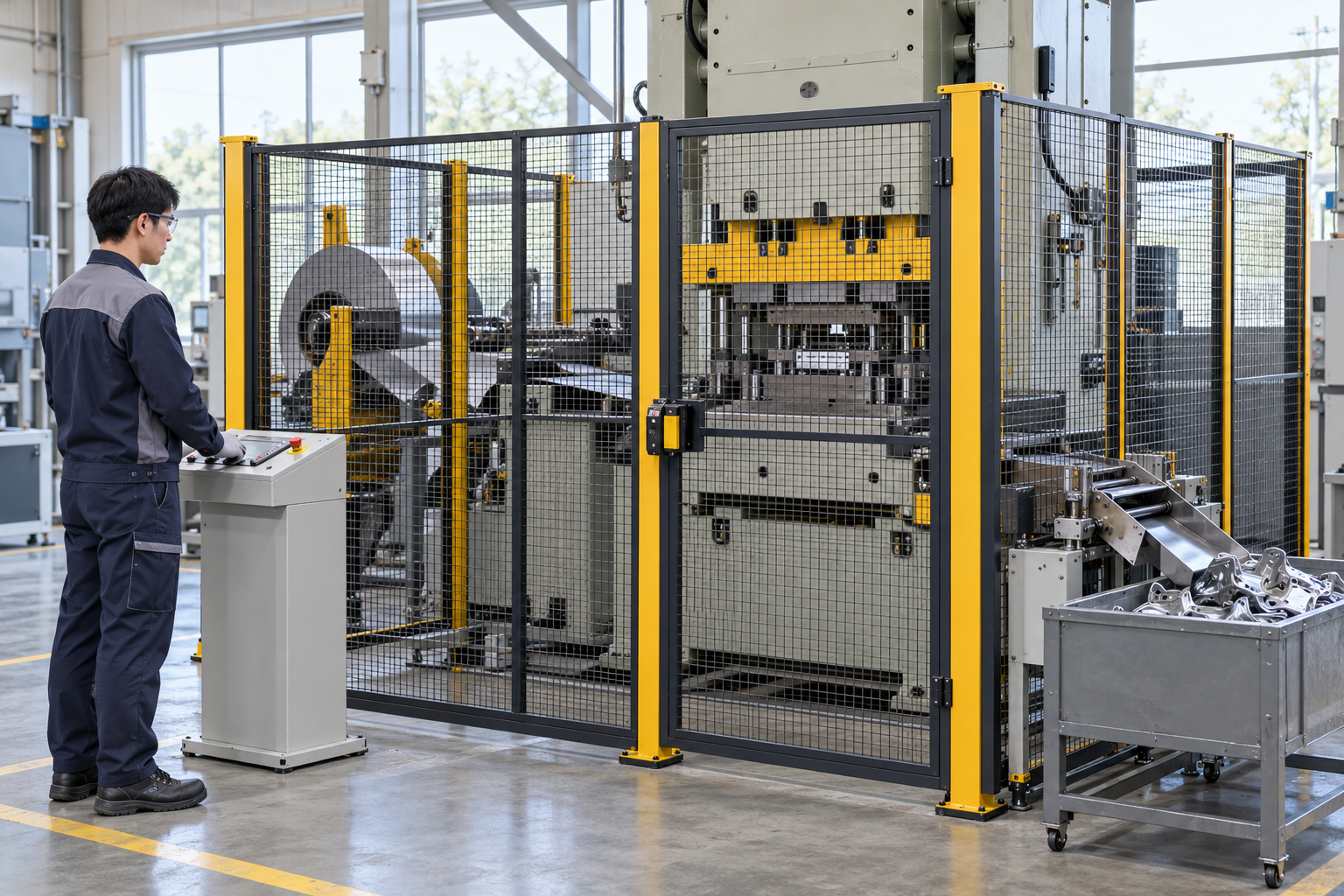
Retained AI-generated educational illustration from the source edition; not a real incident photograph, approved installation drawing or evidence of equipment suitability.
The scenario and record comparisons are fictional teaching examples, not records of real incidents, measurements, inspections, signatures or approvals.
| Item | Fictional scenario |
|---|---|
| Initial | Parts stop emerging during automatic production. |
| Change | An operator presses stop and prepares to reach through the outlet. |
| Failure | Another person assumes the jam is cleared and resets the line. |
| Outcome | Unexpected motion can trap the operator at the die or feeder. |
| Barrier | Keep access blocked, transfer the jam to authorized servicing personnel and verify repair, safeguards and restart authority. |
Why the controls matter
Automatic feeding removes neither feed-roll nip points nor access through the discharge opening. Treat collection beyond a guard boundary as a change of task.
A press can retain dangerous movement after a stop command. Guard selection depends on clutch type, stopping behavior and every access path; do not improvise a light curtain distance or bypass an interlock.
Clearing material and authorizing restart are separate decisions. Authorized personnel control all energy and stored motion for covered jam clearing; restore guards, verify repair and clear people and tools before the designated restart.
Decision sequence
| Step | Decision |
|---|---|
| Known | An operator presses stop and prepares to reach through the outlet. |
| Unknown | Actual condition, extent of damage and suitability of feed alignment, cycle and vibration remain to be established. |
| Hold | Another person assumes the jam is cleared and resets the line. |
| Evidence | Link feed alignment, cycle and vibration, discharge flow, exposure controls, fault location, energy verification to the affected equipment or work area. |
| Next | Keep access blocked, transfer the jam to authorized servicing personnel and verify repair, safeguards and restart authority. |
5. Conditional decisions and common errors
| Condition | Action | Evidence | Proceed when |
|---|---|---|---|
| Guard fault | Stop production | Safeguard test and repair record | Safeguards restored |
| Feed jam | Hold access and isolate for servicing | Energy-control verification | Servicing entry controlled |
| Mode change | Recheck setup and clearance | Mode, personnel and test record | Start sequence verified |
| Shift change | Transfer unresolved faults | Machine and product hold record | Restrictions received |
Similar appearance, different evidence
The scenario and record comparisons are fictional teaching examples, not records of real incidents, measurements, inspections, signatures or approvals.
| Comparison | Supported decision | Insufficient basis |
|---|---|---|
| Condition | Safeguard test and repair record | Guard fault has not been resolved. |
| Evidence | Mode, personnel and test record | A photograph or a completed-looking task without the relevant inspection record. |
| Release | Restrictions received | Completion of one step does not release the excluded tasks in section 2. |
6. Roles and responsibilities
| Role | Responsibility |
|---|---|
| Work supervisor | Assign the task boundary, stop authority, interfaces and emergency communication for automatic-feed mechanical press. |
| Technical lead | Confirm Machine and die IDs; Material specification; Setup status; Open restrictions. Resolve design and manufacturer limits before work. |
| Authorized crew | Apply Guard test record; Clutch and stop data; Interlocks and locks; Defect disposition. Stop when the working arrangement changes. |
| Inspector / receiving lead | Review Feed alignment; Cycle and vibration; Discharge flow; Exposure controls. Transfer Stop and guard state; Product hold IDs; Pending repairs; Receiving person. |
Role labels allocate responsibilities; they do not confer a legal qualification. Verify the competence, training and authority required for the actual task.
Record and handoff perspective
| Stage | Record controls | Verification |
|---|---|---|
| Receive setup | 1. Record machine and die ids2. Record material specification3. Record setup status | 1. Material specification2. Setup status3. Open restrictions |
| Check safeguards | 1. Record guard test record2. Record clutch and stop data3. Record interlocks and locks | 1. Clutch and stop data2. Interlocks and locks3. Defect disposition |
| Select and start | 1. Record mode selection2. Record personnel clearance3. Record tools removed | 1. Personnel clearance2. Tools removed3. Start authorization |
| Monitor forming | 1. Record feed alignment2. Record cycle and vibration3. Record discharge flow | 1. Cycle and vibration2. Discharge flow3. Exposure controls |
| Hold jams | 1. Record fault location2. Record energy verification3. Record repair and tests | 1. Energy verification2. Repair and tests3. Restart authority |
| End and handoff | 1. Record stop and guard state2. Record product hold ids3. Record pending repairs | 1. Product hold IDs2. Pending repairs3. Receiving person |
7. Hold points and record comparison
| Hold point | Evidence before release | Actual record |
|---|---|---|
| HP-0 Start | Monitor normal sheet-metal production from outside the safeguarded press, feed and discharge zones after tooling, setup and safeguarding have been validated; collect parts only at the designed external collection point. | |
| HP-1 Check safeguards | Guard test record; Clutch and stop data; Interlocks and locks; Defect disposition | |
| HP-2 Select and start | Mode selection; Personnel clearance; Tools removed; Start authorization | |
| HP-3 Hold jams | Fault location; Energy verification; Repair and tests; Restart authority | |
| HP-4 End and handoff | Stop and guard state; Product hold IDs; Pending repairs; Receiving person |
These are internal hold points, not issued permits. Recheck affected points after a change, fault or shift handoff; link the actual approval record.
Record comparison
The scenario and record comparisons are fictional teaching examples, not records of real incidents, measurements, inspections, signatures or approvals.
The boxes are static record prompts, not interactive or saved approvals. A tick does not establish suitability or permission to restart. Record the evidence, person, time and unresolved issues; retain the change history.
| Record | Insufficient | Record checklist |
|---|---|---|
| Receive setup | "Checked" without target, criteria or result | □ Machine and die IDs□ Material specification□ Setup status□ Open restrictions |
| Check safeguards | "Checked" without target, criteria or result | □ Guard test record□ Clutch and stop data□ Interlocks and locks□ Defect disposition |
| Monitor forming | "Checked" without target, criteria or result | □ Feed alignment□ Cycle and vibration□ Discharge flow□ Exposure controls |
| End and handoff | "Checked" without target, criteria or result | □ Stop and guard state□ Product hold IDs□ Pending repairs□ Receiving person |
8. Site checklist and emergency response
| Check | Result | Person / action |
|---|---|---|
| □ Receive setup: Machine and die IDs | ||
| □ Clear area: Feed and die perimeter | ||
| □ Check safeguards: Guard test record | ||
| □ Select and start: Mode selection | ||
| □ Monitor forming: Feed alignment | ||
| □ Collect parts: Edges and temperature | ||
| □ Hold jams: Fault location | ||
| □ End and handoff: Stop and guard state | ||
| □ Emergency access and handoff restrictions |
Stop work
Stop production for an unverified guard, interlock or stop function, double feeding, discharge blockage, abnormal stroke, noise or vibration. Do not enter the danger zone on the strength of a stop command.
Emergency response
Stop from a safe location, exclude people from the affected danger zone and activate the site emergency plan. Call 911 for injury or immediate danger. Do not enter an unstable, energized or confined danger area for an improvised rescue; trained responders must control the specific energy and access hazards.
9. Sources and review limits
Public-source review: 2026-10-12. Official regulation pages and specific technical references are distinguished below; no agency or manufacturer has approved this content.
| Source | Reviewed scope and limitation |
|---|---|
| OSHA 29 CFR 1910.217 | Scope, clutch distinctions and point-of-operation safeguarding, including c(3)(iii) restrictions. |
| OSHA 29 CFR 1910.212 | Guarding of machine hazards beyond the die area. |
| OSHA 29 CFR 1910.147 | Servicing scope, narrow exceptions and hazardous-energy control; normal production and servicing are distinguished. |
| OSHA State Plans | Official overview of federal and State Plan jurisdiction and differing public-sector coverage, checked 2026-10-12. Individual state rules require a site-specific check. |
No site measurements, equipment manuals for the actual installation, inspection records or signed technical approvals were supplied. Confirm the applicable requirements and actual product instructions before use; record each criterion with its units, source and equipment or work-area ID.
10. PDF guidance and FAQ
PDF A covers basic task controls; B focuses on technical failures; C covers supervision, records and handover. The article has eight stages with four items per main cell; each PDF has six key stages with three items per main cell. P/S/R/A, measurements, confirmations and signatures remain blank for actual site assessment.
Content group
jsa-automatic-feed-mechanical-press
Does automatic feeding eliminate guarding?
No. Guard the die, feed, discharge and associated danger zones.
Is pressing stop sufficient for jam clearing?
No. Covered servicing requires the applicable hazardous-energy procedure and verification.
Can a light curtain be used on every mechanical press?
No. Clutch and stopping behavior matter; the cited presence-sensing provision excludes full-revolution clutch machines.
Does a good first part prove safe operation?
No. Product appearance does not validate safeguarding, interlocks or safe stopping.
Has a professional approved this JSA?
This reference material was written and revised with AI. It has not been verified or approved by a professional. Review by a suitably qualified professional and required site approval are necessary before field use.
11. Revision history and authorship
This reference material was written and revised with AI. It has not been verified or approved by a professional. Review by a suitably qualified professional and required site approval are necessary before field use.
Korean source created 2026-10-04. This US edition adapts the Korean source; earlier editorial revisions do not constitute professional approval of this edition.
| Date | Edition | Change | Review status |
|---|---|---|---|
| 2026-10-12 | 1.0 | US localization: preserve task judgments; replace Korean legal applicability with scoped US references. | AI editorial and output checks; no professional technical approval. |