The milling drum, conveyor and receiving truck form one changing work zone. Dust control, sight lines and signals must remain effective together.
This is reference content written and revised with AI. It has not been verified or approved by a professional. Review by a suitably qualified professional and required site authorization are necessary before use.
Stop conditions first
Stop for unexpected resistance or utilities, failed dust control, obscured vision, lost signals, people between vehicles or unverified mechanical support for service.
1. US legal and technical basis
Construction road work: apply the relevant OSHA construction equipment, traffic and silica provisions. The road authority traffic-control plan and state requirements remain separate from this JSA.
| Reference | Use and limit |
|---|---|
| OSHA 29 CFR 1926.1153 | Selected Table 1 (xiv)/(xv) and alternative exposure-control route; exact machine/task conditions govern. |
| OSHA 29 CFR 1926.600 | Selected raised-equipment blocking and equipment-operation requirements; construction scope. |
| NIOSH 2015-105 | Selected public summary and ventilation-control guidance; combined exhaust and water-spray principles, not site exposure proof. |
| OSHA State Plans | Federal baseline and State Plan coverage reviewed. Confirm the applicable state program and employer coverage; this edition does not establish nationwide compliance. |
Determine whether Federal OSHA or an applicable State Plan governs the employer and work. Standards incorporated into a regulation must be read in their legally applicable edition. Other NFPA/ANSI guidance and manufacturer instructions have distinct roles; they are not automatically federal law.
2. Scope and required inputs
Included
Cold milling asphalt pavement, controlled loading and truck exchange, planned isolated bit replacement and road-surface handover.
Separate assessment
Hot recycling, paving, compaction, separate processing of reclaimed material and unverified buried-service crossings need separate plans. No general permission to mill another substrate is given.
| Input | Evidence needed |
|---|---|
| Survey surface and services | Survey/depth record; Traffic approval; Covers and exclusions; Plan/site agreement |
| Set loading zone | Routes and sight lines; Vehicle sequence; Boundary condition; Escape clearance |
| Trial cut and set depth | Actual cut depth; Utility clearance; Vibration/bit state; Changed-condition review |
| Hand over surface | Surface/cover condition; Debris/load checks; Night visibility; Restrictions/receiver |
Selected public official provisions were checked on October 14, 2026. This is not a complete legal audit. No actual equipment manual, site measurements, engineering calculations, product certification or professional technical approval was supplied. Full paid NFPA/ANSI standards and state/local amendments were not reviewed. Check actual equipment, jurisdiction and project requirements before use.
Select task-appropriate eye, hand, foot, skin and hearing protection from the exposure assessment. Where respiratory protection is necessary, use the applicable respiratory-protection program; PPE does not replace isolation, guarding, support or ventilation.
3. Eight-stage JSA
| Job stage | Hazards and effects | Failure factors | Controls | Site verification | P | S | R | A |
|---|---|---|---|---|---|---|---|---|
| 1. Survey surface and services | 1. Utility strike2. Traffic collision3. Cover impact4. Wrong area milled | 1. Depth unknown2. Traffic plan absent3. Marks lost4. Drawing mismatch | 1. Verify services and depth2. Apply road traffic plan3. Mark excluded areas4. Define trial-cut area | 1. Survey/depth record2. Traffic approval3. Covers and exclusions4. Plan/site agreement | ||||
| 2. Set loading zone | 1. Person struck2. Reversing crush3. Traffic intrusion4. Signaller trapped | 1. Mixed routes2. Blind truck movement3. Barrier gap4. Escape route absent | 1. Separate traffic and people2. Agree exchange signals3. Maintain barriers4. Provide safe signalling position | 1. Routes and sight lines2. Vehicle sequence3. Boundary condition4. Escape clearance | ||||
| 3. Inspect plant and dust controls | 1. Drum entanglement2. Silica exposure3. Noise injury4. Unexpected start | 1. Guard defective2. Spray/exhaust failed3. Exposure controls missing4. Warning ignored | 1. Check guards and stops2. Verify spray and extraction3. Apply assessed protection4. Clear and signal startup | 1. Guard/stop function2. Nozzle and exhaust3. Silica control basis4. People clear | ||||
| 4. Trial cut and set depth | 1. Service damage2. Machine instability3. Bit fragments4. Unexpected obstruction | 1. Surface alone trusted2. Depth not verified3. Worn bit ignored4. Resistance forced | 1. Compare actual trial result2. Use approved settings3. Inspect cutting response4. Stop unusual resistance | 1. Actual cut depth2. Utility clearance3. Vibration/bit state4. Changed-condition review | ||||
| 5. Mill and load | 1. Flying debris2. Truck/conveyor impact3. Blind-zone crush4. Falling overload | 1. Discharge zone occupied2. Signals conflict3. Signaller relocates4. Load unwatched | 1. Exclude discharge path2. Coordinate relative motion3. Maintain safe signaller spot4. Monitor load distribution | 1. Conveyor zone clear2. Dust/view function3. Signals and position4. Load/departure condition | ||||
| 6. Exchange truck | 1. Reversing crush2. Overhead impact3. Person between vehicles4. Public traffic entry | 1. Movement unannounced2. Conveyor sweep missed3. Gap entered4. Closure changed | 1. Stop discharge for exchange2. Verify sweep and clearance3. Keep gap unoccupied4. Brief revised traffic sequence | 1. Shared stop signal2. Overhead/step clearance3. Personnel location4. Closure integrity | ||||
| 7. Replace bits and clean | 1. Drum restarts2. Machine lowers3. Pressure release4. Sharp-bit cut | 1. Engine stop only2. Hydraulic support only3. Residual energy missed4. Wrong removal tool | 1. Prevent restart and coast2. Use designated blocking3. Verify safe residual state4. Use specified tools | 1. Isolation/verification2. Mechanical support3. Pressure/debris state4. Guard restoration | ||||
| 8. Hand over surface | 1. Traffic hits step2. Debris impact3. Night visibility loss4. Barrier crew struck | 1. Lane opens early2. Material left3. Markers absent4. Removal unplanned | 1. Inspect steps and covers2. Clear loose material3. Mark unfinished zones4. Authorize protected reopening | 1. Surface/cover condition2. Debris/load checks3. Night visibility4. Restrictions/receiver |
Actual risk assessments, measurements, checks, approvals and signatures have not been performed. Keep unverified fields blank and link the actual site records. P/S/R/A mean likelihood, severity, site-method risk and site-defined acceptance/authorization; a score cannot waive a required control.
4. Failure mechanisms and hypothetical case
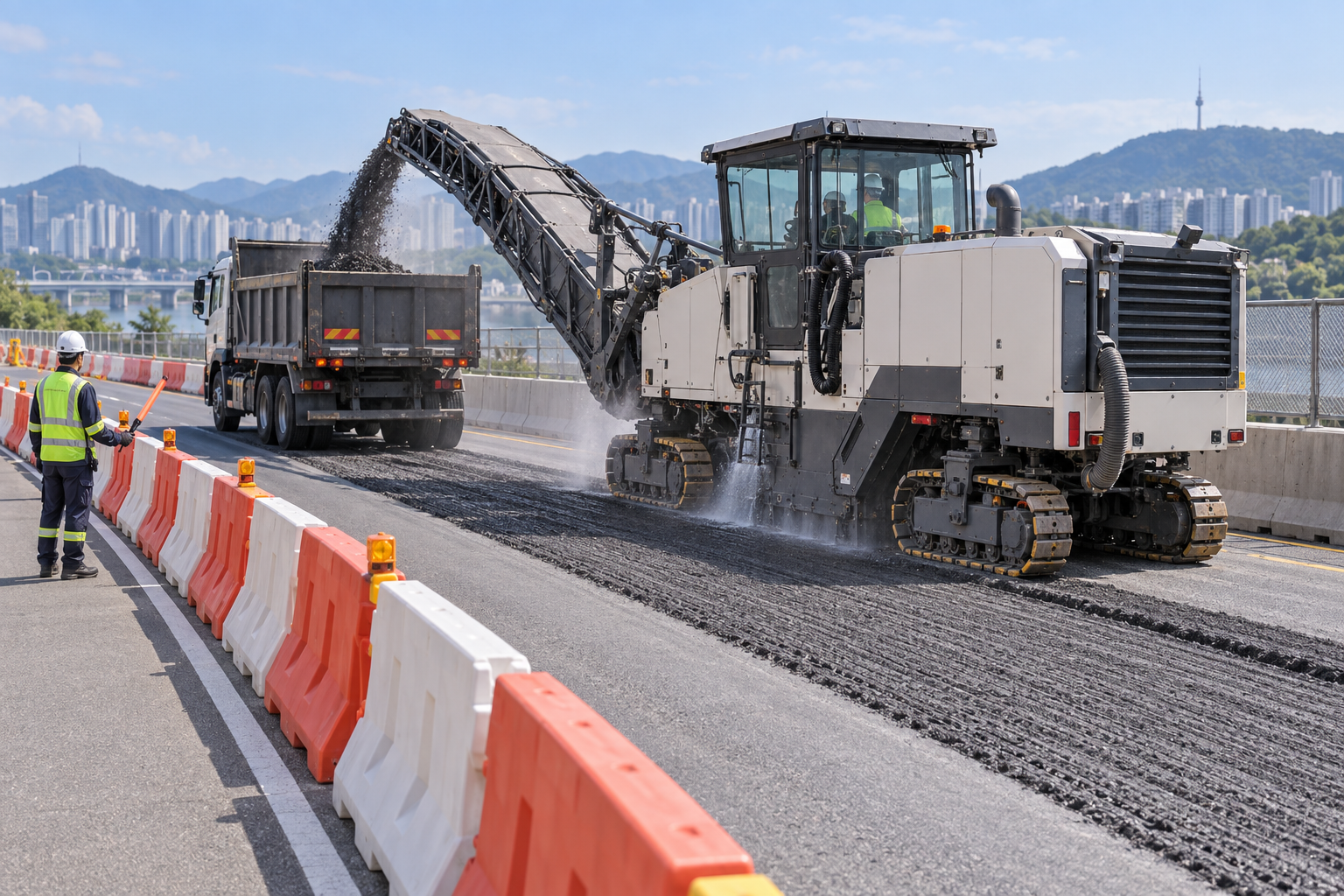
The retained illustration is an AI-generated educational image from the retained source edition. It is not an actual incident photograph, approved drawing, equipment certification or proof that the depicted arrangement is safe.
OSHA Table 1 distinguishes small and large drivable milling machines and substrate/depth. For the large-machine asphalt-only entry, drum-enclosure exhaust and supplemental water sprays operate together. Select and fully implement the applicable entry or use the alternative exposure-assessment route; merely seeing little dust does not prove compliance.
A full water tank does not establish nozzle delivery or exhaust capture. Check the actual system and correct blocked nozzles, ducts and worn enclosure seals. NIOSH research supports combined controls but is not a measurement of this site.
A signaller visible to one driver may be hidden from the other. Plan conveyor sweep, receiving position, escape space and a single exchange signal; stop discharge before the agreed changeover.
Engine stop does not eliminate drum coast-down, gravity, hydraulic energy or loose millings. Prevent restart, verify residual energy and install the specified mechanical support before maintenance access.
Hypothetical decision example
Hypothetical example: water delivery weakens and dust obscures a truck exchange. The signaller moves into the gap between truck and conveyor. Hold milling, discharge and vehicle movement until the person is located and visibility, dust controls and coordinated signals are restored.
The example is fictional; no incident, measurement, inspection or approval is asserted.
Task flow: Survey surface and services → Set loading zone → Inspect plant and dust controls → Trial cut and set depth → Mill and load → Exchange truck → Replace bits and clean → Hand over surface
5. Hold and proceed decisions
| Condition | Action | Evidence | Proceed when |
|---|---|---|---|
| Unknown resistance | Stop; resolve depth/utility | Survey and trial-cut findings | Interference resolved |
| Dust control fails | Hold cutting; repair system | Spray/exhaust function | Controls restored |
| Truck exchange | Stop discharge; agree movement | Driver/signaller positions | Signals confirmed |
| Bit replacement | Isolate and support | Energy and blocking checks | Safe access verified |
Similar observation, different conclusion
| Observation | Supported conclusion | What remains unresolved |
|---|---|---|
| Engine silent | Engine operation stopped | Drum/gravity/pressure remain to verify |
| Tank has water | Water supply present | Nozzle flow and capture unproved |
6. Roles and supervision
| Role | Responsibility |
|---|---|
| Work supervisor | Coordinate survey surface and services, affected operations, stop signals and stage transitions. |
| Technical/equipment reviewer | Verify Survey/depth record, Traffic approval, actual instructions and unresolved technical limits. |
| Task crew | Apply the stated controls, report changes and keep actual checks and signatures factual. |
| Inspector/test lead | Connect Shared stop signal, Overhead/step clearance to the required acceptance criteria. |
| Receiving authority | Accept the recorded restrictions, Night visibility, Restrictions/receiver, and follow-up ownership. |
These are responsibility examples, not invented statutory credentials. Verify actual competence, training and authority for the assigned work.
Supervision and handover controls
| Stage | Management controls | Evidence |
|---|---|---|
| Plan review | 1. Assign technical owner2. Close task-specific questions3. Verify services and depth | 1. Survey/depth record2. Traffic approval3. Plan/site agreement |
| Competence | 1. Verify required competence2. Assign stop authority3. Separate traffic and people | 1. Routes and sight lines2. Training and task briefing3. Escape clearance |
| Prestart evidence | 1. Inspect actual equipment2. Link evidence to this stage3. Compare actual trial result | 1. Actual cut depth2. Utility clearance3. Changed-condition review |
| Change control | 1. Stop and secure the area2. Review affected controls3. Prevent restart and coast | 1. Isolation/verification2. Mechanical support3. Guard restoration |
| Shift handover | 1. Identify remaining restrictions2. Confirm receiving responsibility3. Inspect steps and covers | 1. Surface/cover condition2. Debris/load checks3. Restrictions/receiver |
| Closeout | 1. Record defect disposition2. Archive factual evidence3. Inspect steps and covers | 1. Surface/cover condition2. Debris/load checks3. Restrictions/receiver |
7. Hold points and record quality
| Hold point | Evidence before release | Actual record |
|---|---|---|
| HP-0 Start | Cold milling asphalt pavement, controlled loading and truck exchange, planned isolated bit replacement and road-surface handover. | |
| HP-1 Set loading zone | Routes and sight lines; Vehicle sequence; Boundary condition; Escape clearance | |
| HP-2 Trial cut and set depth | Actual cut depth; Utility clearance; Vibration/bit state; Changed-condition review | |
| HP-3 Replace bits and clean | Isolation/verification; Mechanical support; Pressure/debris state; Guard restoration | |
| HP-4 Hand over surface | Surface/cover condition; Debris/load checks; Night visibility; Restrictions/receiver |
Hold points are internal evidence gates. They do not establish that a statutory permit exists or has been approved. Recheck affected gates after changes, faults and shift handover.
Record comparison - hypothetical templates
The 16 boxes below identify record elements, not completed checks or approvals. They are static symbols. Link equipment/location, date, actual findings and the separate record reference; preserve unresolved items.
| Record | Insufficient entry | Required record elements |
|---|---|---|
| Survey surface and services | "Checked" without supporting facts | □ Survey/depth record□ Traffic approval□ Covers and exclusions□ Plan/site agreement |
| Inspect plant and dust controls | "Checked" without supporting facts | □ Guard/stop function□ Nozzle and exhaust□ Silica control basis□ People clear |
| Mill and load | "Checked" without supporting facts | □ Conveyor zone clear□ Dust/view function□ Signals and position□ Load/departure condition |
| Replace bits and clean | "Checked" without supporting facts | □ Isolation/verification□ Mechanical support□ Pressure/debris state□ Guard restoration |
8. Pre-work checks and emergency response
| Check required | Result | Checker/action |
|---|---|---|
| Survey surface and services: Survey/depth record | ||
| Set loading zone: Routes and sight lines | ||
| Inspect plant and dust controls: Guard/stop function | ||
| Trial cut and set depth: Actual cut depth | ||
| Mill and load: Conveyor zone clear | ||
| Exchange truck: Shared stop signal | ||
| Replace bits and clean: Isolation/verification | ||
| Hand over surface: Surface/cover condition |
Stop work
Stop for unexpected resistance or utilities, failed dust control, obscured vision, lost signals, people between vehicles or unverified mechanical support for service.
Emergency response
Stop equipment from safe controls, warn both drivers and close access. Do not enter between moving vehicles or beneath unsupported machinery. For utility damage, keep people away and contact the utility and emergency services under the road plan. Trained responders control crush hazards before rescue; protect them from live traffic.
9. Official sources and review limits
Official public-source check: October 14, 2026. The review concerns the selected passages described below, not endorsement of this article.
| Official source | Checked scope and limit |
|---|---|
| OSHA 29 CFR 1926.1153 | Selected Table 1 (xiv)/(xv) and alternative exposure-control route; exact machine/task conditions govern. |
| OSHA 29 CFR 1926.600 | Selected raised-equipment blocking and equipment-operation requirements; construction scope. |
| NIOSH 2015-105 | Selected public summary and ventilation-control guidance; combined exhaust and water-spray principles, not site exposure proof. |
| OSHA State Plans | Federal baseline and State Plan coverage reviewed. Confirm the applicable state program and employer coverage; this edition does not establish nationwide compliance. |
Selected public official provisions were checked on October 14, 2026. This is not a complete legal audit. No actual equipment manual, site measurements, engineering calculations, product certification or professional technical approval was supplied. Full paid NFPA/ANSI standards and state/local amendments were not reviewed. Check actual equipment, jurisdiction and project requirements before use.
This is reference content written and revised with AI. It has not been verified or approved by a professional. Review by a suitably qualified professional and required site authorization are necessary before use.
10. PDF use and frequently asked questions
PDF A summarizes core controls; B emphasizes technical failures; C covers supervision, records and handover. Each uses six stages from or aligned with the eight-stage body. All actual risk, measurement, check and signature fields are blank. Use a separate linked record where more space is needed.
Does water alone satisfy every milling task?
No. Match machine size, substrate and cut to the selected silica control method and all applicable conditions.
Can resistance be overcome with more power?
Stop and investigate the actual obstruction, depth and possible service before changing settings.
Can one driver control the exchange?
Both drivers and the signaller must share the safe sequence and stop signal.
Can the lane reopen after cutting?
Check steps, covers, debris, unfinished areas, visibility and road-authority release conditions.
Has a professional approved this JSA?
This is reference content written and revised with AI. It has not been verified or approved by a professional. Review by a suitably qualified professional and required site authorization are necessary before use.
11. Authorship and revision history
This is reference content written and revised with AI. It has not been verified or approved by a professional. Review by a suitably qualified professional and required site authorization are necessary before use.
| Date/version | Editorial history | Technical approval |
|---|---|---|
| September 19, 2026 / Korean v1.0 | Korean source: retained previously displayed draft version and source-check date; no professional review record asserted. | Professional technical approval not performed |
| September 26, 2026 / Korean v1.1 | Korean source: revised task decisions, record checklists, JSA and three PDFs; editorial/source and layout checks. | Professional technical approval not performed |
| October 14, 2026 / US v1.0 | US localization: Retains combined truck/conveyor scenario and engine-stop versus supported-isolation distinction. Adds US silica Table 1 applicability without making research values site results. | Not performed |
Source topic: https://smartjsabridge.com/ko/case-study/jsa-asphalt-milling
Content group: jsa-asphalt-milling