Replacing a compatible regulator on one secured compressed-argon cylinder in a designated ventilated area, with the downstream process stopped. The cylinder, valve outlet, regulator, pressure range and seal must all match the intended gas service.
Stop for uncertain gas identity or compatibility, unsecured cylinders, damaged threads, uncontrolled leakage, poor ventilation, oxygen alarms or pressure that cannot be safely relieved.
Reference content written and revised with AI. It has not been verified or approved by a professional. Review by a suitably qualified professional and site approval are required before use.
1. Legal and technical scope
OSHA 1910.101 addresses compressed-gas cylinder inspection, handling and relief devices in general industry and incorporates specified historical CGA documents. The incorporated documents were not obtained in full for this editorial review. Assess hazard communication under the applicable OSHA rules. A construction use needs its own applicable Part 1926 provisions; welding-specific oxygen/fuel-gas procedures are not automatically argon-regulator instructions.
Determine Federal OSHA or the applicable OSHA-approved State Plan, including public/private employer coverage. State Plans must be at least as effective and can impose different or additional requirements. The actual activity determines construction versus general-industry scope. Manufacturer instructions, consensus standards, project design and site approvals have distinct roles; this page is not a finding of nationwide compliance.
| Basis | Application and limits |
|---|---|
| OSHA 1910.101 | Public text on cylinders and incorporated CGA references; not a full review of the paid CGA documents. |
| OSHA 1910.147 | Conditional general-industry servicing energy control, including stored energy and physical isolation; excludes construction. |
2. Scope and required inputs
Included: Replacing a compatible regulator on one secured compressed-argon cylinder in a designated ventilated area, with the downstream process stopped. The cylinder, valve outlet, regulator, pressure range and seal must all match the intended gas service.
Separate review: Cryogenic liquid containers, oxygen or fuel-gas systems, toxic gases, mixed-gas manifolds, cylinder-valve repair and confined-space work require separate analysis. This is not a procedure for tightening an energized connection.
| Input | Required evidence |
|---|---|
| Identify gas and parts | Cylinder gas identity; Regulator model and rating; Outlet and seal match; Supplier instructions |
| Isolate and bleed | Isolation point identity; Both pressure indications; Bleed path verification; Downstream stop record |
| Fit replacement | Connection identification; Seal and surface check; Assembly method record; Orientation and support |
| Hand over | Gas and regulator IDs; Final pressure setting; Leak check and restrictions; Receiving operator record |
Confirm gas service, inlet and outlet pressure limits, connection and seal identity, ventilation and the approved leak-check method. Select protection for the actual pressure and gas exposure; an air-purifying respirator supplies no oxygen. Record the applicable limits and their document references.
3. Eight-stage JSA
P = likelihood; S = severity; R = risk under the site method; A = acceptance or authorization as defined by the site. Leave these blank until actual assessment and control verification. A low score does not override a legal requirement, product limit or unreleased hold point.
| Job stage | Hazards and effects | Failure factors | Required controls | Site verification | P | S | R | A |
|---|---|---|---|---|---|---|---|---|
| 1. Identify gas and parts | 1. Wrong-gas exposure2. Regulator rupture3. Connection separation4. Process contamination | 1. Label not checked2. Wrong inlet pressure3. Thread match assumed4. Unapproved adapter fitted | 1. Read label and SDS2. Match regulator service3. Check outlet and seal4. Reject improvised adapters | 1. Cylinder gas identity2. Regulator model and rating3. Outlet and seal match4. Supplier instructions | ||||
| 2. Secure and ventilate | 1. Falling cylinder2. Valve impact3. Oxygen displacement4. Blocked escape | 1. Restraint missing2. Handling by regulator3. Enclosed leak location4. Work zone obstructed | 1. Restrain cylinder upright2. Use suitable cylinder cart3. Assess release ventilation4. Keep exit and zone clear | 1. Restraint and support2. Valve protection condition3. Ventilation assessment4. Oxygen-monitoring needs | ||||
| 3. Isolate and bleed | 1. Trapped gas release2. Hose movement3. Cold gas contact4. Unexpected process flow | 1. Regulator used as shutoff2. Downstream pressure trapped3. Unsafe bleed direction4. Process not stopped | 1. Stop downstream use2. Close designated isolation3. Bleed by approved route4. Verify pressure removed | 1. Isolation point identity2. Both pressure indications3. Bleed path verification4. Downstream stop record | ||||
| 4. Remove regulator | 1. Fitting ejection2. Hand injury3. Cylinder movement4. Contaminated connection | 1. Union loosened to vent2. Wrong wrench used3. Cylinder restraint lost4. Open inlet left exposed | 1. Verify zero energy first2. Use specified hand tools3. Maintain secure restraint4. Protect clean connections | 1. Zero-pressure evidence2. Tool and access check3. Cylinder remains secured4. Removed part condition | ||||
| 5. Fit replacement | 1. High-pressure leak2. Seal failure3. Regulator damage4. Gas incompatibility | 1. Wrong seal installed2. Thread damage ignored3. Excess fitting force4. Tape used on wrong joint | 1. Follow model procedure2. Inspect mating surfaces3. Use specified seal only4. Keep body unstressed | 1. Connection identification2. Seal and surface check3. Assembly method record4. Orientation and support | ||||
| 6. Leak check | 1. Part ejection2. Gas accumulation3. Hose whip4. Process overpressure | 1. People in release path2. Ventilation ineffective3. Outlet not controlled4. Wrong test pressure | 1. Follow supply procedure2. Keep release path clear3. Use approved leak method4. Stay within equipment limits | 1. Test method and limits2. Leak result recorded3. Ventilation functioning4. Outlet pressure setting | ||||
| 7. Correct a fault | 1. Pressurized injury2. Worsening leakage3. Oxygen-deficient area4. Repeat seal failure | 1. Live tightening attempted2. Cause not identified3. Alarm disregarded4. Damaged parts reused | 1. Stop and isolate supply2. Relieve trapped pressure3. Withdraw on gas alarm4. Replace defective parts | 1. Fault and isolation record2. Compatibility rechecked3. Safe atmosphere evidence4. Retest result and release | ||||
| 8. Hand over | 1. Unnoticed leakage2. Wrong supply setting3. Unsafe cylinder storage4. Repeat connection error | 1. Results not recorded2. Settings not communicated3. Restraint removed4. Model details omitted | 1. Record final leak test2. Transfer operating limits3. Keep cylinder secured4. Retain part identification | 1. Gas and regulator IDs2. Final pressure setting3. Leak check and restrictions4. Receiving operator record |
4. Hypothetical scenario and failure mechanisms
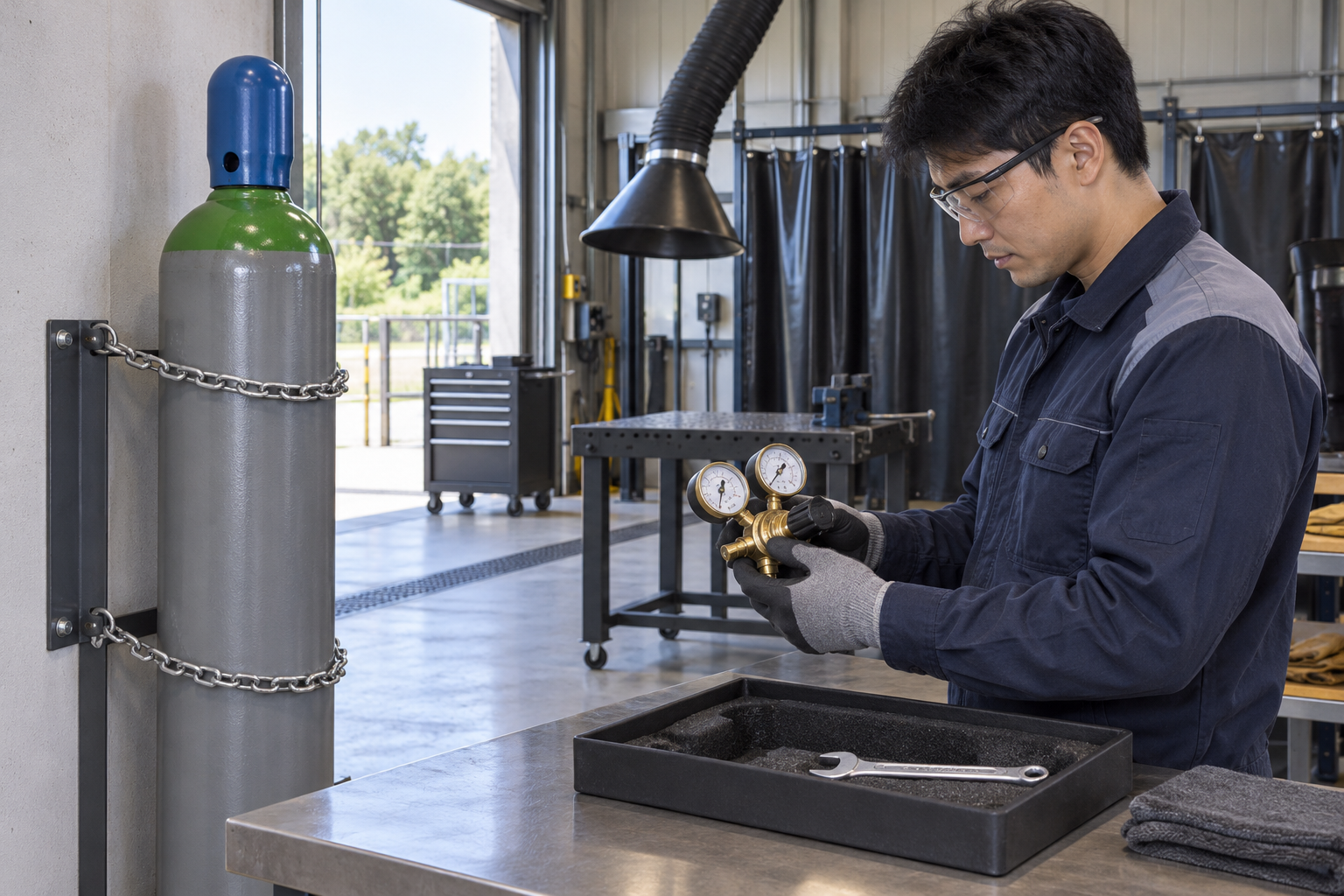 Retained source illustration: an AI-generated educational concept, not a real incident photograph or evidence of equipment suitability.
The following scenario, comparisons and example records are hypothetical teaching material. They do not reproduce actual incidents, measurements, signatures or approvals.
| Item | Hypothetical situation |
|---|---|
| Initial state | A worker changes a regulator on a secured argon cylinder. |
| Change | Leak checking reveals bubbles at the inlet after the valve has been opened. |
| Failure path | Trying to tighten the nut while pressurized leaves the worker beside a leaking high-pressure connection and may damage its seal. |
| Possible harm | A failed fitting can eject parts; released argon can displace breathable air even though it does not burn. |
| Barrier | Stop supply by the safe procedure, relieve trapped pressure through the designated route, and inspect compatibility and sealing before a controlled retest. |
Gas color coding and matching threads do not establish compatibility. Read the cylinder label and SDS and check the exact outlet, regulator service, rated inlet pressure and required seal. An improvised adapter can defeat gas-specific connection safeguards.
The regulator adjustment does not replace cylinder isolation. Closing a supply valve can leave pressure in the regulator and downstream hose. Confirm the controlled bleed path and both relevant pressure indications before removing the connection.
Argon has no useful odor warning and can displace oxygen. Ventilation, layout and oxygen-monitoring needs depend on the expected release and enclosure. An ordinary air-purifying respirator supplies no oxygen and cannot make an oxygen-deficient entry safe.
Leak evidence requires a method and acceptance criterion suitable for the specific equipment. Do not apply oxygen-specific cleaning or valve-opening instructions to every gas, and do not add tape, lubricant or a sealing washer unless the connection manufacturer requires it.
| Decision | Reason and evidence |
|---|---|
| Known facts | Leak checking reveals bubbles at the inlet after the valve has been opened. |
| Unresolved | Trying to tighten the nut while pressurized leaves the worker beside a leaking high-pressure connection and may damage its seal. |
| Hold reason | Stop for uncertain gas identity or compatibility, unsecured cylinders, damaged threads, uncontrolled leakage, poor ventilation, oxygen alarms or pressure that cannot be safely relieved. |
| Evidence needed | Test method and limits; Leak result recorded; Ventilation functioning; Outlet pressure setting. |
| Next decision | Stop supply by the safe procedure, relieve trapped pressure through the designated route, and inspect compatibility and sealing before a controlled retest. |
5. Conditional decisions and common errors
| Condition | Action | Evidence | Proceed when |
|---|---|---|---|
| Parts uncertain | Hold installation and obtain supplier identification. | Gas, outlet, regulator and seal documents. | Compatible parts identified. |
| Pressure remains | Keep the connection closed and resolve the bleed path. | Isolation and pressure verification. | Trapped pressure safely removed. |
| Leak detected | Stop supply and correct only after depressurization. | Leak location, cause and retest record. | Approved leak check passed. |
| Oxygen alarm | Withdraw and prevent entry; activate the response plan. | Release control and competent atmosphere assessment. | Atmosphere and ventilation safe. |
| Comparison | Situation A | Situation B |
|---|---|---|
| Nut feels tight | Correct gas connection and specified seal pass the approved leak check. | A mismatched seal or adapter has merely been forced tight. |
| Nonflammable gas | Ventilation and potential oxygen displacement were assessed. | No ignition source exists, so ventilation was ignored. |
6. Roles and responsibilities
| Role | Responsibility |
|---|---|
| Work supervisor | Confirm scope, task sequence, exclusion and stop authority. Coordinate identify gas and parts with affected operations. |
| Technical reviewer | Resolve the actual design and equipment limits: Cylinder gas identity; Regulator model and rating; Outlet and seal match; Supplier instructions. |
| Work crew | Perform isolate and bleed using the approved procedure; report any mismatch before proceeding. |
| Inspector / assessor | Verify Test method and limits; Leak result recorded; Ventilation functioning; Outlet pressure setting. Record what was actually checked and what remains unresolved. |
| Release / receiving authority | Confirm Gas and regulator IDs; Final pressure setting; Leak check and restrictions; Receiving operator record. Transfer restrictions and the next permitted stage. |
These are responsibility examples, not invented statutory credentials. Meet the actual training, competent-person, qualified-person and licensing requirements for the assigned work. Anyone may raise a hazard and request a stop; only the designated authority may release the affected stage after evidence is reviewed.
7. Hold points and record comparison
| Hold point | Evidence before release | Confirmation / approval |
|---|---|---|
| HP-0 Start | Scope, jurisdiction, equipment identity, responsible people and emergency arrangements. | |
| HP-1 Isolate and bleed | Isolation point identity; Both pressure indications; Bleed path verification; Downstream stop record | |
| HP-2 Fit replacement | Connection identification; Seal and surface check; Assembly method record; Orientation and support | |
| HP-3 Leak check | Test method and limits; Leak result recorded; Ventilation functioning; Outlet pressure setting | |
| HP-4 Hand over | Gas and regulator IDs; Final pressure setting; Leak check and restrictions; Receiving operator record |
Hold points are internal evidence gates. They do not replace statutory permits or actual signatures. Recheck affected gates after a change, abnormal event or shift transfer. The blank record must identify the evidence, person, time, limits and release scope.
| Record | Insufficient record | Record checklist |
|---|---|---|
| Parts | Threads fit | □ Cylinder gas identity□ Regulator model and rating□ Outlet and seal match□ Supplier instructions |
| Isolation | Valve closed | □ Isolation point identity□ Both pressure indications□ Bleed path verification□ Downstream stop record |
| Leak test | No sound heard | □ Test method and limits□ Leak result recorded□ Ventilation functioning□ Outlet pressure setting |
| Release | Regulator changed | □ Gas and regulator IDs□ Final pressure setting□ Leak check and restrictions□ Receiving operator record |
The □ boxes are static prompts, not saved or interactive approvals. Each checks one record element. A tick alone does not establish suitability or permission to restart. Link equipment IDs and supporting records; retain unresolved matters and the earlier record when conditions change.
8. Site checklist and emergency response
| Check item | Result | Person / action |
|---|---|---|
| Cylinder gas identity | ||
| Restraint and support | ||
| Isolation point identity | ||
| Zero-pressure evidence | ||
| Connection identification | ||
| Test method and limits | ||
| Fault and isolation record | ||
| Gas and regulator IDs | ||
| Emergency arrangements and unresolved restrictions communicated |
Stop work: Stop for uncertain gas identity or compatibility, unsecured cylinders, damaged threads, uncontrolled leakage, poor ventilation, oxygen alarms or pressure that cannot be safely relieved.
Emergency response: Withdraw from a suspected oxygen-deficient area and prevent entry. Do not attempt an unprotected rescue. Call 911 and the site emergency team; provide the gas identity and location from a safe position. Only trained, equipped responders may enter hazardous atmospheres. Notify the gas supplier for cylinder or valve defects.
9. Sources and review limits
Official-source review date: October 12, 2026. The following review is limited to the public provisions or selected manufacturer material identified below. It does not establish that any authority approved this article or the actual installation.
- OSHA 1910.101: Public text on cylinders and incorporated CGA references; not a full review of the paid CGA documents.
- OSHA 1910.147: Conditional general-industry servicing energy control, including stored energy and physical isolation; excludes construction.
- OSHA State Plans: jurisdiction and coverage overview; identify the actual state program before use.
Paid consensus standards and site-specific calculations, manuals, inspection records and product certificates were not independently obtained or verified unless specifically identified. Korean legal citations remain in the preserved Korean source as source history; they are not represented as US legal duties.
10. PDF guidance and FAQ
PDF A covers basic task controls; B examines technical failures; C focuses on supervision, evidence and handover. Each has six rows and three items per main cell. They are complementary extracts: apply all eight body stages and the applicable site procedure. An omitted stage is not permission to omit its controls. PDF HP-0 through HP-4 are worksheet labels; match the event, evidence and authority rather than assuming they match another permit by number.
P/S/R/A, actual measurements, confirmations and signatures remain blank. The PDFs are uncompleted reference worksheets, not issued work permits.
Content group ID: jsa-argon-cylinder-regulator-change
Is an argon leak harmless because argon does not burn?
No. Argon can displace oxygen, and high-pressure releases can injure people. Assess ventilation and the release location.
May the inlet nut be tightened during a leak check?
Stop and isolate supply, safely relieve trapped pressure and follow the specific connection procedure before correction. Do not tighten a live leaking joint.
Can any regulator with matching threads be used?
No. Verify gas service, inlet rating, outlet connection and seal compatibility against the actual supplier and manufacturer documents.
Has a professional verified or approved this document?
No. This is AI-assisted reference material. Editorial and layout checks are not a physical inspection or professional technical approval. Obtain qualified professional review and required site approval before use.
11. Revision history and authorship
Reference content written and revised with AI. It has not been verified or approved by a professional. Review by a suitably qualified professional and site approval are required before use.
This system has not physically inspected the equipment, structures, ground, atmosphere or worksite. The document does not replace legal advice, manufacturer procedures, engineering design, inspection certificates, qualification evidence, the site risk assessment or an actual work permit.
Before use, a suitably qualified and authorized person must review the actual equipment, loads, methods, protection, inspection and emergency arrangements and resolve open issues. Record the real reviewer, organization, qualifications, delegated authority, reviewed documents, date, signature, exclusions and conditions of approval separately.
| Date | Version | Change | Review status |
|---|---|---|---|
| 2026-09-26 | 1.0 | Korean source revision retained in the source snapshot. | Historical editorial status; not US professional approval. |
| 2026-10-12 | US 1.0 | US localization of the assigned Korean source; task reasoning, educational image and history retained; US scope and sources reviewed. | AI-assisted editorial work; professional approval not performed. |