Pump pressure is not tendon force. Link the actual jack and gauge to their valid calibration relationship and confirm that the reaction arrangement matches the test plan.
This reference material was written and revised with AI. It has not been verified or approved by a professional. Review by a suitably qualified professional and required site approval are necessary before field use.
Stop before proceeding
Stop loading for sudden pressure or movement changes, moving bearing assemblies, tendon damage or hydraulic defects. Clear the tendon axis and keep further stressing and excavation on hold.
1. Legal and technical scope
Construction excavation work: 1926.651 addresses utilities, access and inspections, and 1926.652 protective systems. FHWA GEC 4 is a 1999 engineering reference, not a current OSHA anchor acceptance rule. The project engineer supplies the approved load, time, movement and lock-off criteria.
Confirm whether federal OSHA or an OSHA-approved State Plan covers this employer and worksite; state requirements and public-sector coverage can differ. Apply the task-specific provisions and limitations identified above.
| Basis | Application |
|---|---|
| OSHA 29 CFR 1926.651 | Underground installations, excavation conditions and competent-person inspections. |
| OSHA 29 CFR 1926.652 | Protective-system selection and design documentation. |
| FHWA GEC 4: Ground Anchors and Anchored Systems | 1999 technical guidance, section 7.3 and calibration discussion reviewed. Historical engineering guidance; project-specific criteria and equipment calibration must be approved. No universal test load or calibration interval adopted. |
| OSHA State Plans | Official overview of federal and State Plan jurisdiction and differing public-sector coverage, checked 2026-10-12. Individual state rules require a site-specific check. |
2. Scope and required inputs
Included scope
Drill, install tendons, grout, verify curing, test, stress and lock off ground anchors, then hand over the excavation stage.
Separate assessment
Anchor design, bond-length selection, test-load specification, redesign of failed anchors and removal of existing anchors require separate engineered procedures.
| Input | Evidence needed |
|---|---|
| Confirm design | Utility clearances; Anchor drawing; Ground information; Acceptance criteria. |
| Drill bore | Rod handling isolation; Depth and angle; Water and strata; Bore condition. |
| Prepare test | Curing evidence; Equipment IDs; Calibration relationship; Reaction condition. |
| Stage handoff | Anchor ID and result; Lock-off protection; Monitoring trends; Excavation hold point. |
No site measurements, equipment manuals for the actual installation, inspection records or signed technical approvals were supplied. Confirm the applicable requirements and actual product instructions before use; record each criterion with its units, source and equipment or work-area ID.
3. Eight-stage JSA
| Job stage | Hazards and effects | Failure factors | Technical and procedural controls | Site verification | P | S | R | A |
|---|---|---|---|---|---|---|---|---|
| 1. Confirm design | 1. Utility strike2. Weak anchorage3. Ground loss4. Support instability | 1. Unsurveyed bore path2. Wrong design stage3. Location changed4. No test criteria | 1. Locate underground services2. Match staged design3. Confirm anchor location4. Approve test plan | 1. Utility clearances2. Anchor drawing3. Ground information4. Acceptance criteria | ||||
| 2. Set drilling rig | 1. Rig overturn2. Hose trip3. Mast collision4. Crushed personnel | 1. Weak working platform2. Cluttered access3. Mast obstruction4. Mixed work zones | 1. Check platform support2. Route hoses safely3. Check mast clearance4. Separate drilling zones | 1. Platform inspection2. Drainage and slope3. Rig positioning4. Signals and access | ||||
| 3. Drill bore | 1. Rotating-rod entanglement2. Bore collapse3. Material ejection4. Ground settlement | 1. Missing guards2. Changed water inflow3. Uncontrolled discharge4. Missing bore log | 1. Guard rotating parts2. Stop on ground changes3. Control spoil discharge4. Record each bore | 1. Rod handling isolation2. Depth and angle3. Water and strata4. Bore condition | ||||
| 4. Insert and grout | 1. Tendon recoil2. Hose release3. Poor bond4. Grout contact | 1. Tendon damage2. Loose connection3. Unrecorded grout loss4. Poor splash control | 1. Support long tendons2. Inspect grout system3. Log grout and losses4. Use grout protection | 1. Tendon protection2. Free and bond lengths3. Grout batch and volume4. Connections and pressure | ||||
| 5. Prepare test | 1. Premature pullout2. Jack failure3. Wrong force estimate4. Reaction movement | 1. No curing evidence2. Misaligned jack3. Gauge mismatch4. Weak bearing support | 1. Verify grout curing2. Align jack and bearing3. Match calibration4. Clear tendon axis | 1. Curing evidence2. Equipment IDs3. Calibration relationship4. Reaction condition | ||||
| 6. Stress and lock | 1. Tendon rupture2. Anchorage release3. Wall movement4. Stored-energy strike | 1. Load step exceeded2. Movement ignored3. Pressure-only judgment4. Lock-off loss missed | 1. Follow approved steps2. Track time and movement3. Keep axis clear4. Verify load transfer | 1. Load-time trace2. Movement and creep3. Lock-off result4. Bearing movement | ||||
| 7. Hold defects | 1. Sudden tension release2. Hydraulic injection3. Repeat failure4. Unstable reaction | 1. Approach under load2. Pressurized disconnect3. Unreviewed restressing4. Wedges struck | 1. Stop additional loading2. Control stored energy3. Engineer recovery plan4. Prohibit improvised release | 1. Residual tension2. Hydraulic state3. Cause and repairs4. Retest authorization | ||||
| 8. Stage handoff | 1. Support collapse2. Loss of lock-off3. Failed anchor used4. Monitoring gap | 1. Single-anchor approval2. Unprotected head3. Defect omitted4. No excavation release | 1. Link anchor results2. Protect anchor heads3. Flag rejected anchors4. Release support stage | 1. Anchor ID and result2. Lock-off protection3. Monitoring trends4. Excavation hold point |
P = likelihood; S = severity; R = risk under the site method; A = the site-defined acceptance/authorization decision. Complete only after actual assessment. Blank cells and checklist prompts are not completed inspections.
4. Fictional scenario and failure mechanisms
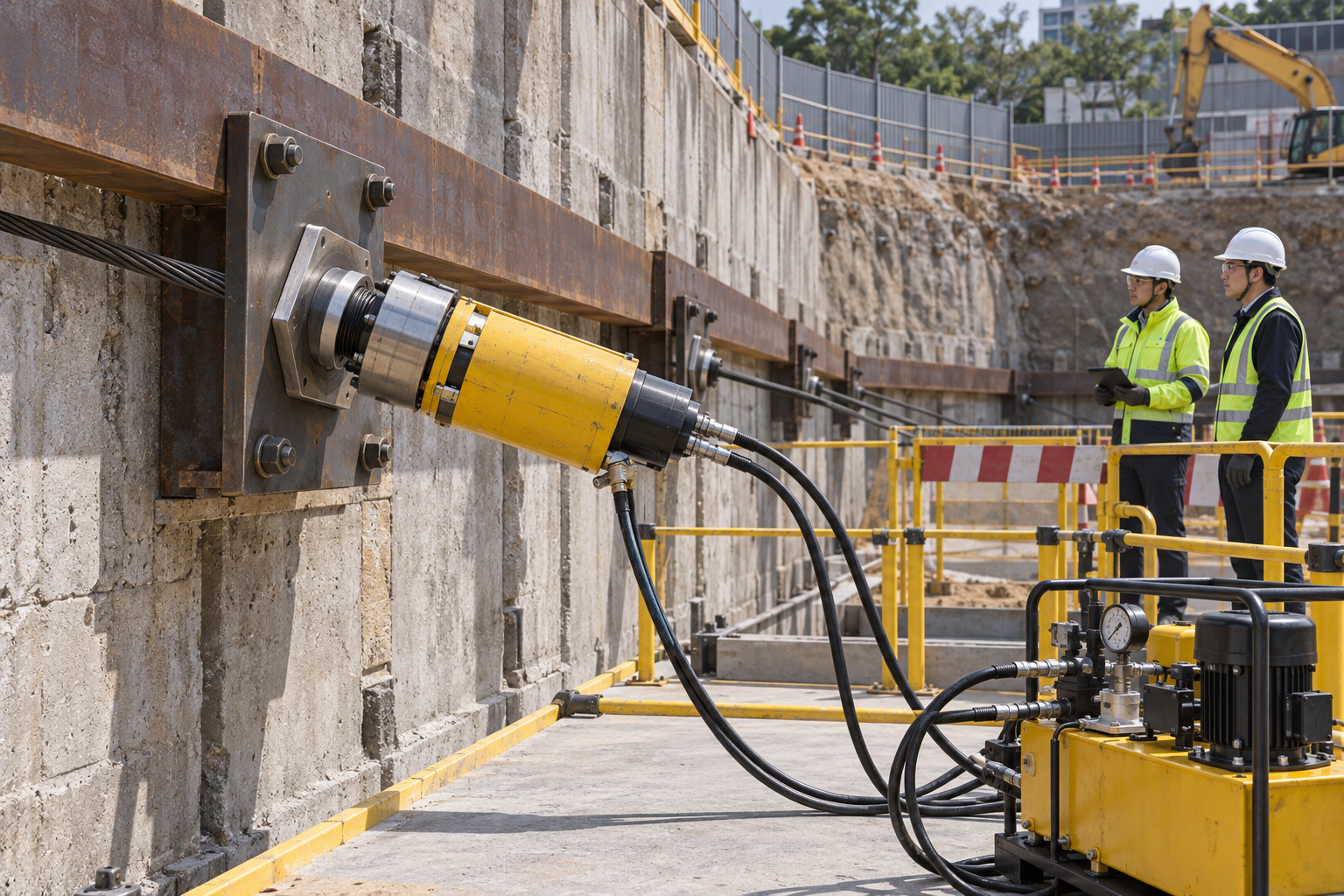
Retained AI-generated educational illustration from the source edition; not a real incident photograph, approved installation drawing or evidence of equipment suitability.
The scenario and record comparisons are fictional teaching examples, not records of real incidents, measurements, inspections, signatures or approvals.
| Item | Fictional scenario |
|---|---|
| Initial | A cured anchor is undergoing its planned load test. |
| Change | Movement continues near the intended load and the bearing assembly shifts. |
| Failure | The crew treats gauge pressure as the sole pass criterion. |
| Outcome | Tendon failure, anchorage release or inadequate excavation support can follow. |
| Barrier | Stop loading, clear the tendon axis and compare calibration, reaction and load-time-movement records before an engineered recovery decision. |
Why the controls matter
Pump pressure is not tendon force. Link the actual jack and gauge to their valid calibration relationship and confirm that the reaction arrangement matches the test plan.
Load, elapsed time and movement must be interpreted together. Reaching the pressure target does not establish bond performance, acceptable creep or sound anchorage.
Testing and lock-off are different transitions. Check load transfer and seating loss before equipment removal; one accepted anchor does not release the entire excavation support stage.
Decision sequence
| Step | Decision |
|---|---|
| Known | Movement continues near the intended load and the bearing assembly shifts. |
| Unknown | Actual condition, extent of damage and suitability of curing evidence, equipment ids remain to be established. |
| Hold | The crew treats gauge pressure as the sole pass criterion. |
| Evidence | Link curing evidence, equipment ids, calibration relationship, reaction condition, residual tension, hydraulic state to the affected equipment or work area. |
| Next | Stop loading, clear the tendon axis and compare calibration, reaction and load-time-movement records before an engineered recovery decision. |
5. Conditional decisions and common errors
| Condition | Action | Evidence | Proceed when |
|---|---|---|---|
| Curing unclear | Hold stressing | Grout and strength evidence | Curing criteria met |
| Gauge mismatch | Match jack and gauge | Equipment IDs and calibration | Calibration matched |
| Movement change | Stop and investigate | Load-time-movement record | Cause addressed |
| Next excavation | Review the whole support stage | Lock-off and monitoring records | Stage released |
Similar appearance, different evidence
The scenario and record comparisons are fictional teaching examples, not records of real incidents, measurements, inspections, signatures or approvals.
| Comparison | Supported decision | Insufficient basis |
|---|---|---|
| Condition | Grout and strength evidence | Curing unclear has not been resolved. |
| Evidence | Load-time-movement record | A photograph or a completed-looking task without the relevant inspection record. |
| Release | Stage released | Completion of one step does not release the excluded tasks in section 2. |
6. Roles and responsibilities
| Role | Responsibility |
|---|---|
| Work supervisor | Assign the task boundary, stop authority, interfaces and emergency communication for ground anchor drilling and stressing. |
| Technical lead | Confirm Utility clearances; Anchor drawing; Ground information; Acceptance criteria. Resolve design and manufacturer limits before work. |
| Authorized crew | Apply Rod handling isolation; Depth and angle; Water and strata; Bore condition. Stop when the working arrangement changes. |
| Inspector / receiving lead | Review Curing evidence; Equipment IDs; Calibration relationship; Reaction condition. Transfer Anchor ID and result; Lock-off protection; Monitoring trends; Excavation hold point. |
Role labels allocate responsibilities; they do not confer a legal qualification. Verify the competence, training and authority required for the actual task.
Record and handoff perspective
| Stage | Record controls | Verification |
|---|---|---|
| Confirm design | 1. Record utility clearances2. Record anchor drawing3. Record ground information | 1. Anchor drawing2. Ground information3. Acceptance criteria |
| Drill bore | 1. Record rod handling isolation2. Record depth and angle3. Record water and strata | 1. Depth and angle2. Water and strata3. Bore condition |
| Insert and grout | 1. Record tendon protection2. Record free and bond lengths3. Record grout batch and volume | 1. Free and bond lengths2. Grout batch and volume3. Connections and pressure |
| Prepare test | 1. Record curing evidence2. Record equipment ids3. Record calibration relationship | 1. Equipment IDs2. Calibration relationship3. Reaction condition |
| Hold defects | 1. Record residual tension2. Record hydraulic state3. Record cause and repairs | 1. Hydraulic state2. Cause and repairs3. Retest authorization |
| Stage handoff | 1. Record anchor id and result2. Record lock-off protection3. Record monitoring trends | 1. Lock-off protection2. Monitoring trends3. Excavation hold point |
7. Hold points and record comparison
| Hold point | Evidence before release | Actual record |
|---|---|---|
| HP-0 Start | Drill, install tendons, grout, verify curing, test, stress and lock off ground anchors, then hand over the excavation stage. | |
| HP-1 Insert and grout | Tendon protection; Free and bond lengths; Grout batch and volume; Connections and pressure | |
| HP-2 Prepare test | Curing evidence; Equipment IDs; Calibration relationship; Reaction condition | |
| HP-3 Stress and lock | Load-time trace; Movement and creep; Lock-off result; Bearing movement | |
| HP-4 Stage handoff | Anchor ID and result; Lock-off protection; Monitoring trends; Excavation hold point |
These are internal hold points, not issued permits. Recheck affected points after a change, fault or shift handoff; link the actual approval record.
Record comparison
The scenario and record comparisons are fictional teaching examples, not records of real incidents, measurements, inspections, signatures or approvals.
The boxes are static record prompts, not interactive or saved approvals. A tick does not establish suitability or permission to restart. Record the evidence, person, time and unresolved issues; retain the change history.
| Record | Insufficient | Record checklist |
|---|---|---|
| Confirm design | "Checked" without target, criteria or result | □ Utility clearances□ Anchor drawing□ Ground information□ Acceptance criteria |
| Drill bore | "Checked" without target, criteria or result | □ Rod handling isolation□ Depth and angle□ Water and strata□ Bore condition |
| Prepare test | "Checked" without target, criteria or result | □ Curing evidence□ Equipment IDs□ Calibration relationship□ Reaction condition |
| Stage handoff | "Checked" without target, criteria or result | □ Anchor ID and result□ Lock-off protection□ Monitoring trends□ Excavation hold point |
8. Site checklist and emergency response
| Check | Result | Person / action |
|---|---|---|
| □ Confirm design: Utility clearances | ||
| □ Set drilling rig: Platform inspection | ||
| □ Drill bore: Rod handling isolation | ||
| □ Insert and grout: Tendon protection | ||
| □ Prepare test: Curing evidence | ||
| □ Stress and lock: Load-time trace | ||
| □ Hold defects: Residual tension | ||
| □ Stage handoff: Anchor ID and result | ||
| □ Emergency access and handoff restrictions |
Stop work
Stop loading for sudden pressure or movement changes, moving bearing assemblies, tendon damage or hydraulic defects. Clear the tendon axis and keep further stressing and excavation on hold.
Emergency response
Stop from a safe location, exclude people from the affected danger zone and activate the site emergency plan. Call 911 for injury or immediate danger. Do not enter an unstable, energized or confined danger area for an improvised rescue; trained responders must control the specific energy and access hazards.
9. Sources and review limits
Public-source review: 2026-10-12. Official regulation pages and specific technical references are distinguished below; no agency or manufacturer has approved this content.
| Source | Reviewed scope and limitation |
|---|---|
| OSHA 29 CFR 1926.651 | Underground installations, excavation conditions and competent-person inspections. |
| OSHA 29 CFR 1926.652 | Protective-system selection and design documentation. |
| FHWA GEC 4: Ground Anchors and Anchored Systems | 1999 technical guidance, section 7.3 and calibration discussion reviewed. Historical engineering guidance; project-specific criteria and equipment calibration must be approved. No universal test load or calibration interval adopted. |
| OSHA State Plans | Official overview of federal and State Plan jurisdiction and differing public-sector coverage, checked 2026-10-12. Individual state rules require a site-specific check. |
No site measurements, equipment manuals for the actual installation, inspection records or signed technical approvals were supplied. Confirm the applicable requirements and actual product instructions before use; record each criterion with its units, source and equipment or work-area ID.
10. PDF guidance and FAQ
PDF A covers basic task controls; B focuses on technical failures; C covers supervision, records and handover. The article has eight stages with four items per main cell; each PDF has six key stages with three items per main cell. P/S/R/A, measurements, confirmations and signatures remain blank for actual site assessment.
Content group
jsa-anchor-stressing
Is target pump pressure a passing test?
No. Use the calibrated load and the approved time, movement and lock-off acceptance criteria.
Can another jack calibration chart be used?
The calibration must apply to the actual jack and measuring system.
Can the jack be removed after the test peak?
Only after the approved load-transfer, lock-off and removal conditions are satisfied.
Does one passing anchor permit deeper excavation?
No. The entire support stage, monitoring trends and unresolved anchors must be reviewed.
Has a professional approved this JSA?
This reference material was written and revised with AI. It has not been verified or approved by a professional. Review by a suitably qualified professional and required site approval are necessary before field use.
11. Revision history and authorship
This reference material was written and revised with AI. It has not been verified or approved by a professional. Review by a suitably qualified professional and required site approval are necessary before field use.
Korean source created 2026-09-19. This US edition adapts the Korean source; earlier editorial revisions do not constitute professional approval of this edition.
| Date | Edition | Change | Review status |
|---|---|---|---|
| 2026-10-12 | 1.0 | US localization: preserve task judgments; replace Korean legal applicability with scoped US references. | AI editorial and output checks; no professional technical approval. |