A blocked tip can stop visible spray while pressure remains behind the blockage. Stopping the pump or setting the trigger lock does not establish a safe opening condition. Follow the complete model procedure; uncertainty about a blockage requires its designated residual-pressure process and competent assistance.
This is reference content written and revised with AI. It has not been verified or approved by a professional. Review by a suitably qualified professional and site authorization are required before use.
Stop before starting
Stop for uncertain cleaner compatibility, missing ventilation/grounding, unverified relief, static discharge, leakage, damaged parts or a failed trigger lock. Do not raise pressure or loosen fittings to diagnose a blockage.
1. Legal and technical scope
| Basis | Scope and limits |
|---|---|
| OSHA 1910.147 | Servicing scope, stored energy and verification; construction excluded. |
| OSHA 1910.107 | Applicable spray finishing: cleaning-solvent/booth ventilation conditions and ignition control; not every cleaning process. |
| OSHA 1926.302 | Construction airless-gun trigger/tip safeguards; not a universal water-hose rule. |
| Graco Contractor PC 3A6285M | Model example: pressure-relief, compatible cleaner, guard and filter care. Match the actual gun, pump and hose manuals; no model is certified here. |
Resolve general-industry maintenance versus construction and the applicable State Plan. Covered servicing requires the employer hazardous-energy procedure under 1910.147; the rule excludes construction. Where 1910.107 applies to flammable/combustible spray finishing, its cleaning-solvent, booth ventilation and ignition controls also matter. Construction airless-gun safeguards are addressed in 1926.302(b)(8)-(9). Neither a trigger lock nor this worksheet proves pressure relief.
2. Scope and required inputs
Included work
Routine tip, guard and gun-filter cleaning of an identified professional airless system in a suitable cleaning area after verified pressure relief. Match coating, cleaner and wetted parts before opening the gun.
Separate assessment
Pump, regulator or hose repair; needle/cartridge rebuilding; pressurized disassembly; improvised blockage clearing; confined-space spraying and two-component reactive systems require separate procedures.
| Required input | Evidence to obtain |
|---|---|
| Identify system | Coating identity; Cleaner compatibility; Gun and pump IDs; Parts specification |
| Prepare area | Ventilation status; Ground and container; Exclusion boundary; Waste arrangement |
| Relieve pressure | Relief procedure; Lock condition; Residual-pressure proof; Collection direction |
| Remove and inspect | Safe opening state; Tip and guard ID; Seal locations; Filter condition |
No actual equipment model, SDS, site measurements, design calculations or authorization record was supplied. Product-specific limits and methods must be verified before use. Federal OSHA is a baseline within its scope; determine the applicable State Plan and local requirements. Manufacturer guidance is not government approval; an incorporated standard differs from voluntary guidance. No nationwide-compliance or expert-approval claim is made.
3. Eight-stage JSA
| Job stage | Hazards and effects | Failure factors | Technical and procedural controls | Site verification | P | S | R | A |
|---|---|---|---|---|---|---|---|---|
| 1. Identify system | 1. Chemical reaction2. Vapor exposure3. Wrong parts4. Fluid leakage | 1. Unknown coating2. Cleaner mismatch3. Wrong gun ID4. Seal mismatch | 1. Match coating SDS2. Check wetted parts3. Identify gun and hose4. Select specified parts | 1. Coating identity2. Cleaner compatibility3. Gun and pump IDs4. Parts specification | ||||
| 2. Prepare area | 1. Vapor ignition2. Static discharge3. Bystander exposure4. Waste leakage | 1. Poor ventilation2. Insulated collection3. Uncontrolled access4. Mixed waste | 1. Ventilate cleaning area2. Verify grounding path3. Control gun direction4. Contain compatible waste | 1. Ventilation status2. Ground and container3. Exclusion boundary4. Waste arrangement | ||||
| 3. Relieve pressure | 1. Injection injury2. Unexpected jet3. Trapped pressure4. Eye splash | 1. Pump stop only2. Lock misused3. Blocked relief path4. Wrong relief sequence | 1. Follow model relief2. Set lock as directed3. Hold uncertain blockage4. Use safe collection | 1. Relief procedure2. Lock condition3. Residual-pressure proof4. Collection direction | ||||
| 4. Remove and inspect | 1. Residual jet2. Tip contact3. Lost seals4. Filter damage | 1. Opening before relief2. Finger at orifice3. Parts order lost4. Improvised tools | 1. Verify relief first2. Keep hands off tip3. Retain parts order4. Use specified tools | 1. Safe opening state2. Tip and guard ID3. Seal locations4. Filter condition | ||||
| 5. Clean components | 1. Skin exposure2. Eye splash3. Orifice damage4. Vapor buildup | 1. Wrong glove material2. Rapid brushing3. Hard scraping4. Ventilation stopped | 1. Use compatible cleaner2. Limit splash3. Use designated tools4. Maintain ventilation | 1. Cleaner and PPE2. Cleaning direction3. Orifice condition4. Air and waste control | ||||
| 6. Restore and test | 1. Missing guard2. Injection leak3. Static ignition4. Abnormal spray | 1. Seal reversed2. Loose fitting3. Ground path lost4. Damaged tip reused | 1. Restore specified parts2. Check lock and joints3. Maintain safe test zone4. Stop abnormal function | 1. Guard and filter2. Seal and lock3. Ground path4. Leak and pattern test | ||||
| 7. Hold abnormality | 1. Repeated injection2. Pressure escalation3. Static recurrence4. Damaged parts reused | 1. Blockage unresolved2. Pressure raised to clear3. Leak touched by hand4. Unrecorded repair | 1. Stop and re-relieve2. Refer blocked line3. Correct defect cause4. Verify before release | 1. Fault and location2. Relief confirmation3. Replacement evidence4. Retest and release | ||||
| 8. Close and hand over | 1. Stored pressure2. Waste fire3. Bad tip reused4. Unsafe next use | 1. End relief omitted2. Rags left exposed3. Defects not marked4. Restrictions lost | 1. Relieve and lock2. Use approved waste cans3. Quarantine bad parts4. Record work and limits | 1. End safe state2. Waste disposal3. Parts replaced4. Recipient and limits |
P = likelihood; S = severity; R = risk under the site method; A = site-defined acceptance/authorization. These actual assessment cells are blank. A low score never overrides a missing safeguard or a legal or manufacturer restriction.
4. Fictional scenario and failure mechanisms
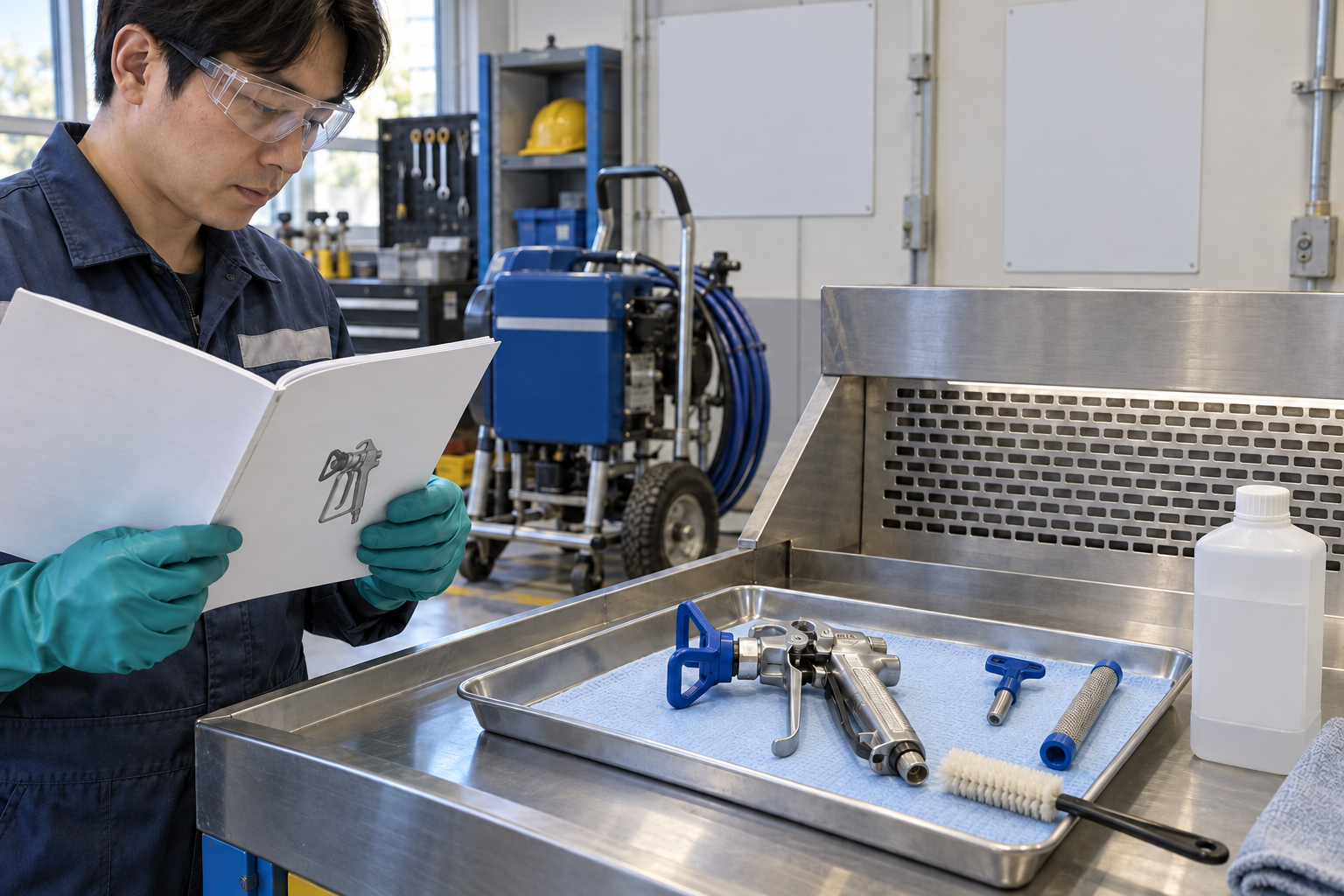
This illustration provides educational context. It is not an actual incident photograph or evidence of equipment suitability; any AI-generated depiction is illustrative only.
The scenario and record comparisons are fictional teaching examples, not records of real incidents, measurements, inspections, signatures or approvals.
| Stage | Fictional situation |
|---|---|
| Initial situation | A fictional crew has no spray from an airless gun and wants to clean its tip. |
| Changed condition | The pump is switched off, but the blocked-line relief status and the ordinary plastic collection bucket are unverified. |
| Failure path | Loosening the fitting can release trapped fluid; unsuitable collection can add ignition exposure. |
| Possible outcome | Possible outcomes include injection, eye exposure and fire. No actual injury or measurement is asserted. |
| Prevention barrier | Hold disassembly; establish model-specific relief, compatible cleaner and safe collection before inspection and controlled restoration. |
Failure mechanisms
A blocked tip can stop visible spray while pressure remains behind the blockage. Stopping the pump or setting the trigger lock does not establish a safe opening condition. Follow the complete model procedure; uncertainty about a blockage requires its designated residual-pressure process and competent assistance.
A cleaner that dissolves paint can still attack seals, hoses or aluminum wetted parts. Match both the coating SDS and equipment compatibility. Keep ventilation, conductive collection arrangements and ignition controls effective through cleaning and testing.
A smooth-looking orifice does not establish the correct spray geometry. Improvised scraping or enlarged holes can damage the tip. Inspect seals, filter and guard separately, restore their specified configuration, and conduct the controlled leak/function check before handover.
Work sequence: Identify system → Prepare area → Relieve pressure → Remove and inspect → Clean components → Restore and test → Hold abnormality → Close and hand over. This is a teaching flow, not a device drawing or a complete operating procedure.
5. Conditional decisions and common errors
| Situation | Required action | Evidence | Proceed when |
|---|---|---|---|
| No spray | Hold opening; verify blocked-line relief | Model procedure and relief evidence | Residual pressure controlled |
| Cleaner uncertain | Do not mix or substitute | SDS and wetted-part compatibility | Cleaner approved for system |
| Leak during test | Stop; relieve by procedure | Seal, fitting and guard inspection | Defect corrected and retested |
| Cleaning finished | Restore and check before release | Guard, lock and function evidence | System accepted for use |
Similar observations, different decisions
The scenario and record comparisons are fictional teaching examples, not records of real incidents, measurements, inspections, signatures or approvals.
| Observation | Insufficient conclusion | Required distinction |
|---|---|---|
| No discharge | A blocked outlet can retain pressure | Verified relief covers the blockage |
| Trigger lock | Prevents unintended triggering | Does not vent stored pressure |
| Clean tip | Visible paint removed | Geometry, seal and guard still need checking |
6. Roles and responsibilities
| Role | Responsibility |
|---|---|
| Work supervisor | Confirm coating identity and the task scope, resources, interfaces and stop authority. |
| Qualified technical reviewer | Review ventilation status, model limits, compatibility and unresolved technical conditions within assigned competence. |
| Work crew | Apply the listed controls, report changes and stop when evidence or safeguards are missing. |
| Inspector / assessor | Record actual cleaner and ppe and other relevant checks; do not mark unverified conditions as accepted. |
| Handover authority | Reconcile end safe state, restrictions and outstanding actions before the next task. Role labels do not establish a legal credential. |
Supervision and handover focus
| Stage | Management action | Evidence |
|---|---|---|
| Identify system | 1. Record coating identity2. Record cleaner compatibility3. Record gun and pump ids | 1. Coating identity2. Cleaner compatibility3. Gun and pump IDs |
| Prepare area | 1. Record ventilation status2. Record ground and container3. Record exclusion boundary | 1. Ventilation status2. Ground and container3. Exclusion boundary |
| Remove and inspect | 1. Record safe opening state2. Record tip and guard id3. Record seal locations | 1. Safe opening state2. Tip and guard ID3. Seal locations |
| Clean components | 1. Record cleaner and ppe2. Record cleaning direction3. Record orifice condition | 1. Cleaner and PPE2. Cleaning direction3. Orifice condition |
| Hold abnormality | 1. Record fault and location2. Record relief confirmation3. Record replacement evidence | 1. Fault and location2. Relief confirmation3. Replacement evidence |
| Close and hand over | 1. Record end safe state2. Record waste disposal3. Record parts replaced | 1. End safe state2. Waste disposal3. Parts replaced |
7. Hold points and record comparison
| Hold point | Evidence before release | Actual approval |
|---|---|---|
| HP-0 Scope | Routine tip, guard and gun-filter cleaning of an identified professional airless system in a suitable cleaning area after verified pressure relief. Match coating, cleaner and wetted parts before opening the gun. | |
| HP-1 Prepare area | Ventilation status; Ground and container; Exclusion boundary; Waste arrangement | |
| HP-2 Remove and inspect | Safe opening state; Tip and guard ID; Seal locations; Filter condition | |
| HP-3 Hold abnormality | Fault and location; Relief confirmation; Replacement evidence; Retest and release | |
| HP-4 Close and hand over | End safe state; Waste disposal; Parts replaced; Recipient and limits |
Hold points are internal project checks. They are not universal statutory permits and do not grant work permission. Reassess after defects, changed conditions and shift changes.
Record comparison
The scenario and record comparisons are fictional teaching examples, not records of real incidents, measurements, inspections, signatures or approvals.
The boxes are static record prompts, not interactive or saved approvals. A tick does not establish suitability or permission to restart. Record the evidence, person, time and unresolved issues; retain the change history.
| Record | Insufficient record | Record checklist |
|---|---|---|
| Identify system | Only marked “OK” | □ Coating identity□ Cleaner compatibility□ Gun and pump IDs□ Parts specification |
| Remove and inspect | Only marked “OK” | □ Safe opening state□ Tip and guard ID□ Seal locations□ Filter condition |
| Hold abnormality | Only marked “OK” | □ Fault and location□ Relief confirmation□ Replacement evidence□ Retest and release |
| Close and hand over | Only marked “OK” | □ End safe state□ Waste disposal□ Parts replaced□ Recipient and limits |
8. Site checklist and emergency response
| Site check | Actual result | Person / action |
|---|---|---|
| Identify system: Coating identity; Cleaner compatibility; Gun and pump IDs; Parts specification | ||
| Prepare area: Ventilation status; Ground and container; Exclusion boundary; Waste arrangement | ||
| Relieve pressure: Relief procedure; Lock condition; Residual-pressure proof; Collection direction | ||
| Remove and inspect: Safe opening state; Tip and guard ID; Seal locations; Filter condition | ||
| Clean components: Cleaner and PPE; Cleaning direction; Orifice condition; Air and waste control | ||
| Restore and test: Guard and filter; Seal and lock; Ground path; Leak and pattern test | ||
| Hold abnormality: Fault and location; Relief confirmation; Replacement evidence; Retest and release | ||
| Close and hand over: End safe state; Waste disposal; Parts replaced; Recipient and limits |
Stop work
Stop for uncertain cleaner compatibility, missing ventilation/grounding, unverified relief, static discharge, leakage, damaged parts or a failed trigger lock. Do not raise pressure or loosen fittings to diagnose a blockage.
Emergency response
Stop safely and keep others clear. Suspected high-pressure injection needs immediate emergency medical care even when the wound is tiny; provide fluid identification and SDS. Use the site emergency plan and call 911 when emergency assistance is needed. Avoid operating unapproved electrical devices in a potentially flammable atmosphere.
9. Sources and review limits
Public-source access/review: 2026-10-12.
| Official source | Reviewed scope and limits |
|---|---|
| OSHA 1910.147 | Servicing scope, stored energy and verification; construction excluded. |
| OSHA 1910.107 | Applicable spray finishing: cleaning-solvent/booth ventilation conditions and ignition control; not every cleaning process. |
| OSHA 1926.302 | Construction airless-gun trigger/tip safeguards; not a universal water-hose rule. |
| Graco Contractor PC 3A6285M | Model example: pressure-relief, compatible cleaner, guard and filter care. Match the actual gun, pump and hose manuals; no model is certified here. |
No actual equipment model, SDS, site measurements, design calculations or authorization record was supplied. Product-specific limits and methods must be verified before use. Federal OSHA is a baseline within its scope; determine the applicable State Plan and local requirements. Manufacturer guidance is not government approval; an incorporated standard differs from voluntary guidance. No nationwide-compliance or expert-approval claim is made.
10. PDF guidance and FAQ
PDF A covers basic task controls; B focuses on technical failures; C covers supervision, records and handover. P/S/R/A, measurements, confirmations and signatures remain blank for actual site assessment.
PDFs are complementary six-stage extracts. Apply all eight body stages and the actual equipment/site procedure.
Does switching off the pump make disassembly safe?
No. Verify the complete pressure-relief procedure, including trapped pressure from a blockage, before opening.
Can any paint solvent be used?
No. Check coating removal, wetted-part compatibility, ventilation and ignition controls together.
Can a leak be checked with a gloved finger?
No. Keep all body parts out of the jet path; stop and relieve the system before investigating.
When is the gun ready for handover?
After the specified tip, filter, seals and guard are restored, the lock works and the controlled test shows acceptable function without leakage.
Has a professional verified or approved this document?
No. Public sources and editorial, layout and consistency checks were reviewed using AI. No site inspection or professional technical approval has been performed. Obtain appropriate professional review before use.
11. Revision history and authorship
This is reference content written and revised with AI. It has not been verified or approved by a professional. Review by a suitably qualified professional and site authorization are required before use.
| Date | Version | Change | Review status |
|---|---|---|---|
| 2026-10-12 | US 1.0 | New US edition from assigned Korean source; task decisions, records and PDFs localized. | AI editorial review; no professional technical approval |
Korean edition revision dates: 2026-03-02, 2026-08-01, 2026-09-23. US v1.0 adapts the earlier edition to United States requirements and terminology.
Site reviewers must add their actual qualifications, scope, date and approval only after the review occurs.