Filter replacement changes both the worker exposure and the air path. Confirm the correct unit, control all fan starting modes, contain the used filter, and verify the new filter seal before restoring service.
This is reference content written and revised with AI. It has not been verified or approved by a professional. Review by a suitably qualified professional and required site authorization are necessary before use.
Stop conditions first
Do not open the unit with unidentified isolation points or any fan movement. Hold work for unknown contamination, mold or leakage, excessive dust release, wrong filters, damaged tracks or seals, or unsafe access.
1. US legal and technical basis
General-industry facility maintenance. Evaluate 1910.147 for servicing hazards; construction employment is excluded from that section and needs its own applicable construction requirements. Electrical work on exposed conductors requires a separate qualified electrical work procedure.
| Reference | Use and limit |
|---|---|
| OSHA 29 CFR 1910.147 | Servicing scope, control-circuit limitations, stored energy, verification and controlled restoration; construction exclusion noted. |
| OSHA 29 CFR 1910.132 | PPE hazard assessment and suitable protection; filter contamination must determine exposure controls. |
| OSHA State Plans | Federal baseline and State Plan coverage reviewed. Confirm the applicable state program and employer coverage; this edition does not establish nationwide compliance. |
Determine whether Federal OSHA or an applicable State Plan governs the employer and work. Standards incorporated into a regulation must be read in their legally applicable edition. Other NFPA/ANSI guidance and manufacturer instructions have distinct roles; they are not automatically federal law.
2. Scope and required inputs
Included
Replace ordinary disposable HVAC filters through an external access opening from a stable floor. No person enters the air handler.
Separate assessment
Internal entry, elevated access, suspected infectious/process/asbestos contamination, HEPA integrity testing, UV treatment and electrostatic-cleaner servicing require separate analysis.
| Input | Evidence needed |
|---|---|
| Identify unit | Unit ID and operator; Filter part and grade; Service interruption plan; Contamination history |
| Isolate fan | Isolation-point list; Lockout verification; Fan-motion check; Accessory identification |
| Remove used filter | Visible damage; Package suitability; Contact protection; Removal arrangement |
| Dispose and hand over | Waste destination; Parts and positions; Date and reading record; Next inspection owner |
Selected public official provisions were checked on October 12, 2026. This is not a complete legal audit. No actual equipment manual, site measurements, engineering calculations, product certification or professional technical approval was supplied. Full paid NFPA/ANSI standards and state/local amendments were not reviewed. Check actual equipment, jurisdiction and project requirements before use.
Select task-appropriate eye, hand, foot, skin and hearing protection from the exposure assessment. Where respiratory protection is necessary, use the applicable respiratory-protection program; PPE does not replace isolation, guarding, support or ventilation.
3. Eight-stage JSA
| Job stage | Hazards and effects | Failure factors | Controls | Site verification | P | S | R | A |
|---|---|---|---|---|---|---|---|---|
| 1. Identify unit | 1. Wrong unit stopped2. Unsuitable filter3. Service interruption4. Hidden contamination | 1. Tag mismatch2. Size-only selection3. Operator not informed4. History omitted | 1. Match unit and service2. Check grade and frame3. Coordinate shutdown4. Review contamination | 1. Unit ID and operator2. Filter part and grade3. Service interruption plan4. Contamination history | ||||
| 2. Isolate fan | 1. Fan contact2. Unexpected restart3. Accessory exposure4. Residual rotation | 1. Remote OFF only2. Auto-start retained3. Accessory feed missed4. Airflow drives fan | 1. Isolate all sources2. Control automatic starts3. Verify isolation and zero motion4. Verify accessory state | 1. Isolation-point list2. Lockout verification3. Fan-motion check4. Accessory identification | ||||
| 3. Prepare access | 1. Door movement2. Dust inhalation3. Pinched fingers4. Blocked withdrawal | 1. Pressure remains2. Residue unknown3. Door unsecured4. Access obstructed | 1. Confirm safe pressure2. Set exposure controls3. Secure access door4. Clear removal path | 1. Door pressure state2. Handling and PPE plan3. Door restraint4. Withdrawal space | ||||
| 4. Remove used filter | 1. Dust release2. Contaminated contact3. Frame cuts4. Dropped filter | 1. Filter shaken2. Packaging absent3. Broken frame gripped4. Load not supported | 1. Withdraw without shaking2. Bag at removal point3. Protect sharp edges4. Support filter weight | 1. Visible damage2. Package suitability3. Contact protection4. Removal arrangement | ||||
| 5. Fit replacement | 1. Air bypass2. Filter collapse3. Wrong filtration4. Loose frame | 1. Seal damaged2. Airflow reversed3. Wrong filter grade4. Fastener omitted | 1. Match part and direction2. Inspect tracks and seals3. Check grade and count4. Secure each position | 1. Part and airflow marks2. Seal continuity3. Installed count4. Retainer condition | ||||
| 6. Restore and start | 1. Tool drawn into fan2. Open rotating parts3. Dust recirculation4. Unexpected occupant impact | 1. Tools left inside2. Door not secured3. Waste remains4. No restart notice | 1. Account for tools and waste2. Close doors and guards3. Clear and notify staff4. Use controlled restart | 1. Tool and waste count2. Door closure3. People clear4. Restart authorization | ||||
| 7. Check operation | 1. Bypass leakage2. Abnormal pressure drop3. Filter deformation4. Missed service fault | 1. Low reading accepted2. Fan condition changed3. Seal gap overlooked4. Noise ignored | 1. Compare operating state2. Check specified readings3. Inspect safe indicators4. Stop on abnormality | 1. Fan operating condition2. Pressure-drop basis3. Seal and defect report4. Corrective action | ||||
| 8. Dispose and hand over | 1. Contaminant spread2. Wrong future replacement3. History loss4. Premature acceptance | 1. Bag reopened2. Location omitted3. Readings unlinked4. Defect concealed | 1. Keep waste contained2. Record filter locations3. Link baseline readings4. Transfer open issues | 1. Waste destination2. Parts and positions3. Date and reading record4. Next inspection owner |
Actual risk assessments, measurements, checks, approvals and signatures have not been performed. Keep unverified fields blank and link the actual site records. P/S/R/A mean likelihood, severity, site-method risk and site-defined acceptance/authorization; a score cannot waive a required control.
4. Failure mechanisms and hypothetical case
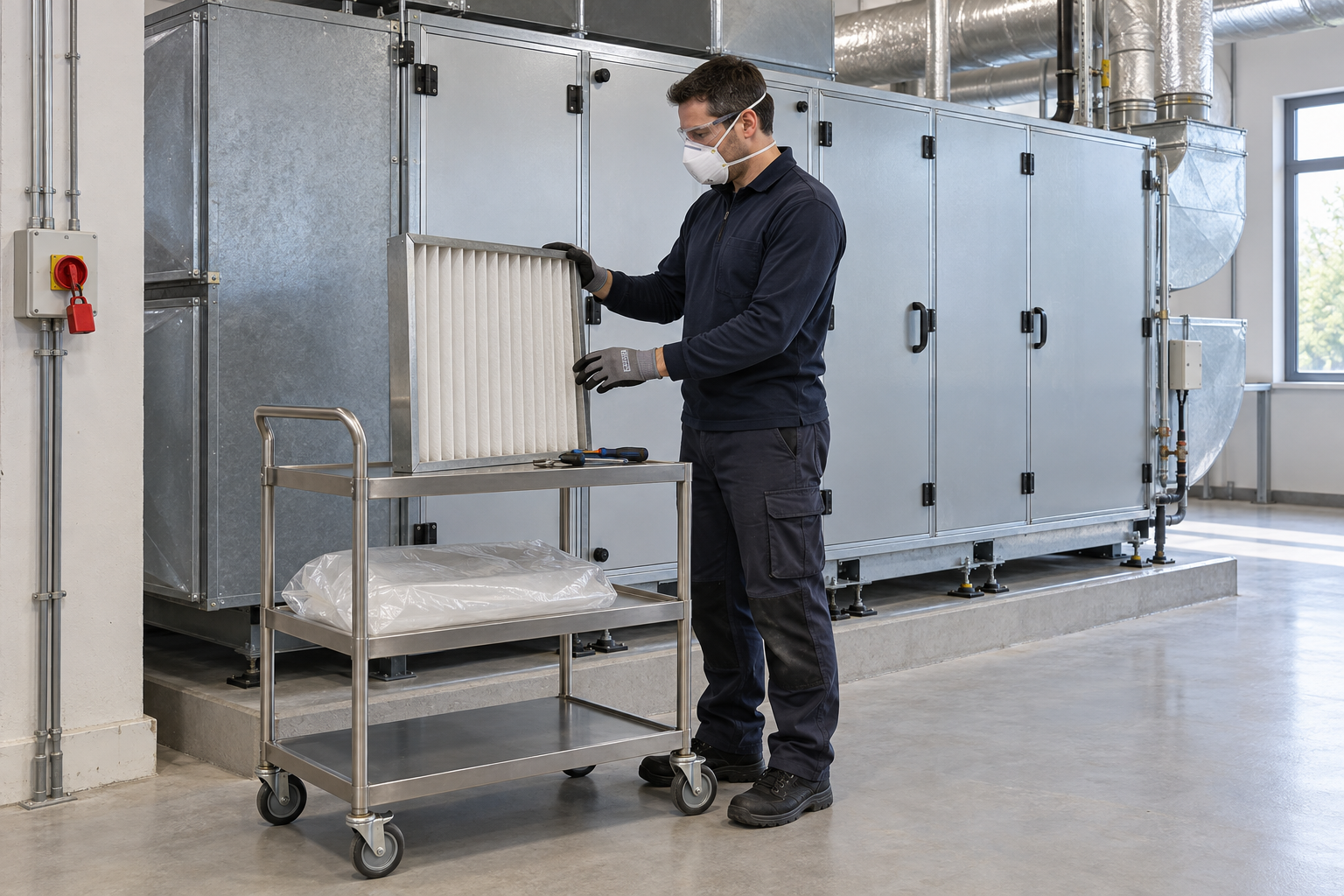
The retained illustration is an AI-generated educational image from the Korean source. It is not an actual incident photograph, approved drawing, equipment certification or proof that the depicted arrangement is safe.
A lower pressure drop is not proof of a successful replacement. A missing filter, edge gap or changed fan operating point can also reduce the reading. Compare readings under documented operating conditions and verify the complete air path.
A remote OFF command does not physically isolate energy. Identify local, building-control and automatic restart sources, accessories and residual rotation. Verify the isolation under the site energy-control program before opening access.
Do not shake or blow out a disposable filter for reuse. Unexpected mold, leakage or process residues change the exposure and disposal assessment; stop and obtain an appropriate containment plan.
Hypothetical decision example
Hypothetical example: pressure drop falls after replacement, but one filter edge has a visible gap and the new frame is thinner. The reading alone cannot release the unit.
The example is fictional; no incident, measurement, inspection or approval is asserted.
Task flow: Identify unit → Isolate fan → Prepare access → Remove used filter → Fit replacement → Restore and start → Check operation → Dispose and hand over
5. Hold and proceed decisions
| Condition | Action | Evidence | Proceed when |
|---|---|---|---|
| Edge gap | Stop and isolate before correction | Part number, track and seal inspection | Correct fit and seal |
| Fan movement | Keep access closed; verify all energy paths | Isolation points and zero-motion check | Fan safely stationary |
| Unknown residue | Contain area and reassess handling | Contamination history and disposal plan | Exposure controls ready |
| Restart | Clear tools, restore doors, notify operators | Closure and operating-condition record | Unit closed and cleared |
Similar observation, different conclusion
| Observation | Supported conclusion | What remains unresolved |
|---|---|---|
| Same dimensions | Correct grade, frame and seal documented | Size alone leaves compatibility unresolved |
| Lower pressure drop | Seal and fan conditions checked | Low reading alone could indicate bypass |
6. Roles and supervision
| Role | Responsibility |
|---|---|
| Work supervisor | Coordinate identify unit, affected operations, stop signals and stage transitions. |
| Technical/equipment reviewer | Verify Unit ID and operator, Filter part and grade, actual instructions and unresolved technical limits. |
| Task crew | Apply the stated controls, report changes and keep actual checks and signatures factual. |
| Inspector/test lead | Connect Tool and waste count, Door closure to the required acceptance criteria. |
| Receiving authority | Accept the recorded restrictions, Date and reading record, Next inspection owner, and follow-up ownership. |
These are responsibility examples, not invented statutory credentials. Verify actual competence, training and authority for the assigned work.
Supervision and handover controls
| Stage | Management controls | Evidence |
|---|---|---|
| Plan review | 1. Assign technical owner2. Close task-specific questions3. Match unit and service | 1. Unit ID and operator2. Filter part and grade3. Contamination history |
| Competence | 1. Verify required competence2. Assign stop authority3. Isolate all sources | 1. Isolation-point list2. Training and task briefing3. Accessory identification |
| Prestart evidence | 1. Inspect actual equipment2. Link evidence to this stage3. Withdraw without shaking | 1. Visible damage2. Package suitability3. Removal arrangement |
| Change control | 1. Stop and secure the area2. Review affected controls3. Compare operating state | 1. Fan operating condition2. Pressure-drop basis3. Corrective action |
| Shift handover | 1. Identify remaining restrictions2. Confirm receiving responsibility3. Keep waste contained | 1. Waste destination2. Parts and positions3. Next inspection owner |
| Closeout | 1. Record defect disposition2. Archive factual evidence3. Keep waste contained | 1. Waste destination2. Parts and positions3. Next inspection owner |
7. Hold points and record quality
| Hold point | Evidence before release | Actual record |
|---|---|---|
| HP-0 Start | Replace ordinary disposable HVAC filters through an external access opening from a stable floor. No person enters the air handler. | |
| HP-1 Isolate fan | Isolation-point list; Lockout verification; Fan-motion check; Accessory identification | |
| HP-2 Remove used filter | Visible damage; Package suitability; Contact protection; Removal arrangement | |
| HP-3 Check operation | Fan operating condition; Pressure-drop basis; Seal and defect report; Corrective action | |
| HP-4 Dispose and hand over | Waste destination; Parts and positions; Date and reading record; Next inspection owner |
Hold points are internal evidence gates. They do not establish that a statutory permit exists or has been approved. Recheck affected gates after changes, faults and shift handover.
Record comparison - hypothetical templates
The 16 boxes below identify record elements, not completed checks or approvals. They are static symbols. Link equipment/location, date, actual findings and the separate record reference; preserve unresolved items.
| Record | Insufficient entry | Required record elements |
|---|---|---|
| Identify unit | "Checked" without supporting facts | □ Unit ID and operator□ Filter part and grade□ Service interruption plan□ Contamination history |
| Prepare access | "Checked" without supporting facts | □ Door pressure state□ Handling and PPE plan□ Door restraint□ Withdrawal space |
| Fit replacement | "Checked" without supporting facts | □ Part and airflow marks□ Seal continuity□ Installed count□ Retainer condition |
| Check operation | "Checked" without supporting facts | □ Fan operating condition□ Pressure-drop basis□ Seal and defect report□ Corrective action |
8. Pre-work checks and emergency response
| Check required | Result | Checker/action |
|---|---|---|
| Identify unit: Unit ID and operator | ||
| Isolate fan: Isolation-point list | ||
| Prepare access: Door pressure state | ||
| Remove used filter: Visible damage | ||
| Fit replacement: Part and airflow marks | ||
| Restore and start: Tool and waste count | ||
| Check operation: Fan operating condition | ||
| Dispose and hand over: Waste destination |
Stop work
Do not open the unit with unidentified isolation points or any fan movement. Hold work for unknown contamination, mold or leakage, excessive dust release, wrong filters, damaged tracks or seals, or unsafe access.
Emergency response
If a fan moves unexpectedly, stop from a safe location and keep everyone outside the rotating parts and access opening. Have the authorized energy-control personnel secure and verify all sources before anyone approaches. For dust or suspected contamination exposure, leave the affected area, prevent dispersal and follow the site exposure-response plan. Call 911 for serious injury or breathing difficulty; give responders the AHU location, energy state and suspected contaminant. Do not restart or reach inside to attempt a rescue.
9. Official sources and review limits
Official public-source check: October 12, 2026. The review concerns the selected passages described below, not endorsement of this article.
| Official source | Checked scope and limit |
|---|---|
| OSHA 29 CFR 1910.147 | Servicing scope, control-circuit limitations, stored energy, verification and controlled restoration; construction exclusion noted. |
| OSHA 29 CFR 1910.132 | PPE hazard assessment and suitable protection; filter contamination must determine exposure controls. |
| OSHA State Plans | Federal baseline and State Plan coverage reviewed. Confirm the applicable state program and employer coverage; this edition does not establish nationwide compliance. |
Selected public official provisions were checked on October 12, 2026. This is not a complete legal audit. No actual equipment manual, site measurements, engineering calculations, product certification or professional technical approval was supplied. Full paid NFPA/ANSI standards and state/local amendments were not reviewed. Check actual equipment, jurisdiction and project requirements before use.
This is reference content written and revised with AI. It has not been verified or approved by a professional. Review by a suitably qualified professional and required site authorization are necessary before use.
10. PDF use and frequently asked questions
PDF A summarizes core controls; B emphasizes technical failures; C covers supervision, records and handover. Each uses six stages from or aligned with the eight-stage body. All actual risk, measurement, check and signature fields are blank. Use a separate linked record where more space is needed.
Does remote OFF make the unit safe?
No. Use the applicable energy-control procedure, including automatic starts, accessories and residual motion.
What pressure drop requires replacement?
Use the actual unit/filter criteria and operating conditions. This edition supplies no universal setting.
Can a disposable filter be cleaned with air?
This scope is replacement, not cleaning for reuse. Avoid dust dispersal and follow the contamination-specific handling plan.
Does this cover entering the unit?
No. Entry, access, energy and possible confined-space hazards require separate assessment.
Has a professional approved this JSA?
This is reference content written and revised with AI. It has not been verified or approved by a professional. Review by a suitably qualified professional and required site authorization are necessary before use.
11. Authorship and revision history
This is reference content written and revised with AI. It has not been verified or approved by a professional. Review by a suitably qualified professional and required site authorization are necessary before use.
| Date/version | Editorial history | Technical approval |
|---|---|---|
| 2026-09-25 | Korean source retained as an unchanged snapshot; source ID 6f0c3694-48e4-462e-84c4-bbf0e44ef9cf | Not asserted |
| 2026-10-12 / US v1.0 | US localization: Retains the Korean source external-access scope, remote-start controls, seal-gap case, differential-pressure limitation, packaging and handover. Replaces Korean legal references with the US general-industry applicability analysis; does not transplant a model-specific pressure limit. | Not performed |
Source topic: https://smartjsabridge.com/ko/case-study/jsa-ahu-filter-replacement
Content group: jsa-ahu-filter-replacement