Plan safe access and isolate the ceiling equipment as separate systems. A lighting switch being off does not establish a safe maintenance state. Keep the platform rescue controls available while preventing unauthorised operation.
Task → floor → pre-use checks → equipment isolation → positioning → maintenance → lowering → handover
This is reference content written and revised with AI. It has not been verified or approved by a professional. Review by a suitably qualified professional and site authorisation are required before use.
Stop work
Stop for unidentified energy, unverified isolation, floor movement, contact with ceiling structures, equipment fault or loss of communication. Do not blindly lower an entrapped person: movement may tighten the trap.
1. Legal and technical scope
| Basis | Application limits |
|---|---|
| OSHA — scissor lifts | Equipment classification, guardrails, stability, positioning, load and manufacturer instructions. |
| OSHA — 1926.453 | Construction aerial lifts: applicable category, authorised operation, fall protection and operating limits. |
| OSHA — 1910.333 | General-industry electrical safe-work practices and verification; not a universal construction procedure. |
United States: determine general-industry or construction scope and the applicable State Plan. OSHA treats scissor lifts as mobile supported scaffolds; covered boom-type aerial lifts have different provisions. Do not apply 1926.453 indiscriminately to both.
For construction aerial lifts, check 29 CFR 1926.453. For scissor lifts, use the relevant scaffold and fall-protection provisions identified by OSHA. Electrical work requires the applicable electrical safe-work rules; 1910.333 addresses deenergising and verification in general industry. A lock or one meter display alone is not proof of a safe state.
2. Scope and required inputs
Included scope
Inspection and maintenance of identified lighting, ventilation and associated ceiling components from a suitable MEWP, after establishing the required safe equipment state.
Separate review
Live electrical work, opening pressurised or unidentified services, unsupported heavy components and climbing out into the roof structure require separate plans. This reference does not authorise them.
| Required input | What to verify |
|---|---|
| Equipment and task | Identify the component, mass, fixings, normal and emergency supplies, pressure, stored energy and adjacent crane or conveyor movement. |
| Platform and floor | Check model, inspection status, capacity, reach, wheel/stabiliser loads, openings, covers, travel path and operating limits. |
| Isolation | Assign competent authorised personnel; identify separation points, prevention of restart, proving the safe state and reinstatement responsibilities. |
| Rescue | Provide a familiarised ground responder, accessible controls, communication and a rescue method for the particular entrapment or machine fault. |
Use the actual model instructions for load, reach, floor reactions, slope, stabilisers, indoor/outdoor use, protective devices and emergency controls. Four outriggers, a 3-degree slope limit, 50-mm pads, a 2-m exclusion radius and a 0.5-second trip are not universal acceptance criteria. Assess falling-object trajectories, traffic and rescue access for the actual zone.
3. Eight-stage JSA
| Job stage | Hazards and effects | Failure factors | Technical and procedural controls | Site verification | P | S | R | A |
|---|---|---|---|---|---|---|---|---|
| 1. Define task and energy | 1. Electric shock2. Pressure release3. Falling component4. Crane collision | 1. Unknown supply2. Stored energy3. Unknown mass4. Parallel movement | 1. Identify sources2. Plan isolation3. Plan component support4. Coordinate adjacent plant | 1. Equipment records2. Isolation plan3. Mass and fixings4. Work interfaces | ||||
| 2. Check floor and zone | 1. Overturning2. Floor collapse3. Vehicle impact4. Open edge | 1. Excess point load2. Hidden opening3. Mixed traffic4. Wrong setup | 1. Verify support2. Secure openings3. Separate traffic4. Set up to manual | 1. Floor loads2. Openings and edges3. Exclusion zone4. Model and setup | ||||
| 3. Check platform and rescue | 1. Ejection2. Unwanted movement3. Hydraulic failure4. Delayed rescue | 1. Defective guard2. Open gate3. Hydraulic leak4. Blocked rescue controls | 1. Check functions2. Close access gate3. Select fall protection4. Check rescue controls | 1. Pre-use record2. Gate and anchor3. Suitable protection4. Ground rescue access | ||||
| 4. Isolate ceiling equipment | 1. Electric shock2. Fan restart3. Pressure release4. Component movement | 1. Second supply2. Unexpected restart3. Trapped pressure4. Gravity load | 1. Isolate all sources2. Prevent restart3. Verify energy state4. Restrain moving parts | 1. Separation points2. Locks and identification3. Verification record4. Platform rescue available | ||||
| 5. Position without trapping | 1. Entrapment2. Service contact3. Collision4. Ejection | 1. Beam behind worker2. Blind elevation3. Wrong direction4. Snagged platform | 1. Check all clearances2. Move slowly with control3. Confirm direction4. Keep clear of structure | 1. Movement space2. View and signals3. Control direction4. Protective devices | ||||
| 6. Maintain and support parts | 1. Falling component2. Hand injury3. Dropped tool4. Side overload | 1. Fixings removed early2. Sharp edge3. Loose tools4. Pushing with platform | 1. Support before release2. Use suitable tools3. Restrain parts and tools4. Avoid side pushing | 1. Component support2. Removal sequence3. Total platform load4. Safe equipment state | ||||
| 7. Lower and clear | 1. Crushing2. Collision3. Falling parts4. Blocked escape | 1. People below2. Blind descent3. Loose parts4. Poor parking position | 1. Stow loose parts2. Clear descent route3. Coordinate lowering4. Keep escape routes free | 1. Parts secured2. Clear route3. Communication4. Platform condition | ||||
| 8. Handover and reinstate | 1. Unexpected start2. Loose cover3. Rollaway4. Repeated fault | 1. Release missing2. Fixing incomplete3. Unsecured parking4. Unreported defect | 1. Authorise equipment restart2. Check covers3. Park securely4. Report remaining defects | 1. People and tools clear2. Equipment release3. Parking condition4. Handover record |
PDF A covers basic task controls; B focuses on technical failures; C covers supervision, records and handover. The article has eight stages with four items per main cell; each PDF has six key stages with three items per main cell. P/S/R/A, measurements, confirmations and signatures remain blank for actual site assessment.
4. Fictional scenario and failure mechanisms
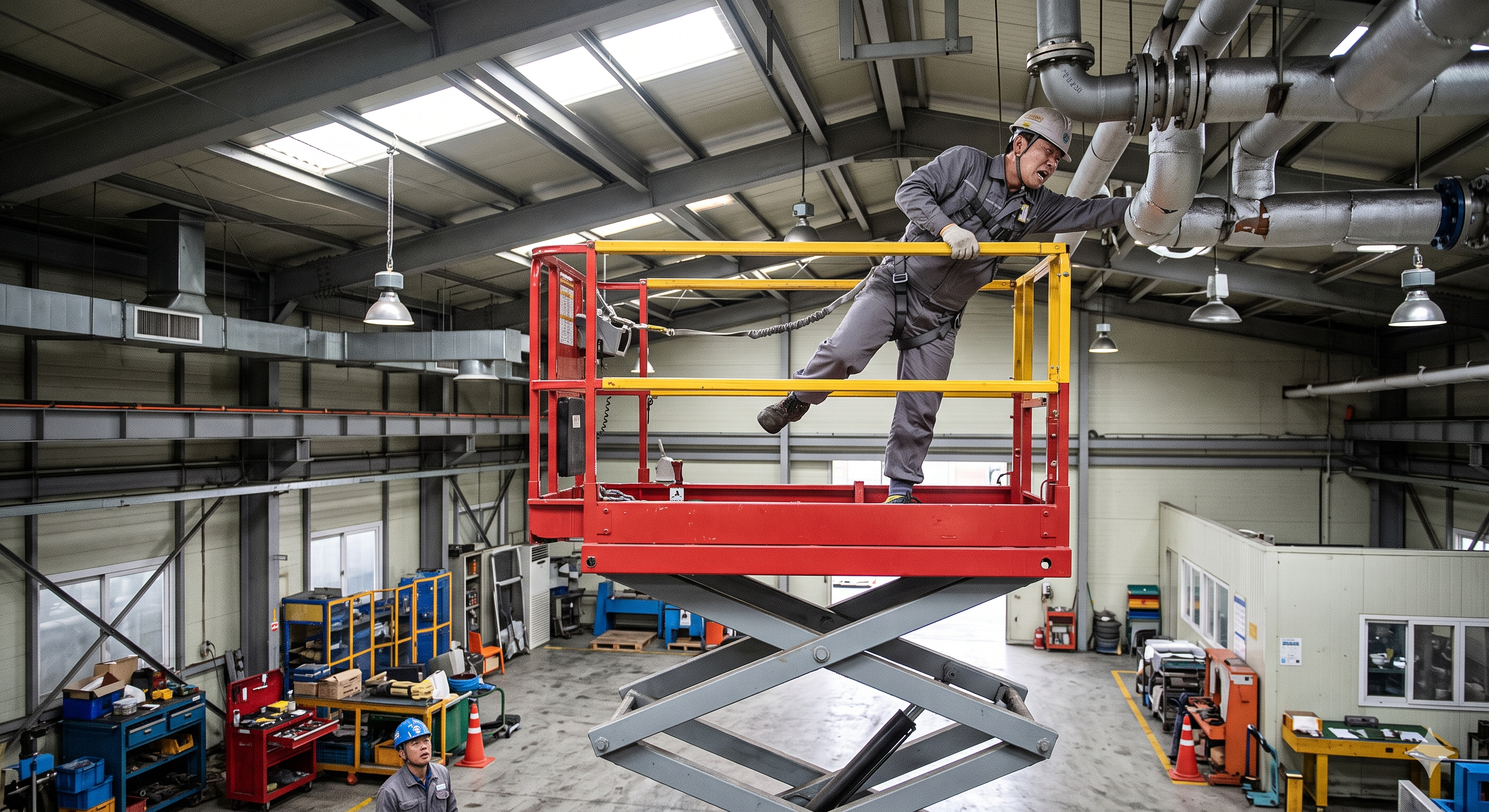
The original educational image is retained. It is not evidence of an actual incident or site suitability.
The scenario and record comparisons are fictional teaching examples, not records of real incidents, measurements, inspections, signatures or approvals.
| Item | Fictional scenario |
|---|---|
| Initial situation | Fictional training example: a worker services a light beneath a ventilation duct. |
| Changed condition | A cross-member moves behind the worker during positioning. |
| Failure path | Further elevation can trap the worker against the controls. |
| Possible outcome | A fitted secondary guard does not prevent every entrapment geometry. |
| Prevention barrier | Stop and apply the planned rescue method suitable for that position. |
Failure mechanisms
Clearance changes between the guardrail, control console, person and fixed ceiling members. A small movement can close the gap. Inspect all directions before moving; secondary guarding supplements route planning and cannot certify a safe gap.
A light can remain hazardous through emergency supply, another circuit or stored energy. One display of 0.00 V does not prove isolation. Authorised personnel must verify the safe state using the applicable procedure and suitable equipment. Separately control fan restart, pressure and gravity.
As fixings are loosened, component weight transfers to remaining fixings or the temporary support. Establish suitable support before release, count removed parts in platform load and restrain tools. Do not use ducts or services as anchors.
Climbing a rail removes the intended protection and increases the chance of falling or ejection. Keep feet on the platform floor; lower and reposition when the work cannot be reached safely. Floor settlement can destabilise the machine, but displacement and overturning cannot be predicted from a single generic settlement value.
Decision sequence
| Decision stage | What to verify |
|---|---|
| Known facts | The light is switched off but its emergency supply is not identified. |
| Unresolved matters | The isolation boundary and safe-state verification are missing. |
| Reason to hold | Opening could expose live parts; disabling all platform controls could also block rescue. |
| Required evidence | Identify every supply, control restart and obtain competent verification for the equipment. |
| Restart decision | Start maintenance only after equipment isolation is confirmed and platform rescue remains available. |
5. Conditional decisions and common errors
| Condition | Action | Evidence | Proceed when |
|---|---|---|---|
| Energy uncertain | Do not open; identify and isolate | Separation points and verification | Isolation confirmed |
| Floor uncertain | Keep platform down; establish support | Point loads, openings and route | Floor suitable |
| Tight clearance | Stop and reposition | Clearance and movement direction | Clearance confirmed |
| Part unsupported | Support before removing fixings | Mass, fixing sequence and support | Part secured |
Similar situations, different decisions
The scenario and record comparisons are fictional teaching examples, not records of real incidents, measurements, inspections, signatures or approvals.
| Comparison | Situation A | Situation B |
|---|---|---|
| Isolation | Switch off; other supplies unknown | Sources isolated and safe state verified |
| Guarding | Sensor fitted; trapping remains possible | Clearance, controls and rescue planned |
| Handover | Platform down; equipment not released | Parts checked; restart separately authorised |
6. Roles and responsibilities
| Role | Responsibility |
|---|---|
| Task supervisor | Defines the component, method and interfaces. |
| Platform operator | Checks the machine, position and movements. |
| Equipment specialist | Establishes isolation and verifies the equipment safe state. |
| Ground responder | Maintains exclusion, communication and rescue access from a safe position outside falling-object and movement hazards. |
| Restart authority | Decides equipment reinstatement after completion checks. |
Supervision, records, handover
| Job stage | Technical and procedural controls | Site verification |
|---|---|---|
| Coordinate task | 1. Define boundaries2. Assign competent people3. Obtain equipment data | 1. Task scope2. Energy sources3. Responsible people |
| Confirm setup | 1. Compare loads2. Check actual setup3. Coordinate traffic | 1. Support capacity2. Actual setup3. Exclusion zone |
| Confirm isolation | 1. Identify sources2. Check security3. Record competent verification | 1. Separation points2. Isolation state3. Verification record |
| Coordinate maintenance | 1. Agree position2. Support components3. Maintain rescue access | 1. Clearance2. Support and load3. Rescue method |
| Handle deviation | 1. Stop and secure2. Choose safe rescue3. Require reassessment | 1. Deviation record2. Rescue decision3. Restart conditions |
| Decide handover | 1. Check completion2. Separate release decisions3. Handover open issues | 1. Component condition2. Restart decision3. Handover record |
7. Hold points and record comparison
| Hold point | Evidence before release | Confirmation / approval |
|---|---|---|
| Start | Inspection and maintenance of identified lighting, ventilation and associated ceiling components from a suitable MEWP, after establishing the required safe equipment state. | |
| HP-1 Check floor and zone | Floor loads · Openings and edges · Exclusion zone · Model and setup | |
| HP-2 Check platform and rescue | Pre-use record · Gate and anchor · Suitable protection · Ground rescue access | |
| HP-3 Isolate ceiling equipment | Separation points · Locks and identification · Verification record · Platform rescue available | |
| HP-4 Maintain and support parts | Component support · Removal sequence · Total platform load · Safe equipment state |
Complete after actual checks. Recheck after changes, defects or shift handover.
Record comparison examples
The scenario and record comparisons are fictional teaching examples, not records of real incidents, measurements, inspections, signatures or approvals.
The boxes are static record prompts, not interactive or saved approvals. A tick does not establish suitability or permission to restart. Record the evidence, person, time and unresolved issues; retain the change history.
| Record type | Insufficient record | Record checklist |
|---|---|---|
| Energy | Equipment off | □ All energy sources□ Isolation and restart control□ Verification method and result□ Responsible competent person |
| Setup | Floor level | □ Capacity and point loads□ Openings and edges□ Model-specific setup□ Traffic segregation |
| Work space | Height sufficient | □ Entrapment points□ Movement direction□ Component support□ Tool retention |
| Rescue | Emergency lowering fitted | □ Familiarised ground responder□ Access to rescue controls□ Suitable release route□ Entrapment procedure |
8. Site checklist and emergency response
| Check item | Result | Person / action |
|---|---|---|
| □ Define task and energy: Equipment records | ||
| □ Check floor and zone: Floor loads | ||
| □ Check platform and rescue: Pre-use record | ||
| □ Isolate ceiling equipment: Separation points | ||
| □ Position without trapping: Movement space | ||
| □ Maintain and support parts: Component support | ||
| □ Lower and clear: Parts secured | ||
| □ Handover and reinstate: People and tools clear | ||
| □ Release / handover authority |
Stop work
Stop for unidentified energy, unverified isolation, floor movement, contact with ceiling structures, equipment fault or loss of communication. Do not blindly lower an entrapped person: movement may tighten the trap.
Emergency response
Stop movement and secure the area. Use the trained ground responder and the model-specific rescue plan, considering the trapping point, energy and direction of release. Escalate to emergency services when needed. Do not climb the scissor mechanism or bypass protective devices.
9. Sources and review limits
2026-10-08
| Source | Scope and limitations |
|---|---|
| OSHA — scissor lifts | Equipment classification, guardrails, stability, positioning, load and manufacturer instructions. |
| OSHA — 1926.453 | Construction aerial lifts: applicable category, authorised operation, fall protection and operating limits. |
| OSHA — 1910.333 | General-industry electrical safe-work practices and verification; not a universal construction procedure. |
This is reference content written and revised with AI. It has not been verified or approved by a professional. Review by a suitably qualified professional and site authorisation are required before use.
10. PDF guidance and FAQ
PDF A covers basic task controls; B focuses on technical failures; C covers supervision, records and handover. The article has eight stages with four items per main cell; each PDF has six key stages with three items per main cell. P/S/R/A, measurements, confirmations and signatures remain blank for actual site assessment.
Content group ID
jsa-aerial-lift
Should the ground key always be removed while elevated?
Prevent unauthorised use while preserving the agreed emergency control arrangement. Automatic key removal must not defeat the planned rescue method.
Does a guard that trips in 0.5 seconds make the task safe?
No universal time is asserted here. Check the actual device and its limitations; avoid trapping geometry and plan rescue.
Is the same fall protection suitable for every platform?
No. Equipment type, local rules, manufacturer instructions, anchor, clearance and rescue determine the system. Restraint and fall arrest have different purposes.
Can equipment restart when the last fixing is fitted?
First check components, guards, tools and people. Equipment reinstatement is a separate decision from parking and handing over the MEWP.
Has a professional verified or approved this document?
No. Public sources and editorial, layout and consistency checks were reviewed using AI. No site inspection or professional technical approval has been performed. Obtain appropriate professional review before use.
11. Revision history and authorship
This is reference content written and revised with AI. It has not been verified or approved by a professional. Review by a suitably qualified professional and site authorisation are required before use.
| Date | Version | Change | Review status |
|---|---|---|---|
| 2026-06-26 | Original version unmarked | Original preserved | No professional approval |
| 2026-10-08 | 1.1 | Decisions, records, JSA and PDFs revised | No professional approval |
Retained pre-use hydraulic checks, floor and traffic controls, closed guardrails, no rail climbing, energy isolation, tool retention and controlled lowering. Removed unsupported fixed dimensions, trip times, guaranteed rescue outcomes, named fictional incident details and professional approval claims. Corrected blanket ground-key removal and universal raised-travel/fall-protection instructions; actual equipment and local rules govern.