Water-based does not mean harmless. Product ingredients and use conditions determine skin, eye and inhalation concerns. Match the container label to its SDS and technical sheet; do not copy glove selection, dilution or drying time from another paint.
This is reference content written and reviced with AI. It has not been verified or approved by a professional. Review by a suitably qualified professional and site authorisation are required before use.
Stop before starting
Stop for unknown product conditions, inadequate ventilation, irritation or dizziness, pedestrian intrusion, unstable flooring or excessive reach. Neither a water-based label nor weak odour establishes safe conditions.
AI-generated reference material; not professionally verified or approved. Before use, a qualified person must review and adapt it to applicable Singapore requirements, the actual equipment/site and approved safe work procedures.
1. Legal and technical scope
Apply Singapore chemical risk assessment and hazard communication to the actual single-component water-based paint and its intended use. Obtain the correct product label, SDS and technical sheet; water-based and low odour descriptions do not establish harmlessness. The employer must coordinate application, drying and reopening with the premises operator and affected occupants.
| Basis | Singapore application |
|---|---|
| Risk management | The employer, self-employed person and principal assess and control work risks. Include preparation, abnormal conditions and maintenance. Coordinate affected trades and communicate controls. |
| Activity-specific guidance | Use WSHC chemical/GHS guidance for product information and exposure controls, ergonomics guidance for reach and repetitive handling, and MOM asbestos roles for the separate suspect-existing-material interface. Neither product category nor dry-to-touch appearance releases occupancy. |
| Permits and authority | Select permit requirements for the actual sector and activity. Site hold points and contractor role labels do not create statutory permits or qualifications. |
| Equipment and design | The actual paint SDS and technical sheet were not provided. No universal dilution, drying/re-entry time, glove type or respiratory cartridge is prescribed. Spraying, two-component coatings, elevated access, confined spaces and old-coating disturbance remain outside this scope. Waste and washwater disposition must follow the approved product/site route. |
2. Scope and required inputs
Included work
Rolling or brushing an identified, ordinary single-component water-based paint onto wall areas comfortably reachable from a stable floor, including product review, area separation, drying and handover.
Separate assessment
Ladders, scaffolds, overhead work, spray application, two-component or isocyanate coatings, solvent thinning, confined spaces and sanding/stripping existing or suspect lead/asbestos coatings require separate assessments.
| Required input | Evidence to obtain |
|---|---|
| Identify paint and wall | Product and ingredients; SDS and expiry; Wall and old coating; Reach and excluded areas |
| Separate and protect area | Boundary and detour; Sheet edges and floor; Exit route; Tray and container position |
| Check ventilation and tools | Airflow and adjacent rooms; PPE selection; Handle and extension; Tool condition |
| Open and distribute paint | Container and tray stability; Mix and product identity; Splash and quantity; Lid and storage condition |
No actual equipment model, SDS, site measurements, design calculations or authorisation record was supplied. Verify actual product limits and applicable Singapore requirements before use. Manufacturer guidance is not government approval.
Singapore site planning
Match the supplied product, batch and labelled working container. Review preservatives and other relevant ingredients, ventilation path and adjacent occupied rooms. Keep work within stable reach from the floor, secure roller connections and protective sheeting, maintain exits and arrange manageable trays. Follow the actual dilution and application instructions, recording relevant temperature in degrees Celsius and time with units when required. Keep the area controlled during drying until product, air, floor and occupancy conditions are accepted. Hold any sanding/stripping of unidentified older coatings for separate lead/asbestos assessment; do not allow scope creep onto chairs or boxes.
3. Eight-stage JSA
| Job stage | Hazards and effects | Failure factors | Technical and procedural controls | Site verification | P | S | R | A |
|---|---|---|---|---|---|---|---|---|
| 1. Identify paint and wall | 1. Chemical exposure2. Hazardous coating dust3. Wrong product use4. Overreach | 1. Container unlabelled2. Old finish unknown3. Instructions absent4. Height unreviewed | 1. Match label and SDS2. Hold sanding or stripping3. Review product conditions4. Define floor-level scope | 1. Product and ingredients2. SDS and expiry3. Wall and old coating4. Reach and excluded areas | ||||
| 2. Separate and protect area | 1. Pedestrian contact2. Sheet slip3. Blocked exit4. Tray overturn | 1. Boundary absent2. Sheet edges loose3. Protection blocks route4. Supplies in walkway | 1. Separate work and travel2. Secure protective sheets3. Keep emergency access4. Locate trays safely | 1. Boundary and detour2. Sheet edges and floor3. Exit route4. Tray and container position | ||||
| 3. Check ventilation and tools | 1. Eye splash2. Skin exposure3. Poor indoor air4. Roller-head drop | 1. Protection mismatched2. Glove damaged3. Air path unverified4. Handle loose | 1. Select product-suitable PPE2. Inspect gloves and eyeshield3. Verify airflow and occupants4. Secure roller connections | 1. Airflow and adjacent rooms2. PPE selection3. Handle and extension4. Tool condition | ||||
| 4. Open and distribute paint | 1. Splash2. Container tip3. Skin contamination4. Handling strain | 1. Pouring rushed2. Tray overfilled3. Lid area dirty4. Container unstable | 1. Use stable pouring setup2. Dispense manageable amounts3. Follow mixing instructions4. Maintain labelled containers | 1. Container and tray stability2. Mix and product identity3. Splash and quantity4. Lid and storage condition | ||||
| 5. Roll and brush wall | 1. Repetitive strain2. Loss of balance3. Paint splash4. Exposure increase | 1. Reach excessive2. Chair improvised3. Roller overloaded4. Ventilation stops | 1. Stay within stable reach2. Adjust work layout3. Control application load4. Monitor airflow and symptoms | 1. Feet shoulder and grip2. Reach and pace3. Splash and skin condition4. Ventilation during work | ||||
| 6. Protect drying area | 1. Wet-film contact2. Residual exposure3. Floor slip4. Early occupancy | 1. Touch-dry assumed safe2. Ventilation ended3. Wet sheets left4. Restriction removed | 1. Follow product drying conditions2. Maintain required ventilation3. Control wet surfaces4. Release through assigned owner | 1. Drying time and conditions/units2. Air and occupancy conditions3. Surface and floor4. Restriction signs | ||||
| 7. Hold spill or irritation | 1. Continued exposure2. Spread contamination3. Repeated symptoms4. Slip injury | 1. Symptoms ignored2. Spill extent unknown3. Cause unresolved4. People enter cleanup | 1. Stop and move to safe air2. Control spill boundary3. Use product cleanup method4. Review before restart | 1. Symptoms and product2. Spill and affected area3. Ventilation correction4. Restart disposition | ||||
| 8. Clean and hand over | 1. Cleaning exposure2. Unlabelled leftovers3. Waste release4. Wrong area opening | 1. Solvent used on skin2. Paint decanted blindly3. Waste poured casually4. Drying limits lost | 1. Follow product tool cleaning2. Close labelled containers3. Use approved waste route4. Transfer area restrictions | 1. Tool and waste status2. Remaining paint storage3. Drying and opening limits4. Recipient and actions |
P = likelihood; S = severity; R = risk using the site method; A = site acceptance/authorisation. Complete after actual assessment; no score overrides an unresolved hold point or equipment limit.
4. Fictional scenario and failure mechanisms
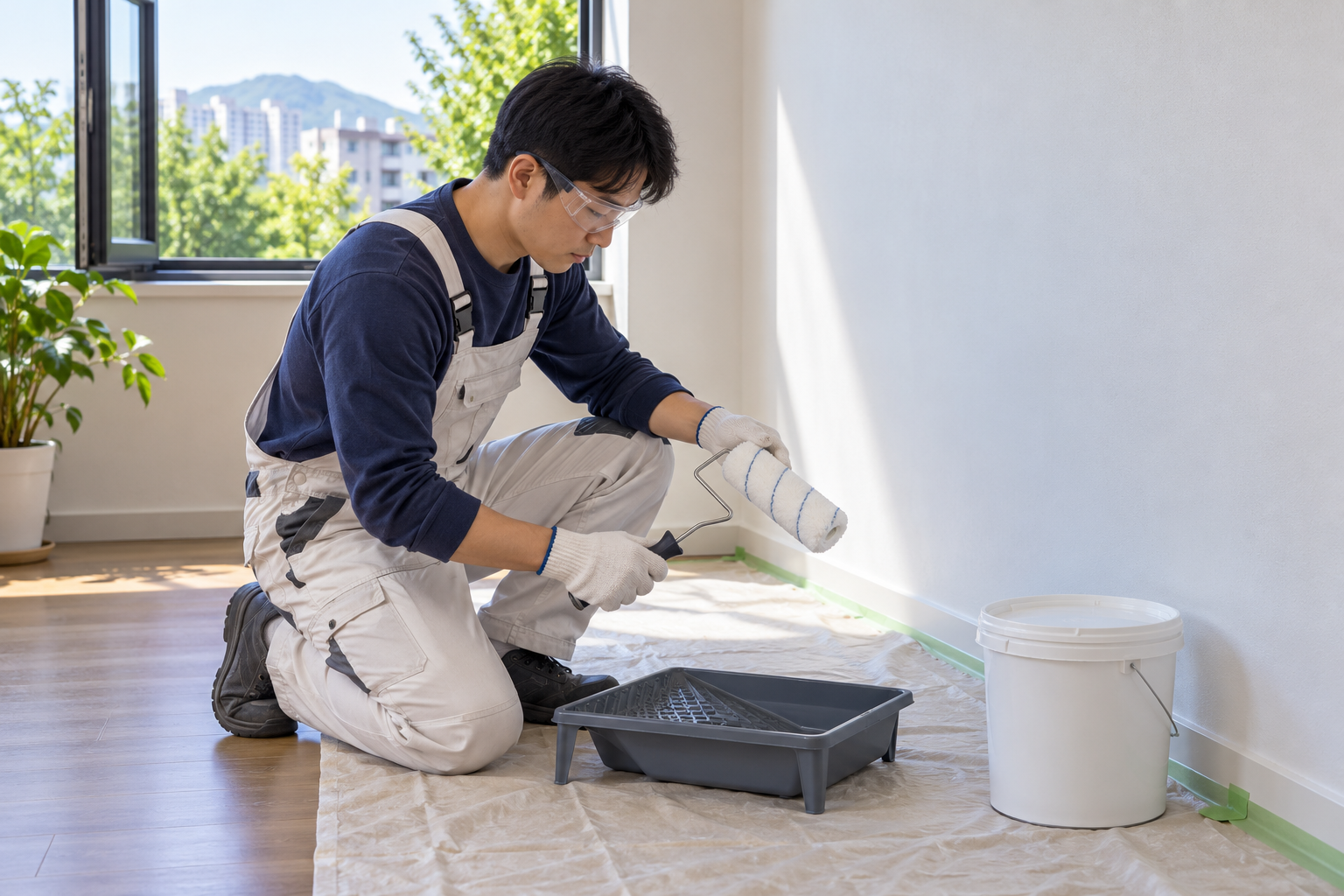
This illustration provides educational context. It is not an actual incident photograph or evidence of equipment suitability; any AI-generated depiction is illustrative only.
The scenario and record comparisons are fictional teaching examples, not records of real incidents, measurements, inspections, signatures or approvals.
| Stage | Fictional situation |
|---|---|
| Initial situation | A fictional worker rolls water-based paint in a corridor. |
| Changed condition | A door used for ventilation closes and a pedestrian enters the wet protected area. |
| Failure path | Weak odour is taken as permission to continue. |
| Possible outcome | Exposure could increase while a moving sheet or tray creates a slip or spill. |
| Prevention barrier | Stop application, stabilise the area and restore the reviewed airflow and separated route before restarting; retain the drying and reopening restrictions. |
Failure mechanisms
Water-based does not mean harmless. Product ingredients and use conditions determine skin, eye and inhalation concerns. Match the container label to its SDS and technical sheet; do not copy glove selection, dilution or drying time from another paint.
An open window does not prove that contaminated air leaves the work area safely. Check the airflow path and adjacent occupants, then maintain the required ventilation during application and drying. Weak odour or a dry-to-touch surface alone does not release the room.
The included working height is the range safely reached from the floor. Chairs and boxes do not extend that scope. If the roller requires unstable posture or excessive reach, change the work method and assess suitable access equipment. Keep trays and protective sheeting out of the standing route.
Work sequence: Identify paint and wall → Separate and protect area → Check ventilation and tools → Open and distribute paint → Roll and brush wall → Protect drying area → Hold spill or irritation → Clean and hand over. This is a teaching flow, not a device drawing or a complete operating procedure.
5. Conditional decisions and common errors
| Situation | Required action | Evidence | Proceed when |
|---|---|---|---|
| Product identity unclear | Hold application | Label, SDS and technical sheet | Product matched |
| Airflow changes | Stop and review | Exhaust path and occupants | Ventilation restored |
| Reach exceeds safe range | Change method | Posture and access review | Stable method ready |
| Surface feels dry | Check full release conditions | Drying, ventilation and floor | Area released |
Similar observations, different decisions
The scenario and record comparisons are fictional teaching examples, not records of real incidents, measurements, inspections, signatures or approvals.
| Observation | Insufficient conclusion | Required distinction |
|---|---|---|
| Water-based label | Product category | Exposure not excluded |
| Weak odour | Subjective observation | Air conditions unproved |
| Dry to touch | Surface condition | Occupancy release separate |
6. Roles and responsibilities
| Role | Responsibility |
|---|---|
| Work supervisor | Confirm product and ingredients and the task scope, resources, interfaces and stop authority. |
| Qualified technical reviewer | Review boundary and detour, model limits, compatibility and unresolved technical conditions within assigned competence. |
| Work crew | Apply the listed controls, report changes and stop when evidence or safeguards are missing. |
| Inspector / assessor | Record actual feet shoulder and grip and other relevant checks; do not mark unverified conditions as accepted. |
| Handover authority | Reconcile tool and waste status, restrictions and outstanding actions before the next task. Role labels do not establish a legal credential. |
The principal and employers coordinate the risk assessment and safe work procedures. These role labels allocate work; verify any qualifications and statutory appointments required for the actual Singapore activity. The receiving person must be given restrictions and unresolved defects before handover.
Record and handover perspective
| Stage | Record controls | Verification |
|---|---|---|
| Identify paint and wall | 1. Record product and ingredients2. Record sds and expiry3. Record wall and old coating | 1. SDS and expiry2. Wall and old coating3. Reach and excluded areas |
| Check ventilation and tools | 1. Record airflow and adjacent rooms2. Record ppe selection3. Record handle and extension | 1. PPE selection2. Handle and extension3. Tool condition |
| Open and distribute paint | 1. Record container and tray stability2. Record mix and product identity3. Record splash and quantity | 1. Mix and product identity2. Splash and quantity3. Lid and storage condition |
| Roll and brush wall | 1. Record feet shoulder and grip2. Record reach and pace3. Record splash and skin condition | 1. Reach and pace2. Splash and skin condition3. Ventilation during work |
| Hold spill or irritation | 1. Record symptoms and product2. Record spill and affected area3. Record ventilation correction | 1. Spill and affected area2. Ventilation correction3. Restart disposition |
| Clean and hand over | 1. Record tool and waste status2. Record remaining paint storage3. Record drying and opening limits | 1. Remaining paint storage2. Drying and opening limits3. Recipient and actions |
7. Hold points and record comparison
| Hold point | Evidence before release | Actual record |
|---|---|---|
| HP-0 Start | Task boundary, site RA, SWP, responsibilities and emergency arrangements | |
| HP-1 Separate and protect area | Boundary and detour; Sheet edges and floor; Exit route; Tray and container position | |
| HP-2 Check ventilation and tools | Airflow and adjacent rooms; PPE selection; Handle and extension; Tool condition | |
| HP-3 Protect drying area | Drying time and conditions/units; Air and occupancy conditions; Surface and floor; Restriction signs | |
| HP-4 Clean and hand over | Tool and waste status; Remaining paint storage; Drying and opening limits; Recipient and actions |
Hold points are internal project checks. They are not universal statutory permits and do not grant work permission. Reassess after defects, changed conditions and shift changes.
Record comparison
The scenario and record comparisons are fictional teaching examples, not records of real incidents, measurements, inspections, signatures or approvals.
The boxes are static record prompts, not interactive or saved approvals. A tick does not establish suitability or permission to restart. Record the evidence, person, time and unresolved issues; retain the change history.
| Record | Insufficient record | Record checklist |
|---|---|---|
| Identify paint and wall | Only marked “OK” | □ Product and ingredients□ SDS and expiry□ Wall and old coating□ Reach and excluded areas |
| Open and distribute paint | Only marked “OK” | □ Container and tray stability□ Mix and product identity□ Splash and quantity□ Lid and storage condition |
| Hold spill or irritation | Only marked “OK” | □ Symptoms and product□ Spill and affected area□ Ventilation correction□ Restart disposition |
| Clean and hand over | Only marked “OK” | □ Tool and waste status□ Remaining paint storage□ Drying and opening limits□ Recipient and actions |
Hold points are internal checks. Determine separately whether Singapore statutory or site permit requirements apply to this work. Leave confirmation, measurements and approval records blank until the authorised site process is completed.
8. Site checklist and emergency response
| Site check | Actual result | Person / action |
|---|---|---|
| Identify paint and wall: Product and ingredients; SDS and expiry; Wall and old coating; Reach and excluded areas | ||
| Separate and protect area: Boundary and detour; Sheet edges and floor; Exit route; Tray and container position | ||
| Check ventilation and tools: Airflow and adjacent rooms; PPE selection; Handle and extension; Tool condition | ||
| Open and distribute paint: Container and tray stability; Mix and product identity; Splash and quantity; Lid and storage condition | ||
| Roll and brush wall: Feet shoulder and grip; Reach and pace; Splash and skin condition; Ventilation during work | ||
| Protect drying area: Application and drying time; Air and occupancy conditions; Surface and floor; Restriction signs | ||
| Hold spill or irritation: Symptoms and product; Spill and affected area; Ventilation correction; Restart disposition | ||
| Clean and hand over: Tool and waste status; Remaining paint storage; Drying and opening limits; Recipient and actions |
Stop work
Stop for unknown product conditions, inadequate ventilation, irritation or dizziness, pedestrian intrusion, unstable flooring or excessive reach. Neither a water-based label nor weak odour establishes safe conditions.
Emergency response
Stop application and move away from exposure to a safe area. Follow the actual SDS and site first-aid procedure; obtain medical help for significant or persistent symptoms. Keep people out of a spill until the approved cleanup and ventilation are complete.
9. Sources and review limits
Official public sources read for this Singapore edition on 2026-10-14. Guidance, statutory explanations and manufacturer limits have different roles; no source provider has approved this JSA.
| Source | Read scope and application limits |
|---|---|
| MOM — Risk management | Official explanation: employer, self-employed person and principal responsibilities; routine and non-routine risk assessment; hierarchy of controls; multidisciplinary assessment team. Official explanation of risk-management duties; no claim of reading the full linked statute. It does not specify task-specific equipment limits. Assess floor-level water-based wall painting with employers, principal and affected contractors; resolve the inputs in section 2. |
| MOM — When should my company review its risk assessment? | Review every three years, after significant changes, new machinery/substances/procedures, hazard-related injury or incident, and when assessment is inadequate. General review guidance. A review interval does not permit continued operation after a known hazard or change. Reassess this operation after changes, defects, incidents or an inadequate assessment; do not wait for a scheduled review. |
| MOM — Permit-to-Work Systems | Formal work authorisation and coordination; OPEC tripartite guidance and competent permit authority with authority to reject work. OPEC-focused guidance page; not evidence of a blanket statutory permit requirement for every task. Determine permits for this actual activity and workplace; distinguish the section 7 internal hold points from statutory or site permits. |
| WSH Council — Preventing Chemical Hazards | Chemical exposure routes, employer/employee roles, risk assessment, safe work procedures, communication, SDS, exposure monitoring and substance-dependent health surveillance. Official overview; linked exposure schedules and medical examination regulations were not read in full. Do not infer a numerical exposure limit or a universal medical examination duty. Use WSHC chemical/GHS guidance for product information and exposure controls, ergonomics guidance for reach and repetitive handling, and MOM asbestos roles for the separate suspect-existing-material interface. Neither product category nor dry-to-touch appearance releases occupancy. |
| WSH Council — GHS classification and labelling | GHS purpose and role table: suppliers provide product classification/labels/SDS; occupiers and employers obtain accessible SDS, label containers, train and inform workers. Official hazard-communication explanation, not approval of any product or proof of equipment material compatibility. Full SS 586 was not read. Use WSHC chemical/GHS guidance for product information and exposure controls, ergonomics guidance for reach and repetitive handling, and MOM asbestos roles for the separate suspect-existing-material interface. Neither product category nor dry-to-touch appearance releases occupancy. |
| WSH Council — Improving Ergonomics in the Workplace (2014) | Introduction and section 4.1 excerpts: force, duration, repetition/posture, bulky and unstable loads, smaller packages, dry clear paths, coordinated handling and suitable mechanical aids. Selected guidance sections only, not a universal lifting-weight rule or current statutory audit. Actual task, worker capability, route and frequency must be assessed. Use WSHC chemical/GHS guidance for product information and exposure controls, ergonomics guidance for reach and repetitive handling, and MOM asbestos roles for the separate suspect-existing-material interface. Neither product category nor dry-to-touch appearance releases occupancy. |
| MOM — Employer, Principal and Occupier Duties in Asbestos-related Work | Complete FAQ role table: competent person for a required survey and occupier responsibility to use an approved asbestos-removal contractor. MOM contractor-approval overview also read. Role guidance, not an actual material survey, removal plan or complete statute review. No asbestos content or removal clearance is asserted for an unidentified gasket. Use WSHC chemical/GHS guidance for product information and exposure controls, ergonomics guidance for reach and repetitive handling, and MOM asbestos roles for the separate suspect-existing-material interface. Neither product category nor dry-to-touch appearance releases occupancy. |
The actual paint SDS and technical sheet were not provided. No universal dilution, drying/re-entry time, glove type or respiratory cartridge is prescribed. Spraying, two-component coatings, elevated access, confined spaces and old-coating disturbance remain outside this scope. Waste and washwater disposition must follow the approved product/site route.
Actual site measurements, equipment instructions, engineering checks and signed approval records were not supplied. A qualified person must resolve these before use.
10. PDF guidance and FAQ
PDF A covers basic task controls; B focuses on technical failures; C covers supervision, records and handover. The article has eight stages with four items per main cell; each PDF has six key stages with three items per main cell. P/S/R/A, measurements, confirmations and signatures remain blank for actual site assessment.
PDFs are complementary six-stage extracts. Apply all eight body stages and the actual equipment/site procedure.
Does water-based paint need ventilation?
Use the actual product and space assessment; maintain the required airflow through application and drying.
Can a chair be used for the last patch?
No. Hold the out-of-reach area and plan appropriate access separately.
Can thinner clean paint from skin?
Do not use solvent to wash skin. Follow the actual product skin-cleaning and first-aid instructions.
Has a professional verified or approved this document?
No. Public sources and editorial, layout and consistency checks were reviewed using AI. No site inspection or professional technical approval has been performed. Obtain appropriate professional review before use.
Does a dry-to-touch surface allow occupants back in?
No. The assigned premises representative must confirm the actual product drying and ventilation conditions, floor safety and remaining restrictions before reopening.
11. Revision history and authorship
AI-generated reference material; not professionally verified or approved. Before use, a qualified person must review and adapt it to applicable Singapore requirements, the actual equipment/site and approved safe work procedures.
This Singapore edition was adapted from the Korean original and its assigned US technical reference. Earlier source revisions are archival editorial history, not Singapore technical approval.
| Date | Edition | Change | Review status |
|---|---|---|---|
| 2026-10-04 | Korean source v1.0 | Source editorial publication or revision; retained as provenance of the Korean edition. | Editorial record only; no professional technical approval recorded. |
| 2026-10-14 | 1.0 en-SG | Singapore legal scope, local planning, responsibility interfaces and SI terminology; new PDF A/B/C. | AI editorial and visual review only; no professional approval. |