For Singapore construction, verify the applicable formwork design, supervision, inspection and removal requirements. The actual system, concrete evidence and staged loading determine the release criteria. This reviced JSA follows retaining wall formwork from delivery to controlled removal. The central decisions are whether each erection stage is stable, whether the assembled system can resist the planned concrete pressure, and whether the wall and retained supports permit stripping. Existing lifting, bracing, access, monitoring and housekeeping controls are retained with their limits made explicit.
Stable erection, controlled pouring and evidence-based stripping
This is reference content written and reviced with AI. It has not been verified or approved by a professional. Review by a suitably qualified professional and site authorisation are required before use.
Stop work
Stop for missing supports or locking parts, anchor movement, unusual leakage or bulging, unexpected ground movement, unsafe wind, loss of communication, access defects or an unreviewed mix/rate change. Keep workers clear of the possible failure path. A low risk score or an unsigned checklist cannot override a failed hold point.
AI-generated reference material; not professionally verified or approved. Before use, a qualified person must review and adapt it to applicable Singapore requirements, the actual equipment/site and approved safe work procedures.
1. Legal and technical scope
Apply Singapore construction formwork, lifting and work-at-height arrangements to the actual wall system and every temporary stage. Management must coordinate the responsible design reviewer, competent assembly supervisor, lifting personnel, pour observer and stripping authority. Verify any required professional design and statutory appointments for this system.
| Basis | Singapore application |
|---|---|
| Risk management | The employer, self-employed person and principal assess and control work risks. Include preparation, abnormal conditions and maintenance. Coordinate affected trades and communicate controls. |
| Activity-specific guidance | Use WSHC formwork advice for planned assembly, securing components and falling-object control, lifting/MOM guidance for handling and equipment status, construction PTW excerpts for covered crane work and height guidance for platforms and rescue. |
| Permits and authority | Select permit requirements for the actual sector and activity. Site hold points and contractor role labels do not create statutory permits or qualifications. |
| Equipment and design | No universal tie spacing, brace angle, pour rate, wind limit or stripping age is provided. Actual design, foundation/anchor evidence, concrete results and manufacturer system instructions were not supplied. Permanent-wall design, excavation support, one-sided reaction design and special gangform lifting need separate specialist review. Full formwork standards and complete regulations were not read. |
2. Scope and required inputs
Included scope
Wall panels, push-pull props, anchors, ties, walers, working platforms and planned lifting interfaces. Identify whether the system has opposing tied faces or is a one-sided form relying on a designed reaction frame and foundation. Review each temporary stage before people or loads are introduced.
Separate review
This reference does not design temporary works or authorise a lift, pour, stripping operation or backfilling. Excavation support, lifting engineering, permanent wall design, confined-space work and any fall rescue need their own applicable plans and competent review. A release to strip is not a release to place soil behind the wall.
| Required input | What to verify |
|---|---|
| Design and ground | Current design reference · Ground acceptance record · System and mix details · Limits and stop criteria |
| Receive and store | Panel weight and lift plan · Accessory inspection record · Storage layout and limits · Briefing and signaller |
| Erect and brace | Brace and anchor checks · Release-to-unhook record · Platform inspection record · Actual weather assessment |
| Pre-pour inspection | Signed assembly inspection · Component identity record · Deviation closeout record · Pour release and limits |
| Release for stripping | Strength basis and lot · Designer removal criteria · Support retention plan · Authorised release record |
| Clear and hand over | Housekeeping check · Defect quarantine log · Stack and access check · Wall handover restrictions |
No universal brace angle, tie spacing, stacking height, wind speed, concrete placement rate or stripping age is assigned. Enter values from the actual design, product instructions, concrete specification and governing rules, with units and document revisions. Paid standards, project calculations, product manuals and test results have not been independently reviewed for this site. Conflicting requirements require technical resolution before work.
Select head, eye, hand and foot protection for actual handling and cement exposure. Prevent wet concrete contact and provide washing arrangements. Prefer protected working platforms and edge protection; where personal fall protection remains necessary, verify the anchor, clearance, compatibility and rescue arrangements. Respiratory and hearing protection follow exposure assessment and do not replace dust or noise control.
Singapore site planning
Distinguish opposing tied faces from one-sided reaction frames. Link panel mass in kg, lifting points, ground and anchor evidence, braces, platforms and wind exposure to the issued erection sequence. Maintain crane support until the designed temporary stability state is achieved and checked. Before pouring, verify component compatibility and approved mix, placement rate, height, temperature and vibration assumptions using their specified units. Observe from a protected position and stop and withdraw for bulging, anchor movement or leakage indicating distress; do not tighten a loaded failing tie. Match concrete strength evidence in MPa to the wall lot and stage before stripping, restrain panels before releasing connections and retain necessary supports. Transfer separate backfill and loading restrictions.
3. Eight-stage JSA
| Job stage | Hazards and effects | Failure factors | Technical and procedural controls | Site verification | P | S | R | A |
|---|---|---|---|---|---|---|---|---|
| 1. Design and ground | 1. Unstable support ground2. Unresolved wind load3. Wrong pressure model4. Nearby excavation failure | 1. Missing design revision2. Unchecked anchor substrate3. Wrong form configuration4. Unplanned plant surcharge | 1. Confirm staged load paths2. Assess foundation capacity3. Identify one-sided systems4. Review excavation interface | 1. Current design reference2. Ground acceptance record3. System and mix details4. Limits and stop criteria | ||||
| 2. Receive and store | 1. Suspended panel strike2. Stack overturning3. Rigging or clamp failure4. Manual handling strain | 1. Wrong lifting attachment2. Damaged stacking bearers3. People under load4. Unknown panel weight | 1. Use specified lift points2. Set stable storage supports3. Separate lifting area4. Plan mechanical handling | 1. Panel mass/kg and lift plan2. Accessory inspection record3. Storage layout and limits4. Briefing and signaller | ||||
| 3. Erect and brace | 1. Unbraced panel collapse2. Wind-driven panel swing3. Fall from access platform4. Crushing during alignment | 1. Early sling release2. Unverified brace anchorage3. Unprotected platform edge4. Hands in closing joints | 1. Follow erection sequence2. Secure designed restraints3. Provide protected access4. Keep clear of pinch points | 1. Brace and anchor checks2. Release-to-unhook record3. Platform inspection record4. Actual weather assessment | ||||
| 4. Pre-pour inspection | 1. Tie or waler failure2. Anchor or base movement3. Fall through access gaps4. One-sided frame overload | 1. Missing locking hardware2. Wrong tie spacing or type3. Unapproved site alteration4. Open stop-end unsupported | 1. Match approved assembly2. Check tie and waler system3. Close design deviations4. Inspect access and stop-ends | 1. Signed assembly inspection2. Component identity record3. Deviation closeout record4. Pour release and limits | ||||
| 5. Place and monitor | 1. Excess concrete pressure2. Form bulging or leakage3. Pump hose movement4. Cement splash and burns | 1. Rate or mix changed2. Warning signs ignored3. Unsafe repair during pour4. Observer cannot stop pump | 1. Follow approved pour plan2. Watch from protected place3. Stop and withdraw on fault4. Control hose and exposure | 1. Pour and mix log2. Observation and stop record3. Communication check4. Weather and movement log | ||||
| 6. Release for stripping | 1. Immature concrete failure2. Loss of wall stability3. Premature support removal4. Unexpected imposed load | 1. Time alone used as proof2. Wrong test lot referenced3. Backfill release assumed4. No agreed removal sequence | 1. Check strength evidence2. Review actual load state3. Retain necessary supports4. Obtain stripping release | 1. Strength/MPa and wall lot2. Designer removal criteria3. Support retention plan4. Authorised release record | ||||
| 7. Strip and lower | 1. Sudden panel detachment2. Falling panel or hardware3. Fall at changing edge4. Adjacent panel instability | 1. Unsupported panel release2. Uncontrolled prying force3. Premature guardrail removal4. Brace sequence ignored | 1. Restrain before release2. Lower by planned method3. Maintain edge protection4. Keep exclusion zone clear | 1. Panel restraint check2. Removal sequence briefing3. Rigging and zone checks4. Remaining stability check | ||||
| 8. Clear and hand over | 1. Nails and projecting ties2. Unstable recovered stack3. Excavation edge overload4. Early backfill loading | 1. Sharp debris left exposed2. Damaged panel reused3. Stack outside layout4. Wall restrictions omitted | 1. Collect and protect sharps2. Quarantine damaged parts3. Store within agreed limits4. Transfer loading restrictions | 1. Housekeeping check2. Defect quarantine log3. Stack and access check4. Wall handover restrictions |
P = likelihood; S = severity; R = risk using the site method; A = site acceptance/authorisation. Complete after actual assessment; no score overrides an unresolved hold point or equipment limit.
4. Fictional scenario and failure mechanisms
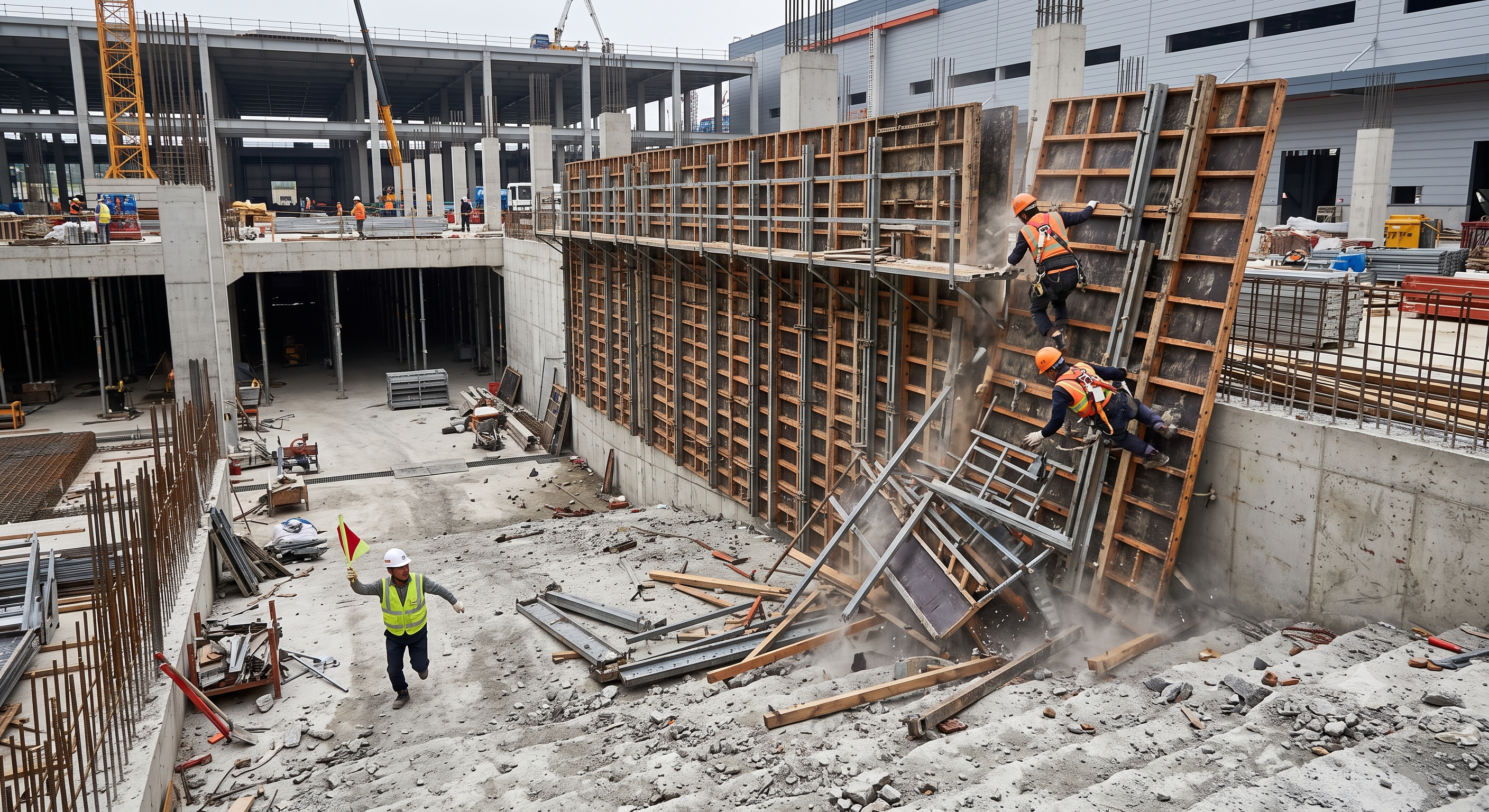
Retained educational illustration; not evidence of an actual incident.
The scenario and record comparisons are fictional teaching examples, not records of real incidents, measurements, inspections, signatures or approvals.
| Item | Fictional scenario |
|---|---|
| Initial situation | A hypothetical crew erects large wall panels beside an access ramp before changing weather. This is a teaching scenario, not a documented accident or an authority investigation. |
| Changed condition | Pressure to release the crane leads to a proposed unhooking before brace anchorage and the temporary stage have been checked. The neighbouring panel joint is incorrectly treated as proof of overall stability. |
| Failure path | A wind gust or eccentric platform load could rotate or slide the unsupported assembly. People on the platform and within the potential fall area would be exposed; the precise outcome cannot be inferred from the illustration. |
| Possible outcome | Keep the crane operation under its lift plan, stop the proposed release, clear the potential collapse area and obtain a safe stabilisation method from the responsible specialists. Do not send people under an unstable panel to fit a missing brace. |
| Prevention barrier | Resume only after the required supports and anchors are installed and checked, actual conditions match the design, and the responsible person releases that erection stage. Record the changed sequence and brief the crew. |
Failure mechanisms
Before pouring, wind, lifting movement and eccentric platform loads act through the temporary assembly and its supports. Adjacent panels or ground friction alone do not demonstrate adequate stability. Anchor capacity depends on the actual substrate, installation and design actions; an arbitrary angle or generic expansion anchor is not a substitute for design.
During pouring, pressure depends on concrete properties, temperature, placement rate, vibration and the design model. It may approach liquid-head pressure in relevant conditions. There is no general rule that pressure rises exponentially. Ties, walers, connections and supports form a connected load path, so a local defect can affect adjoining elements.
A one-sided system may have no through-ties to an opposing face. Its reaction frames, anchorage and foundation must carry the design actions. Do not transfer tie spacing or push-pull prop details from a two-sided system into a one-sided arrangement without technical review.
Stripping changes the support and access arrangements as well as exposing the concrete. The authorised strength basis must match the actual wall and loading stage. Remaining restraints, future wind, soil, plant and construction loads still matter after removal; concrete appearance or elapsed time alone does not establish release.
Decision sequence
| Decision stage | What to verify |
|---|---|
| Known facts | Identify the wall, system, current drawing and temporary stage. |
| Unresolved matters | Find the missing brace, change, abnormal movement or unverified evidence. |
| Reason to hold | Stop the affected operation and isolate its danger area. |
| Required evidence | Have the authorised specialists resolve the cause, inspect the corrected system and document the applicable release. |
| Restart decision | Communicate the new limits and verify conditions before the next stage. |
5. Conditional decisions and common errors
| Condition | Action | Evidence | Proceed when |
|---|---|---|---|
| Brace missing or anchor uncertain | Stop erection release; keep people clear and obtain a designed stabilisation method. | Brace layout, anchor installation evidence and stage inspection record. | Specified restraints installed and checked. |
| Pour conditions differ or form moves | Stop concrete placement, warn the crew and withdraw from the potential failure zone. | Actual mix/rate log, movement observations and technical change review. | Cause resolved; system re-inspected and pour reauthorised. |
| Stripping evidence incomplete | Retain supports and hold stripping until wall-specific evidence and sequence are reviewed. | Strength basis, wall/lot identity, actual loads and written release scope. | Removal criteria met and stripping release issued. |
| Weather or access becomes unsafe | Suspend affected lifting or elevated work and reassess protection and conditions. | Weather assessment, applicable limits and access/rescue inspection. | Conditions within limits and protected access restored. |
Similar situations, different decisions
The scenario and record comparisons are fictional teaching examples, not records of real incidents, measurements, inspections, signatures or approvals.
| Comparison | Situation A | Situation B |
|---|---|---|
| Erection | “The next panel is connected, so unhook.” | Check the designed temporary support state and record the release. |
| Pouring | “The usual pump speed is acceptable.” | Compare the actual mix and placement with the approved pressure assumptions. |
| Stripping | “The wall looks hard and the next crew is waiting.” | Match the strength evidence, loads and retained supports to the stripping release. |
6. Roles and responsibilities
| Role | Responsibility |
|---|---|
| Work management | Coordinate contractors, access, deliveries, excavation interfaces and stop authority. Ensure competent people have current drawings and sufficient time to carry out checks. |
| Design review | The responsible temporary-works and permanent-works specialists define stage loads, stability, acceptance criteria and interfaces. The required professional status and checking arrangements depend on the applicable Singapore requirements and project. |
| Lifting and assembly | The designated lifting and assembly personnel follow the approved sequence, verify product compatibility and obtain release before unhooking. Qualifications must match actual equipment and duties. |
| Pour supervisor and observer | Confirm the pour release and agreed limits; keep a usable stop link to the pump. Observe from a protected position and stop on unexplained movement or changed conditions. |
| Stripping and handover | The authorised reviewer checks the concrete evidence and removal scope. The supervisor maintains support, exclusion and fall protection through removal and transfers wall loading restrictions. |
The principal and employers coordinate the risk assessment and safe work procedures. These role labels allocate work; verify any qualifications and statutory appointments required for the actual Singapore activity. The receiving person must be given restrictions and unresolved defects before handover.
Record and handover perspective
| Stage | Record controls | Verification |
|---|---|---|
| Design and ground | 1. Record current design reference2. Record ground acceptance record3. Record system and mix details | 1. Ground acceptance record2. System and mix details3. Limits and stop criteria |
| Erect and brace | 1. Record brace and anchor checks2. Record release-to-unhook record3. Record platform inspection record | 1. Release-to-unhook record2. Platform inspection record3. Actual weather assessment |
| Pre-pour inspection | 1. Record signed assembly inspection2. Record component identity record3. Record deviation closeout record | 1. Component identity record2. Deviation closeout record3. Pour release and limits |
| Place and monitor | 1. Record pour and mix log2. Record observation and stop record3. Record communication check | 1. Observation and stop record2. Communication check3. Weather and movement log |
| Strip and lower | 1. Record panel restraint check2. Record removal sequence briefing3. Record rigging and zone checks | 1. Removal sequence briefing2. Rigging and zone checks3. Remaining stability check |
| Clear and hand over | 1. Record housekeeping check2. Record defect quarantine log3. Record stack and access check | 1. Defect quarantine log2. Stack and access check3. Wall handover restrictions |
7. Hold points and record comparison
| Hold point | Evidence before release | Actual record |
|---|---|---|
| HP-0 Start | Task boundary, site RA, SWP, responsibilities and emergency arrangements | |
| HP-1 Receive and store | Panel mass/kg and lift plan; Accessory inspection record; Storage layout and limits; Briefing and signaller | |
| HP-2 Erect and brace | Brace and anchor checks; Release-to-unhook record; Platform inspection record; Actual weather assessment | |
| HP-3 Release for stripping | Strength/MPa and wall lot; Designer removal criteria; Support retention plan; Authorised release record | |
| HP-4 Clear and hand over | Housekeeping check; Defect quarantine log; Stack and access check; Wall handover restrictions |
Complete after actual checks. Recheck after changes, defects or shift handover.
Record comparison examples
The scenario and record comparisons are fictional teaching examples, not records of real incidents, measurements, inspections, signatures or approvals.
The boxes are static record prompts, not interactive or saved approvals. A tick does not establish suitability or permission to restart. Record the evidence, person, time and unresolved issues; retain the change history.
| Record type | Insufficient record | Record checklist |
|---|---|---|
| Design and ground | Only “OK” | □ Current design reference□ Ground acceptance record□ System and mix details□ Limits and stop criteria |
| Erect and brace | Only “OK” | □ Brace and anchor checks□ Release-to-unhook record□ Platform inspection record□ Actual weather assessment |
| Place and monitor | Only “OK” | □ Pour and mix log□ Observation and stop record□ Communication check□ Weather and movement log |
| Release for stripping | Only “OK” | □ Strength basis and lot□ Designer removal criteria□ Support retention plan□ Authorised release record |
Hold points are internal checks. Determine separately whether Singapore statutory or site permit requirements apply to this work. Leave confirmation, measurements and approval records blank until the authorised site process is completed.
8. Site checklist and emergency response
| Check item | Result | Person / action |
|---|---|---|
| □ Design and ground: Current design reference | ||
| □ Receive and store: Panel weight and lift plan | ||
| □ Erect and brace: Brace and anchor checks | ||
| □ Pre-pour inspection: Signed assembly inspection | ||
| □ Place and monitor: Pour and mix log | ||
| □ Release for stripping: Strength basis and lot | ||
| □ Strip and lower: Panel restraint check | ||
| □ Clear and hand over: Housekeeping check | ||
| □ Release / handover authority |
Stop work
Stop for missing supports or locking parts, anchor movement, unusual leakage or bulging, unexpected ground movement, unsafe wind, loss of communication, access defects or an unreviewed mix/rate change. Keep workers clear of the possible failure path. A low risk score or an unsigned checklist cannot override a failed hold point.
Emergency response
Raise the alarm, stop affected equipment safely and prevent entry into the collapse or suspended-load area. Activate the site emergency plan and trained rescue arrangements; avoid impulsive entry beneath unstable components. Stabilisation and recovery require a separately reviewed method. Preserve observations and report through the applicable incident process.
9. Sources and review limits
Official public sources read for this Singapore edition on 2026-10-14. Guidance, statutory explanations and manufacturer limits have different roles; no source provider has approved this JSA.
| Source | Read scope and application limits |
|---|---|
| MOM — Risk management | Official explanation: employer, self-employed person and principal responsibilities; routine and non-routine risk assessment; hierarchy of controls; multidisciplinary assessment team. Official explanation of risk-management duties; no claim of reading the full linked statute. It does not specify task-specific equipment limits. Assess retaining wall formwork and staged release with employers, principal and affected contractors; resolve the inputs in section 2. |
| MOM — When should my company review its risk assessment? | Review every three years, after significant changes, new machinery/substances/procedures, hazard-related injury or incident, and when assessment is inadequate. General review guidance. A review interval does not permit continued operation after a known hazard or change. Reassess this operation after changes, defects, incidents or an inadequate assessment; do not wait for a scheduled review. |
| MOM — Permit-to-Work Systems | Formal work authorisation and coordination; OPEC tripartite guidance and competent permit authority with authority to reject work. OPEC-focused guidance page; not evidence of a blanket statutory permit requirement for every task. Determine permits for this actual activity and workplace; distinguish the section 7 internal hold points from statutory or site permits. |
| WSH Council — Construction vigilance advisory, 3 January 2025 | Formwork-related work: SWPs for erection/use/dismantling, securing tools/components and physically controlling overhead-work danger zones; lift planning and competent teams. Official advisory; full Construction Regulations access failed. This source does not establish a pour-rate value, design threshold or a completed formwork approval. Use WSHC formwork advice for planned assembly, securing components and falling-object control, lifting/MOM guidance for handling and equipment status, construction PTW excerpts for covered crane work and height guidance for platforms and rescue. |
| WSH Council — Planning a Lift | Lift planning documents, load/equipment/crew/method/site information, complex-lift engineering, and stopping when site conditions differ from the approved plan. Official practical guidance, with crane-oriented examples. Statutory appointments and permit applicability depend on the equipment and activity; not an issued permit or support design. Use WSHC formwork advice for planned assembly, securing components and falling-object control, lifting/MOM guidance for handling and equipment status, construction PTW excerpts for covered crane work and height guidance for platforms and rescue. |
| MOM — Register Lifting Equipment | Equipment categories requiring registration, including chain blocks as lifting appliances, lifts/hoists, lifting machines and lifting gear. Registration overview; exemptions and equipment classification must be confirmed for the actual asset. Registration is not proof of suitability for a particular lift. Use WSHC formwork advice for planned assembly, securing components and falling-object control, lifting/MOM guidance for handling and equipment status, construction PTW excerpts for covered crane work and height guidance for platforms and rescue. |
| MOM — Circular MOM/OSHD/2025-05, lifting equipment tests and examination | All three pages: requirements effective 12 September 2025, category-specific examination intervals, registration and post-change tests, and footnotes defining hoists and competent-person lifting-gear re-examination. Category-specific official circular, not a site test certificate. Periodic overload testing was removed; do not substitute routine checks for required examinations or apply lifting-gear examiner provisions to every lifting appliance. Use WSHC formwork advice for planned assembly, securing components and falling-object control, lifting/MOM guidance for handling and equipment status, construction PTW excerpts for covered crane work and height guidance for platforms and rescue. |
| Singapore Statutes Online — Construction Regulations, Part III | Official indexed excerpts of regulation 10 listing tunnelling as high-risk construction work, regulation 11 appointments and regulation 14 assessor endorsement to the project manager. Selected official search excerpts only; not full permit processing text or an issued permit. Confirm current complete provisions and actual appointments. Use WSHC formwork advice for planned assembly, securing components and falling-object control, lifting/MOM guidance for handling and equipment status, construction PTW excerpts for covered crane work and height guidance for platforms and rescue. |
| WSH Council — Preventing Falls from Height | Employer access/protection controls, workplace-dependent fall prevention plan, hazardous work at height PTW applicability and supervisor/assessor/authorised-manager process. Official overview, not a full reading of the WAH Regulations or linked codes. PTW threshold does not mean lower falls are safe; actual anchorage, access and rescue require assessment. Use WSHC formwork advice for planned assembly, securing components and falling-object control, lifting/MOM guidance for handling and equipment status, construction PTW excerpts for covered crane work and height guidance for platforms and rescue. |
No universal tie spacing, brace angle, pour rate, wind limit or stripping age is provided. Actual design, foundation/anchor evidence, concrete results and manufacturer system instructions were not supplied. Permanent-wall design, excavation support, one-sided reaction design and special gangform lifting need separate specialist review. Full formwork standards and complete regulations were not read.
Actual site measurements, equipment instructions, engineering checks and signed approval records were not supplied. A qualified person must resolve these before use.
10. PDF guidance and FAQ
PDF A covers basic task controls; B focuses on technical failures; C covers supervision, records and handover. The article has eight stages with four items per main cell; each PDF has six key stages with three items per main cell. P/S/R/A, measurements, confirmations and signatures remain blank for actual site assessment.
Content group ID
jsa-wall-form
Can the JSA set a universal pour rate?
No. Use the applicable design and actual concrete conditions; reassess changes before resuming.
Can the crane be released after joining adjacent panels?
Only when the planned temporary support state has been achieved, checked and released under the lifting and erection arrangements. A joint alone proves neither anchorage nor stability.
Does stripping permit immediate backfilling?
No. Backfill and other loading need a separate check of the permanent wall, concrete strength, restraints and design sequence.
What can be entered into Smart JSA Bridge?
Enter the wall identity, system, design revisions, limits, responsible roles, inspection evidence and stage decisions. These are proposed documentation inputs; this article does not establish that the software calculates structural designs or guarantees compliance.
Has a professional verified or approved this document?
No. Public sources and editorial, layout and consistency checks were reviewed using AI. No site inspection or professional technical approval has been performed. Obtain appropriate professional review before use.
11. Revision history and authorship
AI-generated reference material; not professionally verified or approved. Before use, a qualified person must review and adapt it to applicable Singapore requirements, the actual equipment/site and approved safe work procedures.
This Singapore edition was adapted from the Korean original and its assigned US technical reference. Earlier source revisions are archival editorial history, not Singapore technical approval.
| Date | Edition | Change | Review status |
|---|---|---|---|
| 2026-07-26 | Korean source | Source editorial publication or revision; retained as provenance of the Korean edition. | Editorial record only; no professional technical approval recorded. |
| 2026-10-04 | Korean source v1.1 | Source editorial publication or revision; retained as provenance of the Korean edition. | Editorial record only; no professional technical approval recorded. |
| 2026-10-14 | 1.0 en-SG | Singapore legal scope, local planning, responsibility interfaces and SI terminology; new PDF A/B/C. | AI editorial and visual review only; no professional approval. |