The power unit and operator need space throughout the turn. A reversing device cannot make an otherwise closing gap safe or replace pedestrian separation.
AI-generated reference material. It has not been verified or approved by a professional. Before use, a qualified person must review and adapt it to applicable Singapore requirements, the actual equipment and site, and approved safe work procedures.
1. Singapore legal and technical basis
Singapore WSH risk management and machinery controls require a suitable truck, task-trained authorised operator and a protected route. Resolve the actual equipment classification and applicable training requirements; pedestrian low-lift equipment must not inherit a different truck type training or licensing assumption. Model familiarisation and demonstrated safe use remain necessary.
| Source category | Task application and limit |
|---|---|
| MOM - Risk management | Assess full swept path, operator position and pedestrian interfaces. Official explanation of WSH Risk Management duties, not a complete consolidated statutory text. |
| WSHC - Safe Use of Machinery | Verify training, safe functions, defects and isolation for repair. Official guidance with a summary of statutory duties; not a machine-specific safeguard design or full review of current legislation or paid standards. |
| WSHC - Loading and Unloading Operations | Apply relevant stable-load and segregation controls. General guidance, not a dock-leveller design standard or proof that one restraint fits every trailer. Actual device instructions govern compatibility and support. |
Use Singapore requirements and SI units. Manufacturer limits apply to the actual model. Foreign technical examples do not establish Singapore statutory duties. A job safety analysis or completed checklist is not a permit or approval.
2. Scope and required inputs
Included
An authorised trained operator moves stable pallet loads with a walkie low-lift electric truck over a designated level indoor route, then lowers and parks it.
Separate assessment
Rider trucks, stackers, rack placement, slopes, docks, trailers, elevators, towing, personnel transport, battery charging/change and repairs require separate assessment.
| Input | Evidence needed |
|---|---|
| Identify truck and load | Model and rating; Training/evaluation; Pallet mass/support; Route exclusions |
| Inspect functions | Brake/tiller/steering; Horn/disconnect; Fork/wheel condition; Battery exterior/errors |
| Engage and lift | Fork/pallet match; Insertion/support; Load stability; People clear |
| Park and hand over | Parking/fork position; Power/key state; Battery service needs; Defect/receiver record |
Select task-appropriate eye, hand, foot, skin and hearing protection from the exposure assessment. Where respiratory protection is necessary, use the applicable respiratory-protection program; PPE does not replace isolation, guarding, support or ventilation.
Singapore application
This scope is pedestrian operation on a designated level indoor floor. Rider trucks, stackers, ramps, docks, vehicle interiors, lifts, charging and repairs are separate tasks. Check the actual tiller braking zones and permitted travel modes in a controlled area without using a person as a test target.
3. Eight-stage JSA
| Job stage | Hazards and effects | Failure factors | Controls | Site verification | P | S | R | A |
|---|---|---|---|---|---|---|---|---|
| 1. Identify truck and load | 1. Load collapse2. Wrong control response3. Overload4. Untrained operation | 1. Rating unreadable2. Model confused3. Mass unknown4. Evaluation missing | 1. Match truck and manual2. Verify controls/training3. Check rated stable load4. Confirm workplace authority | 1. Model and rating2. Model and site competence3. Pallet mass/support4. Route exclusions | ||||
| 2. Inspect functions | 1. Brake failure2. Unexpected travel3. Fork failure4. Battery fault | 1. Checks omitted2. Tiller return faulty3. Cracks ignored4. Warning reset only | 1. Use designated check area2. Verify stopping functions3. Inspect forks and wheels4. Hold defective equipment | 1. Brake/tiller/steering2. Horn/disconnect3. Fork/wheel condition4. Battery exterior/errors | ||||
| 3. Prepare route | 1. Wall entrapment2. Pedestrian impact3. Slip/loss of control4. Blind collision | 1. Power-unit swing omitted2. Mixed traffic3. Floor defective4. Sight line blocked | 1. Allow full swept path2. Separate pedestrians3. Correct floor hazards4. Maintain clear view | 1. Operator walking space2. Traffic/crossings3. Floor and obstacles4. Turning/escape space | ||||
| 4. Engage and lift | 1. Foot crush2. Pallet breakage3. Load tilts4. Hands trapped | 1. Forks not aligned2. Support insufficient3. Load off centre4. Manual correction attempted | 1. Align before entry2. Support pallet adequately3. Verify balanced load4. Keep hands and feet clear | 1. Fork/pallet match2. Insertion/support3. Load stability4. People clear | ||||
| 5. Travel and turn | 1. Operator pinned2. Load shifts3. Foot run over4. Pedestrian struck | 1. Body toward wall2. Abrupt controls3. Feet in wheel path4. Direction not checked | 1. Use taught operator position2. Control smooth movement3. Keep clear of power unit4. Recheck travel direction | 1. Body/swing clearance2. Load and stopping space3. View and path4. People separation | ||||
| 6. Lower and withdraw | 1. Lowered load crush2. Pallet dragged3. Unstable placement4. Fork impact | 1. Person near load2. Weight remains on forks3. Floor unsuitable4. Exit path blocked | 1. Clear hands and feet2. Set load fully down3. Use stable destination4. Check withdrawal route | 1. Floor/load support2. People clear3. Weight transferred4. Exit clearance | ||||
| 7. Hold abnormal operation | 1. Truck runs again2. Recovery crush3. Repeated brake fault4. Unauthorised reuse | 1. Body blocks truck2. Recovery improvised3. Reset treated as repair4. Defect unmarked | 1. Stop by safe procedure2. Secure recovery zone3. Remove from service4. Require authorised repair | 1. Fault/location record2. Motion/load state3. Repair/function evidence4. Responsible return authority | ||||
| 8. Park and hand over | 1. Unauthorised travel2. Trip on forks3. Rollaway4. Defect overlooked | 1. Key/control unsecured2. Forks raised3. Parking unsuitable4. Shift report omitted | 1. Use designated parking2. Lower forks safely3. Secure power and brake4. Transfer unresolved faults | 1. Parking/fork position2. Power/key state3. Battery service needs4. Defect/receiver record |
P/S/R/A and actual measurements, checks, names and signatures remain blank for the site assessment. A score cannot waive a required control.
4. Hypothetical scenario and failure mechanisms
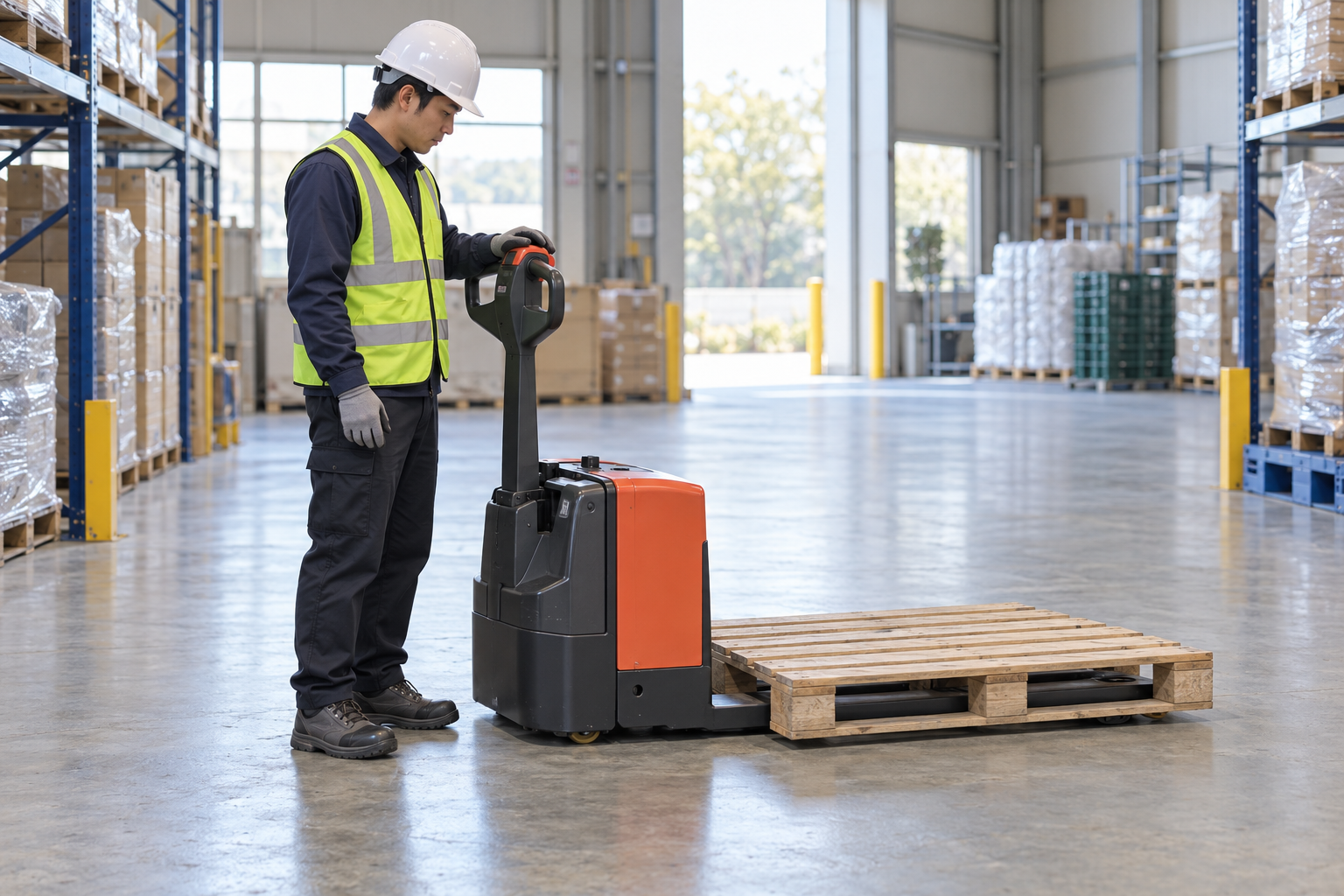
The retained illustration is an AI-generated educational image from the retained source edition. It is not an actual incident photograph, approved drawing, equipment certification or proof that the depicted arrangement is safe.
This powered truck is different from a manual pallet jack. Verify the actual model and workplace training, including practical competence. Complete the manufacturer and site pre-use/shift checks, report defects immediately and hold unsafe equipment from use.
The power unit sweeps a different path from the forks. Assess operator walking space through the complete turn, including walls, posts and rack ends. Separate pedestrians and keep hands and feet outside wheel and fork paths.
Tiller braking zones, return functions and special travel modes vary by model. Use the actual manual and designated function-check procedure in a controlled area; do not generalize a special braking override from another model.
A reversing device does not protect every trapping geometry. Never use a person as a test object or treat the device as permission to enter a closing gap. Stop and change the route when safe walking clearance is unavailable.
Hypothetical decision example
Hypothetical example: while traveling forks first between racks, the operator turns and the power unit swings toward a wall. The operator is tempted to continue because a reversing button is fitted. Stop safely, exclude traffic and replan the position and turn before proceeding.
The example is fictional; no incident, measurement, inspection or approval is asserted.
Task flow: Identify truck and load → Inspect functions → Prepare route → Engage and lift → Travel and turn → Lower and withdraw → Hold abnormal operation → Park and hand over
5. Hold and proceed decisions
| Condition | Action | Evidence | Proceed when |
|---|---|---|---|
| Brake abnormal | Stop; remove from service | Fault, repair and function check | Safe function verified |
| Walking gap closes | Stop; change route | Full turn and operator clearance | Clearance available |
| Load unstable | Lower safely; reassess | Pallet, mass and support | Stable rated load |
| Control unfamiliar | Hold operation | Model training and evaluation | Operator authorised |
Similar observation, different conclusion
| Observation | Supported conclusion | What remains unresolved |
|---|---|---|
| Reversing device fitted | A model-specific function exists | Whole trapping geometry remains to assess |
| Error display cleared | Message no longer displayed | Fault repair and braking unproved |
6. Roles and supervision
| Role | Responsibility |
|---|---|
| Work supervisor | Coordinate identify truck and load, affected operations, stop signals and stage transitions. |
| Technical/equipment reviewer | Verify Model and rating, Training/evaluation, actual instructions and unresolved technical limits. |
| Task crew | Apply the stated controls, report changes and keep actual checks and signatures factual. |
| Inspector/test lead | Connect Floor/load support, People clear to the required acceptance criteria. |
| Receiving authority | Accept the recorded restrictions, Battery service needs, Defect/receiver record, and follow-up ownership. |
These are responsibility examples, not invented statutory credentials. Verify actual competence, training and authority for the assigned work.
Supervision and handover controls
| Stage | Management controls | Evidence |
|---|---|---|
| Plan review | 1. Assign technical owner2. Close task-specific questions3. Match truck and manual | 1. Model and rating2. Training/evaluation3. Route exclusions |
| Competence | 1. Verify required competence2. Assign stop authority3. Use designated check area | 1. Brake/tiller/steering2. Training and task briefing3. Battery exterior/errors |
| Prestart evidence | 1. Inspect actual equipment2. Link evidence to this stage3. Align before entry | 1. Fork/pallet match2. Insertion/support3. People clear |
| Change control | 1. Stop and secure the area2. Review affected controls3. Stop by safe procedure | 1. Fault/location record2. Motion/load state3. Return authority |
| Shift handover | 1. Identify remaining restrictions2. Confirm receiving responsibility3. Use designated parking | 1. Parking/fork position2. Power/key state3. Defect/receiver record |
| Closeout | 1. Record defect disposition2. Archive factual evidence3. Use designated parking | 1. Parking/fork position2. Power/key state3. Defect/receiver record |
Singapore application
The employer verifies the actual training requirement and documents operator competence for the model and workplace. The operator completes the required pre-use/shift checks and removes defective trucks from service. The authorised maintenance person supplies repair and function-check evidence before the responsible person permits reuse.
7. Hold points and record quality
| Hold point | Evidence before release | Actual record |
|---|---|---|
| HP-0 Start | An authorised trained operator moves stable pallet loads with a walkie low-lift electric truck over a designated level indoor route, then lowers and parks it. | |
| HP-1 Inspect functions | Brake/tiller/steering; Horn/disconnect; Fork/wheel condition; Battery exterior/errors | |
| HP-2 Engage and lift | Fork/pallet match; Insertion/support; Load stability; People clear | |
| HP-3 Hold abnormal operation | Fault/location record; Motion/load state; Repair/function evidence; Return authority | |
| HP-4 Park and hand over | Parking/fork position; Power/key state; Battery service needs; Defect/receiver record |
Hold points are internal evidence gates. They do not establish that a statutory permit exists or has been approved. Recheck affected gates after changes, faults and shift handover.
Record comparison - hypothetical templates
The 16 boxes below identify record elements, not completed checks or approvals. They are static symbols. Link equipment/location, date, actual findings and the separate record reference; preserve unresolved items.
| Record | Insufficient entry | Required record elements |
|---|---|---|
| Identify truck and load | "Checked" without supporting facts | □ Model and rating□ Training/evaluation□ Pallet mass/support□ Route exclusions |
| Prepare route | "Checked" without supporting facts | □ Operator walking space□ Traffic/crossings□ Floor and obstacles□ Turning/escape space |
| Travel and turn | "Checked" without supporting facts | □ Body/swing clearance□ Load and stopping space□ View and path□ People separation |
| Hold abnormal operation | "Checked" without supporting facts | □ Fault/location record□ Motion/load state□ Repair/function evidence□ Return authority |
8. Pre-work checks and emergency response
| Check required | Result | Checker/action |
|---|---|---|
| Identify truck and load: Model and rating | ||
| Inspect functions: Brake/tiller/steering | ||
| Prepare route: Operator walking space | ||
| Engage and lift: Fork/pallet match | ||
| Travel and turn: Body/swing clearance | ||
| Lower and withdraw: Floor/load support | ||
| Hold abnormal operation: Fault/location record | ||
| Park and hand over: Parking/fork position |
Stop work
Do not operate with unfamiliar controls, deficient training, abnormal braking/steering/tiller return, damaged safety functions, unstable loads or inadequate walking and turning clearance. Remove unsafe trucks from service; an error reset is not a repair.
Emergency response
Use the model-specific stopping or disconnect control only from a safe position. Warn others and clear the travel path; do not stop the truck with the body or step into a closing gap. For trapped or injured people, stop further motion, activate the site rescue plan and contact the site emergency responders as needed. Trained responders must assess load stability and the effect of any recovery movement before release.
9. Sources and review limits
Public-source review: 14 October 2026. Only the material and limits identified below were reviewed.
| Source | Reviewed material | Task application |
|---|---|---|
| MOM - Risk management | Responsibilities; routine and non-routine work; hierarchy of control and risk assessment team. Official explanation of WSH Risk Management duties, not a complete consolidated statutory text. | Assess full swept path, operator position and pedestrian interfaces. |
| WSHC - Safe Use of Machinery | Printed pages 4, 27, 37-39: dangerous parts, maintenance training, hazardous-energy isolation, verification, group/shift continuity and restoration. Official guidance with a summary of statutory duties; not a machine-specific safeguard design or full review of current legislation or paid standards. | Verify training, safe functions, defects and isolation for repair. |
| WSHC - Loading and Unloading Operations | Hazards, designated areas, vehicle movement prevention, floor/access conditions, employer and driver roles. General guidance, not a dock-leveller design standard or proof that one restraint fits every trailer. Actual device instructions govern compatibility and support. | Apply relevant stable-load and segregation controls. |
Selected public official sources were reviewed on 14 October 2026 within the recorded scope. No full consolidated legal audit, paid Singapore Standard, actual model manual, site inspection, engineering calculation or professional approval is claimed. Verify current detailed requirements and actual equipment/site records before use.
AI-generated reference material. It has not been verified or approved by a professional. Before use, a qualified person must review and adapt it to applicable Singapore requirements, the actual equipment and site, and approved safe work procedures.
10. PDF use and frequently asked questions
PDF A summarizes core controls; B emphasizes technical failures; C covers supervision, records and handover. Each uses six stages from or aligned with the eight-stage body. All actual risk, measurement, check and signature fields are blank. Use a separate linked record where more space is needed.
Is manual pallet-jack experience enough?
No. Powered truck controls, training and workplace evaluation must match this equipment and operation.
Will releasing the tiller always stop it immediately?
Verify the actual model, mode, load, floor and braking function; never assume a common stopping distance.
May a person ride on the forks?
No. This scope is pedestrian operation with no passengers on truck, forks, pallet or load.
May a faulty truck return after resetting?
Hold it until authorised repair and required checks establish safe operating condition.
Has a professional approved this JSA?
This is reference content written and revised with AI. It has not been verified or approved by a professional. Review by a suitably qualified professional and required site authorisation are necessary before use.
Singapore application
Read A, B and C together with all eight JSA stages and the approved work procedure. The sheets are complementary extracts, not separate work authorisations.
11. Authorship and revision history
AI-generated reference material. It has not been verified or approved by a professional. Before use, a qualified person must review and adapt it to applicable Singapore requirements, the actual equipment and site, and approved safe work procedures.
| Date / edition | Authorship and scope | Professional approval |
|---|---|---|
| 2026-10-03 / Korean source | Original topic and educational illustration retained as references. Source content is unchanged. | Not asserted |
| 14 October 2026 / Singapore 1.0 | Replaced foreign examination-frequency wording with Singapore task/model checks and clarified low-lift truck classification. | Not performed |
Source topic: https://smartjsabridge.com/ko/case-study/jsa-walkie-electric-pallet-truck