An open primary breaker does not exclude secondary backfeed. Trace both sides, standby generation, auxiliary supplies and automatic controls before releasing a connection task.
This is reference content written and reviced with AI. It has not been verified or approved by a professional. Review by a suitably qualified professional and required site authorisation are necessary before use.
Stop conditions first
Hold access for unknown sources, unverified deenergisation/earthing, unsafe lifting/support, bushing strain, connection discrepancy, failed inspection or unaccounted test leads and temporary earths.
AI-generated reference material; not professionally verified or approved. Before use, a qualified person must review and adapt it to applicable Singapore requirements, the actual equipment/site and approved safe work procedures.
1. Singapore legal and technical basis
Coordinate Singapore transformer installation through an appropriately licensed electrical worker and the installation owner. Licence class, voltage limits, competence and operating authority must match the actual system. Mechanical installation and de-energised inspection are separate from controlled electrical testing and subsequent energisation.
| Basis | Singapore application |
|---|---|
| Risk management | The employer, self-employed person and principal assess and control work risks. Include preparation, abnormal conditions and maintenance. Coordinate affected trades and communicate controls. |
| Activity-specific guidance | Use EMA guidance for suitable LEW responsibility, WSHC electrical guidance for isolation and competent work, and WSHC/MOM lifting sources for equipment status and unit-specific handling. |
| Permits and authority | Select permit requirements for the actual sector and activity. Site hold points and contractor role labels do not create statutory permits or qualifications. |
| Equipment and design | No universal clearance, torque, insulation-test voltage, discharge time or earthing arrangement is assigned. Actual design, manufacturer manual, LEW licence and utility operating instructions were not supplied. Live work, internal oil work, parallel operation, tap-changing operations and test execution are outside this installation assessment. Full electrical standards were not read. |
2. Scope and required inputs
Included
Receive, position and secure a new transformer; make de-energised primary, secondary and earthing connections; inspect and hand over to a separately controlled testing and energisation process.
Separate assessment
Live connection, unapproved tap changes, parallel operation, internal operating-unit inspection, oil processing and performance of electrical testing or energisation are outside this installation release.
| Input | Evidence needed |
|---|---|
| Plan nameplate and sources | Nameplate/drawing; Source and feed inventory; Standby/auxiliary controls; Scope/qualified personnel |
| Receive and position | Weight/rigging data; Base and route capacity; Landing/clearance; Transport condition |
| Prepare cables and terminals | Support/bend condition; Bushing external forces; Lug/crimp data; Cleanliness/insulation |
| Hand over for energisation | Lead/earth inventory; Configuration/test dossier; People/covers clear; Defects and receiving authority |
No actual equipment model, SDS, site measurements, design calculations or authorisation record was supplied. Verify actual product limits and applicable Singapore requirements before use. Manufacturer guidance is not government approval.
Select task-appropriate eye, hand, foot, skin and hearing protection from the exposure assessment. Where respiratory protection is necessary, use the applicable respiratory-protection program; PPE does not replace isolation, guarding, support or ventilation.
Singapore site planning
Confirm nameplate rating and voltages in kV or V, vector group, terminal arrangement and every possible HV, LV, standby, auxiliary or induced source. Use the unit-specific mass in kg, centre of gravity, transport constraints and designated lifting points. Isolate, lock and verify all sources with suitable instruments; plan stored-energy discharge and any protective earthing through the responsible electrical lead. Support cables independently so bushings carry no unintended pull. Match phase, neutral/earth arrangement, tap setting, lug/crimp system and specified tightening values with units. Check the actual oil-filled or dry-type requirements. Reconcile temporary leads and earths, tests, covers, defects and restrictions before separate operating release.
3. Eight-stage JSA
| Job stage | Hazards and effects | Failure factors | Technical and procedural controls | Site verification | P | S | R | A |
|---|---|---|---|---|---|---|---|---|
| 1. Plan nameplate and sources | 1. Wrong voltage connection2. Secondary backfeed3. Unexpected automatic start4. Wrong unit installed | 1. Diagram outdated2. Generator missed3. Controls untraced4. Nameplate not compared | 1. Compare all system sources2. Trace both transformer sides3. Control automatic starts4. Match unit and design | 1. Nameplate/drawing2. Source and feed inventory3. Standby/auxiliary controls4. LEW scope and voltage limits | ||||
| 2. Receive and position | 1. Dropped transformer2. Foundation failure3. Crush at landing4. Unit damage | 1. Weight/lug unknown2. Bearing unverified3. People at pinch point4. Wrong handling point | 1. Use unit-specific lift plan2. Verify route and base3. Exclude landing zone4. Use designated handling points | 1. Mass/kg and rigging data2. Base and route capacity3. Landing/clearance4. Transport condition | ||||
| 3. Isolate and verify | 1. Electric shock2. Arc injury3. Stored-charge contact4. Adjacent live contact | 1. Primary only isolated2. Restart possible3. Discharge omitted4. Work boundary unclear | 1. Isolate relevant sources2. Lock and verify isolations3. Verify/discharge/earth by plan4. Protect adjacent hazards | 1. Isolation points/controls2. Proven instrument results3. Discharge/earth state4. Work boundary authorisation | ||||
| 4. Prepare cables and terminals | 1. Bushing fracture2. Cable insulation damage3. Wrong terminal fit4. Contamination fault | 1. Cable weight unsupported2. Bend forced3. Lug incompatible4. Moisture/debris present | 1. Support cables independently2. Align without strain3. Match conductor and lug4. Keep connections clean/dry | 1. Support/bend condition2. Bushing external forces3. Lug/crimp data4. Cleanliness/insulation | ||||
| 5. Connect and fasten | 1. Phase/configuration fault2. Loose hot connection3. Bushing damage4. Earthing defect | 1. Identification wrong2. Torque guessed3. Connection forced4. Neutral/earth confused | 1. Verify phase and winding plan2. Use specified fastening3. Control external cable force4. Check earthing arrangement | 1. Phase/tap/diagram2. Crimp/torque evidence3. Bushing condition4. Earth/neutral continuity | ||||
| 6. Inspect de-energised unit | 1. Insulation failure2. Oil leak/fire exposure3. Overheating4. Object left inside | 1. Clearance missed2. Seal damage ignored3. Vent blocked4. Tool count absent | 1. Inspect insulation/clearance2. Check type-specific condition3. Keep required ventilation4. Reconcile tools/covers | 1. Clearance/insulation2. Liquid/leak controls3. Dry-type ventilation4. Tools/covers record | ||||
| 7. Control test and rework | 1. Test-voltage shock2. Residual charge3. Wrong test circuit4. Unexpected reenergisation | 1. Installation release overused2. Discharge omitted3. Components not protected4. Rework without isolation | 1. Require separate test control2. Verify safe post-test state3. Follow unit test procedure4. Re-isolate before rework | 1. Test scope and authority2. Discharge/reverification3. Circuit/instrument criteria4. Rework boundary | ||||
| 8. Hand over for energisation | 1. Energised with earths2. Wrong tap/phase3. Person still exposed4. Unresolved defect used | 1. Inventory incomplete2. Checks not reconciled3. People not cleared4. Release assumed | 1. Reconcile leads and earths2. Review configuration/tests3. Clear and secure work zone4. Require separate operation release | 1. Lead/earth inventory2. Configuration/test dossier3. People/covers clear4. Defects and receiving authority |
P = likelihood; S = severity; R = risk using the site method; A = site acceptance/authorisation. Complete after actual assessment; no score overrides an unresolved hold point or equipment limit.
4. Failure mechanisms and hypothetical case
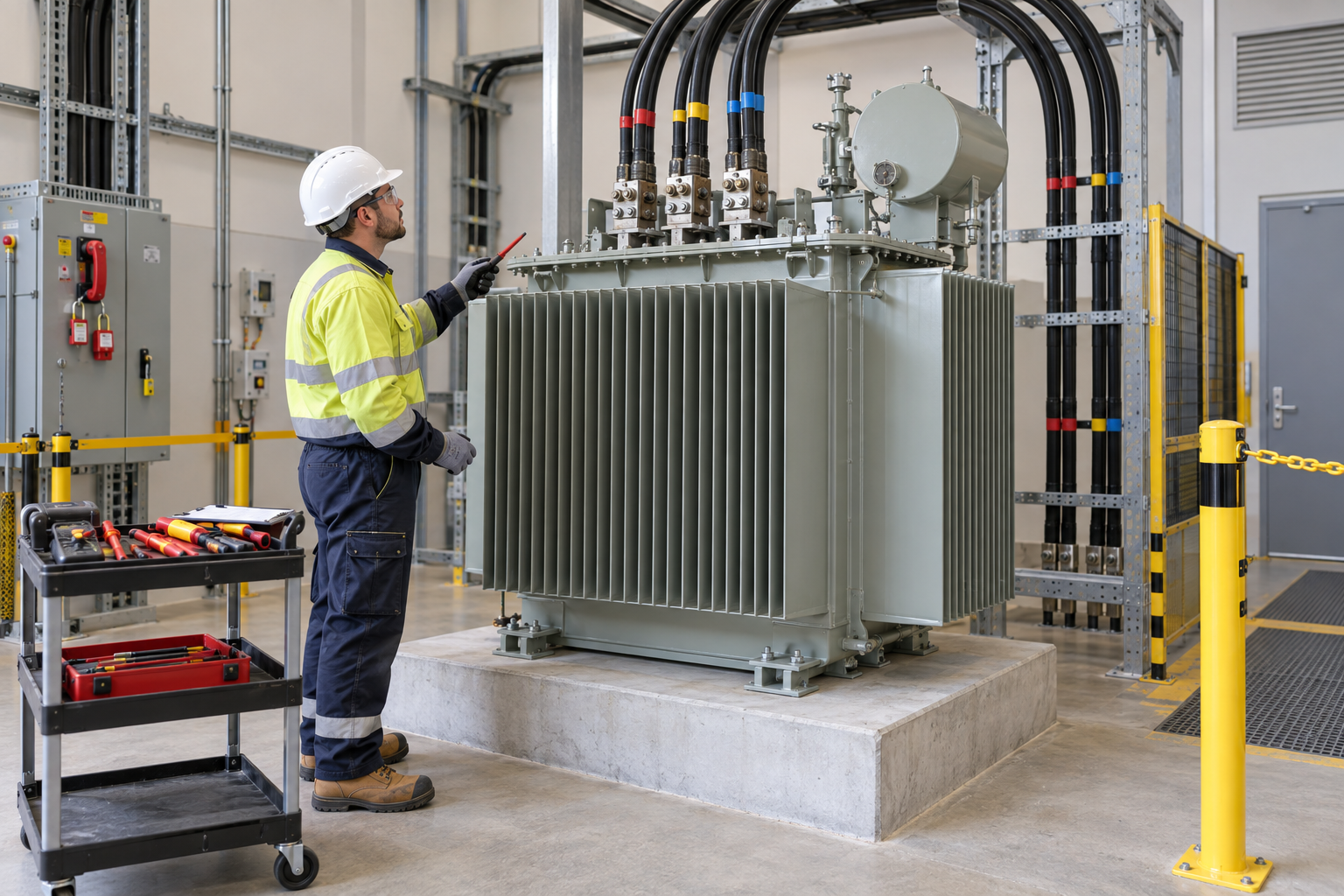
The retained illustration is an AI-generated educational image from the retained source edition. It is not an actual incident photograph, approved drawing, equipment certification or proof that the depicted arrangement is safe.
Identify all primary, secondary, standby and auxiliary sources and prevent unintended energisation. Qualified personnel verify the actual work-point state with suitable proven instruments and the applicable discharge/earthing procedure. An open-position indication alone is insufficient.
Terminal torque does not prove that a bushing is free from cable weight, bend force or installation strain. Support cables independently, align connections and inspect each bushing and connection using the actual transformer instructions.
A good insulation result addresses its defined test circuit and conditions. It does not replace phase/vector relationship, tap, protection, earthing, clearance, leak or ventilation checks. Testing creates a different energy state and requires its own exclusion and post-test discharge/reverification.
Temporary earths and test leads require a controlled inventory and sequence. Do not remove all earths merely because a test ends or energize with unaccounted connections. Installation completion, test acceptance and operational release remain separate.
Hypothetical decision example
Hypothetical example: primary isolation is recorded, but a standby generator path on the secondary and its automatic start state are unresolved. Keep the connection boundary closed until all sources, controls, work-point verification and required protective earthing are established.
The example is fictional; no incident, measurement, inspection or approval is asserted.
Task flow: Plan nameplate and sources → Receive and position → Isolate and verify → Prepare cables and terminals → Connect and fasten → Inspect de-energised unit → Control test and rework → Hand over for energisation
5. Hold and proceed decisions
| Condition | Action | Evidence | Proceed when |
|---|---|---|---|
| Secondary source unknown | Hold access; trace all feeds | Drawings and isolation evidence | Safe state verified |
| Cable strains bushing | Hold connection acceptance | Support/alignment inspection | External force resolved |
| Connection differs | Resolve drawing discrepancy | Phase/tap/earth records | Configuration accepted |
| Test handover incomplete | Keep installation on hold | Lead/earth/people inventory | Separate release issued |
Similar observation, different conclusion
| Observation | Supported conclusion | What remains unresolved |
|---|---|---|
| Primary breaker open | Primary switching state indicated | Secondary/auxiliary feeds unresolved |
| Torque recorded | Specified fastening documented | Cable support and bushing condition unproved |
6. Roles and supervision
| Role | Responsibility |
|---|---|
| Work supervisor | Coordinate plan nameplate and sources, affected operations, stop signals and stage transitions. |
| Technical/equipment reviewer | Verify Nameplate/drawing, Source and feed inventory, actual instructions and unresolved technical limits. |
| Task crew | Apply the stated controls, report changes and keep actual checks and signatures factual. |
| Inspector/test lead | Connect Clearance/insulation, Liquid/leak controls to the required acceptance criteria. |
| Receiving authority | Accept the recorded restrictions, People/covers clear, Defects and receiving authority, and follow-up ownership. |
These are responsibility examples, not invented statutory credentials. Verify actual competence, training and authority for the assigned work.
The principal and employers coordinate the risk assessment and safe work procedures. These role labels allocate work; verify any qualifications and statutory appointments required for the actual Singapore activity. The receiving person must be given restrictions and unresolved defects before handover.
Record and handover perspective
| Stage | Record controls | Verification |
|---|---|---|
| Plan nameplate and sources | 1. Record nameplate/drawing2. Record source and feed inventory3. Record standby/auxiliary controls | 1. Source and feed inventory2. Standby/auxiliary controls3. LEW scope and voltage limits |
| Isolate and verify | 1. Record isolation points/controls2. Record proven instrument results3. Record discharge/earth state | 1. Proven instrument results2. Discharge/earth state3. Work boundary authorisation |
| Prepare cables and terminals | 1. Record support/bend condition2. Record bushing external forces3. Record lug/crimp data | 1. Bushing external forces2. Lug/crimp data3. Cleanliness/insulation |
| Connect and fasten | 1. Record phase/tap/diagram2. Record crimp/torque evidence3. Record bushing condition | 1. Crimp/torque evidence2. Bushing condition3. Earth/neutral continuity |
| Control test and rework | 1. Record test scope and authority2. Record discharge/reverification3. Record circuit/instrument criteria | 1. Discharge/reverification2. Circuit/instrument criteria3. Rework boundary |
| Hand over for energisation | 1. Record lead/earth inventory2. Record configuration/test dossier3. Record people/covers clear | 1. Configuration/test dossier2. People/covers clear3. Defects and receiving authority |
7. Hold points and record quality
| Hold point | Evidence before release | Actual record |
|---|---|---|
| HP-0 Start | Task boundary, site RA, SWP, responsibilities and emergency arrangements | |
| HP-1 Receive and position | Mass/kg and rigging data; Base and route capacity; Landing/clearance; Transport condition | |
| HP-2 Isolate and verify | Isolation points/controls; Proven instrument results; Discharge/earth state; Work boundary authorisation | |
| HP-3 Inspect de-energised unit | Clearance/insulation; Liquid/leak controls; Dry-type ventilation; Tools/covers record | |
| HP-4 Hand over for energisation | Lead/earth inventory; Configuration/test dossier; People/covers clear; Defects and receiving authority |
Hold points are internal evidence gates. They do not establish that a statutory permit exists or has been approved. Recheck affected gates after changes, faults and shift handover.
Record comparison - hypothetical templates
The 16 boxes below identify record elements, not completed checks or approvals. They are static symbols. Link equipment/location, date, actual findings and the separate record reference; preserve unresolved items.
| Record | Insufficient entry | Required record elements |
|---|---|---|
| Plan nameplate and sources | "Checked" without supporting facts | □ Nameplate/drawing□ Source and feed inventory□ Standby/auxiliary controls□ Scope/qualified personnel |
| Isolate and verify | "Checked" without supporting facts | □ Isolation points/controls□ Proven instrument results□ Discharge/earth state□ Work boundary authorisation |
| Connect and fasten | "Checked" without supporting facts | □ Phase/tap/diagram□ Crimp/torque evidence□ Bushing condition□ Earth/neutral continuity |
| Control test and rework | "Checked" without supporting facts | □ Test scope and authority□ Discharge/reverification□ Circuit/instrument criteria□ Rework boundary |
Hold points are internal checks. Determine separately whether Singapore statutory or site permit requirements apply to this work. Leave confirmation, measurements and approval records blank until the authorised site process is completed.
8. Pre-work checks and emergency response
| Check required | Result | Checker/action |
|---|---|---|
| Plan nameplate and sources: Nameplate/drawing | ||
| Receive and position: Weight/rigging data | ||
| Isolate and verify: Isolation points/controls | ||
| Prepare cables and terminals: Support/bend condition | ||
| Connect and fasten: Phase/tap/diagram | ||
| Inspect de-energised unit: Clearance/insulation | ||
| Control test and rework: Test scope and authority | ||
| Hand over for energisation: Lead/earth inventory |
Stop work
Hold access for unknown sources, unverified deenergisation/earthing, unsafe lifting/support, bushing strain, connection discrepancy, failed inspection or unaccounted test leads and temporary earths.
Emergency response
Keep clear of suspected energised equipment, fallen conductors, unstable loads and leaking/fire-affected transformers. Isolate remotely only when authorised and safe, restrict access and call the site electrical emergency team and the site emergency service for serious injury or fire. Do not touch an electrical casualty until the energy hazard is controlled. Trained responders handle electrical rescue, fire and spill hazards using the unit type and site plan.
9. Official sources and review limits
Official public sources read for this Singapore edition on 2026-10-14. Guidance, statutory explanations and manufacturer limits have different roles; no source provider has approved this JSA.
| Source | Read scope and application limits |
|---|---|
| MOM — Risk management | Official explanation: employer, self-employed person and principal responsibilities; routine and non-routine risk assessment; hierarchy of controls; multidisciplinary assessment team. Official explanation of risk-management duties; no claim of reading the full linked statute. It does not specify task-specific equipment limits. Assess transformer installation and separate electrical release with employers, principal and affected contractors; resolve the inputs in section 2. |
| MOM — When should my company review its risk assessment? | Review every three years, after significant changes, new machinery/substances/procedures, hazard-related injury or incident, and when assessment is inadequate. General review guidance. A review interval does not permit continued operation after a known hazard or change. Reassess this operation after changes, defects, incidents or an inadequate assessment; do not wait for a scheduled review. |
| MOM — Permit-to-Work Systems | Formal work authorisation and coordination; OPEC tripartite guidance and competent permit authority with authority to reject work. OPEC-focused guidance page; not evidence of a blanket statutory permit requirement for every task. Determine permits for this actual activity and workplace; distinguish the section 7 internal hold points from statutory or site permits. |
| EMA — Engaging Licensed Electrical Workers | Overview and licence-class table: electrical wiring, circuit breaker and control-unit work carried out or superviced by a Licensed Electrical Worker; check valid licence and class for installation load/voltage. Official consumer overview, not a detailed installation standard or design approval. The actual installation conditions and LEW licence restrictions remain to be verified. Use EMA guidance for suitable LEW responsibility, WSHC electrical guidance for isolation and competent work, and WSHC/MOM lifting sources for equipment status and unit-specific handling. |
| EMA — Electrical Engineer Licence | Overview and assessment-preparation sections: appropriate licence class, voltage-limited authority, installation operation/maintenance and high-voltage competence. Licence overview only. Actual licence, utility operating rules, line configuration and full linked electrical standards were not supplied or read; no switching authority or method approval is inferred. Use EMA guidance for suitable LEW responsibility, WSHC electrical guidance for isolation and competent work, and WSHC/MOM lifting sources for equipment status and unit-specific handling. |
| WSH Council — Electrocution-related Workplace Fatal Injuries in 2H2023 | Complete one-page advisory, particularly competent workers, equipment labelling, de-energisation, lockout, permit coordination, protective measures and defect maintenance. Official advisory recommendations, not a blanket statutory live-work permission. Direct General Provisions statute access failed; linked SS 638/SS 571 full texts were not read. Use an appropriate complete proving-dead method for the actual equipment; a general detector recommendation does not settle every circuit test. Use EMA guidance for suitable LEW responsibility, WSHC electrical guidance for isolation and competent work, and WSHC/MOM lifting sources for equipment status and unit-specific handling. |
| WSH Council — Planning a Lift | Lift planning documents, load/equipment/crew/method/site information, complex-lift engineering, and stopping when site conditions differ from the approved plan. Official practical guidance, with crane-oriented examples. Statutory appointments and permit applicability depend on the equipment and activity; not an issued permit or support design. Use EMA guidance for suitable LEW responsibility, WSHC electrical guidance for isolation and competent work, and WSHC/MOM lifting sources for equipment status and unit-specific handling. |
| MOM — Register Lifting Equipment | Equipment categories requiring registration, including chain blocks as lifting appliances, lifts/hoists, lifting machines and lifting gear. Registration overview; exemptions and equipment classification must be confirmed for the actual asset. Registration is not proof of suitability for a particular lift. Use EMA guidance for suitable LEW responsibility, WSHC electrical guidance for isolation and competent work, and WSHC/MOM lifting sources for equipment status and unit-specific handling. |
| MOM — Circular MOM/OSHD/2025-05, lifting equipment tests and examination | All three pages: requirements effective 12 September 2025, category-specific examination intervals, registration and post-change tests, and footnotes defining hoists and competent-person lifting-gear re-examination. Category-specific official circular, not a site test certificate. Periodic overload testing was removed; do not substitute routine checks for required examinations or apply lifting-gear examiner provisions to every lifting appliance. Use EMA guidance for suitable LEW responsibility, WSHC electrical guidance for isolation and competent work, and WSHC/MOM lifting sources for equipment status and unit-specific handling. |
No universal clearance, torque, insulation-test voltage, discharge time or earthing arrangement is assigned. Actual design, manufacturer manual, LEW licence and utility operating instructions were not supplied. Live work, internal oil work, parallel operation, tap-changing operations and test execution are outside this installation assessment. Full electrical standards were not read.
Actual site measurements, equipment instructions, engineering checks and signed approval records were not supplied. A qualified person must resolve these before use.
10. PDF use and frequently asked questions
PDF A summarizes core controls; B emphasizes technical failures; C covers supervision, records and handover. Each uses six stages from or aligned with the eight-stage body. All actual risk, measurement, check and signature fields are blank. Use a separate linked record where more space is needed.
Does primary isolation permit connection work?
Only after every relevant source and the actual work-point safe state have been verified.
Can oil-filled transformer values apply to dry types?
No. Use the exact unit and component instructions.
Does one good test result authorize energisation?
No. Complete the required configuration, condition and separate release checks.
When are temporary earths removed?
Only through the approved protective-state and restoration sequence by authorised personnel.
Has a professional approved this JSA?
This is reference content written and reviced with AI. It has not been verified or approved by a professional. Review by a suitably qualified professional and required site authorisation are necessary before use.
11. Authorship and revision history
AI-generated reference material; not professionally verified or approved. Before use, a qualified person must review and adapt it to applicable Singapore requirements, the actual equipment/site and approved safe work procedures.
This Singapore edition was adapted from the Korean original and its assigned US technical reference. Earlier source revisions are archival editorial history, not Singapore technical approval.
| Date | Edition | Change | Review status |
|---|---|---|---|
| 2026-09-19 | Korean source v1.1 | Source editorial publication or revision; retained as provenance of the Korean edition. | Editorial record only; no professional technical approval recorded. |
| 2026-09-26 | Korean source v1.2 | Source editorial publication or revision; retained as provenance of the Korean edition. | Editorial record only; no professional technical approval recorded. |
| 2026-10-14 | 1.0 en-SG | Singapore legal scope, local planning, responsibility interfaces and SI terminology; new PDF A/B/C. | AI editorial and visual review only; no professional approval. |