Separate temporary placement, crane release, any specified preloading, retained-load acceptance and permission to excavate. A pressure display or seated beam cannot release all of these decisions.
AI-generated reference material. It has not been verified or approved by a professional. Before use, a qualified person must review and adapt it to applicable Singapore requirements, the actual equipment and site, and approved safe work procedures.
1. Singapore legal and technical basis
Singapore earth-retaining and stabilising structures require the applicable QP design, supervision and structural approval arrangements. BCA ERSS guidance addresses staged soil/water and surcharge loads, support connections, bearing and preloading. The accepted installed support and active monitoring must precede release of the next excavation stage; an internal permit cannot replace the design.
| Source category | Task application and limit |
|---|---|
| MOM - Risk management | Assess installation stages, access and simultaneous work. Official explanation of WSH Risk Management duties, not a complete consolidated statutory text. |
| BCA - ERSS design considerations, advisory note 1/09 | Consider ground/water, staged load paths, restraint and preload in the actual ERSS design. Older advisory, selected indexed text only; direct fetch failed. No numeric load/factor adopted and no full current legal/design audit. Project QP must verify current requirements and actual staged design. |
| BCA - Permit for structural works | Resolve project structural permission and design-change approval. Actual work classification, exemptions and submitted design were not supplied. Linked forms were not reviewed and are not reproduced as completed records. |
| WSHC - Planning a Lift | Plan actual member lifting and protected rigging release. Official guidance. The plan and permit requirements must be determined for the actual lifting operation; this page is not a universal permit rule. |
| MOM - Work at Heights amendment factsheet | Plan protected access, fall prevention and rescue. Official 2014 explanatory factsheet accessed now. Consolidated SSO fetch returned 403; full current statutory text not verified. Course names and detailed permit arrangements need current confirmation. |
| EMA - Earthworks Contractors | Resolve underground electrical-service interfaces. This review covers requirements, not individual case findings or all utility authorities. Cable-detection records do not alone authorise penetration at a particular column. |
| MOM - Requirements for hygiene monitoring | Assess welding/coating fumes separately from atmosphere alarms. Material-specific exposure and actual monitoring frequency have not been determined. No workplace measurement is supplied. |
Use Singapore requirements and SI units. Manufacturer limits apply to the actual model. Foreign technical examples do not establish Singapore statutory duties. A job safety analysis or completed checklist is not a permit or approval.
2. Scope and required inputs
Included: receiving and placing corbels, walers and struts, temporary restraint, bolting/welding, specified hydraulic preloading, protected access and handover. Each installation stage must maintain excavation protection; this article does not authorise entry into an unsupported excavation to install its first protective system.
| Input | Evidence required |
|---|---|
| Design and ground | Current staged drawings, geotechnical model, water conditions, utilities, adjacent structures, surcharge and monitoring triggers. |
| Members and connections | Member marks and material records; bearings, packing, restraints, bolts/welds and crane-release criteria. |
| Lift and access | Actual member mass, crane/rigging configuration, ground reaction, safe connection/release positions and rescue. |
| Preload and transfer | Specified jack/gauge combination, calibration and force basis, load/movement limits, sequence and retained-load method. |
| Stage release | As-built inspection, defect disposition, monitoring availability, permitted next cut and named authority. |
Tiebacks, underpinning, support removal/repositioning, transfer to the permanent structure and major dewatering changes need separate engineering. Preload is applied only where the actual design specifies it. No project calculation, equipment manual or site measurements were supplied; no generic force, bolt torque, weld size or weather limit is prescribed.
3. Eight-stage JSA
| Job stage | Hazards and effects | Failure factors | Controls | Site verification | P | S | R | A |
|---|---|---|---|---|---|---|---|---|
| 1. Plan and ground | 1. Ground collapse2. Water or base failure3. Service strike4. Adjacent settlement | 1. Wrong ground model2. Excavation too deep3. Unknown services4. Surcharge omitted | 1. Check staged design2. Verify ground and water3. Locate and protect services4. Set monitoring triggers | 1. QP design and stage revision2. Ground and water record3. Service clearance4. Baseline and triggers | ||||
| 2. Lift and access | 1. Dropped steel2. Crane or platform overturns3. Fall from access4. Crushing by load | 1. Wrong mass or rigging2. Weak plant support3. Unreachable sling release4. Shared lifting zone | 1. Verify actual lift setup2. Provide checked plant base3. Plan protected access4. Exclude load movement zone | 1. Mass and rigging check2. Plant support assessment3. Access and rescue plan4. Signalling and exclusion | ||||
| 3. Seats and walers | 1. Falling bracket2. Waler rotation3. Weld burn or fire4. Wall connection failure | 1. Wrong bearing detail2. Early hook release3. Uncontrolled hot work4. Unapproved attachment | 1. Match seats to design2. Secure before hook release3. Apply hot-work controls4. Inspect required connections | 1. Seat and bearing check2. Erection release record3. Hot-work and fume controls4. Weld and bolt evidence | ||||
| 4. Place struts | 1. Strut rolls or slips2. Hand crushed at joint3. Fall from bare beam4. Temporary instability | 1. Missing erection restraint2. Hands in bolt holes3. No protected work position4. Wrong member or length | 1. Fit designed restraints2. Use alignment tools3. Keep off bare flanges4. Verify member and seating | 1. Member identification2. Restraint inspection3. Protected access check4. Load-transfer release | ||||
| 5. Connect and brace | 1. Member buckling2. Connection failure3. Dropped tools4. Welding fume exposure | 1. Brace has no load path2. Wrong bolt or weld3. Tools unsecured4. Poor source extraction | 1. Complete load-path details2. Apply connection procedure3. Secure tools and lower zone4. Control fumes at source | 1. Brace and reaction check2. Bolt and weld acceptance3. Tool and zone check4. Exposure-control evidence | ||||
| 6. Preload and lock | 1. Jack or plate ejects2. Hydraulic injection3. Support overload4. Load lost at lock-off | 1. Eccentric jack reaction2. Damaged pressure line3. Wrong force conversion4. Unverified retaining system | 1. Use engineered procedure2. Keep clear of release paths3. Monitor force and movement4. Verify retained load transfer | 1. Jack and gauge records2. Preload and movement log3. Retained-load acceptance4. Leak and pressure checks | ||||
| 7. Inspect and access | 1. Unaccepted support loaded2. Fall from walkway3. Added load overstresses strut4. Unresolved defect | 1. Inspection incomplete2. Missing edge protection3. Walkway load omitted4. Paint mark treated as proof | 1. Close stage defects2. Check walkway and guards3. Verify added loads by design4. Record acceptance evidence | 1. As-built support record2. Walkway and guard check3. Added-load approval basis4. Closed inspection issues | ||||
| 8. Handover and monitor | 1. Next excavation collapses2. Movement goes unnoticed3. Unsafe alteration4. Rescuer exposed | 1. Stage not released2. Monitoring unavailable3. Strut removed for access4. Rescue improvised | 1. Release next stage explicitly2. Maintain trigger response3. Control all support changes4. Use planned protected rescue | 1. QP next-stage limits2. Monitoring status3. Change-control record4. Emergency readiness |
P/S/R/A and actual measurements, checks, names and signatures remain blank for the site assessment. A score cannot waive a required control.
4. Hypothetical scenario and failure mechanisms
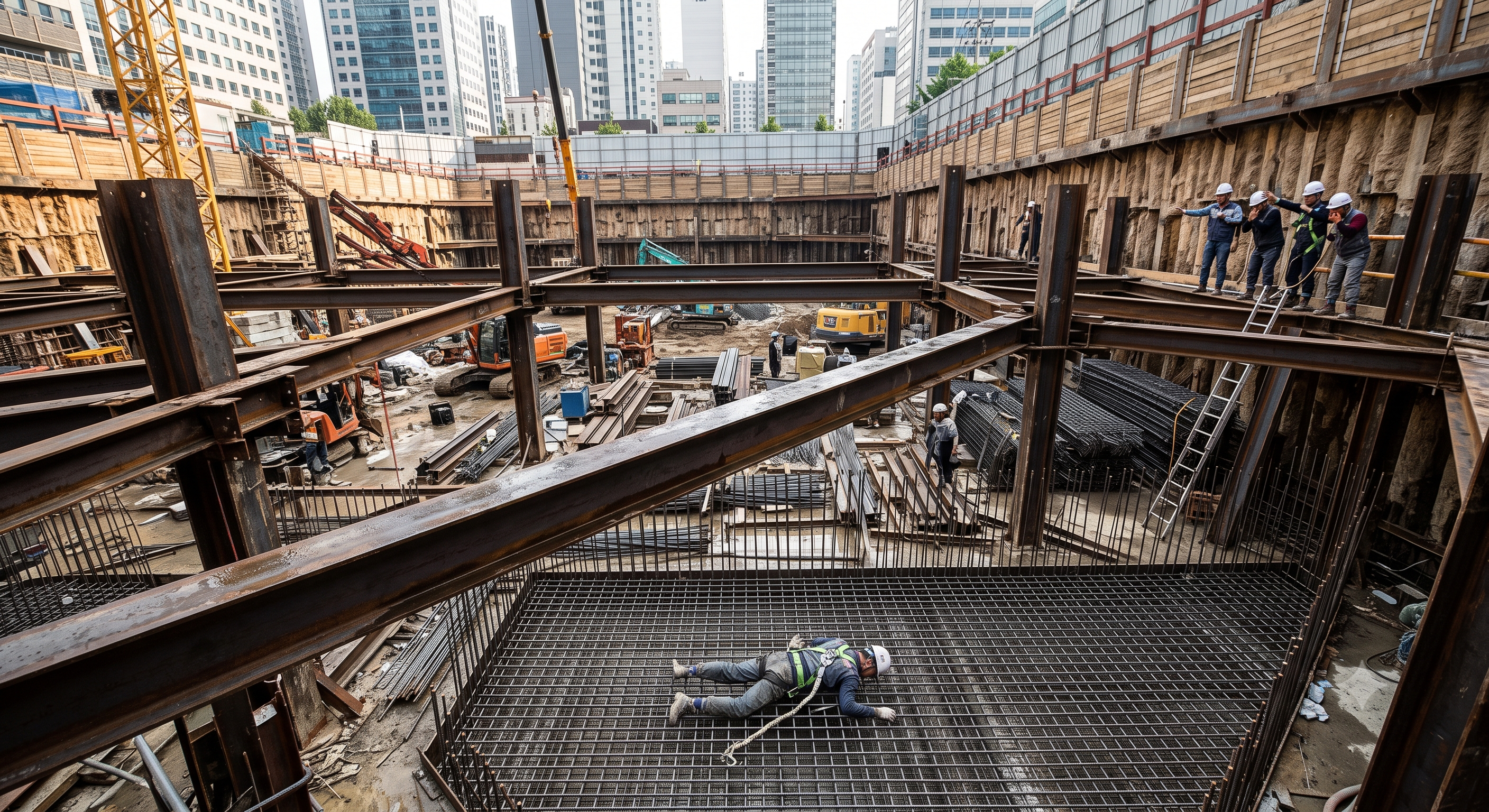
The retained educational image and this scenario are hypothetical. They are not actual incident, inspection, measurement or professional approval records.
| Step | Fictional scenario |
|---|---|
| Initial state | A crew applies the specified preload to a newly installed strut. |
| Changed condition | The gauge shows the planned indication, but bearing contact and the load-retaining arrangement have not been confirmed. |
| Failure path | The crew proposes releasing the jack and starting the next excavation from the gauge reading alone. |
| Possible consequence | Load may be lost or an incompletely supported stage loaded, causing movement or loss of excavation stability. |
| Barrier | Hold jack withdrawal and excavation; verify the force basis, bearing, completed connections, retained-load transfer and monitoring before separate releases. |
Why the controls matter
The temporary erection state has a different load path from the completed support system. A crane may be released only after the specified seating, connections and restraint are accepted. Use protected access to reach joints and lifting accessories; an unprotected steel flange is not a walkway.
A hydraulic reading must be interpreted using the actual jack, instrumentation, alignment and contact conditions. Design axial load, applied preload and load retained after transfer are different quantities. Do not vent or disconnect a jack merely because the target indication appeared.
Strut buckling resistance depends on member, unbraced length, end conditions and real restraint. Crossing members do not automatically brace one another. Added walkways, stored materials and plant surcharge require design consideration.
Known facts are the current loading stage and indications. Unresolved facts are actual bearing, connections and retained load. The hold remains until the specified inspections, force/movement records and engineering disposition are available. Next excavation also needs functioning monitoring and explicit stage limits.
5. Hold and proceed decisions
| Condition | Action | Evidence | Proceed when |
|---|---|---|---|
| Rain or seepage changes | Hold affected work | Water, ground and support review | Conditions accepted |
| Rigging release unreachable | Keep support; revise access | Protected reach and lift plan | Access and seating accepted |
| Abnormal preload response | Hold; exclude release paths | Force/movement and engineering review | Cause and retention resolved |
| Monitoring unavailable | Hold next excavation | Restored readings and trigger plan | Monitoring active |
| Next cut requested | Close support defects | As-built acceptance and stage limits | Stage released |
Similar appearance, different evidence
| Observation | What it shows | What remains to verify |
|---|---|---|
| Beam rests on seat | Contact exists | Designed bearing, restraint and connection. |
| Gauge reaches indication | A pressure is displayed | Valid force basis and retained-load transfer. |
| Two struts cross | Geometry intersects | Designed connected restraint. |
| Permit signed | Administrative action recorded | Physical controls and technical acceptance. |
Use the engineered response to unexpected pressure or movement. Sudden depressurisation can remove support; isolate and stabilise only through the approved stage-specific method. Never search for a hydraulic leak with a hand, tighten live fittings or alter a loaded member without engineering review.
6. Roles and supervision
| Role | Task responsibility |
|---|---|
| Developer, QP and builder | Resolve applicable approval and supervision, ground model and staged design; the QP handles required design changes. |
| Installation supervisor | Coordinate receiving supports, member identity, temporary restraint, connections and the actual crane-release hold point. |
| Lifting team | Verify lift configuration, member load, plant support, signals and protected positions for receiving and unhooking. |
| Preload team and designated inspector | Use the specified equipment and sequence; record force/movement, lock-off and retained-load acceptance. |
| Monitoring and excavation team | Maintain baseline, readings and trigger response; obtain explicit limits before the next cut. |
| Site and emergency leads | Coordinate access, hot-work/exposure controls, exclusion and protected rescue. |
Training, task authorisation, engineering acceptance, inspection and permission for excavation are separate records. No role may release a technical issue outside its competence and assigned authority.
7. Hold points and record quality
| Hold point | Required evidence | Responsible review |
|---|---|---|
| Before installation | Current stage, ground, utilities, lift/access and equipment | QP and site/lifting leads |
| Before crane release | Bearing, required connections and erection restraint | Installation supervisor and designated inspector |
| Before preload, where specified | Actual jack/gauge basis, reactions, sequence and stop limits | Technical authority and preload supervisor |
| Before jack withdrawal | Retained-load transfer and completed inspection | Designated inspector and technical authority |
| Before next excavation | Accepted support, active monitoring and explicit cut limits | QP and excavation supervisor |
Record actual time, location, drawing revision, evidence, person and unresolved matters. These worksheet hold points do not define statutory permit categories. Revalidate after changed water, ground, equipment, support, access or monitoring conditions.
Record comparison prompts
These are blank prompts and fictional examples of insufficient records; ticking a box is not an approval.
| Record type | Insufficient record | Evidence checklist |
|---|---|---|
| Design and ground | Looks unchanged | □ Stage revision | □ Ground/water | □ Service clearance | □ Baseline and triggers |
| Placed member | Seated | □ Member identity | □ Bearing/restraint | □ Connection checks | □ Crane-release evidence |
| Preload and transfer | Gauge normal | □ Jack/gauge basis | □ Force and movement | □ Retained-load acceptance | □ Defect disposition |
| Next excavation | Installation complete | □ As-built support | □ Monitoring active | □ Permitted cut limits | □ Named release authority |
8. Pre-work checks and emergency response
| Pre-work check | Actual result | Person / action |
|---|---|---|
| □ Current QP stage and ground/water conditions | ||
| □ Service clearance and surcharge | ||
| □ Lift, rigging and plant support | ||
| □ Protected joint and unhooking access | ||
| □ Member, bearing and temporary restraints | ||
| □ Bolts/welds and inspection requirements | ||
| □ Preload, retention and isolation procedure | ||
| □ Monitoring, escape and rescue |
Stop work
Stop affected work for movement, lost bearing, connection distress, abnormal pressure/travel, impact, unsafe water, atmospheric alarm, unavailable monitoring, failed access protection or lost lifting signals. Exclude exposed people; stabilisation and restart require the stage-specific engineering and competent site response.
Emergency response
Raise the alarm and keep people outside collapse, falling-member and hydraulic-release paths. Maintain the required support state; do not improvise jack unloading, strut removal or entry to rescue someone. Activate the planned trained rescue and emergency services, giving the current support and energy state.
9. Sources and review limits
Public-source review: 14 October 2026. Only the material and limits identified below were reviewed.
| Source | Reviewed material | Task application |
|---|---|---|
| MOM - Risk management | Responsibilities; routine and non-routine work; hierarchy of control and risk assessment team. Official explanation of WSH Risk Management duties, not a complete consolidated statutory text. | Assess installation stages, access and simultaneous work. |
| BCA - ERSS design considerations, advisory note 1/09 | Indexed page 9 design checklist: ground/water, surcharge and staged loads, walers/struts, bearing packing, preloading, restraint and neighbouring ground effects. Older advisory, selected indexed text only; direct fetch failed. No numeric load/factor adopted and no full current legal/design audit. Project QP must verify current requirements and actual staged design. | Consider ground/water, staged load paths, restraint and preload in the actual ERSS design. |
| BCA - Permit for structural works | Main overview, joint developer/QP/builder application, material-change approval and immaterial-change records; current page March 2026. Actual work classification, exemptions and submitted design were not supplied. Linked forms were not reviewed and are not reproduced as completed records. | Resolve project structural permission and design-change approval. |
| WSHC - Planning a Lift | Main guidance on lifting plans, load, equipment, crew, method, communication, environment and changed conditions. Official guidance. The plan and permit requirements must be determined for the actual lifting operation; this page is not a universal permit rule. | Plan actual member lifting and protected rigging release. |
| MOM - Work at Heights amendment factsheet | Pages 1-4, particularly Annex A questions 1-3 on factories, hazardous height and effective protection; training/role explanations. Official 2014 explanatory factsheet accessed now. Consolidated SSO fetch returned 403; full current statutory text not verified. Course names and detailed permit arrangements need current confirmation. | Plan protected access, fall prevention and rescue. |
| EMA - Earthworks Contractors | Requirements preceding enforcement tables: utility plans, licensed cable detection, advance notification, SP PowerGrid conditions and RES scope. This review covers requirements, not individual case findings or all utility authorities. Cable-detection records do not alone authorise penetration at a particular column. | Resolve underground electrical-service interfaces. |
| MOM - Requirements for hygiene monitoring | Main requirements: competent monitoring personnel, toxic substances, results and reporting, recommended frequency table and noise applicability. Material-specific exposure and actual monitoring frequency have not been determined. No workplace measurement is supplied. | Assess welding/coating fumes separately from atmosphere alarms. |
Selected public official sources were reviewed on 14 October 2026 within the recorded scope. No full consolidated legal audit, paid Singapore Standard, actual model manual, site inspection, engineering calculation or professional approval is claimed. Verify current detailed requirements and actual equipment/site records before use.
AI-generated reference material. It has not been verified or approved by a professional. Before use, a qualified person must review and adapt it to applicable Singapore requirements, the actual equipment and site, and approved safe work procedures.
10. PDF use and frequently asked questions
Use A for core controls, B for technical failure review and C for supervision and records. Each is a complementary six-stage extract from this eight-stage article. Use all stages and the actual approved procedure. Blank P/S/R/A, observations and signatures must be completed only from actual assessment.
Does every strut require preload?
Only as specified by the design, with its equipment, sequence, force/movement and retained-load criteria.
Does a pressure reading establish accepted support?
No. Verify the actual measurement basis, bearings, connections and retained load after transfer.
Does every deep excavation have the same entry-permit status?
No. Assess the actual Singapore confined-space definition and workplace permit requirements separately. An open excavation still needs atmosphere, access and rescue controls appropriate to its hazards; depth alone does not settle entry classification.
Can a signed JSA change the structural design?
No. Resolve changes through the responsible QP and applicable approval process before altering the system.
Has a professional approved this article?
AI-generated reference material. It has not been verified or approved by a professional. Before use, a qualified person must review and adapt it to applicable Singapore requirements, the actual equipment and site, and approved safe work procedures.
Singapore application
Read A, B and C together with all eight JSA stages and the approved work procedure. The sheets are complementary extracts, not separate work authorisations.
11. Authorship and revision history
AI-generated reference material. It has not been verified or approved by a professional. Before use, a qualified person must review and adapt it to applicable Singapore requirements, the actual equipment and site, and approved safe work procedures.
| Date / edition | Authorship and scope | Professional approval |
|---|---|---|
| 2026-08-03 / Korean source | Original topic and educational illustration retained as references. Source content is unchanged. | Not asserted |
| 14 October 2026 / Singapore 1.0 | Rebuilt foreign jurisdiction, imperial scenario and speculative workflow sections around Singapore ERSS staged acceptance and monitoring; retained eight technical stages. | Not performed |
Source topic: https://smartjsabridge.com/ko/case-study/jsa-timbering-installation