Prefer a suitable protected platform where practicable. If a chair is justified, verify independent protection and the supporting structure before crossing the edge; two ropes on one weak support do not provide independent safety.
AI-generated reference material. It has not been verified or approved by a professional. Before use, a qualified person must review and adapt it to applicable Singapore requirements, the actual equipment and site, and approved safe work procedures.
1. Singapore legal and technical basis
Singapore scaffold definitions exclude a boatswain chair from the defined suspended-scaffold category. Confirm the actual access-system classification and applicable duties before use; do not copy powered-cradle certification assumptions into this task. General WSH fall-prevention, competent rigging, suitable anchorage and rescue planning still apply.
| Source category | Task application and limit |
|---|---|
| MOM - Risk management | Assess access selection, public exposure and task changes. Official explanation of WSH Risk Management duties, not a complete consolidated statutory text. |
| SSO - Scaffolds Regulations, definitions | Distinguish a single-person chair from the suspended-scaffold definition. Selected indexed provision only; not a complete current regulatory assessment of the actual chair system. No general WSH exemption is inferred. |
| MOM - Work at Heights amendment factsheet | Apply fall-prevention planning and actual permit applicability. Official 2014 explanatory factsheet accessed now. Consolidated SSO fetch returned 403; full current statutory text not verified. Course names and detailed permit arrangements need current confirmation. |
| WSHC - Anchorage, lifelines and temporary edge protection | Verify substrate, compatible equipment, line routing and rescue load paths. Selected guidance text, not complete paid standards or visual diagrams. Older standard editions and numerical examples are not treated as current universal statutory design values; confirm actual system/current specification. |
Use Singapore requirements and SI units. Manufacturer limits apply to the actual model. Foreign technical examples do not establish Singapore statutory duties. A job safety analysis or completed checklist is not a permit or approval.
2. Scope and required inputs
Included scope
This revision covers planning, rigging, protected transfer, controlled descent, light facade painting, recovery and handover of a single-person suspended chair. First assess a scaffold or elevating platform that avoids prolonged suspension.
Separate review
Powered cradles, crane-suspended baskets, improvised seats, structural demolition and specialist rope rescue are outside this reference. Rope access and a suspension scaffold are not interchangeable regulatory categories.
| Required input | What to verify |
|---|---|
| Select access | Access assessment · Approved work scope · Rescue demonstration · Exclusion plan |
| Verify anchors | Anchor design · Independent load paths · Equipment records · Rescue load case |
| Rig and protect | Edge route inspection · Connector orientation · End protection · Compatibility evidence |
| Board the chair | Transfer arrangement · Backup connection · Buddy check · Tool retention |
| Inspect and hand over | Inspection record · Quarantine identity · Storage conditions · Handover responsibility |
The retained title is not an anchor certificate. Do not adopt a universal 15 kN, 22 kN, rope diameter, knot tail, wind speed or side-reach angle from the original. The competent design must cover the actual system, support structure, fall clearance and rescue load. No actual equipment manual or paid standard was audited.
Select a compatible full-body fall-protection system, seating support, connectors and helmet for the actual arrangement; the seat is not the fall-arrest harness. Select eye, skin and respiratory protection from coating data and exposure assessment. Do not attach tool tethers where they compromise the life-safety system.
Singapore application
Record why the selected chair is suitable and identify the competent system designer and rigging team. Verify the working suspension, personal protective system and rescue arrangement against actual compatible equipment instructions. The choice of a chair does not authorise improvised lifting of a person or substitute for an assessed rope-access system.
3. Eight-stage JSA
| Job stage | Hazards and effects | Failure factors | Controls | Site verification | P | S | R | A |
|---|---|---|---|---|---|---|---|---|
| 1. Select access | 1. Fall at roof edge2. Unsuitable chair3. Delayed rescue4. Public exposure | 1. Platform option skipped2. Work scope unclear3. No rescue route4. Open pavement | 1. Assess safer access2. Define chair limits3. Plan assisted recovery4. Barrier the drop zone | 1. Access assessment2. Approved work scope3. Rescue demonstration4. Chair category and method | ||||
| 2. Verify anchors | 1. Anchor pull-out2. Shared failure3. Rope rupture4. Roof overload | 1. Unverified structure2. Common weak support3. Damaged rope4. Unknown loads | 1. Verify load paths2. Separate safety system3. Reject damaged lines4. Check roof capacity | 1. Anchor design2. Independent load paths3. Equipment records4. Independent support evidence | ||||
| 3. Rig and protect | 1. Edge cutting2. Connector opening3. Rope run-out4. Device mismatch | 1. Moving edge pad2. Cross-loaded gate3. Insufficient length4. Wrong rope diameter | 1. Secure edge protection2. Lock rated connectors3. Check full rope reach4. Match rope and device | 1. Edge route inspection2. Connector orientation3. End protection4. Compatibility evidence | ||||
| 4. Board the chair | 1. Unprotected transfer2. Shock loading3. Harness misconnection4. Dropped tools | 1. Backup attached late2. Jump into seat3. Wrong attachment point4. Loose containers | 1. Connect before exposure2. Transfer under control3. Check harness routing4. Secure tools and paint | 1. Transfer arrangement2. Backup connection3. Buddy check4. Tool retention | ||||
| 5. Descend and work | 1. Pendulum impact2. Rope abrasion3. Solvent damage4. Paint inhalation | 1. Side reach excessive2. Guard displaced3. Spilled coating4. Wrong respirator | 1. Remain in planned lane2. Watch both rope paths3. Keep chemicals off ropes4. Control coating exposure | 1. Weather and movement2. Protector position3. Coating safety data4. Respiratory selection | ||||
| 6. Respond to defect | 1. Suspended casualty2. Continued line damage3. Rescuer fall4. Uncontrolled lowering | 1. Alarm ignored2. Blind continued descent3. Improvised rescue4. Wrong control action | 1. Stop and communicate2. Secure safe position3. Use planned rescue team4. Quarantine damaged kit | 1. Casualty location2. Safe recovery route3. Rescue team readiness4. Defect isolation | ||||
| 7. Land and recover | 1. Early disconnection2. Falling equipment3. Trip at landing4. Tensioned release | 1. Unstable landing2. Loose bucket3. Uncontrolled rope loop4. Anchor untied loaded | 1. Reach safe landing2. Keep attachment until safe3. Recover kit in bags4. Unload before de-rigging | 1. Landing clearance2. Safe disconnection point3. Tool count4. Zero suspended load | ||||
| 8. Inspect and hand over | 1. Hidden rope damage2. Unsafe reuse3. Chemical contamination4. Unprotected roof edge | 1. No post-use check2. Defect unrecorded3. Wrong cleaning method4. Barriers removed early | 1. Inspect contact zones2. Tag and isolate defects3. Clean per instructions4. Hand over roof protection | 1. Inspection record2. Quarantine identity3. Storage conditions4. Handover responsibility |
P/S/R/A and actual measurements, checks, names and signatures remain blank for the site assessment. A score cannot waive a required control.
4. Hypothetical scenario and failure mechanisms
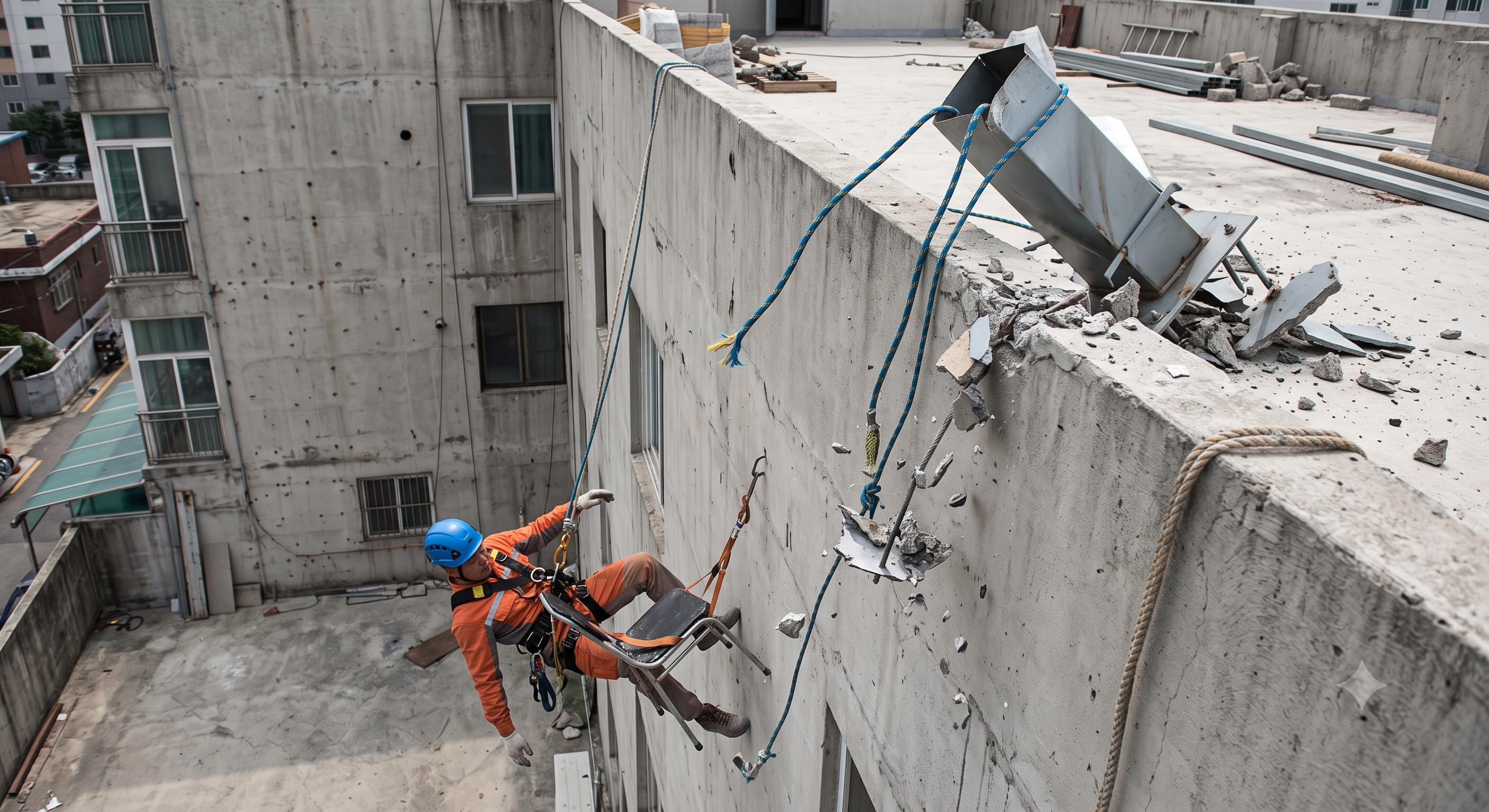
Retained educational illustration; not evidence of an actual incident or site suitability. Its creation method, including possible AI use, has not been verified.
The scenario and record comparisons are fictional teaching examples, not records of real incidents, measurements, inspections, signatures or approvals.
| Item | Fictional scenario |
|---|---|
| Initial situation | A painter proposes moving sideways around a facade return. |
| Changed condition | Both ropes cross the same coping joint; one protector has shifted. |
| Failure path | Anchor independence below the roof finish and the new rope path are unverified. |
| Possible outcome | Hold the transfer or move to the planned safe recovery point; do not continue to test the rope by loading it. |
| Prevention barrier | Obtain a support assessment, protected routes and a rehearsed recovery method before a new work release. |
Failure mechanisms
Separate attachment labels do not eliminate a shared weak host structure or common cutting edge.
Lateral movement changes rope contact and pendulum exposure; a protector must remain effective as the lines move.
A simple weight or energy equation does not predict the peak arrest force of a complete harness, rope, absorber and anchor system.
Decision sequence
| Decision stage | What to verify |
|---|---|
| Known facts | Locate the actual load-bearing supports and both rope paths. |
| Unresolved matters | Identify missing structural, compatibility and rescue evidence. |
| Reason to hold | Hold access while either protection path is uncertain. |
| Required evidence | Record competent design, rigging inspection and controlled rescue demonstration. |
| Restart decision | Release only the defined work lane; reassess each relocation. |
5. Hold and proceed decisions
| Condition | Action | Evidence | Proceed when |
|---|---|---|---|
| Unknown anchor | Hold loading; obtain structural assessment | Anchor identity, design and installation record | Load paths verified |
| Shifted edge guard | Stop; reposition and secure protection | Inspection across full working movement | Both rope paths protected |
| Wind or lateral motion | Recover to safe location; reassess method | Weather record and system limits | Movement within plan |
| Damaged line | Isolate line; replace and inspect system | Defect record and replacement compatibility | Defective line excluded |
Similar situations, different decisions
The scenario and record comparisons are fictional teaching examples, not records of real incidents, measurements, inspections, signatures or approvals.
| Comparison | Situation A | Situation B |
|---|---|---|
| Two attachment points | Two eyes on an unverified sheet-metal housing | Separate systems with verified host load paths |
| Rope looks intact | Only a distant visual check | Identity, tactile inspection and contact-zone check |
| Worker has landed | Feet touch an unstable ledge | Safe standing and disconnection point confirmed |
6. Roles and supervision
| Role | Responsibility |
|---|---|
| Select access | Assign access planner · Check alternatives · Name rescue lead |
| Verify anchors | Commission anchor design · Check common failure · Verify rescue loading |
| Rig and protect | Approve rope/device pairing · Assign edge inspection · Record rigging check |
| Board the chair | Brief transfer sequence · Verify backup connection · Control public exclusion |
| Respond to defect | Maintain work suspension · Coordinate recovery team · Require defect release |
| Inspect and hand over | Transfer equipment history · Control quarantined kit · Assign roof handover |
Supervision, records, handover
| Job stage | Technical and procedural controls | Site verification |
|---|---|---|
| Select access | 1. Assign access planner2. Check alternatives3. Name rescue lead | 1. Access assessment2. Approved work scope3. Rescue demonstration |
| Verify anchors | 1. Commission anchor design2. Check common failure3. Verify rescue loading | 1. Anchor design2. Independent load paths3. Equipment records |
| Rig and protect | 1. Approve rope/device pairing2. Assign edge inspection3. Record rigging check | 1. Edge route inspection2. Connector orientation3. End protection |
| Board the chair | 1. Brief transfer sequence2. Verify backup connection3. Control public exclusion | 1. Transfer arrangement2. Backup connection3. Buddy check |
| Respond to defect | 1. Maintain work suspension2. Coordinate recovery team3. Require defect release | 1. Casualty location2. Safe recovery route3. Rescue team readiness |
| Inspect and hand over | 1. Transfer equipment history2. Control quarantined kit3. Assign roof handover | 1. Inspection record2. Quarantine identity3. Storage conditions |
Singapore application
The building owner supplies reliable anchor and host-structure information. The rigging supervisor verifies both load paths and every facade return. The work supervisor controls ground exclusion, weather and communications; trained rescuers remain able to reach a stranded worker without relying solely on a public emergency response.
7. Hold points and record quality
| Hold point | Evidence before release | Confirmation / approval |
|---|---|---|
| Start | This revision covers planning, rigging, protected transfer, controlled descent, light facade painting, recovery and handover of a single-person suspended chair. First assess a scaffold or elevating platform that avoids prolonged suspension. | |
| HP-1 Verify anchors | Anchor design · Independent load paths · Equipment records · Rescue load case | |
| HP-2 Rig and protect | Edge route inspection · Connector orientation · End protection · Compatibility evidence | |
| HP-3 Board the chair | Transfer arrangement · Backup connection · Buddy check · Tool retention | |
| HP-4 Respond to defect | Casualty location · Safe recovery route · Rescue team readiness · Defect isolation |
Complete after actual checks. Recheck after changes, defects or shift handover.
Record comparison examples
The scenario and record comparisons are fictional teaching examples, not records of real incidents, measurements, inspections, signatures or approvals.
The boxes are static record prompts, not interactive or saved approvals. A tick does not establish suitability or permission to restart. Record the evidence, person, time and unresolved issues; retain the change history.
| Record type | Insufficient record | Record checklist |
|---|---|---|
| Verify anchors | Checked. | □ Anchor design□ Independent load paths□ Equipment records□ Rescue load case |
| Rig and protect | Checked. | □ Edge route inspection□ Connector orientation□ End protection□ Compatibility evidence |
| Board the chair | Checked. | □ Transfer arrangement□ Backup connection□ Buddy check□ Tool retention |
| Inspect and hand over | Checked. | □ Inspection record□ Quarantine identity□ Storage conditions□ Handover responsibility |
8. Pre-work checks and emergency response
| Check item | Result | Person / action |
|---|---|---|
| □ Select access: Access assessment | ||
| □ Verify anchors: Anchor design | ||
| □ Rig and protect: Edge route inspection | ||
| □ Board the chair: Transfer arrangement | ||
| □ Descend and work: Weather and movement | ||
| □ Respond to defect: Casualty location | ||
| □ Land and recover: Landing clearance | ||
| □ Inspect and hand over: Inspection record | ||
| □ Release / handover authority |
Stop work
Stop for rope damage, displaced edge protection, uncertain anchors, loss of communication, uncontrolled movement or impaired recovery capability. Do not bypass an arrester or continue a lateral traverse to finish a small area.
Emergency response
Use the planned assisted recovery with trained personnel and compatible equipment. Maintain communication, protect rescuers and call the designated emergency service. Do not improvise another person on the same anchor or cut a loaded line; rapid recovery must follow the assessed method.
9. Sources and review limits
Public-source review: 14 October 2026. Only the material and limits identified below were reviewed.
| Source | Reviewed material | Task application |
|---|---|---|
| MOM - Risk management | Responsibilities; routine and non-routine work; hierarchy of control and risk assessment team. Official explanation of WSH Risk Management duties, not a complete consolidated statutory text. | Assess access selection, public exposure and task changes. |
| SSO - Scaffolds Regulations, definitions | Indexed regulation 2 definition: suspended scaffold excludes a boatswain chair or similar appliance. Selected indexed provision only; not a complete current regulatory assessment of the actual chair system. No general WSH exemption is inferred. | Distinguish a single-person chair from the suspended-scaffold definition. |
| MOM - Work at Heights amendment factsheet | Pages 1-4, particularly Annex A questions 1-3 on factories, hazardous height and effective protection; training/role explanations. Official 2014 explanatory factsheet accessed now. Consolidated SSO fetch returned 403; full current statutory text not verified. Course names and detailed permit arrangements need current confirmation. | Apply fall-prevention planning and actual permit applicability. |
| WSHC - Anchorage, lifelines and temporary edge protection | Printed pages 3-7 hierarchy/substrate/climate; 14-17 identification, installation evidence and compatible systems; 24-27 deflection/clearance and SRL restrictions. Selected guidance text, not complete paid standards or visual diagrams. Older standard editions and numerical examples are not treated as current universal statutory design values; confirm actual system/current specification. | Verify substrate, compatible equipment, line routing and rescue load paths. |
Selected public official sources were reviewed on 14 October 2026 within the recorded scope. No full consolidated legal audit, paid Singapore Standard, actual model manual, site inspection, engineering calculation or professional approval is claimed. Verify current detailed requirements and actual equipment/site records before use.
AI-generated reference material. It has not been verified or approved by a professional. Before use, a qualified person must review and adapt it to applicable Singapore requirements, the actual equipment and site, and approved safe work procedures.
10. PDF use and frequently asked questions
PDF A covers basic task controls; B focuses on technical failures; C covers supervision, records and handover. The article has eight stages with four items per main cell; each PDF has six key stages with three items per main cell. P/S/R/A, measurements, confirmations and signatures remain blank for actual site assessment.
Content group ID
jsa-suspended-scaffold
What work does this reference cover?
This revision covers planning, rigging, protected transfer, controlled descent, light facade painting, recovery and handover of a single-person suspended chair. First assess a scaffold or elevating platform that avoids prolonged suspension.
Do the headline numbers prove the site is safe?
The retained title is not an anchor certificate. Do not adopt a universal 15 kN, 22 kN, rope diameter, knot tail, wind speed or side-reach angle from the original. The competent design must cover the actual system, support structure, fall clearance and rescue load. No actual equipment manual or paid standard was audited.
Which personal protection is needed?
Select a compatible full-body fall-protection system, seating support, connectors and helmet for the actual arrangement; the seat is not the fall-arrest harness. Select eye, skin and respiratory protection from coating data and exposure assessment. Do not attach tool tethers where they compromise the life-safety system.
What happens if rescue is required?
Use the planned assisted recovery with trained personnel and compatible equipment. Maintain communication, protect rescuers and call the designated emergency service. Do not improvise another person on the same anchor or cut a loaded line; rapid recovery must follow the assessed method.
Has a professional verified or approved this document?
No. Public sources and editorial, layout and consistency checks were reviewed using AI. No site inspection or professional technical approval has been performed. Obtain appropriate professional review before use.
Singapore application
Read A, B and C together with all eight JSA stages and the approved work procedure. The sheets are complementary extracts, not separate work authorisations.
11. Authorship and revision history
AI-generated reference material. It has not been verified or approved by a professional. Before use, a qualified person must review and adapt it to applicable Singapore requirements, the actual equipment and site, and approved safe work procedures.
| Date / edition | Authorship and scope | Professional approval |
|---|---|---|
| 2026-09-06 / Korean source | Original topic and educational illustration retained as references. Source content is unchanged. | Not asserted |
| 14 October 2026 / Singapore 1.0 | Clarified Singapore boatswain-chair classification and independent support/edge protection with preplanned rescue. | Not performed |
Source topic: https://smartjsabridge.com/ko/case-study/jsa-suspended-scaffold