Support the roll and carriage before access. A remembered automatic command, an upstream conveyor or a helper at another station can create motion while the film path is occupied.
AI-generated reference material. It has not been verified or approved by a professional. Before use, a qualified person must review and adapt it to applicable Singapore requirements, the actual equipment and site, and approved safe work procedures.
1. Singapore legal and technical basis
Singapore WSH machinery and risk-management controls apply to roll changing and film threading. Establish and verify the actual electrical, pneumatic, gravity and linked-conveyor isolation boundary. An interlocked gate or routine roll-change label does not establish a safe energy state.
| Source category | Task application and limit |
|---|---|
| MOM - Risk management | Assess machine access and adjacent production interfaces. Official explanation of WSH Risk Management duties, not a complete consolidated statutory text. |
| WSHC - Safe Use of Machinery | Use guarding, verified isolation and controlled restoration. Official guidance with a summary of statutory duties; not a machine-specific safeguard design or full review of current legislation or paid standards. |
| WSHC - Loading and Unloading Operations | Apply relevant handling and pedestrian separation principles. General guidance, not a dock-leveller design standard or proof that one restraint fits every trailer. Actual device instructions govern compatibility and support. |
Use Singapore requirements and SI units. Manufacturer limits apply to the actual model. Foreign technical examples do not establish Singapore statutory duties. A job safety analysis or completed checklist is not a permit or approval.
2. Scope and required inputs
Included: Isolated replacement and threading of an identified film roll on an automatic pallet stretch wrapper using the actual manufacturer-permitted roll-change position and procedure.
Separate review: Live film splicing, defeated interlocks, unvalidated special operating modes, elevated access, carriage repairs and changes to control-system safety functions require separate procedures.
| Input | Required evidence |
|---|---|
| Identify wrapper boundary | Wrapper and conveyor IDs; Remote and automatic commands; Roll width core and winding; Mass and handling assistance |
| Isolate and support | Isolation points and custody; Carriage support and gravity; Residual pressure and motion; Upstream restart prevention |
| Install and thread | Width core and winding match; Film path and roller condition; Cutter and pinch-zone control; Retainer and roll seating |
| Hand over production | Wrapper and film identification; Machine functional acceptance; Load-quality status; Receiving operator and holds |
Identify the wrapper, turntable or rotating arm, carriage, cutter and connected conveyor boundaries. Confirm the designated change position, electrical and pneumatic sources, gravity and stored motion, mechanical supports, roll width, mass, core and winding direction, threading diagram and safe restart procedure. This JSA uses isolated roll change and requires verified isolation throughout roll access.
Singapore application
Identify remote starts, automatic cycle memory, carriage fall, cutter energy and conveyors that can reach the access zone. Assign one restoration coordinator and account for everyone whose task crosses that boundary. Record the actual manufacturer method for roll support and threading.
3. Eight-stage JSA
| Job stage | Hazards and effects | Failure factors | Controls | Site verification | P | S | R | A |
|---|---|---|---|---|---|---|---|---|
| 1. Identify wrapper boundary | 1. Remote unexpected start2. Conveyor crush3. Wrong film application4. Unreviewed roll handling | 1. Upstream control omitted2. Linked machine still active3. Roll specification unknown4. Mass not checked | 1. Identify connected equipment2. Define isolation boundary3. Match film and machine4. Plan supported roll handling | 1. Wrapper and conveyor IDs2. Remote and automatic commands3. Roll width core and winding4. Shared isolation boundary | ||||
| 2. Position and stop | 1. Rotating-arm strike2. Carriage pinch3. Cutter injury4. Worker in motion envelope | 1. Person enters during positioning2. Wrong change position3. Cutter cycle unreviewed4. Visibility obstructed | 1. Clear area before positioning2. Use designated change position3. Stop by actual procedure4. Confirm complete motion stop | 1. People outside machine envelope2. Carriage change position3. Arm turntable and cutter state4. Stop and command status | ||||
| 3. Isolate and support | 1. Unexpected rotation2. Gravity carriage drop3. Pressure release4. Stored-motion contact | 1. Control stop used alone2. Carriage unsupported3. Pneumatics not isolated4. Residual energy unverified | 1. Apply energy-control procedure2. Use specified mechanical support3. Control pressure and stored energy4. Verify safe state before entry | 1. Isolation points and custody2. Carriage support and gravity3. Residual pressure and motion4. Upstream restart prevention | ||||
| 4. Remove supported roll | 1. Dropped roll2. Finger crush3. Handling strain4. Sharp-edge cuts | 1. Retainer released unsupported2. Hands beneath roll3. Heavy roll lifted alone4. Damaged core or edge | 1. Support before release2. Keep hands clear of pinch zone3. Use suitable handling assistance4. Inspect removed roll and holder | 1. Support and release sequence2. Roll mass and lifting aid3. Core spindle and retainer4. Safe old-roll storage | ||||
| 5. Install and thread | 1. Roller entanglement2. Cutter contact3. Film tear on restart4. Roll release | 1. Energy control lost2. Hands cross cutter path3. Wrong winding or routing4. Retainer incomplete | 1. Maintain verified isolation2. Use actual threading diagram3. Match film specification4. Secure roll and retainers | 1. Width core and winding match2. Film path and roller condition3. Cutter and pinch-zone control4. Retainer and roll seating | ||||
| 6. Restore and test | 1. Person struck by arm2. Guarding failure3. Tool ejection4. Unstable pallet load | 1. Person remains inside2. Guard not restored3. Tools left in machine4. Wrapping quality assumed | 1. Account for people and tools2. Restore guards before restart3. Announce controlled test4. Check film and load separately | 1. Clear envelope and tool count2. Guards and protective functions3. Authorised restart sequence4. Film application and load condition | ||||
| 7. Hold repeated tearing | 1. Hand caught in rollers2. Unexpected automatic start3. Interlock bypass injury4. Repeated defective wrap | 1. Film guided while moving2. Pending command ignored3. Gate switch defeated4. Cause not investigated | 1. Stop and isolate again2. Prohibit hand guiding in motion3. Preserve protective functions4. Review roll path and settings | 1. Tear location and timing2. Roll and roller condition3. Threading and settings basis4. Re-isolate for investigation | ||||
| 8. Hand over production | 1. Unsafe automatic restart2. Loose roll release3. Unaccepted load dispatch4. Lost machine restriction | 1. Release scope unclear2. Retainer check missing3. Machine test equals load release4. Defect left verbal | 1. Confirm normal configuration2. Record roll seating and guards3. Separate load acceptance4. Transfer defects and limits | 1. Wrapper and film identification2. Machine functional acceptance3. Load-quality status4. Receiving operator and holds |
P/S/R/A and actual measurements, checks, names and signatures remain blank for the site assessment. A score cannot waive a required control.
4. Hypothetical scenario and failure mechanisms
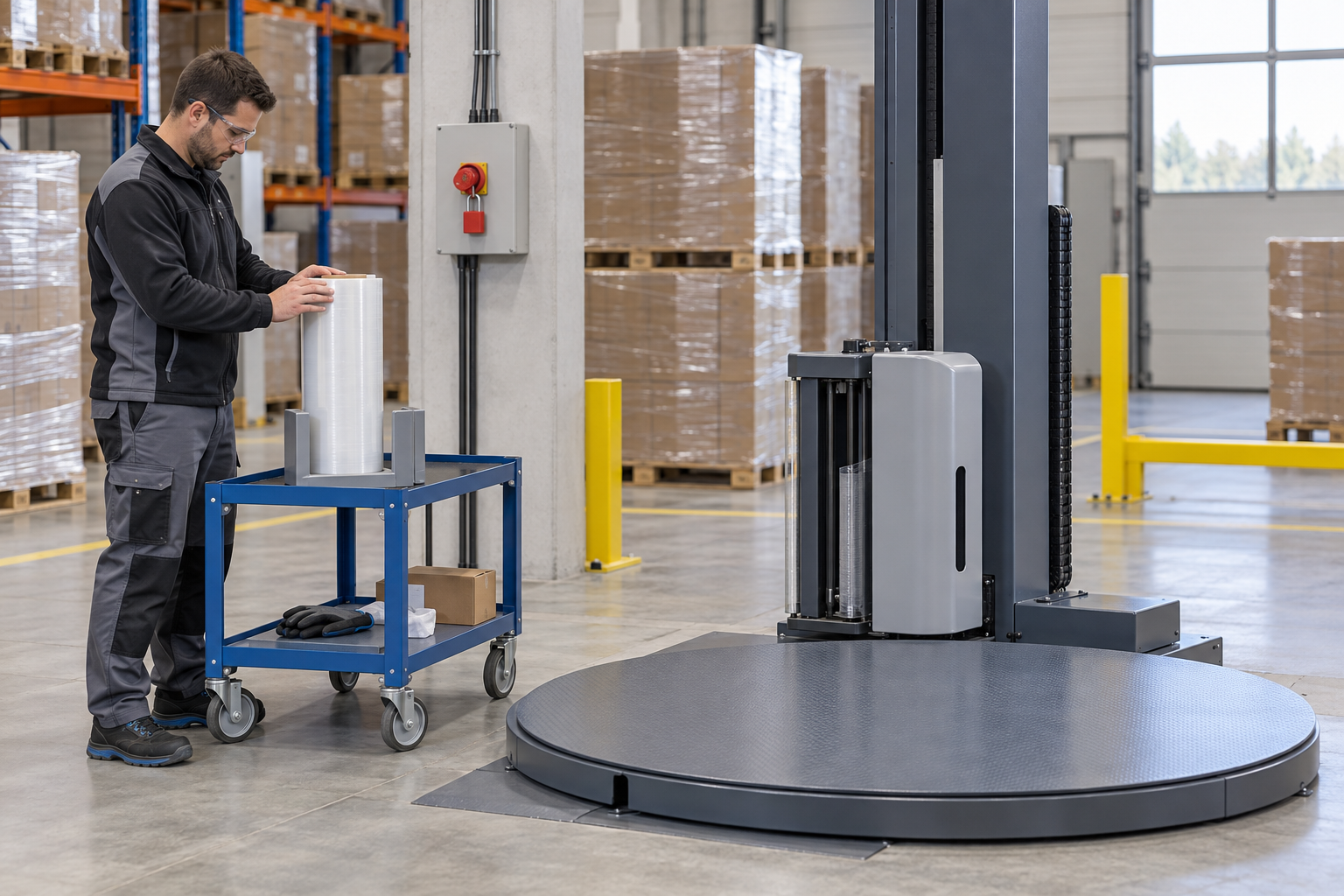
The following scenario, comparisons and example records are hypothetical teaching material. They do not reproduce actual incidents, measurements, signatures or approvals.
| Item | Hypothetical situation |
|---|---|
| Initial state | The film tears again during a controlled trial after a roll change. |
| Change | The operator opens the gate and reaches toward the film path while an automatic request remains pending. |
| Failure path | The operator intends to guide the film by hand while another person restarts the cycle. |
| Possible harm | Carriage, pre-stretch rollers, cutter or rotating machinery can trap the hand or strike the person. |
| Barrier | Stop, isolate again and investigate the roll, threading, roller condition and settings before a guarded test with the area clear. |
A stop command, open gate or selected manual mode may interrupt motion while energy and pending commands remain available. Identify the connected conveyor and remote-start boundary, isolate the relevant sources and verify the safe state before access.
Carriage position does not prove mechanical support. Follow the designated change position and control gravity, pneumatic pressure and stored motion before placing hands in the roll or cutter area. Do not use an improvised prop.
The same-looking film roll may differ in weight, width, core or winding direction. Support the roll before releasing its retainer, use appropriate handling assistance and thread only according to the actual machine diagram.
A satisfactory guarded cycle checks wrapper function but does not establish pallet load stability. Record film application and load condition separately. Repeated tearing requires another isolated investigation, not hand guiding or interlock defeat.
| Decision | Reason and evidence |
|---|---|
| Known facts | The operator opens the gate and reaches toward the film path while an automatic request remains pending. |
| Unresolved | The operator intends to guide the film by hand while another person restarts the cycle. |
| Hold reason | Hold for uncertain energy boundaries, possible upstream or remote restart, unsupported carriage, unknown roll dimensions or mass, damaged rollers or guards, incorrect threading, repeated film tearing or people within the machine envelope. |
| Evidence needed | Width core and winding match; Film path and roller condition; Cutter and pinch-zone control; Retainer and roll seating. |
| Next decision | Stop, isolate again and investigate the roll, threading, roller condition and settings before a guarded test with the area clear. |
5. Hold and proceed decisions
| Condition | Action | Evidence | Proceed when |
|---|---|---|---|
| Remote boundary unclear | Hold entry and map restart sources. | Machine and line isolation plan. | Safe state verified. |
| Carriage support uncertain | Hold work beneath or within its path. | Manufacturer support method. | Gravity controlled. |
| Film tears again | Stop and reisolate. | Film path, rollers and settings. | Cause corrected and tested. |
| Trial successful | Complete separate load checks. | Guarded function and load records. | Both decisions recorded. |
| Comparison | Situation A | Situation B |
|---|---|---|
| Gate open | Energy and restart sources are isolated and verified. | The gate switch is treated as isolation. |
| Film tear recurs | Cause is investigated under isolation. | A worker holds film during automatic motion. |
6. Roles and supervision
| Role | Responsibility |
|---|---|
| Work supervisor | Confirm scope, task sequence, exclusion and stop authority. Coordinate identify wrapper boundary with affected operations. |
| Technical reviewer | Resolve the actual design and equipment limits: Wrapper and conveyor IDs; Remote and automatic commands; Roll width core and winding; Mass and handling assistance. |
| Work crew | Perform isolate and support using the approved procedure; report any mismatch before proceeding. |
| Inspector / assessor | Verify Clear envelope and tool count; Guards and protective functions; Authorised restart sequence; Film application and load condition. Record what was actually checked and what remains unresolved. |
| Release / receiving authority | Confirm Wrapper and film identification; Machine functional acceptance; Load-quality status; Receiving operator and holds. Transfer restrictions and the next permitted stage. |
These are responsibility examples, not invented statutory credentials. Meet the actual training, competent-person, qualified-person and licensing requirements for the assigned work. Anyone may raise a hazard and request a stop; only the designated authority may release the affected stage after evidence is reviewed.
Singapore application
Maintenance releases guards, interlocks and functional checks. Production separately accepts the film path, tension and wrapped-load stability during a controlled trial. Repeated tearing returns the task to a stopped, isolated investigation; hands must not guide film during movement.
7. Hold points and record quality
| Hold point | Evidence before release | Confirmation / approval |
|---|---|---|
| HP-0 Start | Scope, jurisdiction, equipment identity, responsible people and emergency arrangements. | |
| HP-1 Identify wrapper boundary | Wrapper and conveyor IDs; Remote and automatic commands; Roll width core and winding; Mass and handling assistance | |
| HP-2 Isolate and support | Isolation points and custody; Carriage support and gravity; Residual pressure and motion; Upstream restart prevention | |
| HP-3 Install and thread | Width core and winding match; Film path and roller condition; Cutter and pinch-zone control; Retainer and roll seating | |
| HP-4 Hand over production | Wrapper and film identification; Machine functional acceptance; Load-quality status; Receiving operator and holds |
Hold points are internal evidence gates. They do not replace statutory permits or actual signatures. Recheck affected gates after a change, abnormal event or shift transfer. The blank record must identify the evidence, person, time, limits and release scope.
| Record | Insufficient record | Record checklist |
|---|---|---|
| Boundary | Machine stopped | □ Wrapper and conveyor IDs□ Remote and automatic commands□ Roll width core and winding□ Mass and handling assistance |
| Isolation | Gate open | □ Isolation points and custody□ Carriage support and gravity□ Residual pressure and motion□ Upstream restart prevention |
| Threading | Film fitted | □ Width core and winding match□ Film path and roller condition□ Cutter and pinch-zone control□ Retainer and roll seating |
| Release | One cycle passed | □ Wrapper and film identification□ Machine functional acceptance□ Load-quality status□ Receiving operator and holds |
The □ boxes are static prompts, not saved or interactive approvals. Each checks one record element. A tick alone does not establish suitability or permission to restart. Link equipment IDs and supporting records; retain unresolved matters and the earlier record when conditions change.
8. Pre-work checks and emergency response
| Check item | Result | Person / action |
|---|---|---|
| Wrapper and conveyor IDs | ||
| People outside machine envelope | ||
| Isolation points and custody | ||
| Support and release sequence | ||
| Width core and winding match | ||
| Clear envelope and tool count | ||
| Tear location and timing | ||
| Wrapper and film identification | ||
| Emergency arrangements and unresolved restrictions communicated |
Stop work: Hold for uncertain energy boundaries, possible upstream or remote restart, unsupported carriage, unknown roll dimensions or mass, damaged rollers or guards, incorrect threading, repeated film tearing or people within the machine envelope.
Emergency response: Use the emergency stop from a safe location, prevent further movement and contact the site emergency responders for entrapment or serious injury. Rescue requires controlled energy and supported moving parts; do not defeat an interlock or reverse motion without the planned rescue assessment.
9. Sources and review limits
Public-source review: 14 October 2026. Only the material and limits identified below were reviewed.
| Source | Reviewed material | Task application |
|---|---|---|
| MOM - Risk management | Responsibilities; routine and non-routine work; hierarchy of control and risk assessment team. Official explanation of WSH Risk Management duties, not a complete consolidated statutory text. | Assess machine access and adjacent production interfaces. |
| WSHC - Safe Use of Machinery | Printed pages 4, 27, 37-39: dangerous parts, maintenance training, hazardous-energy isolation, verification, group/shift continuity and restoration. Official guidance with a summary of statutory duties; not a machine-specific safeguard design or full review of current legislation or paid standards. | Use guarding, verified isolation and controlled restoration. |
| WSHC - Loading and Unloading Operations | Hazards, designated areas, vehicle movement prevention, floor/access conditions, employer and driver roles. General guidance, not a dock-leveller design standard or proof that one restraint fits every trailer. Actual device instructions govern compatibility and support. | Apply relevant handling and pedestrian separation principles. |
Selected public official sources were reviewed on 14 October 2026 within the recorded scope. No full consolidated legal audit, paid Singapore Standard, actual model manual, site inspection, engineering calculation or professional approval is claimed. Verify current detailed requirements and actual equipment/site records before use.
AI-generated reference material. It has not been verified or approved by a professional. Before use, a qualified person must review and adapt it to applicable Singapore requirements, the actual equipment and site, and approved safe work procedures.
10. PDF use and frequently asked questions
PDF A covers basic task controls; B examines technical failures; C focuses on supervision, evidence and handover. Each has six rows and three items per main cell. They are complementary extracts: apply all eight body stages and the applicable site procedure. An omitted stage is not permission to omit its controls. PDF HP-0 through HP-4 are worksheet labels; match the event, evidence and authority rather than assuming they match another permit by number.
P/S/R/A, actual measurements, confirmations and signatures remain blank. The PDFs are uncompleted reference worksheets, not issued work permits.
Content group ID: jsa-stretch-wrapper-film-change
Is opening the gate enough for changing a roll?
No. This method requires the actual isolation procedure and verification of gravity, pressure and restart hazards.
Is a routine roll change automatically exempt from lockout?
No. This task requires the defined, verified isolation method; a routine roll change does not establish an exemption.
Can someone guide film while the wrapper runs?
Do not reach into the machine during motion. Stop and isolate to investigate tearing.
Does a successful test cycle approve the pallet for shipment?
No. Confirm the separate load-stability and wrapping-quality criteria.
Has a professional verified or approved this document?
No. This is AI-assisted reference material. Editorial and layout checks are not a physical inspection or professional technical approval. Obtain qualified professional review and required site approval before use.
Singapore application
Read A, B and C together with all eight JSA stages and the approved work procedure. The sheets are complementary extracts, not separate work authorisations.
11. Authorship and revision history
AI-generated reference material. It has not been verified or approved by a professional. Before use, a qualified person must review and adapt it to applicable Singapore requirements, the actual equipment and site, and approved safe work procedures.
| Date / edition | Authorship and scope | Professional approval |
|---|---|---|
| 2026-09-25 / Korean source | Original topic and educational illustration retained as references. Source content is unchanged. | Not asserted |
| 14 October 2026 / Singapore 1.0 | Removed the foreign minor-servicing exception narrative and added Singapore verified-isolation and joint restart responsibility. | Not performed |
Source topic: https://smartjsabridge.com/ko/case-study/jsa-stretch-wrapper-film-change