Select the access method before replacing a ceiling lamp, driver or ballast. A heavy fitting, sustained two-handed work or sideways force can require a platform even when the ceiling is low.
Stepladder lighting maintenance
This is reference content written and reviced with AI. It has not been verified or approved by a professional. Review by a suitably qualified professional and site authorisation are required before use.
Stop work
Stop if a critical control is missing, the conditions change, an unplanned movement occurs, or an exclusion boundary is breached. Secure the area. The responsible competent person must resolve the cause, document the evidence and obtain site authorisation before restart.
AI-generated reference material; not professionally verified or approved. Before use, a qualified person must review and adapt it to applicable Singapore requirements, the actual equipment/site and approved safe work procedures.
1. Legal and technical scope
Apply Singapore risk assessment to the access method and isolated lighting task. WSHC ladder guidance supports inspection, stable setup and three-point contact; it is not permission to perform every short task from a ladder. Wiring and connection work must be carried out or superviced by an appropriately licensed EMA electrical worker within the licence scope.
| Basis | Singapore application |
|---|---|
| Risk management | The employer, self-employed person and principal assess and control work risks. Include preparation, abnormal conditions and maintenance. Coordinate affected trades and communicate controls. |
| Activity-specific guidance | Use the WSHC ladder checklist and fall-prevention guidance for access selection, EMA guidance for appropriate LEW involvement, and electrical safety guidance for isolation and controlled restoration. |
| Permits and authority | Select permit requirements for the actual sector and activity. Site hold points and contractor role labels do not create statutory permits or qualifications. |
| Equipment and design | No Korean ladder-height rule, foreign maximum working height or universal standing-step permission is adopted. The exact ladder, installation and fitting instructions were not supplied. A helper holding the ladder cannot correct unsuitable reach or force. Lamp replacement scope must be distinguished from regulated wiring work. |
2. Scope and required inputs
Included scope
Planning, preparation, execution, controlled shutdown and handover are covered by the eight stages below. Each stage requires site-specific inputs and competent review.
Separate review
Live electrical work, improvised ladder configurations and tasks beyond the selected access equipment are excluded.
| Required input | What to verify |
|---|---|
| Select access | Access choice · Task duration · Fitting weight · Standing-level label |
| Inspect and set | Ladder ID · Feet and locks · Support condition · Barrier layout |
| Isolate supply | Isolation register · Tester before/after · All conductors tested · Appropriate LEW supervision |
| Climb and transfer | Climbing route · Tool bag check · Load transfer plan · Clear landing |
| Replace fitting | Standing position · Stable working posture · Fitting support · Isolation remains valid |
| Check before power | Connection inspection · Product compatibility · Covers secured · Area clear confirmation |
| Restore and test | Lock removal record · Function test result · Fault disposition · Release authority |
| Clear and hand over | Waste classification · Final area check · Equipment defect log · Handover record |
Official Singapore sources for this edition were checked on 14 October 2026. Paid standards, project calculations and the actual equipment manuals were not reviewed in full. This is not a compliance certificate. Confirm the applicable jurisdiction, current texts and model instructions before use.
Select head, eye, hand and foot protection for the actual hazards and compatibility. Respiratory, hearing, electrical and fall protection require task-specific selection and training; equipment must not create an additional hazard. PPE does not replace isolation, structural stability or exclusion.
Singapore site planning
The maintenance employer and building operator must identify working height in m, fitting mass in kg, task duration, fixing force and safe standing level. Prefer a suitable stable platform when the work needs two-handed support or force that defeats safe ladder use. Secure doors and pedestrian routes. Identify normal and emergency supplies, batteries and stored energy; prove the actual conductors dead with suitable verified equipment. Keep fitting support separate from the worker balance task. Descend before repositioning, and obtain the electrical restoration release only after connections, covers, tools and people are checked.
3. Eight-stage JSA
| Job stage | Hazards and effects | Failure factors | Technical and procedural controls | Site verification | P | S | R | A |
|---|---|---|---|---|---|---|---|---|
| 1. Select access | 1. Fall from height2. Overreach3. Heavy fitting4. Long exposure | 1. Wrong ladder size2. Work needs two hands3. Forceful fixing4. Platform not considered | 1. Choose safer platform2. Limit light brief work3. Check reach and load4. Apply model and WSHC limits | 1. Access choice2. Task duration3. Fitting mass/kg and reach/m4. Standing-level label | ||||
| 2. Inspect and set | 1. Ladder collapse2. Foot slip3. Hinge pinch4. Impact from doors | 1. Worn feet2. Spreaders unlocked3. Uneven support4. Traffic crosses base | 1. Quarantine defects2. Open and lock fully3. Use firm level support4. Secure doors and zone | 1. Ladder ID2. Feet and locks3. Support condition4. Barrier layout | ||||
| 3. Isolate supply | 1. Electric shock2. Arc injury3. Unexpected restart4. Stored charge | 1. Wrong circuit2. Switch only off3. Battery still connected4. Untested conductor | 1. Identify all feeds2. Lock isolation points3. Discharge per procedure4. Prove dead with suitable tester | 1. Isolation register2. Tester before/after3. All conductors tested4. Appropriate LEW supervision | ||||
| 4. Climb and transfer | 1. Loss of grip2. Dropped lamp3. Missed step4. Side loading | 1. Hands carry tools2. Face away on descent3. Loose footwear4. Large load on handline | 1. Face ladder and grip2. Maintain three contacts3. Use secured tool bag4. Transfer loads safely | 1. Climbing route2. Tool bag check3. Load transfer plan4. Clear landing | ||||
| 5. Replace fitting | 1. Fall while reaching2. Sharp-edge cut3. Fitting drops4. Unexpected live part | 1. Stand on forbidden step2. Lean beyond rails3. Release unsupported lamp4. Scope changed | 1. Use permitted standing level2. Descend to reposition3. Support fitting before release4. Stop for changed scope | 1. Standing position2. Stable working posture3. Fitting support4. Isolation remains valid | ||||
| 6. Check before power | 1. Shock at open cover2. Loose electrical joint3. Falling loose parts4. Unexpected illumination | 1. Cover left open2. Wrong replacement3. Tools inside fitting4. People still exposed | 1. Electrician checks connections2. Secure all covers3. Count tools and parts4. Clear people before restoration | 1. Connection inspection2. Product compatibility3. Covers secured4. Area clear confirmation | ||||
| 7. Restore and test | 1. Unexpected energisation2. Electrical fault3. Fall during test4. Public entry | 1. Lock removed by others2. Fault ignored3. Live adjustment on ladder4. Barriers removed early | 1. Use authorised restoration2. Test from safe position3. Stop and reisolate faults4. Keep zone until safe | 1. Lock removal record2. Function test result3. Fault disposition4. Release authority | ||||
| 8. Clear and hand over | 1. Broken glass2. Mercury exposure3. Folding pinch4. Blocked escape route | 1. Mix lamp waste2. Sweep broken tube dry3. Hands in hinge4. Unsecured storage | 1. Use suitable waste container2. Apply lamp spill procedure3. Fold by designated grips4. Secure ladder and clear route | 1. Waste classification2. Final area check3. Equipment defect log4. Handover record |
P = likelihood; S = severity; R = risk using the site method; A = site acceptance/authorisation. Complete after actual assessment; no score overrides an unresolved hold point or equipment limit.
4. Fictional scenario and failure mechanisms
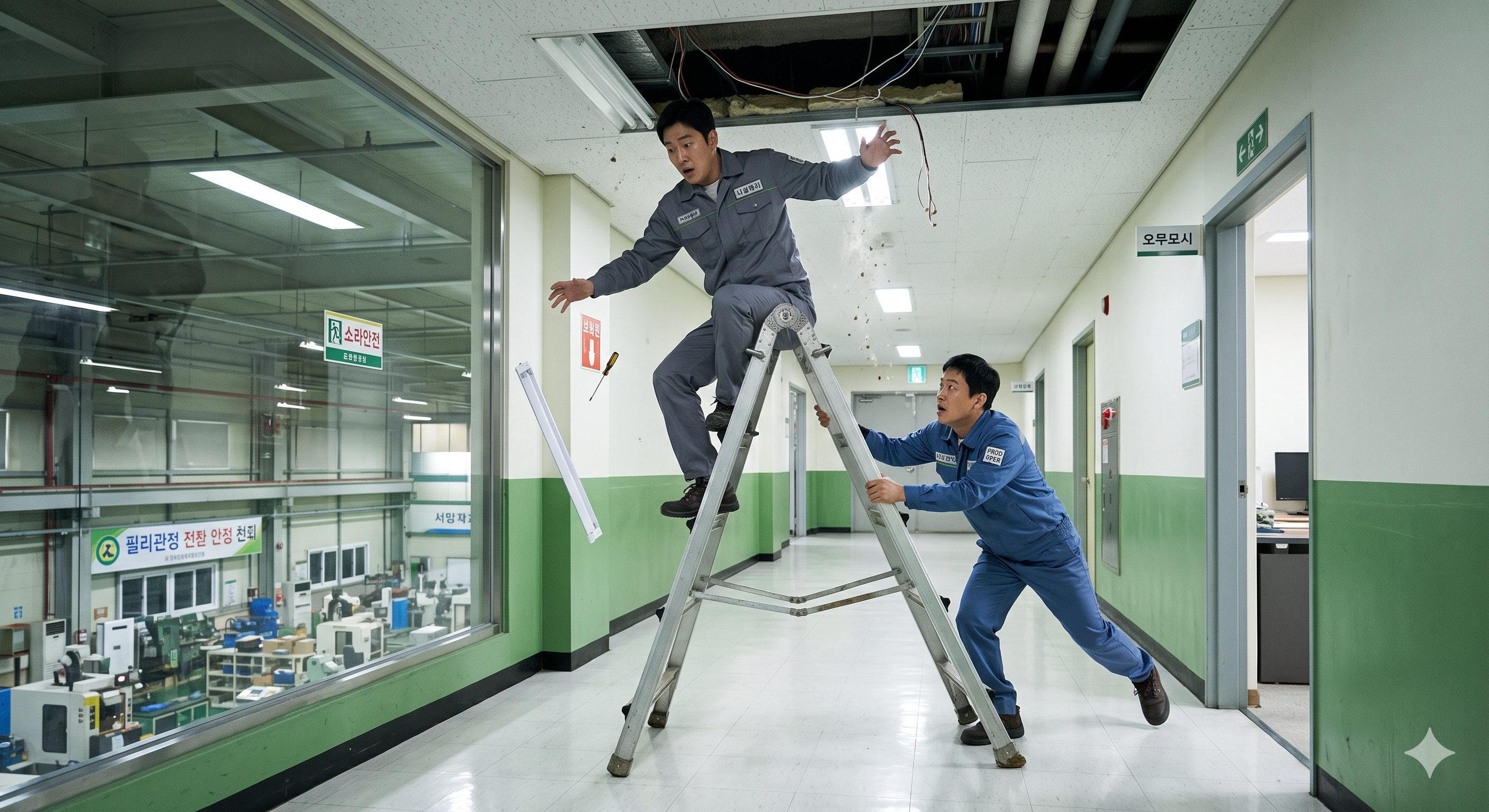
Retained educational illustration; not evidence of an actual incident.
The scenario and record comparisons are fictional teaching examples, not records of real incidents, measurements, inspections, signatures or approvals.
| Item | Fictional scenario |
|---|---|
| Initial situation | A worker plans a brief ceiling fitting replacement. |
| Changed condition | The fixing cannot be reached comfortably and a second electrical feed is unverified. |
| Failure path | Reaching from an unsuitable step while touching a live component could cause loss of balance. |
| Possible outcome | Possible outcomes include electric injury, falling and a dropped fitting; no actual accident is asserted. |
| Prevention barrier | Stop, choose suitable access and prove the correct isolation before release. |
Failure mechanisms
A sideways force and raised centre of mass can overturn a ladder; a person holding the base does not guarantee stability. Inspect support, locks, loading and reach together.
A wall switch or non-contact detector alone does not establish electrical isolation. Identify emergency batteries and other feeds, control stored energy, and have a qualified person verify absence of voltage using an appropriate instrument checked before and after use.
Decision sequence
| Decision stage | What to verify |
|---|---|
| Known facts | A worker plans a brief ceiling fitting replacement. |
| Unresolved matters | The fixing cannot be reached comfortably and a second electrical feed is unverified. |
| Reason to hold | Reaching from an unsuitable step while touching a live component could cause loss of balance. |
| Required evidence | Access choice · Task duration · Fitting weight · Standing-level label |
| Restart decision | Stop, choose suitable access and prove the correct isolation before release. Site evidence is pending; no work permission is granted by this document. |
5. Conditional decisions and common errors
| Condition | Action | Evidence | Proceed when |
|---|---|---|---|
| Fall from height | Choose safer platform · Limit light brief work · Check reach and load · Apply model and WSHC limits | Access choice · Task duration · Fitting weight · Standing-level label | Safe access chosen |
| Electric shock | Identify all feeds · Lock isolation points · Discharge per procedure · Prove dead with suitable tester | Isolation register · Tester before/after · All conductors tested · Appropriate LEW supervision | All feeds isolated |
| Fall while reaching | Use permitted standing level · Descend to reposition · Support fitting before release · Stop for changed scope | Standing position · Stable working posture · Fitting support · Isolation remains valid | Stable position confirmed |
Similar situations, different decisions
The scenario and record comparisons are fictional teaching examples, not records of real incidents, measurements, inspections, signatures or approvals.
| Comparison | Situation A | Situation B |
|---|---|---|
| Select access | Wrong ladder size · Work needs two hands · Forceful fixing · Platform not considered | Choose safer platform · Limit light brief work · Check reach and load · Apply model and WSHC limits |
| Isolate supply | Wrong circuit · Switch only off · Battery still connected · Untested conductor | Identify all feeds · Lock isolation points · Discharge per procedure · Prove dead with suitable tester |
| Replace fitting | Stand on forbidden step · Lean beyond rails · Release unsupported lamp · Scope changed | Use permitted standing level · Descend to reposition · Support fitting before release · Stop for changed scope |
6. Roles and responsibilities
| Role | Responsibility |
|---|---|
| Work supervisor | Confirm the work method, resources, competence and stage permission. |
| Technical reviewer | Resolve design, electrical, structural or equipment questions within the person’s competence. |
| Authorised operator / worker | Inspect before use, follow the agreed method and stop when conditions change. |
| Area controller | Keep people outside the danger area and maintain agreed communications. |
| Handover authority | Review open defects, restrictions and evidence before returning the area or starting the next stage. |
The principal and employers coordinate the risk assessment and safe work procedures. These role labels allocate work; verify any qualifications and statutory appointments required for the actual Singapore activity. The receiving person must be given restrictions and unresolved defects before handover.
Record and handover perspective
| Stage | Record controls | Verification |
|---|---|---|
| Select access | 1. Record access choice2. Record task duration3. Record fitting mass/kg and reach/m | 1. Task duration2. Fitting mass/kg and reach/m3. Standing-level label |
| Isolate supply | 1. Record isolation register2. Record tester before/after3. Record all conductors tested | 1. Tester before/after2. All conductors tested3. Appropriate LEW supervision |
| Climb and transfer | 1. Record climbing route2. Record tool bag check3. Record load transfer plan | 1. Tool bag check2. Load transfer plan3. Clear landing |
| Replace fitting | 1. Record standing position2. Record stable working posture3. Record fitting support | 1. Stable working posture2. Fitting support3. Isolation remains valid |
| Restore and test | 1. Record lock removal record2. Record function test result3. Record fault disposition | 1. Function test result2. Fault disposition3. Release authority |
| Clear and hand over | 1. Record waste classification2. Record final area check3. Record equipment defect log | 1. Final area check2. Equipment defect log3. Handover record |
7. Hold points and record comparison
| Hold point | Evidence before release | Actual record |
|---|---|---|
| HP-0 Start | Task boundary, site RA, SWP, responsibilities and emergency arrangements | |
| HP-1 Inspect and set | Ladder ID; Feet and locks; Support condition; Barrier layout | |
| HP-2 Isolate supply | Isolation register; Tester before/after; All conductors tested; Appropriate LEW supervision | |
| HP-3 Check before power | Connection inspection; Product compatibility; Covers secured; Area clear confirmation | |
| HP-4 Clear and hand over | Waste classification; Final area check; Equipment defect log; Handover record |
Complete after actual checks. Recheck after changes, defects or shift handover.
Record comparison examples
The scenario and record comparisons are fictional teaching examples, not records of real incidents, measurements, inspections, signatures or approvals.
The boxes are static record prompts, not interactive or saved approvals. A tick does not establish suitability or permission to restart. Record the evidence, person, time and unresolved issues; retain the change history.
| Record type | Insufficient record | Record checklist |
|---|---|---|
| Before start | Not verified or not recorded | □ Location and asset ID□ Verifier and time□ Evidence reference□ Unresolved issues |
| Critical control | Not verified or not recorded | □ Control checked□ Actual observation□ Inspector and time□ Decision authority |
| Change or stop | Not verified or not recorded | □ Change and reason□ Immediate protection□ Reviced evidence□ Restart authorisation |
| Handover | Not verified or not recorded | □ Remaining hazards□ Equipment restrictions□ Receiving person and time□ Next inspection |
Hold points are internal checks. Determine separately whether Singapore statutory or site permit requirements apply to this work. Leave confirmation, measurements and approval records blank until the authorised site process is completed.
8. Site checklist and emergency response
| Check item | Result | Person / action |
|---|---|---|
| □ Select access: Access choice | ||
| □ Inspect and set: Ladder ID | ||
| □ Isolate supply: Isolation register | ||
| □ Climb and transfer: Climbing route | ||
| □ Replace fitting: Standing position | ||
| □ Check before power: Connection inspection | ||
| □ Restore and test: Lock removal record | ||
| □ Clear and hand over: Waste classification | ||
| □ Release / handover authority |
Stop work
Stop if a critical control is missing, the conditions change, an unplanned movement occurs, or an exclusion boundary is breached. Secure the area. The responsible competent person must resolve the cause, document the evidence and obtain site authorisation before restart.
Emergency response
Stop work and warn others from a safe position. Isolate energy only where safe. Activate the site emergency plan and local emergency services. Do not enter an unstable structure, touch an electrically exposed casualty or attempt an improvised suspended rescue. Use trained rescuers and the planned equipment.
9. Sources and review limits
Official public sources read for this Singapore edition on 2026-10-14. Guidance, statutory explanations and manufacturer limits have different roles; no source provider has approved this JSA.
| Source | Read scope and application limits |
|---|---|
| MOM — Risk management | Official explanation: employer, self-employed person and principal responsibilities; routine and non-routine risk assessment; hierarchy of controls; multidisciplinary assessment team. Official explanation of risk-management duties; no claim of reading the full linked statute. It does not specify task-specific equipment limits. Assess stepladder lighting maintenance with employers, principal and affected contractors; resolve the inputs in section 2. |
| MOM — When should my company review its risk assessment? | Review every three years, after significant changes, new machinery/substances/procedures, hazard-related injury or incident, and when assessment is inadequate. General review guidance. A review interval does not permit continued operation after a known hazard or change. Reassess this operation after changes, defects, incidents or an inadequate assessment; do not wait for a scheduled review. |
| MOM — Permit-to-Work Systems | Formal work authorisation and coordination; OPEC tripartite guidance and competent permit authority with authority to reject work. OPEC-focused guidance page; not evidence of a blanket statutory permit requirement for every task. Determine permits for this actual activity and workplace; distinguish the section 7 internal hold points from statutory or site permits. |
| WSH Council — Safe Use of Ladders (2025) | Complete one-page checklist: condition, full opening, stable level support, top-rung restriction, hands-free climbing, three-point contact and footwear. Basic guidance, not approval of a particular task or permission to adopt a foreign height limit. Actual model and stable working posture remain decisive. Use the WSHC ladder checklist and fall-prevention guidance for access selection, EMA guidance for appropriate LEW involvement, and electrical safety guidance for isolation and controlled restoration. |
| WSH Council — Preventing Falls from Height | Employer access/protection controls, workplace-dependent fall prevention plan, hazardous work at height PTW applicability and supervisor/assessor/authorised-manager process. Official overview, not a full reading of the WAH Regulations or linked codes. PTW threshold does not mean lower falls are safe; actual anchorage, access and rescue require assessment. Use the WSHC ladder checklist and fall-prevention guidance for access selection, EMA guidance for appropriate LEW involvement, and electrical safety guidance for isolation and controlled restoration. |
| EMA — Engaging Licensed Electrical Workers | Overview and licence-class table: electrical wiring, circuit breaker and control-unit work carried out or superviced by a Licensed Electrical Worker; check valid licence and class for installation load/voltage. Official consumer overview, not a detailed installation standard or design approval. The actual installation conditions and LEW licence restrictions remain to be verified. Use the WSHC ladder checklist and fall-prevention guidance for access selection, EMA guidance for appropriate LEW involvement, and electrical safety guidance for isolation and controlled restoration. |
| WSH Council — Electrocution-related Workplace Fatal Injuries in 2H2023 | Complete one-page advisory, particularly competent workers, equipment labelling, de-energisation, lockout, permit coordination, protective measures and defect maintenance. Official advisory recommendations, not a blanket statutory live-work permission. Direct General Provisions statute access failed; linked SS 638/SS 571 full texts were not read. Use an appropriate complete proving-dead method for the actual equipment; a general detector recommendation does not settle every circuit test. Use the WSHC ladder checklist and fall-prevention guidance for access selection, EMA guidance for appropriate LEW involvement, and electrical safety guidance for isolation and controlled restoration. |
No Korean ladder-height rule, foreign maximum working height or universal standing-step permission is adopted. The exact ladder, installation and fitting instructions were not supplied. A helper holding the ladder cannot correct unsuitable reach or force. Lamp replacement scope must be distinguished from regulated wiring work.
Actual site measurements, equipment instructions, engineering checks and signed approval records were not supplied. A qualified person must resolve these before use.
10. PDF guidance and FAQ
PDF A covers basic task controls; B focuses on technical failures; C covers supervision, records and handover. The article has eight stages with four items per main cell; each PDF has six key stages with three items per main cell. P/S/R/A, measurements, confirmations and signatures remain blank for actual site assessment.
Content group ID
jsa-stepladder-work
What must be confirmed for Select access?
Required controls: Choose safer platform; Limit light brief work; Check reach and load; Apply model and WSHC limits. Evidence to record: Access choice; Task duration; Fitting weight; Standing-level label.
What must be confirmed for Isolate supply?
Required controls: Identify all feeds; Lock isolation points; Discharge per procedure; Prove dead with suitable tester. Evidence to record: Isolation register; Tester before/after; All conductors tested; Appropriate LEW supervision.
What must be confirmed for Replace fitting?
Required controls: Use permitted standing level; Descend to reposition; Support fitting before release; Stop for changed scope. Evidence to record: Standing position; Stable working posture; Fitting support; Isolation remains valid.
What must be confirmed for Clear and hand over?
Required controls: Use suitable waste container; Apply lamp spill procedure; Fold by designated grips; Secure ladder and clear route. Evidence to record: Waste classification; Final area check; Equipment defect log; Handover record.
Has a professional verified or approved this document?
No. Public sources and editorial, layout and consistency checks were reviewed using AI. No site inspection or professional technical approval has been performed. Obtain appropriate professional review before use.
11. Revision history and authorship
AI-generated reference material; not professionally verified or approved. Before use, a qualified person must review and adapt it to applicable Singapore requirements, the actual equipment/site and approved safe work procedures.
This Singapore edition was adapted from the Korean original and its assigned US technical reference. Earlier source revisions are archival editorial history, not Singapore technical approval.
| Date | Edition | Change | Review status |
|---|---|---|---|
| 2026-06-26 | Korean source | Source editorial publication or revision; retained as provenance of the Korean edition. | Editorial record only; no professional technical approval recorded. |
| 2026-10-05 | Korean source v1.1 | Source editorial publication or revision; retained as provenance of the Korean edition. | Editorial record only; no professional technical approval recorded. |
| 2026-10-14 | 1.0 en-SG | Singapore legal scope, local planning, responsibility interfaces and SI terminology; new PDF A/B/C. | AI editorial and visual review only; no professional approval. |