Wet soil changes payload and discharge behaviour. Stop if a wheel sinks or material hangs on one side; do not drive or jolt a raised body to shake it free.
AI-generated reference material. It has not been verified or approved by a professional. Before use, a qualified person must review and adapt it to applicable Singapore requirements, the actual equipment and site, and approved safe work procedures.
1. Singapore legal and technical basis
Singapore WSH vehicle controls require a planned haul route, safe loading and separation from people. LTA public-road restrictions depend on the actual vehicle, load and route; applicable oversized movement permission must be resolved separately. PUB earth-control arrangements also apply to site runoff and the controlled exit. None of these establishes a universal body-fill percentage or site speed.
| Source category | Task application and limit |
|---|---|
| MOM - Risk management | Assess loading, travel, tipping and recovery interfaces. Official explanation of WSH Risk Management duties, not a complete consolidated statutory text. |
| WSHC - Loading and Unloading Operations | Apply stable loading and segregation principles. General guidance, not a dock-leveller design standard or proof that one restraint fits every trailer. Actual device instructions govern compatibility and support. |
| LTA - Commercial vehicles | Confirm actual road restrictions, route and permit applicability. Vehicle-category details and actual permit route were not assessed. Crane stow-warning provisions are not represented as tipper-body requirements; no universal site speed or loading percentage adopted. |
| PUB - ECM guidelines for stakeholders | Control muddy runoff and the site exit. Direct fetch failed after indexed main text was read. Detailed current Code of Practice and project approvals were not reviewed; ECM does not automatically approve process-slurry discharge. |
| MOM - Heat stress measures for outdoor work | Plan outdoor heat controls for the exposed work crew. Applies to outdoor heat exposure; the 32 C trigger is WBGT, not air temperature. Four enhanced requirements begin 1 December 2026, after this review date. |
Use Singapore requirements and SI units. Manufacturer limits apply to the actual model. Foreign technical examples do not establish Singapore statutory duties. A job safety analysis or completed checklist is not a permit or approval.
2. Scope and required inputs
Included scope
Covers loading, covering, site haulage, reversing, tipping, lowering and controlled departure of a soil-carrying tipper. Assess the actual vehicle, material density, route and receiving ground before each changed operation.
Separate review
Excavation stability, contaminated waste, public-road permits and work beneath raised bodies need separate competent arrangements. This sheet does not design an embankment or prescribe maintenance entry.
| Required input | What to verify |
|---|---|
| Plan route and tip | Route and traffic plan · Ground and edge assessment · Raised body clearance · Driver and site briefing |
| Inspect vehicle | Pre-use defect record · Tyres brakes and steering · Hydraulics and restraints · Visibility and alarms |
| Load and contain | Payload and distribution · Material identity · Tailgate and cover · Loading exclusion |
| Haul to destination | Route condition · Restraint and driving checks · Body-down indication · Fatigue and visibility |
| Position for tipping | Signal and exclusion · Ground and edge setback · Vehicle alignment · Overhead clearance |
| Lower and hand over | Body-down confirmation · Latch and load residue · Route ready for departure · Defects and handover |
Determine mass and axle limits, speed, overhead clearance and edge setback from applicable rules, engineering assessment and the exact vehicle instructions. A universal 80% fill, slope angle or exclusion distance is not established. Paid standards and installed vehicle manuals were not inspected.
Separate pedestrians and vehicles, minimise reversing and provide a protected loading position. A driver may stay only in a suitably protected cab or a designated safe place according to the loading plan. Visibility clothing and footwear supplement separation; dust and noise protection follow the exposure assessment.
Singapore application
Confirm actual laden mass and axle distribution, road access restrictions, destination acceptance and load containment. Contaminated soil, an unknown waste classification or work beneath a raised body needs its own competent assessment and method.
3. Eight-stage JSA
| Job stage | Hazards and effects | Failure factors | Controls | Site verification | P | S | R | A |
|---|---|---|---|---|---|---|---|---|
| 1. Plan route and tip | 1. Vehicle overturn2. Pedestrian collision3. Edge collapse4. Overhead contact | 1. Route not assessed2. Mixed pedestrian route3. Unknown ground strength4. Raised height omitted | 1. Agree haul and tip plan2. Separate people and vehicles3. Assess tipping support4. Check full overhead envelope | 1. Route and traffic plan2. Ground and edge assessment3. Raised body clearance4. Driver and route briefing | ||||
| 2. Inspect vehicle | 1. Brake failure2. Tyre failure3. Body falls unexpectedly4. Poor rear visibility | 1. Defects not reported2. Damaged tyres or suspension3. Hydraulic or latch defect4. Dirty mirrors and cameras | 1. Check vehicle before shift2. Quarantine critical defects3. Inspect body and tailgate4. Verify vision and warnings | 1. Pre-use defect record2. Tyres brakes and steering3. Hydraulics and restraints4. Visibility and alarms | ||||
| 3. Load and contain | 1. Falling soil2. Vehicle instability3. Person struck by bucket4. Fall while sheeting | 1. Load too heavy or uneven2. People in loading zone3. Unsafe sheet access4. Tailgate unsecured | 1. Load within verified limits2. Distribute and contain soil3. Keep people out of loading4. Use safe sheeting method | 1. Payload and distribution2. Material identity3. Tailgate and cover4. Loading exclusion | ||||
| 4. Haul to destination | 1. Collision at crossing2. Loss of braking3. Load spilled on road4. Fatigue error | 1. Speed exceeds conditions2. Route changed or damaged3. Body not fully lowered4. Driver fatigue or dust | 1. Use agreed route and speed2. Wear seat restraint3. Travel with body lowered4. Stop for lost visibility | 1. Route condition2. Restraint and driving checks3. Body-down indication4. Fatigue and visibility | ||||
| 5. Position for tipping | 1. Reversing collision2. Edge failure3. Lateral overturn4. Overhead strike | 1. Lost signaller contact2. Soft edge or side slope3. Articulated unit misaligned4. Unverified overhead clearance | 1. Use controlled positioning2. Stop if contact is lost3. Confirm firm level support4. Align unit and clear overhead | 1. Signal and exclusion2. Ground and edge setback3. Vehicle alignment4. Overhead clearance | ||||
| 6. Raise and discharge | 1. Vehicle overturn2. Load buries a person3. Tailgate strikes worker4. Load hangs in body | 1. Uneven ground settlement2. People behind or beside3. Wrong tailgate release4. Sticky or frozen material | 1. Exclude discharge area2. Operate from safe position3. Observe tilt and flow4. Stop when load hangs | 1. Exclusion retained2. Body and ground movement3. Tailgate discharge path4. Material flow | ||||
| 7. Resolve abnormality | 1. Body crushes mechanic2. Hydraulic injection3. Sudden load release4. Vehicle rolls away | 1. Work under unsupported body2. Stored pressure retained3. Driving to shake load free4. Uncontrolled access | 1. Stop and isolate safely2. Use rated mechanical support3. Use planned blockage method4. Keep recovery zone closed | 1. Isolation and support2. Stored-energy control3. Competent recovery method4. Reinspection record | ||||
| 8. Lower and hand over | 1. Raised body hits bridge2. Tailgate opens in travel3. Residual soil falls4. Unrecorded defect repeats | 1. Body-down not checked2. Latch not secured3. Unsafe cleaning access4. Defect omitted at handover | 1. Verify body fully lowered2. Secure tailgate and equipment3. Clean from protected position4. Record defects and release | 1. Body-down confirmation2. Latch and load residue3. Exit and LTA route checks4. Defects and handover |
P/S/R/A and actual measurements, checks, names and signatures remain blank for the site assessment. A score cannot waive a required control.
4. Hypothetical scenario and failure mechanisms
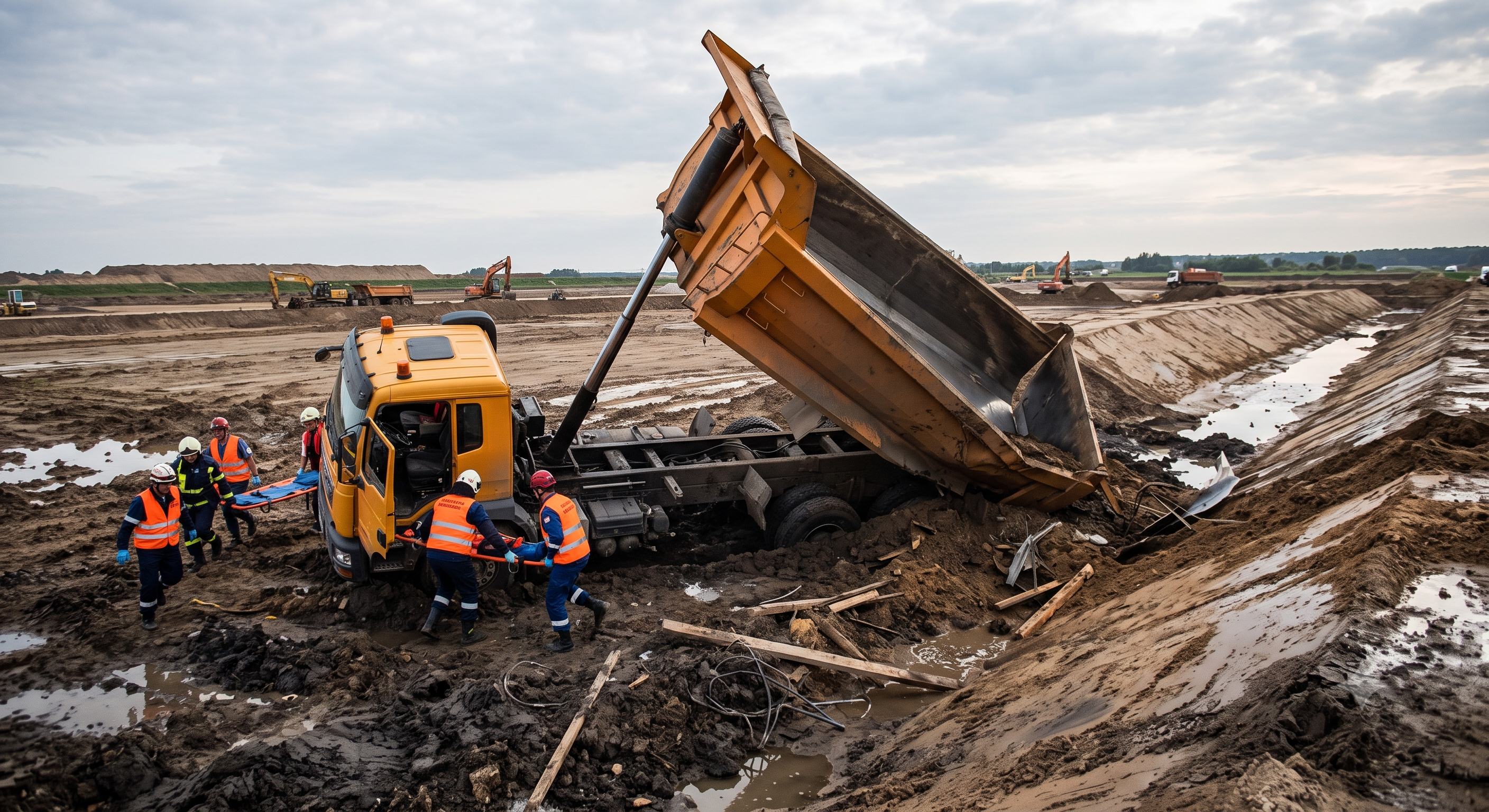
Retained educational illustration; not evidence of an actual incident.
The scenario and record comparisons are fictional teaching examples, not records of real incidents, measurements, inspections, signatures or approvals.
| Item | Fictional scenario |
|---|---|
| Initial situation | A fictional tipper delivers wet soil to a recently changed discharge area. |
| Changed condition | The surface looks firm, but one wheel settles and sticky material remains on one side as the body rises. |
| Failure path | The raised centre of gravity and asymmetric load increase the overturning tendency; a wheel stop does not prove ground capacity. |
| Possible outcome | Moving or jolting the truck can increase instability and expose nearby people to the truck and falling soil. |
| Prevention barrier | Stop, keep the zone clear and follow the manufacturer-approved recovery process with competent support; reassess before further tipping. |
Failure mechanisms
Volume does not establish payload: moisture and material density change mass and axle loading. Confirm the vehicle-specific distribution and evidence of loading.
Raising the body increases sensitivity to ground settlement, crossfall and uneven load release. Assess the whole supporting area, not just the rear wheels or the appearance of a level surface.
Reversing aids have blind spots and a signaller needs a safe position and an agreed stop signal. Loss of the agreed contact requires stopping until safe control is restored.
Decision sequence
| Decision stage | What to verify |
|---|---|
| Known facts | A fictional tipper delivers wet soil to a recently changed discharge area. |
| Unresolved matters | The surface looks firm, but one wheel settles and sticky material remains on one side as the body rises. |
| Reason to hold | The raised centre of gravity and asymmetric load increase the overturning tendency; a wheel stop does not prove ground capacity. |
| Required evidence | Payload and distribution · Material identity · Tailgate and cover · Loading exclusion |
| Restart decision | Stop, keep the zone clear and follow the manufacturer-approved recovery process with competent support; reassess before further tipping. |
5. Hold and proceed decisions
| Condition | Action | Evidence | Proceed when |
|---|---|---|---|
| Ground changes | Suspend tipping and reassess support | Ground assessment and vehicle position | Stable support confirmed |
| Signal lost | Stop and restore safe communication | Signaller position and agreed signals | Contact restored |
| Load sticks | Stop raising; use planned recovery | Vehicle instructions and recovery plan | Safe discharge method confirmed |
| Departure | Lower and secure body; check mud | Body indicator, tailgate and exit checks | Body secured and route clear |
Similar situations, different decisions
The scenario and record comparisons are fictional teaching examples, not records of real incidents, measurements, inspections, signatures or approvals.
| Comparison | Situation A | Situation B |
|---|---|---|
| Payload | Body looks partly empty | Verify mass, axle loads and distribution. |
| Edge protection | Wheel stop present | Confirm its position and the bearing ground. |
| Raised body | Drive to shake material | Stop and follow controlled recovery. |
6. Roles and supervision
| Role | Responsibility |
|---|---|
| Work supervisor | Agree haul and tip plan · Separate people and vehicles · Assess tipping support · Check full overhead envelope |
| Technical reviewer | Check vehicle before shift · Quarantine critical defects · Inspect body and tailgate · Verify vision and warnings |
| Work crew | Use agreed route and speed · Wear seat restraint · Travel with body lowered · Stop for lost visibility |
| Inspector / assessor | Exclude discharge area · Operate from safe position · Observe tilt and flow · Stop when load hangs |
| Release / handover authority | Verify body fully lowered · Secure tailgate and equipment · Clean from protected position · Record defects and release |
Supervision, records, handover
| Job stage | Technical and procedural controls | Site verification |
|---|---|---|
| Plan route and tip | 1. Check Route and traffic plan2. Record Ground and edge assessment3. Brief Raised body clearance | 1. Ground and edge assessment2. Raised body clearance3. Driver and site briefing |
| Inspect vehicle | 1. Check Pre-use defect record2. Record Tyres brakes and steering3. Brief Hydraulics and restraints | 1. Tyres brakes and steering2. Hydraulics and restraints3. Visibility and alarms |
| Load and contain | 1. Check Payload and distribution2. Record Material identity3. Brief Tailgate and cover | 1. Material identity2. Tailgate and cover3. Loading exclusion |
| Position for tipping | 1. Check Signal and exclusion2. Record Ground and edge setback3. Brief Vehicle alignment | 1. Ground and edge setback2. Vehicle alignment3. Overhead clearance |
| Resolve abnormality | 1. Check Isolation and support2. Record Stored-energy control3. Brief Competent recovery method | 1. Stored-energy control2. Competent recovery method3. Reinspection record |
| Lower and hand over | 1. Check Body-down confirmation2. Record Latch and load residue3. Brief Route ready for departure | 1. Latch and load residue2. Route ready for departure3. Defects and handover |
Singapore application
The loading supervisor accepts mass and distribution; the receiving supervisor accepts level supporting ground and the tipping exclusion zone. Before departure, the driver confirms the body is fully lowered, tailgate and equipment secured, and the exit clear. The transport owner resolves public-road permissions independently of the site release.
7. Hold points and record quality
| Hold point | Evidence before release | Confirmation / approval |
|---|---|---|
| Start | Covers loading, covering, site haulage, reversing, tipping, lowering and controlled departure of a soil-carrying tipper. Assess the actual vehicle, material density, route and receiving ground before each changed operation. | |
| HP-1 Plan route and tip | Route and traffic plan · Ground and edge assessment · Raised body clearance · Driver and site briefing | |
| HP-2 Load and contain | Payload and distribution · Material identity · Tailgate and cover · Loading exclusion | |
| HP-3 Position for tipping | Signal and exclusion · Ground and edge setback · Vehicle alignment · Overhead clearance | |
| HP-4 Raise and discharge | Exclusion retained · Body and ground movement · Tailgate discharge path · Material flow |
Complete after actual checks. Recheck after changes, defects or shift handover.
Record comparison examples
The scenario and record comparisons are fictional teaching examples, not records of real incidents, measurements, inspections, signatures or approvals.
The boxes are static record prompts, not interactive or saved approvals. A tick does not establish suitability or permission to restart. Record the evidence, person, time and unresolved issues; retain the change history.
| Record type | Insufficient record | Record checklist |
|---|---|---|
| Plan | Only OK | □ Route and traffic plan□ Ground and edge assessment□ Raised body clearance□ Driver and site briefing |
| Load | Only OK | □ Payload and distribution□ Material identity□ Tailgate and cover□ Loading exclusion |
| Discharge | Only OK | □ Exclusion retained□ Body and ground movement□ Tailgate discharge path□ Material flow |
| Handover | Only OK | □ Body-down confirmation□ Latch and load residue□ Route ready for departure□ Defects and handover |
8. Pre-work checks and emergency response
| Check item | Result | Person / action |
|---|---|---|
| □ Plan route and tip: Route and traffic plan | ||
| □ Inspect vehicle: Pre-use defect record | ||
| □ Load and contain: Payload and distribution | ||
| □ Haul to destination: Route condition | ||
| □ Position for tipping: Signal and exclusion | ||
| □ Raise and discharge: Exclusion retained | ||
| □ Resolve abnormality: Isolation and support | ||
| □ Lower and hand over: Body-down confirmation | ||
| □ Release / handover authority |
Stop work
Stop for lost communication or visibility, pedestrians in the zone, subsiding ground, an unverified overhead clearance, uneven discharge or a raised-body fault. Do not drive or jerk the truck to release stuck material.
Emergency response
Keep others away from an unstable truck or electrical contact. Activate the site emergency plan and utility response; do not approach or attempt improvised rescue. Resume only after the responsible people verify ground, equipment and controls.
9. Sources and review limits
Public-source review: 14 October 2026. Only the material and limits identified below were reviewed.
| Source | Reviewed material | Task application |
|---|---|---|
| MOM - Risk management | Responsibilities; routine and non-routine work; hierarchy of control and risk assessment team. Official explanation of WSH Risk Management duties, not a complete consolidated statutory text. | Assess loading, travel, tipping and recovery interfaces. |
| WSHC - Loading and Unloading Operations | Hazards, designated areas, vehicle movement prevention, floor/access conditions, employer and driver roles. General guidance, not a dock-leveller design standard or proof that one restraint fits every trailer. Actual device instructions govern compatibility and support. | Apply stable loading and segregation principles. |
| LTA - Commercial vehicles | Main selected sections on goods-vehicle restrictions, oversized movement and over-height route planning. Vehicle-category details and actual permit route were not assessed. Crane stow-warning provisions are not represented as tipper-body requirements; no universal site speed or loading percentage adopted. | Confirm actual road restrictions, route and permit applicability. |
| PUB - ECM guidelines for stakeholders | Public indexed main text: QECP design, construction information, PUB approval, implementation and joint audit. Direct fetch failed after indexed main text was read. Detailed current Code of Practice and project approvals were not reviewed; ECM does not automatically approve process-slurry discharge. | Control muddy runoff and the site exit. |
| MOM - Heat stress measures for outdoor work | Outdoor scope, acclimatisation, hourly WBGT monitoring, hydration, rest and emergency measures; distinction between requirements and recommendations. Applies to outdoor heat exposure; the 32 C trigger is WBGT, not air temperature. Four enhanced requirements begin 1 December 2026, after this review date. | Plan outdoor heat controls for the exposed work crew. |
Selected public official sources were reviewed on 14 October 2026 within the recorded scope. No full consolidated legal audit, paid Singapore Standard, actual model manual, site inspection, engineering calculation or professional approval is claimed. Verify current detailed requirements and actual equipment/site records before use.
AI-generated reference material. It has not been verified or approved by a professional. Before use, a qualified person must review and adapt it to applicable Singapore requirements, the actual equipment and site, and approved safe work procedures.
10. PDF use and frequently asked questions
PDF A covers basic task controls; B focuses on technical failures; C covers supervision, records and handover. The article has eight stages with four items per main cell; each PDF has six key stages with three items per main cell. P/S/R/A, measurements, confirmations and signatures remain blank for actual site assessment.
Content group ID
jsa-soil-transtport
Is 80% of body volume always safe?
No. Material density, moisture, vehicle mass limits and axle distribution determine the loading assessment.
Does a camera replace pedestrian separation?
No. Use route design, exclusion and appropriate reversing controls together.
Can a stuck load be shaken free?
Do not drive or jerk the truck for this purpose. Stop and follow a planned, authorised recovery method.
When is departure allowed?
After the body is down and secured, the tailgate and load are controlled, and the route and public exit are safe.
Has a professional verified or approved this document?
No. Public sources and editorial, layout and consistency checks were reviewed using AI. No site inspection or professional technical approval has been performed. Obtain appropriate professional review before use.
Singapore application
Read A, B and C together with all eight JSA stages and the approved work procedure. The sheets are complementary extracts, not separate work authorisations.
11. Authorship and revision history
AI-generated reference material. It has not been verified or approved by a professional. Before use, a qualified person must review and adapt it to applicable Singapore requirements, the actual equipment and site, and approved safe work procedures.
| Date / edition | Authorship and scope | Professional approval |
|---|---|---|
| 2026-07-30 / Korean source | Original topic and educational illustration retained as references. Source content is unchanged. | Not asserted |
| 14 October 2026 / Singapore 1.0 | Added Singapore LTA road-release and PUB exit/runoff responsibilities without treating site tipping as road approval. | Not performed |
Source topic: https://smartjsabridge.com/ko/case-study/jsa-soil-transtport