Verify the host structure and every suspension point for the actual staged and uneven loads. A permitted total load does not prove that a heavily loaded corner or temporary removal stage is safe.
AI-generated reference material. It has not been verified or approved by a professional. Before use, a qualified person must review and adapt it to applicable Singapore requirements, the actual equipment and site, and approved safe work procedures.
1. Singapore legal and technical basis
Classify the fixed slung system against Singapore hanging-scaffold requirements. Regulation 54 requires PE design/drawings where a person may fall more than 2 m; regulation 55 specifies a harness with shock absorption and independent lifeline or equally effective secured anchorage. Confirm the applicable scaffold contractor and competent supervision arrangements before installation.
| Source category | Task application and limit |
|---|---|
| MOM - Risk management | Assess full load path and changing erection/removal states. Official explanation of WSH Risk Management duties, not a complete consolidated statutory text. |
| SSO - Scaffolds Regulations, hanging scaffolds | Check hanging-scaffold classification, design, access and user protection. Direct full-page access failed. Selected indexed text only, not a consolidated audit. Confirm current detailed provisions, scaffold category and project design before use. |
| MOM - Approved scaffold contractor | Confirm applicable Approved Scaffold Contractor arrangements. Approval applicability depends on actual scaffold type and height. Contractor approval does not certify the project design, anchors or erected condition. |
| WSHC - Anchorage, lifelines and temporary edge protection | Verify compatible personal protection and rescue load paths. Selected guidance text, not complete paid standards or visual diagrams. Older standard editions and numerical examples are not treated as current universal statutory design values; confirm actual system/current specification. |
Use Singapore requirements and SI units. Manufacturer limits apply to the actual model. Foreign technical examples do not establish Singapore statutory duties. A job safety analysis or completed checklist is not a permit or approval.
2. Scope and required inputs
Included scope
Fixed slung scaffolds supported from an assessed bridge or other overhead structure, including erection, handover, use and dismantling. Record the actual geometry, suspension type and design revision before work.
Separate review
Powered swing stages, suspended access cradles, rope access, lifting people, catch scaffolds and structural bridge repair are not fully covered. Refer them to their own design and method. Enclosures, water, traffic, live services and simultaneous trades need specific coordination.
| Required input | What to verify |
|---|---|
| Design and scope | Design and type · Host structure survey · Load and wind schedule · Local duty allocation |
| Receive components | Part identification · Condition and rejection log · Compatibility records · Delivery route and racks |
| Access and rescue | Access protection plan · Anchor and system design · Rescue team and equipment · Communication drill |
| Suspension points | Termination permission · Support installation record · Product torque or assembly data · Hold-point release record |
| Deck and edges | Deck and edge check · Bracing and restraints · Lift and exclusion plan · Access continuity |
| Dismantle and lower | Remaining support check · Stage protection check · Lowering route and load · Final closure record |
Dimensions, anchor capacity, rope size, clip count, torque, spacing, wind limits and load limits must come from applicable local rules, the verified design and exact product instructions. Paid standards and the installed products were not inspected. Do not substitute a generic 15 kN or 22.2 kN figure or a claimed termination efficiency for that verification.
Plan collective edge protection and protected assembly access first. Where personal fall protection is required, verify compatible equipment, anchorage and a load path independent of scaffold suspension failure, clearance, swing fall and prompt rescue. This does not necessarily mean an entirely different host structure. Never assume a guardrail is an arrest anchor. Select head, eye, hand and foot protection for handling, drilling, coating or hot work; respiratory and chemical controls require their own exposure assessment.
Singapore application
The hanging-scaffold provisions require construction before hanging into position, restraint against sway, a horizontal platform and safe stair or ladder access. Plan that sequence and the lifting interface with the PE and scaffold team; do not treat an adjustable powered cradle as this fixed system.
3. Eight-stage JSA
| Job stage | Hazards and effects | Failure factors | Controls | Site verification | P | S | R | A |
|---|---|---|---|---|---|---|---|---|
| 1. Design and scope | 1. Support failure2. Fall at access3. Water or traffic below4. Wind on sheeting | 1. Scaffold type unclear2. Host steel not assessed3. Loads omitted4. Wrong jurisdiction | 1. Classify fixed or adjustable2. Verify complete load path3. Plan each temporary state4. Confirm local requirements | 1. Design and type2. Host structure survey3. Load and wind schedule4. Singapore type and PE duties | ||||
| 2. Receive components | 1. Rope failure2. Fitting slip3. Handling strain4. Dropped bundles | 1. Unidentified components2. Damaged rope or coupler3. Mixed incompatible parts4. Unstable storage | 1. Match approved component list2. Quarantine defects3. Use compatible rated parts4. Secure handling and storage | 1. Part identification2. Condition and rejection log3. Compatibility records4. Delivery route and racks | ||||
| 3. Access and rescue | 1. Fall during assembly2. Swing fall impact3. Suspension intolerance4. Drowning below | 1. Protection starts too late2. Unverified rescue anchor3. Inadequate fall clearance4. Rescue route obstructed | 1. Provide protected access2. Verify independent arrest path3. Check clearance and rescue4. Add water rescue if exposed | 1. Access protection plan2. Anchor and system design3. Rescue team and equipment4. Communication drill | ||||
| 4. Suspension points | 1. Whole platform collapse2. Rope end pullout3. Beam clamp movement4. Crushing at connection | 1. Wrong termination type2. Unverified host capacity3. Missing restraint or torque4. Unchecked eccentric loads | 1. Use permitted designed ends2. Verify host and each support3. Follow exact product method4. Secure temporary load states | 1. Termination permission2. Support installation record3. Product torque or assembly data4. Hold-point release record | ||||
| 5. Deck and edges | 1. Fall through opening2. Falling boards or tools3. Platform sway4. Trapping at members | 1. Incomplete staged protection2. Unsecured deck units3. Missing bracing4. Poor lifting coordination | 1. Install staged fall protection2. Secure deck and edge system3. Fit designed sway restraints4. Lift with controlled exclusion | 1. Deck and edge check2. Bracing and restraints3. Lift and exclusion plan4. Access continuity | ||||
| 6. Handover and loading | 1. Local overload2. Uneven suspension loads3. Fall at entry4. Unauthorised use | 1. Loads stacked at one point2. Missing inspection3. Design changes unrecorded4. Status tag misunderstood | 1. Verify completed configuration2. Authorise use after inspection3. Post load and access limits4. Control changes and handover | 1. Inspection and release2. Load distribution plan3. User briefing record4. Design and change review | ||||
| 7. Use and inspection | 1. Hot work rope damage2. Fire and falling debris3. Wind instability4. Electrical contact | 1. Current through suspension2. Unplanned enclosure3. Lost daily checks4. Work near live services | 1. Isolate heat and current path2. Reassess wind and enclosure3. Inspect before use and events4. Apply service isolation plan | 1. Hot work protection2. Weather and enclosure record3. Defect and reinspection log4. Electrical coordination | ||||
| 8. Dismantle and lower | 1. Collapse of remainder2. Fall at exposed edge3. Dropped members4. People enter drop zone | 1. Support removed too early2. Protection removed too soon3. Uncontrolled lowering4. Incomplete shift handover | 1. Follow designed removal stages2. Keep access and arrest path3. Lower secured loads4. Maintain exclusion and handover | 1. Remaining support check2. Stage protection check3. Lowering route and load4. Final closure record |
P/S/R/A and actual measurements, checks, names and signatures remain blank for the site assessment. A score cannot waive a required control.
4. Hypothetical scenario and failure mechanisms
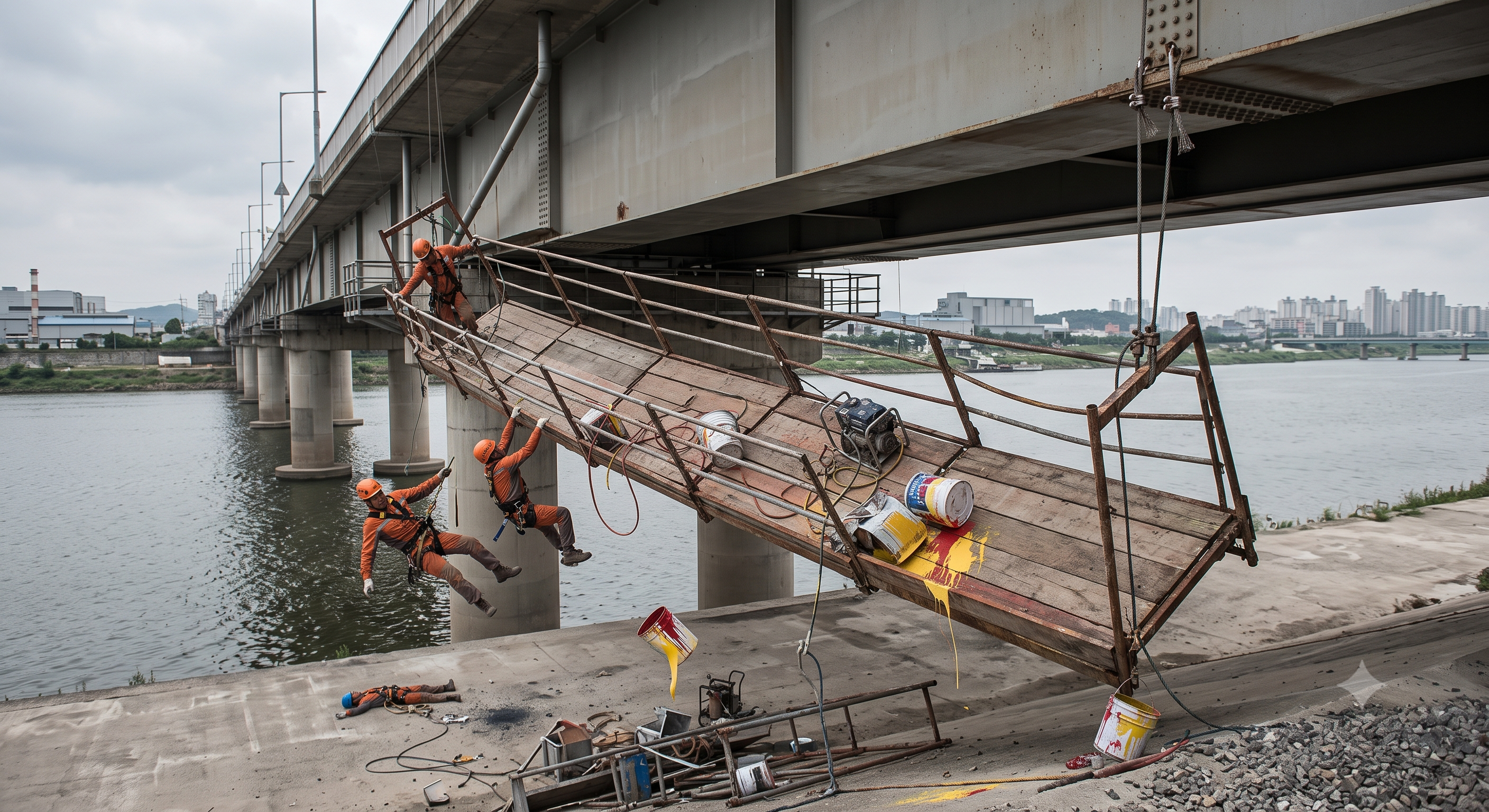
Retained educational illustration; not evidence of an actual incident.
The scenario and record comparisons are fictional teaching examples, not records of real incidents, measurements, inspections, signatures or approvals.
| Item | Fictional scenario |
|---|---|
| Initial situation | A hypothetical Singapore maintenance crew prepares a fixed slung scaffold while another contractor proposes hoisted-platform procedures. This is a fictional teaching example. |
| Changed condition | The scaffold classification is unresolved and the replacement rope termination has not been checked against the actual application and product restrictions. |
| Failure path | Off-centre loading could make an unverified connection slip, tilt the platform and overload the remaining suspension points. |
| Possible outcome | Using a platform guardrail as the fall-arrest anchorage could expose both protections to the same structural failure. |
| Prevention barrier | Keep the platform closed, preserve the exclusion zone, verify the support and termination design and inspect the completed arrangement before authorised use. |
Failure mechanisms
Each load travels from the deck through members, connections and hangers into the host structure. A strong rope does not establish the strength of the termination, beam flange or temporary erection state.
Load sharing is affected by geometry, stiffness and where people and materials stand. Do not assume each hanger carries an equal fraction of the total load. Wind on sheets and netting can add forces absent from the original design.
Incorrect rope-end assembly can damage or release the rope; there is no universal percentage loss for every product and defect. Product instructions may restrict termination types even where a general regulation discusses clips.
An independent fall-arrest load path must remain effective for the assessed failure case and have adequate clearance and rescue access. The harness does not prevent scaffold collapse, falling materials or drowning.
Decision sequence
| Decision stage | What to verify |
|---|---|
| Known facts | A hypothetical Singapore maintenance crew prepares a fixed slung scaffold while another contractor proposes hoisted-platform procedures. This is a fictional teaching example. |
| Unresolved matters | The scaffold classification is unresolved and the replacement rope termination has not been checked against the actual application and product restrictions. |
| Reason to hold | Off-centre loading could make an unverified connection slip, tilt the platform and overload the remaining suspension points. |
| Required evidence | Design revision, host inspection, exact termination instructions, installation evidence, fall protection and rescue assessment. |
| Restart decision | Keep the platform closed, preserve the exclusion zone, verify the support and termination design and inspect the completed arrangement before authorised use. |
5. Hold and proceed decisions
| Condition | Action | Evidence | Proceed when |
|---|---|---|---|
| Unknown end fitting | Hold loading; obtain permitted detail | Product identification and permitted connection detail | Permitted ends and joints verified |
| New sheeting | Reassess forces and connections | Revised load assessment and connection design | Changed loads reassessed |
| Support movement | Close access; obtain competent review | Support inspection and stability assessment | Support stability confirmed |
| Removal stage | Check remaining stability and protection | Removal-stage design and protection checks | Remaining support and guards secured |
Similar situations, different decisions
The scenario and record comparisons are fictional teaching examples, not records of real incidents, measurements, inspections, signatures or approvals.
| Comparison | Situation A | Situation B |
|---|---|---|
| Rope clip | “The saddle is the right way round.” | Show that this termination is permitted for the exact application, then verify its assembly. |
| Capacity | “The rope is strong enough.” | Verify the complete support chain and the worst temporary and uneven loading cases. |
| Handover | “The tag is green.” | Read the inspection record, actual configuration, restrictions and authority to use. |
6. Roles and supervision
| Role | Responsibility |
|---|---|
| Work management | Provide a coordinated design, competent team, access controls and sufficient time; obtain the necessary local approvals. |
| Design review | Assess host structure, all suspension details, load cases, temporary states, protection interfaces and any changes. |
| Scaffold supervision | Control each stage, verify hold points and stop when the arrangement differs from the plan. |
| Work crew | Use identified parts and approved methods; report defects and never improvise rope ends or remove supports. |
| Handover and rescue | Maintain exclusion and communication, prepare rescue including water exposure, and record the transfer to users. |
Supervision, records, handover
| Job stage | Technical and procedural controls | Site verification |
|---|---|---|
| Design control | 1. Appoint design reviewer2. Resolve host and load gaps3. Freeze agreed design issue | 1. Reviewer and scope2. Design issue register3. Open issues closed |
| Competence and supply | 1. Match skills to scaffold type2. Approve exact components3. Brief handling and rejection | 1. Training and authority2. Approved parts list3. Rejected items isolated |
| Permission to erect | 1. Confirm permitted rope ends2. Require support installation log3. Hold unresolved connections | 1. Termination evidence2. Installation records3. Hold-point authority |
| Permission to use | 1. Require competent inspection2. Brief users on load limits3. Record permitted configuration | 1. Inspection report2. User handover3. Limits and access status |
| Change control | 1. Stop unplanned changes2. Reassess heat, wind and loads3. Record inspection after events | 1. Change approval2. Event inspection3. Defect closure |
| Closure and rescue | 1. Preserve rescue during removal2. Record stable unfinished state3. Close and return the area | 1. Rescue readiness2. Shift handover3. Final area release |
Singapore application
Keep the applicable PE-certified design and drawings at the workplace. The scaffold supervisor controls erection and dismantling stages, the designated inspector records the installed state, and the user controls the marked load zones. Required personal protection remains effective throughout access and use.
7. Hold points and record quality
| Hold point | Evidence before release | Confirmation / approval |
|---|---|---|
| Start | Fixed slung scaffolds supported from an assessed bridge or other overhead structure, including erection, handover, use and dismantling. Record the actual geometry, suspension type and design revision before work. | |
| HP-1 Design and scope | Design and type · Host structure survey · Load and wind schedule · Local duty allocation | |
| HP-2 Suspension points | Termination permission · Support installation record · Product torque or assembly data · Hold-point release record | |
| HP-3 Handover and loading | Inspection and release · Load distribution plan · User briefing record · Changed-condition review | |
| HP-4 Dismantle and lower | Remaining support check · Stage protection check · Lowering route and load · Final closure record |
Complete after actual checks. Recheck after changes, defects or shift handover.
Record comparison examples
The scenario and record comparisons are fictional teaching examples, not records of real incidents, measurements, inspections, signatures or approvals.
The boxes are static record prompts, not interactive or saved approvals. A tick does not establish suitability or permission to restart. Record the evidence, person, time and unresolved issues; retain the change history.
| Record type | Insufficient record | Record checklist |
|---|---|---|
| Design | Only OK | □ Design and type□ Host structure survey□ Load and wind schedule□ Local duty allocation |
| Suspension | Only OK | □ Termination permission□ Support installation record□ Product torque or assembly data□ Hold-point release record |
| Handover | Only OK | □ Inspection and release□ Load distribution plan□ User briefing record□ Changed-condition review |
| Removal | Only OK | □ Remaining support check□ Stage protection check□ Lowering route and load□ Final closure record |
8. Pre-work checks and emergency response
| Check item | Result | Person / action |
|---|---|---|
| □ Design and scope: Design and type | ||
| □ Receive components: Part identification | ||
| □ Access and rescue: Access protection plan | ||
| □ Suspension points: Termination permission | ||
| □ Deck and edges: Deck and edge check | ||
| □ Handover and loading: Inspection and release | ||
| □ Use and inspection: Hot work protection | ||
| □ Dismantle and lower: Remaining support check | ||
| □ Release / handover authority |
Stop work
Stop access or the affected operation for an unidentified or prohibited termination, support movement, damaged rope, missing protection, unexpected load, unsafe weather, electrical conflict or unavailable rescue. Keep people clear while the competent team defines a safe response; do not re-tension a suspect loaded suspension by trial.
Emergency response
Raise the site alarm and isolate the affected area from a safe position. Use the planned trained rescue team and equipment; do not enter an unstable platform or improvise a suspended rescue. Preserve access for emergency services and manage water rescue where relevant. Restart requires reassessment and recorded authorisation.
9. Sources and review limits
Public-source review: 14 October 2026. Only the material and limits identified below were reviewed.
| Source | Reviewed material | Task application |
|---|---|---|
| MOM - Risk management | Responsibilities; routine and non-routine work; hierarchy of control and risk assessment team. Official explanation of WSH Risk Management duties, not a complete consolidated statutory text. | Assess full load path and changing erection/removal states. |
| SSO - Scaffolds Regulations, hanging scaffolds | Indexed regulation 54 and 55 text returned with 2024 amendment annotations; indexed regulation 2 hanging-scaffold definition. Direct full-page access failed. Selected indexed text only, not a consolidated audit. Confirm current detailed provisions, scaffold category and project design before use. | Check hanging-scaffold classification, design, access and user protection. |
| MOM - Approved scaffold contractor | ASC scope and exceptions, manufacturer procedures, component condition and trained erection/supervision teams. Approval applicability depends on actual scaffold type and height. Contractor approval does not certify the project design, anchors or erected condition. | Confirm applicable Approved Scaffold Contractor arrangements. |
| WSHC - Anchorage, lifelines and temporary edge protection | Printed pages 3-7 hierarchy/substrate/climate; 14-17 identification, installation evidence and compatible systems; 24-27 deflection/clearance and SRL restrictions. Selected guidance text, not complete paid standards or visual diagrams. Older standard editions and numerical examples are not treated as current universal statutory design values; confirm actual system/current specification. | Verify compatible personal protection and rescue load paths. |
Selected public official sources were reviewed on 14 October 2026 within the recorded scope. No full consolidated legal audit, paid Singapore Standard, actual model manual, site inspection, engineering calculation or professional approval is claimed. Verify current detailed requirements and actual equipment/site records before use.
AI-generated reference material. It has not been verified or approved by a professional. Before use, a qualified person must review and adapt it to applicable Singapore requirements, the actual equipment and site, and approved safe work procedures.
10. PDF use and frequently asked questions
PDF A covers basic task controls; B focuses on technical failures; C covers supervision, records and handover. The article has eight stages with four items per main cell; each PDF has six key stages with three items per main cell. P/S/R/A, measurements, confirmations and signatures remain blank for actual site assessment.
Content group ID
jsa-slung-scaffold
Is correct clip orientation enough?
No. First establish whether that type of termination is permitted for the scaffold and product. Only then apply the exact assembly and inspection instructions.
Does every slung scaffold use the same fall protection?
No. Identify its type, stage, local rule and design. Collective protection and any required personal protection must both be effective during their intended stages.
Can dismantling simply reverse assembly?
Use the planned removal sequence. Each remaining configuration, access route and fall protection arrangement must remain safe; a slogan about reverse order is insufficient.
Does the PDF authorise loading?
No. Actual inspection, measurements, risk scores, names and approvals remain blank for qualified site personnel.
Has a professional verified or approved this document?
No. Public sources and editorial, layout and consistency checks were reviewed using AI. No site inspection or professional technical approval has been performed. Obtain appropriate professional review before use.
Singapore application
Read A, B and C together with all eight JSA stages and the approved work procedure. The sheets are complementary extracts, not separate work authorisations.
11. Authorship and revision history
AI-generated reference material. It has not been verified or approved by a professional. Before use, a qualified person must review and adapt it to applicable Singapore requirements, the actual equipment and site, and approved safe work procedures.
| Date / edition | Authorship and scope | Professional approval |
|---|---|---|
| 2026-09-06 / Korean source | Original topic and educational illustration retained as references. Source content is unchanged. | Not asserted |
| 14 October 2026 / Singapore 1.0 | Replaced foreign scaffold classification with Singapore hanging-scaffold provisions and PE/independent-protection evidence. | Not performed |
Source topic: https://smartjsabridge.com/ko/case-study/jsa-slung-scaffold