Preattached sign panels change wind area, centre of gravity and the location of wind force, not only weight. The lift plan must match the actual assembly and temporary state. A changed radius also changes the crane capacity condition.
This is reference content written and reviced with AI. It has not been verified or approved by a professional. Review by a suitably qualified professional and site authorisation are required before use.
Stop before starting
Hold lifting, support release or reopening for public intrusion, signal loss, gusts beyond the plan, increased radius without review, anchor damage, incomplete temporary connections or unverified traffic clearance.
AI-generated reference material; not professionally verified or approved. Before use, a qualified person must review and adapt it to applicable Singapore requirements, the actual equipment/site and approved safe work procedures.
1. Legal and technical scope
Coordinate Singapore lifting safety, crane/gear status, work-at-height protection and LTA road-work requirements for the actual gantry operation. The lifting supervisor, crane operator, rigger and signalman must have the required competence and assigned responsibilities. Structural release and road reopening remain separate approvals.
| Basis | Singapore application |
|---|---|
| Risk management | The employer, self-employed person and principal assess and control work risks. Include preparation, abnormal conditions and maintenance. Coordinate affected trades and communicate controls. |
| Activity-specific guidance | Use WSHC lifting guidance for coordinated planning and stop decisions, MOM sources for applicable lifting equipment registration/examination, LTA information for street-work and traffic arrangements, and height guidance for accepted elevated access. |
| Permits and authority | Select permit requirements for the actual sector and activity. Site hold points and contractor role labels do not create statutory permits or qualifications. |
| Equipment and design | No universal wind limit, bolt count, road clearance, crane capacity or foundation strength is supplied. Actual approved drawings, closure and lift plan were not provided. MOM examination requirements vary by lifting-equipment category and use; the 2025 change to periodic overload testing is not an exemption from inspection or maintenance. |
2. Scope and required inputs
Included work
Ground assembly, lifting, setting, permanent fastening and inspection of a steel overhead road-sign gantry on accepted foundations, followed by a separate traffic-opening handover.
Separate assessment
Existing-structure removal, electrical wiring and foundation construction are separate tasks. Changes to sign preattachment, panel area or night closure require a reviewed plan.
| Required input | Evidence to obtain |
|---|---|
| Review design and lift | Foundation and anchors; Weight centre and panels; Lift configuration; Traffic and utility plan |
| Set crane and access | Ground and supports; Exclusion zone; Fall and rescue plan; Traffic-control positions |
| Assemble on ground | Stable supports; Connection detail; Rigging and lift points; Preattached-panel check |
| Trial lift and raise | Balance and sling seating; Weather observation; Exclusion maintained; Actual load configuration |
No actual equipment model, SDS, site measurements, design calculations or authorisation record was supplied. Verify actual product limits and applicable Singapore requirements before use. Manufacturer guidance is not government approval.
Singapore site planning
The main contractor, structural designer and lifting team must match the actual preattached panels, mass in kg, centre of gravity, wind area, lift points and staged connections. Check crane radius in m, load-chart configuration, ground reactions and support. Confirm the applicable LTA permit, closure window and traffic-control plan, including protection for the closure crew. Hold changed radius, gusts or misalignment for review; retain lifting support until the designed temporary state is accepted. Record final connection, height/clearance survey, loose-item removal and the authorised traffic reopening.
3. Eight-stage JSA
| Job stage | Hazards and effects | Failure factors | Technical and procedural controls | Site verification | P | S | R | A |
|---|---|---|---|---|---|---|---|---|
| 1. Review design and lift | 1. Foundation failure2. Assembly drop3. Traffic strike4. Power-line contact | 1. Anchor evidence absent2. Actual weight unknown3. Closure scope missing4. Overhead conflict missed | 1. Accept foundation records2. Match actual assembly3. Approve traffic closure4. Review overhead exposures | 1. Foundation and anchors2. Mass/kg, centre and panels3. Lift configuration4. Traffic and utility plan | ||||
| 2. Set crane and access | 1. Crane settlement2. Public intrusion3. Elevated fall4. Traffic-control injury | 1. Support unreviewed2. Boundary incomplete3. Access absent4. Flagger exposed | 1. Review reactions and ground2. Separate traffic and plant3. Provide accepted access4. Protect closure crew | 1. Ground and supports2. Exclusion zone3. Fall and rescue plan4. Traffic-control positions | ||||
| 3. Assemble on ground | 1. Member roll2. Joint pinch3. Rigging failure4. Panel release | 1. Supports absent2. Hands align holes3. Lift points damaged4. Panels uninspected | 1. Restrain long members2. Use alignment tools3. Inspect lift attachments4. Verify panel fastening | 1. Stable supports2. Connection detail3. Rigging and lift points4. Preattached-panel check | ||||
| 4. Trial lift and raise | 1. Rotation2. Wind swing3. Load strike4. Crane overload | 1. Balance unchecked2. Wind area ignored3. People below4. Radius increases | 1. Check balance low2. Apply actual weather limits3. Clear load path4. Monitor radius and capacity | 1. Balance and sling seating2. Weather observation3. Exclusion maintained4. Actual radius/m and load | ||||
| 5. Set temporary joints | 1. Hand crush2. Anchor damage3. Dropped tools4. Collapse after release | 1. Hands in joint2. Braces incomplete3. Tools unsecured4. Support released early | 1. Guide with suitable tools2. Install planned restraints3. Control loose parts4. Retain hoist until accepted | 1. Hand and body position2. Anchors bolts and braces3. Drop-zone control4. Support-release evidence | ||||
| 6. Fasten and survey | 1. Joint slip2. Panel loss3. Reaction crush4. Access fall | 1. Method mixed2. Inspection skipped3. Reaction point wrong4. Overreach | 1. Use approved fastening2. Inspect each connection3. Control tool reaction4. Maintain safe access | 1. Fastening method2. Plumb height and direction3. Panel and brace checks4. Access and reaction path | ||||
| 7. Hold abnormal condition | 1. Residual-load motion2. Wind overturn3. Weakened connection4. Recovery collision | 1. Cause unreviewed2. Limits ignored3. Holes modified casually4. Signals conflict | 1. Exclude unstable zone2. Use safe-load recovery plan3. Review design alterations4. Keep one signal authority | 1. Support and residual load2. Changed weather radius3. Alteration review4. Restart conditions | ||||
| 8. Inspect and open road | 1. Loose-item fall2. Vehicle collision3. Connection failure4. Closure-removal strike | 1. Tools left2. Clearance unmeasured3. Defects not transferred4. Removal sequence wrong | 1. Account for loose items2. Measure traffic clearance3. Resolve acceptance holds4. Release traffic separately | 1. Final connection records2. Clearance survey3. Sign and debris checks4. LTA/road-owner release |
P = likelihood; S = severity; R = risk using the site method; A = site acceptance/authorisation. Complete after actual assessment; no score overrides an unresolved hold point or equipment limit.
4. Fictional scenario and failure mechanisms
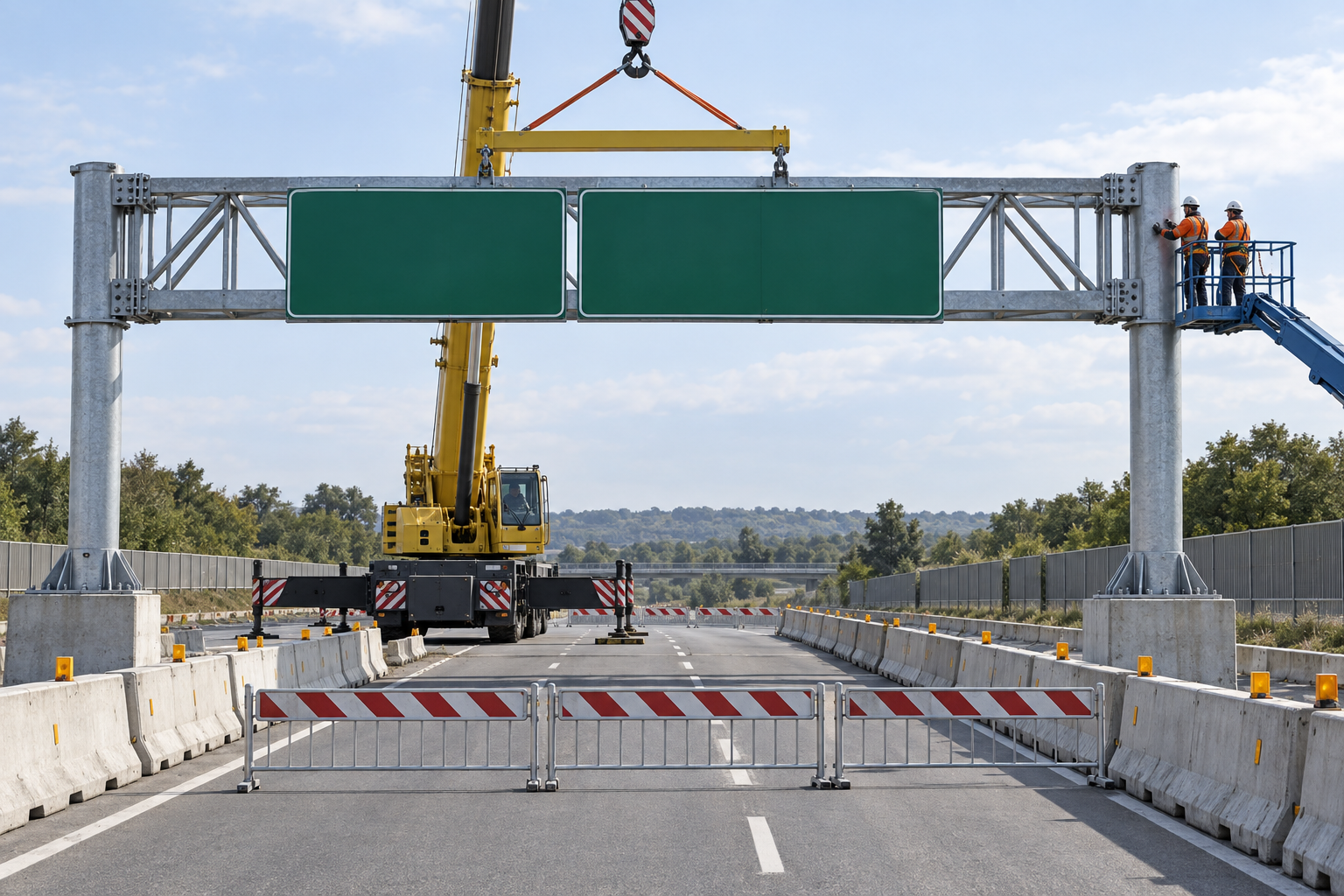
This illustration provides educational context. It is not an actual incident photograph or evidence of equipment suitability; any AI-generated depiction is illustrative only.
The scenario and record comparisons are fictional teaching examples, not records of real incidents, measurements, inspections, signatures or approvals.
| Stage | Fictional situation |
|---|---|
| Initial situation | A fictional gantry is lifted with sign panels already attached. |
| Changed condition | A gust occurs and the radius increases during alignment. |
| Failure path | Partial bolting is mistaken for a complete structure and both rigging and road closure are about to be released. |
| Possible outcome | The assembly could rotate, overturn or drop parts into traffic. |
| Prevention barrier | Hold release, reassess wind and actual crane configuration, verify staged stability and final connections, then separately obtain traffic-opening authorisation. |
Failure mechanisms
Preattached sign panels change wind area, centre of gravity and the location of wind force, not only weight. The lift plan must match the actual assembly and temporary state. A changed radius also changes the crane capacity condition.
An accepted foundation cannot compensate for incomplete column-to-beam connections. Identify the staged load path through anchors, braces and temporary connections and the conditions for releasing the lifting support.
Crane departure does not open the road. Final connection and panel checks, measured traffic clearance, sign orientation, loose-item removal and safe removal of traffic controls require their own accepted handover.
Work sequence: Review design and lift → Set crane and access → Assemble on ground → Trial lift and raise → Set temporary joints → Fasten and survey → Hold abnormal condition → Inspect and open road. This is a teaching flow, not a device drawing or a complete operating procedure.
5. Conditional decisions and common errors
| Situation | Required action | Evidence | Proceed when |
|---|---|---|---|
| Panel arrangement changes | Review actual lift | Weight, centre and wind area | Configuration accepted |
| Wind or radius changes | Hold movement safely | Actual chart and support conditions | Lift released |
| Temporary connection only | Retain lifting support | Staged bolts, anchors and braces | Stability accepted |
| Road reopening proposed | Inspect complete clearance | Survey, debris and traffic plan | Authority releases |
Similar observations, different decisions
The scenario and record comparisons are fictional teaching examples, not records of real incidents, measurements, inspections, signatures or approvals.
| Observation | Insufficient conclusion | Required distinction |
|---|---|---|
| Foundation accepted | Foundation condition | Temporary joints separate |
| Gantry set in position | Geometry achieved | Rigging release unproved |
| Crane leaves | Lifting completed | Road opening separate |
6. Roles and responsibilities
| Role | Responsibility |
|---|---|
| Work supervisor | Confirm foundation and anchors and the task scope, resources, interfaces and stop authority. |
| Qualified technical reviewer | Review ground and supports, model limits, compatibility and unresolved technical conditions within assigned competence. |
| Work crew | Apply the listed controls, report changes and stop when evidence or safeguards are missing. |
| Inspector / assessor | Record actual hand and body position and other relevant checks; do not mark unverified conditions as accepted. |
| Handover authority | Reconcile final connection records, restrictions and outstanding actions before the next task. Role labels do not establish a legal credential. |
The principal and employers coordinate the risk assessment and safe work procedures. These role labels allocate work; verify any qualifications and statutory appointments required for the actual Singapore activity. The receiving person must be given restrictions and unresolved defects before handover.
Record and handover perspective
| Stage | Record controls | Verification |
|---|---|---|
| Review design and lift | 1. Record foundation and anchors2. Record mass/kg, centre and panels3. Record lift configuration | 1. Mass/kg, centre and panels2. Lift configuration3. Traffic and utility plan |
| Assemble on ground | 1. Record stable supports2. Record connection detail3. Record rigging and lift points | 1. Connection detail2. Rigging and lift points3. Preattached-panel check |
| Trial lift and raise | 1. Record balance and sling seating2. Record weather observation3. Record exclusion maintained | 1. Weather observation2. Exclusion maintained3. Actual radius/m and load |
| Set temporary joints | 1. Record hand and body position2. Record anchors bolts and braces3. Record drop-zone control | 1. Anchors bolts and braces2. Drop-zone control3. Support-release evidence |
| Hold abnormal condition | 1. Record support and residual load2. Record changed weather radius3. Record alteration review | 1. Changed weather radius2. Alteration review3. Restart conditions |
| Inspect and open road | 1. Record final connection records2. Record clearance survey3. Record sign and debris checks | 1. Clearance survey2. Sign and debris checks3. LTA/road-owner release |
7. Hold points and record comparison
| Hold point | Evidence before release | Actual record |
|---|---|---|
| HP-0 Start | Task boundary, site RA, SWP, responsibilities and emergency arrangements | |
| HP-1 Set crane and access | Ground and supports; Exclusion zone; Fall and rescue plan; Traffic-control positions | |
| HP-2 Assemble on ground | Stable supports; Connection detail; Rigging and lift points; Preattached-panel check | |
| HP-3 Fasten and survey | Fastening method; Plumb height and direction; Panel and brace checks; Access and reaction path | |
| HP-4 Inspect and open road | Final connection records; Clearance survey; Sign and debris checks; LTA/road-owner release |
Hold points are internal project checks. They are not universal statutory permits and do not grant work permission. Reassess after defects, changed conditions and shift changes.
Record comparison
The scenario and record comparisons are fictional teaching examples, not records of real incidents, measurements, inspections, signatures or approvals.
The boxes are static record prompts, not interactive or saved approvals. A tick does not establish suitability or permission to restart. Record the evidence, person, time and unresolved issues; retain the change history.
| Record | Insufficient record | Record checklist |
|---|---|---|
| Review design and lift | Only marked “OK” | □ Foundation and anchors□ Weight centre and panels□ Lift configuration□ Traffic and utility plan |
| Trial lift and raise | Only marked “OK” | □ Balance and sling seating□ Weather observation□ Exclusion maintained□ Actual load configuration |
| Hold abnormal condition | Only marked “OK” | □ Support and residual load□ Changed weather radius□ Alteration review□ Restart conditions |
| Inspect and open road | Only marked “OK” | □ Final connection records□ Clearance survey□ Sign and debris checks□ LTA/road-authority release |
Hold points are internal checks. Determine separately whether Singapore statutory or site permit requirements apply to this work. Leave confirmation, measurements and approval records blank until the authorised site process is completed.
8. Site checklist and emergency response
| Site check | Actual result | Person / action |
|---|---|---|
| Review design and lift: Foundation and anchors; Weight centre and panels; Lift configuration; Traffic and utility plan | ||
| Set crane and access: Ground and supports; Exclusion zone; Fall and rescue plan; Traffic-control positions | ||
| Assemble on ground: Stable supports; Connection detail; Rigging and lift points; Preattached-panel check | ||
| Trial lift and raise: Balance and sling seating; Weather observation; Exclusion maintained; Actual load configuration | ||
| Set temporary joints: Hand and body position; Anchors bolts and braces; Drop-zone control; Support-release evidence | ||
| Fasten and survey: Fastening method; Plumb height and direction; Panel and brace checks; Access and reaction path | ||
| Hold abnormal condition: Support and residual load; Changed weather radius; Alteration review; Restart conditions | ||
| Inspect and open road: Final connection records; Clearance survey; Sign and debris checks; LTA/road-authority release |
Stop work
Hold lifting, support release or reopening for public intrusion, signal loss, gusts beyond the plan, increased radius without review, anchor damage, incomplete temporary connections or unverified traffic clearance.
Emergency response
Maintain the road closure and load exclusion, stop movements safely under one signal authority and activate the site emergency plan. Keep people out of the gantry collapse zone until qualified stabilization and recovery arrangements are established.
9. Sources and review limits
Official public sources read for this Singapore edition on 2026-10-14. Guidance, statutory explanations and manufacturer limits have different roles; no source provider has approved this JSA.
| Source | Read scope and application limits |
|---|---|
| MOM — Risk management | Official explanation: employer, self-employed person and principal responsibilities; routine and non-routine risk assessment; hierarchy of controls; multidisciplinary assessment team. Official explanation of risk-management duties; no claim of reading the full linked statute. It does not specify task-specific equipment limits. Assess road-sign gantry erection with employers, principal and affected contractors; resolve the inputs in section 2. |
| MOM — When should my company review its risk assessment? | Review every three years, after significant changes, new machinery/substances/procedures, hazard-related injury or incident, and when assessment is inadequate. General review guidance. A review interval does not permit continued operation after a known hazard or change. Reassess this operation after changes, defects, incidents or an inadequate assessment; do not wait for a scheduled review. |
| MOM — Permit-to-Work Systems | Formal work authorisation and coordination; OPEC tripartite guidance and competent permit authority with authority to reject work. OPEC-focused guidance page; not evidence of a blanket statutory permit requirement for every task. Determine permits for this actual activity and workplace; distinguish the section 7 internal hold points from statutory or site permits. |
| WSH Council — Planning a Lift | Lift planning documents, load/equipment/crew/method/site information, complex-lift engineering, and stopping when site conditions differ from the approved plan. Official practical guidance, with crane-oriented examples. Statutory appointments and permit applicability depend on the equipment and activity; not an issued permit or support design. Use WSHC lifting guidance for coordinated planning and stop decisions, MOM sources for applicable lifting equipment registration/examination, LTA information for street-work and traffic arrangements, and height guidance for accepted elevated access. |
| MOM — Register Lifting Equipment | Equipment categories requiring registration, including chain blocks as lifting appliances, lifts/hoists, lifting machines and lifting gear. Registration overview; exemptions and equipment classification must be confirmed for the actual asset. Registration is not proof of suitability for a particular lift. Use WSHC lifting guidance for coordinated planning and stop decisions, MOM sources for applicable lifting equipment registration/examination, LTA information for street-work and traffic arrangements, and height guidance for accepted elevated access. |
| MOM — Circular MOM/OSHD/2025-05, lifting equipment tests and examination | All three pages: requirements effective 12 September 2025, category-specific examination intervals, registration and post-change tests, and footnotes defining hoists and competent-person lifting-gear re-examination. Category-specific official circular, not a site test certificate. Periodic overload testing was removed; do not substitute routine checks for required examinations or apply lifting-gear examiner provisions to every lifting appliance. Use WSHC lifting guidance for coordinated planning and stop decisions, MOM sources for applicable lifting equipment registration/examination, LTA information for street-work and traffic arrangements, and height guidance for accepted elevated access. |
| LTA — Requirements for Street Work Proposals | Current index explanations for public-street work permits, reinstatement and traffic-control planning; links to the applicable codes and traffic-regulation authorisation. Official overview read; it is not a permit or a complete reading of every linked traffic layout. Confirm the current code, work approval and road-specific conditions. Use WSHC lifting guidance for coordinated planning and stop decisions, MOM sources for applicable lifting equipment registration/examination, LTA information for street-work and traffic arrangements, and height guidance for accepted elevated access. |
| WSH Council — Preventing Falls from Height | Employer access/protection controls, workplace-dependent fall prevention plan, hazardous work at height PTW applicability and supervisor/assessor/authorised-manager process. Official overview, not a full reading of the WAH Regulations or linked codes. PTW threshold does not mean lower falls are safe; actual anchorage, access and rescue require assessment. Use WSHC lifting guidance for coordinated planning and stop decisions, MOM sources for applicable lifting equipment registration/examination, LTA information for street-work and traffic arrangements, and height guidance for accepted elevated access. |
No universal wind limit, bolt count, road clearance, crane capacity or foundation strength is supplied. Actual approved drawings, closure and lift plan were not provided. MOM examination requirements vary by lifting-equipment category and use; the 2025 change to periodic overload testing is not an exemption from inspection or maintenance.
Actual site measurements, equipment instructions, engineering checks and signed approval records were not supplied. A qualified person must resolve these before use.
10. PDF guidance and FAQ
PDF A covers basic task controls; B focuses on technical failures; C covers supervision, records and handover. The article has eight stages with four items per main cell; each PDF has six key stages with three items per main cell. P/S/R/A, measurements, confirmations and signatures remain blank for actual site assessment.
PDFs are complementary six-stage extracts. Apply all eight body stages and the actual equipment/site procedure.
Can signs be attached before lifting?
Only when the actual panel arrangement, weight, centre and wind effects are covered by the accepted lift and stability plan.
Can a few temporary bolts support the gantry?
Use the designed staged connection and release criteria; this document supplies no generic bolt count.
Does crane removal authorize traffic?
No. Resolve final inspection, clearance and the LTA or relevant road authority's reopening requirements.
Has a professional verified or approved this document?
No. Public sources and editorial, layout and consistency checks were reviewed using AI. No site inspection or professional technical approval has been performed. Obtain appropriate professional review before use.
Does an unchanged foundation approve a changed panel arrangement?
No. Preattached panels change mass distribution and wind effects, including during lifting and temporary support. Review the actual arrangement and release criteria before continuing.
11. Revision history and authorship
AI-generated reference material; not professionally verified or approved. Before use, a qualified person must review and adapt it to applicable Singapore requirements, the actual equipment/site and approved safe work procedures.
This Singapore edition was adapted from the Korean original and its assigned US technical reference. Earlier source revisions are archival editorial history, not Singapore technical approval.
| Date | Edition | Change | Review status |
|---|---|---|---|
| 2026-09-19 | Korean source v1.1 | Source editorial publication or revision; retained as provenance of the Korean edition. | Editorial record only; no professional technical approval recorded. |
| 2026-09-26 | Korean source v1.2 | Source editorial publication or revision; retained as provenance of the Korean edition. | Editorial record only; no professional technical approval recorded. |
| 2026-10-14 | 1.0 en-SG | Singapore legal scope, local planning, responsibility interfaces and SI terminology; new PDF A/B/C. | AI editorial and visual review only; no professional approval. |