A drainage column is not an immediate bearing support for the rig. Link each withdrawal interval to actual sand discharge and keep the later staged-fill release dependent on the ground design and monitoring.
AI-generated reference material. It has not been verified or approved by a professional. Before use, a qualified person must review and adapt it to applicable Singapore requirements, the actual equipment and site, and approved safe work procedures.
1. Singapore legal and technical basis
Singapore WSH risk management applies to rig stability, stored energy and underground-service interfaces. Resolve applicable structural and geotechnical approval through the project QP. EMA requires the relevant cable-detection and notification arrangements before earthworks near electrical cables. PUB earth-control measures address site runoff; they do not prove that the engineered sand-drain system works.
| Source category | Task application and limit |
|---|---|
| MOM - Risk management | Assess rig moves, pressure and ground changes. Official explanation of WSH Risk Management duties, not a complete consolidated statutory text. |
| EMA - Earthworks Contractors | Resolve buried electrical services and applicable earthworks notification. This review covers requirements, not individual case findings or all utility authorities. Cable-detection records do not alone authorise penetration at a particular column. |
| PUB - ECM guidelines for stakeholders | Coordinate site runoff controls and drainage protection. Direct fetch failed after indexed main text was read. Detailed current Code of Practice and project approvals were not reviewed; ECM does not automatically approve process-slurry discharge. |
| BCA - Permit for structural works | Resolve applicable QP and structural permission responsibilities. Actual work classification, exemptions and submitted design were not supplied. Linked forms were not reviewed and are not reproduced as completed records. |
| WSHC - Safe Use of Machinery | Use guarded gates, verified isolation and nonentry recovery. Official guidance with a summary of statutory duties; not a machine-specific safeguard design or full review of current legislation or paid standards. |
Use Singapore requirements and SI units. Manufacturer limits apply to the actual model. Foreign technical examples do not establish Singapore statutory duties. A job safety analysis or completed checklist is not a permit or approval.
2. Scope and required inputs
Included scope
Form drainage sand columns in terrestrial soft ground by casing penetration, sand filling and controlled withdrawal, then connect horizontal drainage and hand over to monitored staged fill operations.
Separate assessment
Sand compaction piles, stone columns, prefabricated vertical drains, marine work and routine hopper entry are excluded. Installation completion does not authorize equipment loading or embankment fill.
| Input | Evidence needed |
|---|---|
| Review drainage design | Ground and drain layout; Depth spacing and sand; Fill and wait criteria; Monitoring locations. |
| Inspect hopper system | Hopper and metering; Hose and protection; Gate and guard; Sand lot and condition. |
| Fill and withdraw | Depth and time; Fill and withdrawal; Discharge and pressure; Suspect interval. |
| Handoff to staged fill | Drain and column records; Settlement trend; Pore pressure and movement; Fill-release authority. |
No site measurements, equipment manuals for the actual installation, inspection records or signed technical approvals were supplied. Confirm the applicable requirements and actual product instructions before use; record each criterion with its units, source and equipment or work-area ID.
Singapore application
This scope forms drainage sand columns by casing penetration, filling and withdrawal. It is not a sand compaction pile or a prefabricated drain installation. The geotechnical designer sets column criteria, working-platform reactions and staged-fill trigger/action levels using the actual ground model.
3. Eight-stage JSA
| Job stage | Hazards and effects | Failure factors | Controls | Site verification | P | S | R | A |
|---|---|---|---|---|---|---|---|---|
| 1. Review drainage design | 1. Poor drainage2. Buried service strike3. Fill instability4. Wrong method | 1. Drain type confused2. Utilities unknown3. Stage plan absent4. Outlet unplanned | 1. Confirm sand-drain scope2. Locate buried services3. Define stage criteria4. Plan drain connection | 1. Ground and drain layout2. Depth spacing and sand3. Fill and wait criteria4. QP monitoring and triggers | ||||
| 2. Set rig and platform | 1. Rig overturns2. Power line contact3. Ground sinks4. Track crush | 1. Weak platform2. Mast clearance unknown3. Drain seen as support4. People in travel path | 1. Verify rig-load support2. Control overhead hazards3. Use approved move route4. Clear travel area | 1. Platform and drainage2. Rig configuration3. Mast clearance plan4. Signals and escape | ||||
| 3. Inspect hopper system | 1. Engulfment2. Pressure discharge3. Gate crush4. Sand contamination | 1. Entry to clear bridge2. Hose defect3. Gravity uncontrolled4. Mixed sand | 1. Plan nonentry clearing2. Check pressure system3. Guard gate movement4. Identify sand quality | 1. Hopper and metering2. Hose and protection3. Gate and guard4. Sand lot and condition | ||||
| 4. Penetrate casing | 1. Casing drops2. Rig leans3. Utility impact4. Connection separates | 1. People below2. Resistance ignored3. Wrong location4. Joint defective | 1. Exclude fall and swing2. Track verticality3. Verify position4. Inspect casing connection | 1. Position and depth2. Resistance and inclination3. People clear4. Connection state | ||||
| 5. Fill and withdraw | 1. Sand eruption2. Column discontinuity3. Hose whip4. Shortage concealed | 1. Pressure uncontrolled2. Withdrawal mismatched3. Coupling damaged4. Total only recorded | 1. Follow approved sequence2. Correlate sand and depth3. Monitor hose condition4. Mark abnormal interval | 1. Depth and time2. Fill and withdrawal3. Discharge and pressure4. Suspect interval | ||||
| 6. Move and connect drain | 1. Rig sinks2. Drain path breaks3. Outlet blocks4. Person struck | 1. Ground assumed strong2. Layer contaminated3. Outlet ignored4. Signals conflict | 1. Use accepted platform2. Connect horizontal layer3. Inspect outlet4. Use single move signal | 1. Route support2. Column drain connection3. Outlet cleanliness4. Travel exclusion | ||||
| 7. Recover abnormality | 1. Hopper engulfment2. Pressure injury3. Gate moves4. Casing falls | 1. Hand poking2. Opened under pressure3. Restart not prevented4. No mechanical support | 1. Stop and isolate2. Relieve verify pressure3. Control sand and gates4. Support falling parts | 1. Power and pressure2. Gravity and gate3. Safe access method4. Repair and rework plan | ||||
| 8. Handoff to staged fill | 1. Ground slides2. Incomplete consolidation3. False release4. Defect loaded | 1. Fill too rapid2. Pore pressure ignored3. Readings conflict4. Rework unmarked | 1. Transfer column records2. Use stage design criteria3. Review all trends4. Mark restricted areas | 1. Drain and column records2. Settlement trend3. Pore pressure and movement4. Geotechnical fill release |
P/S/R/A and actual measurements, checks, names and signatures remain blank for the site assessment. A score cannot waive a required control.
4. Hypothetical scenario and failure mechanisms
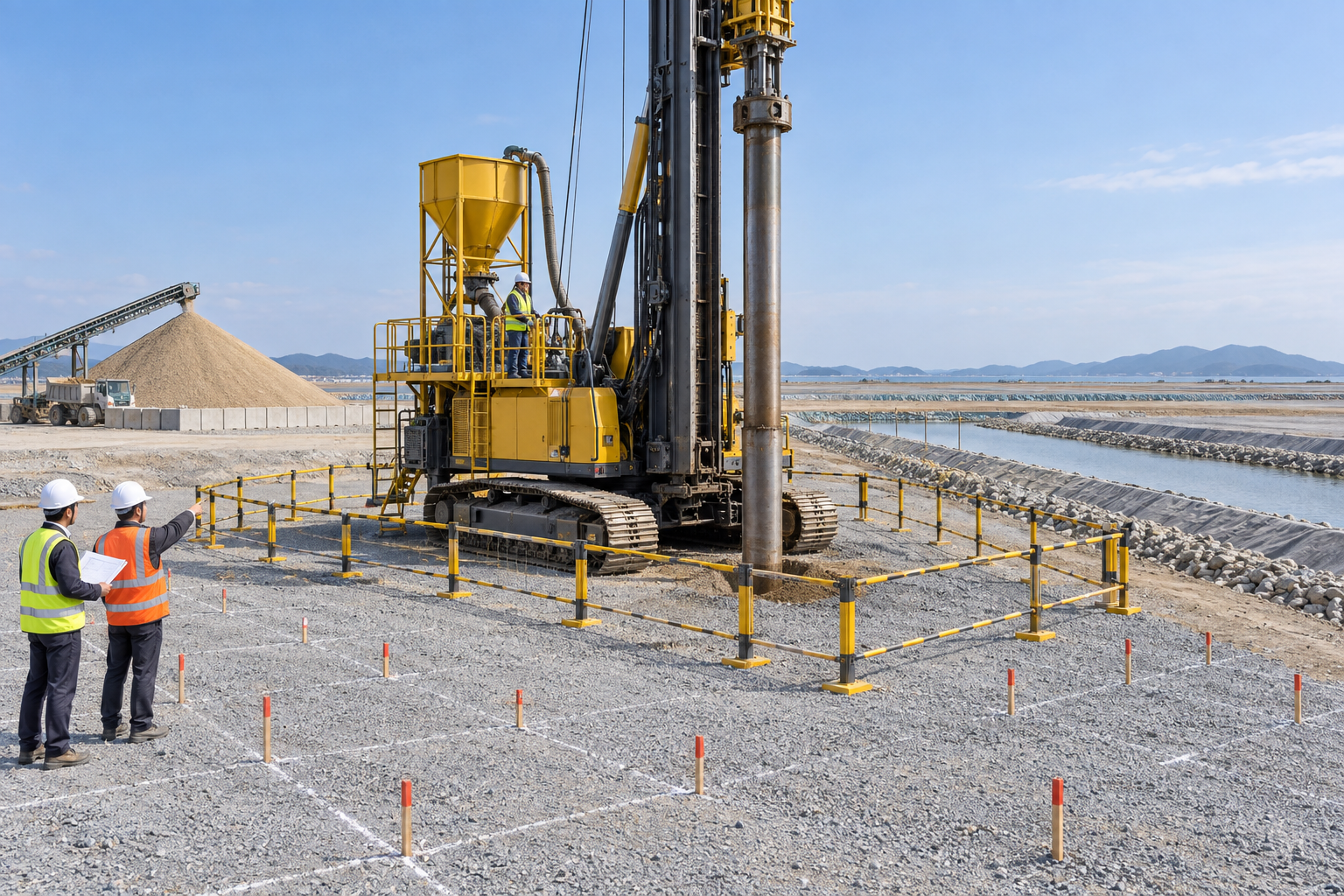
Retained AI-generated educational illustration from the source edition; not a real incident photograph, approved installation drawing or evidence of equipment suitability.
The scenario and record comparisons are fictional teaching examples, not records of real incidents, measurements, inspections, signatures or approvals.
| Item | Fictional scenario |
|---|---|
| Initial | A sand column is being formed. |
| Change | Sand discharge decreases while casing withdrawal continues. |
| Failure | Daily material totals are used to declare the column complete. |
| Outcome | A discontinuity can delay drainage while subsequent fill increases ground instability. |
| Barrier | Hold completion and fill release; correlate depth, discharge and withdrawal and resolve the affected interval and drainage connection. |
Why the controls matter
A sand drain shortens the water drainage path during consolidation; it is not evidence of immediate bearing capacity for the rig. Assess the working platform and every move independently of completed drain locations.
Daily sand totals do not show continuity at each depth. Relate depth and time to filling, discharge and casing withdrawal, then identify any suspected necking or shortage for designed verification or remedial work.
Connect the sand columns to the horizontal drainage layer and a functioning outlet. Staged fill decisions need the design and settlement, pore-pressure and lateral-movement trends; an installation count or one favorable instrument reading cannot release additional load.
Hopper bridging stores gravity hazards even after power is off. Keep routine recovery outside the hopper and control pneumatic pressure, gates, sand and suspended casing with an approved isolation and support method.
Decision sequence
| Step | Decision |
|---|---|
| Known | Sand discharge decreases while casing withdrawal continues. |
| Unknown | Actual condition, extent of damage and suitability of depth and time, fill and withdrawal remain to be established. |
| Hold | Daily material totals are used to declare the column complete. |
| Evidence | Link depth and time, fill and withdrawal, discharge and pressure, suspect interval, power and pressure, gravity and gate to the affected equipment or work area. |
| Next | Hold completion and fill release; correlate depth, discharge and withdrawal and resolve the affected interval and drainage connection. |
5. Hold and proceed decisions
| Condition | Action | Evidence | Proceed when |
|---|---|---|---|
| Discharge decreases | Control withdrawal and hold | Depth time and sand record | Continuity resolved |
| Hopper bridges | Stop and isolate | Pressure gate and gravity control | Safe recovery arranged |
| Platform settles | Stop rig movement | Ground and rig-load review | Platform accepted |
| Fill requested | Review separate release | Drain records and monitoring | Stage criteria met |
Similar appearance, different evidence
The scenario and record comparisons are fictional teaching examples, not records of real incidents, measurements, inspections, signatures or approvals.
| Comparison | Supported decision | Insufficient basis |
|---|---|---|
| Condition | Depth time and sand record | Discharge decreases has not been resolved. |
| Evidence | Ground and rig-load review | A photograph or a completed-looking task without the relevant inspection record. |
| Release | Stage criteria met | Completion of one step does not release the excluded tasks in section 2. |
6. Roles and supervision
| Role | Responsibility |
|---|---|
| Work supervisor | Assign the task boundary, stop authority, interfaces and emergency communication for vertical sand drain installation. |
| Technical lead | Confirm Ground and drain layout; Depth spacing and sand; Fill and wait criteria; Monitoring locations. Resolve design and manufacturer limits before work. |
| Authorised crew | Apply Hopper and metering; Hose and protection; Gate and guard; Sand lot and condition. Stop when the working arrangement changes. |
| Inspector / receiving lead | Review Depth and time; Fill and withdrawal; Discharge and pressure; Suspect interval. Transfer Drain and column records; Settlement trend; Pore pressure and movement; Fill-release authority. |
Role labels allocate responsibilities; they do not confer a legal qualification. Verify the competence, training and authority required for the actual task.
Record and handoff perspective
| Stage | Record controls | Verification |
|---|---|---|
| Review drainage design | 1. Record ground and drain layout2. Record depth spacing and sand3. Record fill and wait criteria | 1. Depth spacing and sand2. Fill and wait criteria3. Monitoring locations |
| Inspect hopper system | 1. Record hopper and metering2. Record hose and protection3. Record gate and guard | 1. Hose and protection2. Gate and guard3. Sand lot and condition |
| Penetrate casing | 1. Record position and depth2. Record resistance and inclination3. Record people clear | 1. Resistance and inclination2. People clear3. Connection state |
| Fill and withdraw | 1. Record depth and time2. Record fill and withdrawal3. Record discharge and pressure | 1. Fill and withdrawal2. Discharge and pressure3. Suspect interval |
| Recover abnormality | 1. Record power and pressure2. Record gravity and gate3. Record safe access method | 1. Gravity and gate2. Safe access method3. Repair and rework plan |
| Handoff to staged fill | 1. Record drain and column records2. Record settlement trend3. Record pore pressure and movement | 1. Settlement trend2. Pore pressure and movement3. Fill-release authority |
Singapore application
The installation team records column ID, depth, time, sand discharge and interruptions. The drainage team verifies the horizontal layer and outlet. The geotechnical lead reconciles settlement, pore-pressure and lateral-movement trends before the designated person releases each fill stage; daily totals cannot close a suspect interval.
7. Hold points and record quality
| Hold point | Evidence before release | Actual record |
|---|---|---|
| HP-0 Start | Form drainage sand columns in terrestrial soft ground by casing penetration, sand filling and controlled withdrawal, then connect horizontal drainage and hand over to monitored staged fill operations. | |
| HP-1 Set rig and platform | Platform and drainage; Rig configuration; Mast clearance plan; Signals and escape | |
| HP-2 Penetrate casing | Position and depth; Resistance and inclination; People clear; Connection state | |
| HP-3 Fill and withdraw | Depth and time; Fill and withdrawal; Discharge and pressure; Suspect interval | |
| HP-4 Handoff to staged fill | Drain and column records; Settlement trend; Pore pressure and movement; Fill-release authority |
These are internal hold points, not issued permits. Recheck affected points after a change, fault or shift handoff; link the actual approval record.
Record comparison
The scenario and record comparisons are fictional teaching examples, not records of real incidents, measurements, inspections, signatures or approvals.
The boxes are static record prompts, not interactive or saved approvals. A tick does not establish suitability or permission to restart. Record the evidence, person, time and unresolved issues; retain the change history.
| Record | Insufficient | Record checklist |
|---|---|---|
| Review drainage design | "Checked" without target, criteria or result | □ Ground and drain layout□ Depth spacing and sand□ Fill and wait criteria□ Monitoring locations |
| Inspect hopper system | "Checked" without target, criteria or result | □ Hopper and metering□ Hose and protection□ Gate and guard□ Sand lot and condition |
| Fill and withdraw | "Checked" without target, criteria or result | □ Depth and time□ Fill and withdrawal□ Discharge and pressure□ Suspect interval |
| Handoff to staged fill | "Checked" without target, criteria or result | □ Drain and column records□ Settlement trend□ Pore pressure and movement□ Fill-release authority |
8. Pre-work checks and emergency response
| Check | Result | Person / action |
|---|---|---|
| □ Review drainage design: Ground and drain layout | ||
| □ Set rig and platform: Platform and drainage | ||
| □ Inspect hopper system: Hopper and metering | ||
| □ Penetrate casing: Position and depth | ||
| □ Fill and withdraw: Depth and time | ||
| □ Move and connect drain: Route support | ||
| □ Recover abnormality: Power and pressure | ||
| □ Handoff to staged fill: Drain and column records | ||
| □ Emergency access and handoff restrictions |
Stop work
Stop for interrupted discharge, abnormal sand quantity by depth, rig/casing inclination, platform settlement, pressure leakage or monitoring anomalies. Do not release a suspected column or subsequent fill from daily totals alone.
Emergency response
Clear the rig/casing danger radius and follow the approved stabilization plan. Do not enter or poke a bridged hopper. Control power, pressure, gates and gravity before recovery; contact the site emergency responders/site rescue for injury or engulfment risk and prevent unplanned entry.
9. Sources and review limits
Public-source review: 14 October 2026. Only the material and limits identified below were reviewed.
| Source | Reviewed material | Task application |
|---|---|---|
| MOM - Risk management | Responsibilities; routine and non-routine work; hierarchy of control and risk assessment team. Official explanation of WSH Risk Management duties, not a complete consolidated statutory text. | Assess rig moves, pressure and ground changes. |
| EMA - Earthworks Contractors | Requirements preceding enforcement tables: utility plans, licensed cable detection, advance notification, SP PowerGrid conditions and RES scope. This review covers requirements, not individual case findings or all utility authorities. Cable-detection records do not alone authorise penetration at a particular column. | Resolve buried electrical services and applicable earthworks notification. |
| PUB - ECM guidelines for stakeholders | Public indexed main text: QECP design, construction information, PUB approval, implementation and joint audit. Direct fetch failed after indexed main text was read. Detailed current Code of Practice and project approvals were not reviewed; ECM does not automatically approve process-slurry discharge. | Coordinate site runoff controls and drainage protection. |
| BCA - Permit for structural works | Main overview, joint developer/QP/builder application, material-change approval and immaterial-change records; current page March 2026. Actual work classification, exemptions and submitted design were not supplied. Linked forms were not reviewed and are not reproduced as completed records. | Resolve applicable QP and structural permission responsibilities. |
| WSHC - Safe Use of Machinery | Printed pages 4, 27, 37-39: dangerous parts, maintenance training, hazardous-energy isolation, verification, group/shift continuity and restoration. Official guidance with a summary of statutory duties; not a machine-specific safeguard design or full review of current legislation or paid standards. | Use guarded gates, verified isolation and nonentry recovery. |
Selected public official sources were reviewed on 14 October 2026 within the recorded scope. No full consolidated legal audit, paid Singapore Standard, actual model manual, site inspection, engineering calculation or professional approval is claimed. Verify current detailed requirements and actual equipment/site records before use.
AI-generated reference material. It has not been verified or approved by a professional. Before use, a qualified person must review and adapt it to applicable Singapore requirements, the actual equipment and site, and approved safe work procedures.
10. PDF use and frequently asked questions
PDF A covers basic task controls; B focuses on technical failures; C covers supervision, records and handover. The article has eight stages with four items per main cell; each PDF has six key stages with three items per main cell. P/S/R/A, measurements, confirmations and signatures remain blank for actual site assessment.
Content group
jsa-sanddrain-installation
Is this a sand compaction pile?
No. This scope creates drainage columns; do not import bearing or compaction claims from another method.
Does the daily sand total prove continuity?
No. Relate filling and withdrawal to each column and depth interval.
Can the rig move over a completed column?
Only on a separately accepted working platform and route.
Can workers enter a bridged hopper?
Not as routine clearing. Use planned nonentry recovery and control pressure, gates, gravity and power.
Has a professional approved this JSA?
This reference material was written and revised with AI. It has not been verified or approved by a professional. Review by a suitably qualified professional and required site approval are necessary before field use.
Singapore application
Read A, B and C together with all eight JSA stages and the approved work procedure. The sheets are complementary extracts, not separate work authorisations.
11. Authorship and revision history
AI-generated reference material. It has not been verified or approved by a professional. Before use, a qualified person must review and adapt it to applicable Singapore requirements, the actual equipment and site, and approved safe work procedures.
| Date / edition | Authorship and scope | Professional approval |
|---|---|---|
| 2026-09-19 / Korean source | Original topic and educational illustration retained as references. Source content is unchanged. | Not asserted |
| 14 October 2026 / Singapore 1.0 | Added Singapore cable/earth-control interfaces and QP-led separation of drain completion from staged fill. | Not performed |
Source topic: https://smartjsabridge.com/ko/case-study/jsa-sanddrain-installation