A closed gate does not prove that the cell is empty. Evaluate the robot, tool, workpiece and integrated equipment as one hazard area, then separately verify reset, start and personnel clearance.
This is reference content written and reviced with AI. It has not been verified or approved by a professional. Review by a suitably qualified professional and required site authorisation are necessary before use.
Stop conditions first
Hold installation access for uncertain isolation, gravity-axis support or residual pressure. Stop tests/production for unexpected motion, bypasses, competing control, an unaccounted person or unverified safety response.
AI-generated reference material; not professionally verified or approved. Before use, a qualified person must review and adapt it to applicable Singapore requirements, the actual equipment/site and approved safe work procedures.
1. Singapore legal and technical basis
Apply Singapore workplace machinery and risk-management duties to the integrated robot cell, including external axes, tooling, workpieces and conveyors. The employer and system integrator must distinguish isolated installation or servicing from separately assessed powered teaching and safety-function tests. WSHC robot guidance is not a certification of the complete cell.
| Basis | Singapore application |
|---|---|
| Risk management | The employer, self-employed person and principal assess and control work risks. Include preparation, abnormal conditions and maintenance. Coordinate affected trades and communicate controls. |
| Activity-specific guidance | Use WSHC robot guidance for task-specific assessment and mode separation, machinery guidance for guarding/isolation and validation, and EMA guidance for applicable electrical installation responsibility. |
| Permits and authority | Select permit requirements for the actual sector and activity. Site hold points and contractor role labels do not create statutory permits or qualifications. |
| Equipment and design | Full robot and functional-safety standards, actual controller/manual and measured stopping data were not supplied. No universal reduced speed, separation distance or required performance level is assigned. Collaborative-operation assessment and automatic motion with people inside the hazard zone remain excluded. |
2. Scope and required inputs
Included
Install fixed perimeter guarding and access doors, verify safety interlocks/circuits, conduct planned manual teaching and functional tests, and hand over for controlled production release.
Separate assessment
Collaborative-operation certification, bypassed safety circuits, personnel in automatic-mode hazard zones and unreviewed safety-distance/performance calculations are excluded.
| Input | Evidence needed |
|---|---|
| Assess complete cell | Tool/work envelope; Integrated equipment; Stopping/distance basis; Escape/rescue plan |
| Isolate and support | Lockout/verification; Gravity/work support; Air/hydraulic state; Shared supply/conveyor |
| Install fence and gate | Support/hand position; Temporary boundary; Anchor installation; Gate/escape function |
| Release to production | Whole-area clearance; Tool/programmeme/speed limits; Operations/rescue briefing; Validation/receiver |
No actual equipment model, SDS, site measurements, design calculations or authorisation record was supplied. Verify actual product limits and applicable Singapore requirements before use. Manufacturer guidance is not government approval.
Select task-appropriate eye, hand, foot, skin and hearing protection from the exposure assessment. Where respiratory protection is necessary, use the applicable respiratory-protection programmeme; PPE does not replace isolation, guarding, support or ventilation.
Singapore site planning
Establish the hazard envelope and stopping/distance evidence in mm and seconds for the actual settings, tool and load. Coordinate the integrator, electrical lead, maintenance team and production owner; verify appropriate LEW involvement for regulated electrical installation work. Support gravity axes and workpieces and isolate connected equipment before installation. For powered tests, specify authorised manual mode, enabling device, exclusive control and escape. Record expected versus observed gate, reset, start, stop and power-return responses against circuit/software revisions. Account for people and remove unauthorised bypasses before separate production release.
3. Eight-stage JSA
| Job stage | Hazards and effects | Failure factors | Technical and procedural controls | Site verification | P | S | R | A |
|---|---|---|---|---|---|---|---|---|
| 1. Assess complete cell | 1. Robot crush2. Tool/workpiece ejection3. Reach through guard4. Person trapped | 1. Arm reach alone used2. External equipment omitted3. Stopping distance ignored4. Escape unplanned | 1. Assess full hazard envelope2. Include tools/external axes3. Verify safeguarding design4. Plan escape/rescue | 1. Tool/work envelope2. Integrated equipment3. Stopping/distance basis and units4. Escape/rescue plan | ||||
| 2. Isolate and support | 1. Unexpected motion2. Gravity-axis drop3. Pressure release4. Conveyor starts | 1. Control stop only2. Axis/work unsupported3. Pressure trapped4. Shared energy missed | 1. Isolate all energy sources2. Support axes/work safely3. Control residual energy4. Include connected equipment | 1. Lockout/verification2. Gravity/work support3. Air/hydraulic state4. Shared supply/conveyor | ||||
| 3. Inspect floor and parts | 1. Fence overturns2. Embedded cable hit3. Sharp-edge cut4. Unsafe access gap | 1. Anchor/base unknown2. Hole unverified3. Edges unprotected4. Panel dimensions wrong | 1. Match base/anchor design2. Locate embedded services3. Control edges/tools4. Check guard dimensions | 1. Substrate/anchor basis2. Service locations3. Panel condition4. Height/gap/distance | ||||
| 4. Install fence and gate | 1. Panel crush2. Temporary collapse3. Anchor release4. Entrant trapped | 1. Panel unsupported2. Unfixed section left open3. Anchor method wrong4. Inside escape absent | 1. Support panels during work2. Exclude incomplete areas3. Follow anchor procedure4. Provide designed escape | 1. Support/hand position2. Temporary boundary3. Anchor installation4. Gate/escape function | ||||
| 5. Verify safety circuits | 1. Start with gate open2. Motion on reset3. Defeated safety function4. Sensor blind area | 1. Ordinary signal substituted2. Restart logic wrong3. Bypass wiring4. Sensor misplaced | 1. Use validated safety design2. Separate reset/start3. Remove unauthorised bypasses4. Test detection/stop responses | 1. Circuit/version2. Reset/start response3. Bypass review4. Gate/sensor coverage | ||||
| 6. Teach and function test | 1. Slow-motion crush2. Automatic-mode exposure3. Residual person trapped4. Stop function fails | 1. Mode not controlled2. Enabling defeated3. Outside reset attempted4. Test plan absent | 1. Use assessed manual mode2. Maintain enabling/sole control3. Verify people and escape4. Test expected safety responses | 1. Mode/speed units and evidence2. Enabling/control owner3. People/clearance4. Stop/restart results | ||||
| 7. Hold defect or change | 1. Bypassed production2. Unexpected reentry motion3. Gravity drop4. Unverified new settings | 1. Bypass accepted for output2. Access without isolation3. Supports disturbed4. Change test omitted | 1. Hold faulty application2. Re-isolate before service3. Recheck mechanical support4. Validate affected functions | 1. Isolation/no bypass2. Setup authority3. Axis/work support4. Change/test record | ||||
| 8. Release to production | 1. Person remains inside2. New tool extends hazard3. Contractor confusion4. Defective cell runs | 1. Area not searched2. Change limits unrecorded3. Training handover missed4. Validation incomplete | 1. Reconcile people/tools2. Transfer change requirements3. Train designated operators4. Authorize verified release | 1. Whole-area clearance2. Tool/programmememe/speed limits3. Operations/rescue briefing4. Validation/receiver |
P = likelihood; S = severity; R = risk using the site method; A = site acceptance/authorisation. Complete after actual assessment; no score overrides an unresolved hold point or equipment limit.
4. Failure mechanisms and hypothetical case
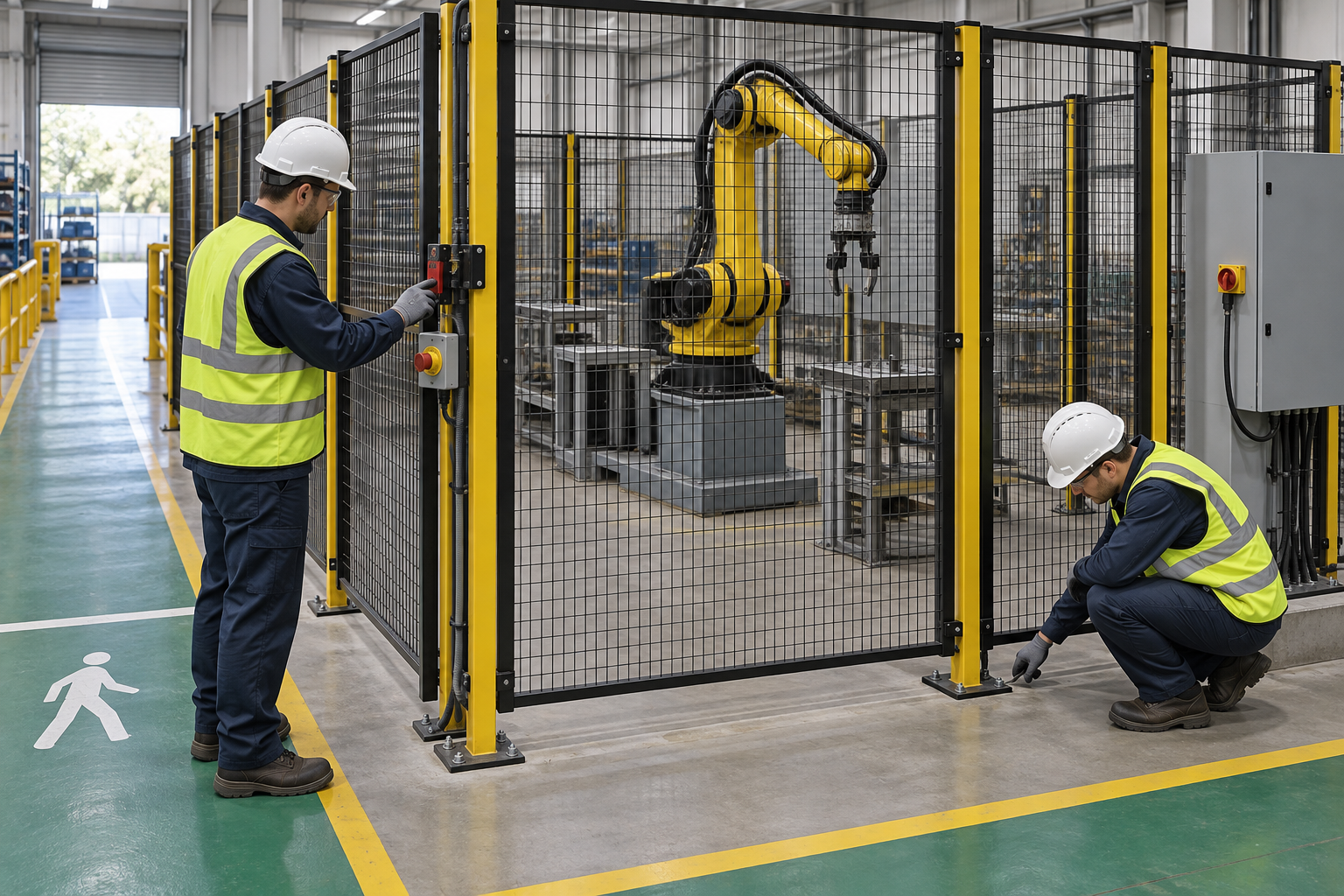
The retained illustration is an AI-generated educational image from the Korean source. It is not an actual incident photograph, approved drawing, equipment certification or proof that the depicted arrangement is safe.
Robot reach alone does not define the hazard space. Tool/workpiece projection, external axes, conveyors, stopping motion and ejection can change the required safeguarding.
An interlock stop, emergency stop and energy isolation serve different purposes. Installation/service access needs appropriate isolation and stored-energy support; powered teaching/testing needs its separately assessed mode and controls.
Gate status describes the gate, not the people inside. Reset must not become an unintended start command. Check blind areas, access accountability, escape and integrated-equipment responses before release.
Reduced-speed manual motion can still trap someone against a fixed object. An enabling device does not replace safe clearance and exclusive control. Reassess affected safety functions after tool, programmeme or setting changes.
Hypothetical decision example
Hypothetical example: a teacher remains inside the cell while an outside worker sees the gate-closed indication and reaches for reset. Reset/start is held until people, control ownership and escape are confirmed and the planned safety-response tests are completed.
The example is fictional; no incident, measurement, inspection or approval is asserted.
Task flow: Assess complete cell → Isolate and support → Inspect floor and parts → Install fence and gate → Verify safety circuits → Teach and function test → Hold defect or change → Release to production
5. Hold and proceed decisions
| Condition | Action | Evidence | Proceed when |
|---|---|---|---|
| Energy boundary unclear | Hold service access | All equipment and stored-force evidence | Isolation verified |
| Gate/fence incomplete | Exclude unfinished zone | Anchors, gaps and escape checks | Safeguard installed |
| Reset response unknown | Hold production | Expected/actual safety tests | Restart logic verified |
| Person unaccounted for | No reset/start | Area search and access reconciliation | Area released |
Similar observation, different conclusion
| Observation | Supported conclusion | What remains unresolved |
|---|---|---|
| Gate indicates closed | Gate state observed | No proof the cell is empty |
| Robot stopped once | One stop occurred | All required safety functions unproved |
6. Roles and supervision
| Role | Responsibility |
|---|---|
| Work supervisor | Coordinate assess complete cell, affected operations, stop signals and stage transitions. |
| Technical/equipment reviewer | Verify Tool/work envelope, Integrated equipment, actual instructions and unresolved technical limits. |
| Task crew | Apply the stated controls, report changes and keep actual checks and signatures factual. |
| Inspector/test lead | Connect Mode/speed evidence, Enabling/control owner to the required acceptance criteria. |
| Receiving authority | Accept the recorded restrictions, Operations/rescue briefing, Validation/receiver, and follow-up ownership. |
These are responsibility examples, not invented statutory credentials. Verify actual competence, training and authority for the assigned work.
The principal and employers coordinate the risk assessment and safe work procedures. These role labels allocate work; verify any qualifications and statutory appointments required for the actual Singapore activity. The receiving person must be given restrictions and unresolved defects before handover.
Record and handover perspective
| Stage | Record controls | Verification |
|---|---|---|
| Assess complete cell | 1. Record tool/work envelope2. Record integrated equipment3. Record stopping/distance basis and units | 1. Integrated equipment2. Stopping/distance basis and units3. Escape/rescue plan |
| Inspect floor and parts | 1. Record substrate/anchor basis2. Record service locations3. Record panel condition | 1. Service locations2. Panel condition3. Height/gap/distance |
| Install fence and gate | 1. Record support/hand position2. Record temporary boundary3. Record anchor installation | 1. Temporary boundary2. Anchor installation3. Gate/escape function |
| Verify safety circuits | 1. Record circuit/version2. Record reset/start response3. Record bypass review | 1. Reset/start response2. Bypass review3. Gate/sensor coverage |
| Hold defect or change | 1. Record isolation/no bypass2. Record setup authority3. Record axis/work support | 1. Setup authority2. Axis/work support3. Change/test record |
| Release to production | 1. Record whole-area clearance2. Record tool/programmememe/speed limits3. Record operations/rescue briefing | 1. Tool/programmememe/speed limits2. Operations/rescue briefing3. Validation/receiver |
7. Hold points and record quality
| Hold point | Evidence before release | Actual record |
|---|---|---|
| HP-0 Start | Task boundary, site RA, SWP, responsibilities and emergency arrangements | |
| HP-1 Isolate and support | Lockout/verification; Gravity/work support; Air/hydraulic state; Shared supply/conveyor | |
| HP-2 Inspect floor and parts | Substrate/anchor basis; Service locations; Panel condition; Height/gap/distance | |
| HP-3 Teach and function test | Mode/speed units and evidence; Enabling/control owner; People/clearance; Stop/restart results | |
| HP-4 Release to production | Whole-area clearance; Tool/programmememe/speed limits; Operations/rescue briefing; Validation/receiver |
Hold points are internal evidence gates. They do not establish that a statutory permit exists or has been approved. Recheck affected gates after changes, faults and shift handover.
Record comparison - hypothetical templates
The 16 boxes below identify record elements, not completed checks or approvals. They are static symbols. Link equipment/location, date, actual findings and the separate record reference; preserve unresolved items.
| Record | Insufficient entry | Required record elements |
|---|---|---|
| Assess complete cell | "Checked" without supporting facts | □ Tool/work envelope□ Integrated equipment□ Stopping/distance basis□ Escape/rescue plan |
| Inspect floor and parts | "Checked" without supporting facts | □ Substrate/anchor basis□ Service locations□ Panel condition□ Height/gap/distance |
| Verify safety circuits | "Checked" without supporting facts | □ Circuit/version□ Reset/start response□ Bypass review□ Gate/sensor coverage |
| Hold defect or change | "Checked" without supporting facts | □ Isolation/no bypass□ Setup authority□ Axis/work support□ Change/test record |
Hold points are internal checks. Determine separately whether Singapore statutory or site permit requirements apply to this work. Leave confirmation, measurements and approval records blank until the authorised site process is completed.
8. Pre-work checks and emergency response
| Check required | Result | Checker/action |
|---|---|---|
| Assess complete cell: Tool/work envelope | ||
| Isolate and support: Lockout/verification | ||
| Inspect floor and parts: Substrate/anchor basis | ||
| Install fence and gate: Support/hand position | ||
| Verify safety circuits: Circuit/version | ||
| Teach and function test: Mode/speed evidence | ||
| Hold defect or change: Isolation/no bypass | ||
| Release to production: Whole-area clearance |
Stop work
Hold installation access for uncertain isolation, gravity-axis support or residual pressure. Stop tests/production for unexpected motion, bypasses, competing control, an unaccounted person or unverified safety response.
Emergency response
Use the planned safe stop and summon the site robot-rescue response. Do not enter an active cell, bypass a gate or restart motion to free a person. Qualified responders must establish electrical, pneumatic, hydraulic and gravity-energy control, including supported axes/workpieces, before access. Call the site emergency service for serious crushing injury and provide cell location, current mode, trapped-person position and stored-energy information.
9. Official sources and review limits
Official public sources read for this Singapore edition on 2026-10-14. Guidance, statutory explanations and manufacturer limits have different roles; no source provider has approved this JSA.
| Source | Read scope and application limits |
|---|---|
| MOM — Risk management | Official explanation: employer, self-employed person and principal responsibilities; routine and non-routine risk assessment; hierarchy of controls; multidisciplinary assessment team. Official explanation of risk-management duties; no claim of reading the full linked statute. It does not specify task-specific equipment limits. Assess robot-cell guarding and setup with employers, principal and affected contractors; resolve the inputs in section 2. |
| MOM — When should my company review its risk assessment? | Review every three years, after significant changes, new machinery/substances/procedures, hazard-related injury or incident, and when assessment is inadequate. General review guidance. A review interval does not permit continued operation after a known hazard or change. Reassess this operation after changes, defects, incidents or an inadequate assessment; do not wait for a scheduled review. |
| MOM — Permit-to-Work Systems | Formal work authorisation and coordination; OPEC tripartite guidance and competent permit authority with authority to reject work. OPEC-focused guidance page; not evidence of a blanket statutory permit requirement for every task. Determine permits for this actual activity and workplace; distinguish the section 7 internal hold points from statutory or site permits. |
| WSH Council — Working Safely with Industrial Robots | Official article page 4 excerpt: non-routine operation, task assessment, LOTO, assessed manual enabling control and perimeter safeguarding; current WSH advisory guarding/training excerpt also read. General guidance, not a robot-specific safety-function design or certification. Full referenced standards and actual stopping performance were not reviewed. Controlled teaching mode does not authorise improvised safeguard bypass. Use WSHC robot guidance for task-specific assessment and mode separation, machinery guidance for guarding/isolation and validation, and EMA guidance for applicable electrical installation responsibility. |
| WSH Council — Guidelines on Safe Use of Machinery | Sections 1.1 and 1.3: scope and explanation of safeguarding/LOTO duties. Sections 4.3–4.4.3: training, maintenance, specified replacement parts and isolation of all energy sources; commissioning safety-device checks. Official practical guidance and explanation; complete current subsidiary legislation and every annex were not read. Actual manufacturer isolation and restoration instructions remain necessary. Use WSHC robot guidance for task-specific assessment and mode separation, machinery guidance for guarding/isolation and validation, and EMA guidance for applicable electrical installation responsibility. |
| EMA — Engaging Licensed Electrical Workers | Overview and licence-class table: electrical wiring, circuit breaker and control-unit work carried out or superviced by a Licensed Electrical Worker; check valid licence and class for installation load/voltage. Official consumer overview, not a detailed installation standard or design approval. The actual installation conditions and LEW licence restrictions remain to be verified. Use WSHC robot guidance for task-specific assessment and mode separation, machinery guidance for guarding/isolation and validation, and EMA guidance for applicable electrical installation responsibility. |
Full robot and functional-safety standards, actual controller/manual and measured stopping data were not supplied. No universal reduced speed, separation distance or required performance level is assigned. Collaborative-operation assessment and automatic motion with people inside the hazard zone remain excluded.
Actual site measurements, equipment instructions, engineering checks and signed approval records were not supplied. A qualified person must resolve these before use.
10. PDF use and frequently asked questions
PDF A summarizes core controls; B emphasizes technical failures; C covers supervision, records and handover. Each uses six stages from or aligned with the eight-stage body. All actual risk, measurement, check and signature fields are blank. Use a separate linked record where more space is needed.
Does emergency stop authorize fence installation?
No. Verify the appropriate hazardous-energy isolation and support of axes and workpieces.
Does slow mode remove crushing risk?
No. Preserve safe clearance, assessed manual mode, enabling control and control ownership.
Can reset also start production?
Verify a deliberate separate start process and protection against unexpected restart, together with a cleared cell.
Does a tool-only change need review?
Yes when it affects reach, mass, movement, stopping or other hazards; verify the affected functions before use.
Has a professional approved this JSA?
This is reference content written and reviced with AI. It has not been verified or approved by a professional. Review by a suitably qualified professional and required site authorisation are necessary before use.
11. Authorship and revision history
AI-generated reference material; not professionally verified or approved. Before use, a qualified person must review and adapt it to applicable Singapore requirements, the actual equipment/site and approved safe work procedures.
This Singapore edition was adapted from the Korean original and its assigned US technical reference. Earlier source revisions are archival editorial history, not Singapore technical approval.
| Date | Edition | Change | Review status |
|---|---|---|---|
| 2026-09-19 | Korean source v1.1 | Source editorial publication or revision; retained as provenance of the Korean edition. | Editorial record only; no professional technical approval recorded. |
| 2026-09-26 | Korean source v1.2 | Source editorial publication or revision; retained as provenance of the Korean edition. | Editorial record only; no professional technical approval recorded. |
| 2026-10-14 | 1.0 en-SG | Singapore legal scope, local planning, responsibility interfaces and SI terminology; new PDF A/B/C. | AI editorial and visual review only; no professional approval. |