The gap between a reversing truck and a moving paver is a crushing zone. Alarms and cameras do not establish that it is clear. Agree a driver-guide signal method, exclude people and stop if contact is lost; do not infer permission from silence.
AI-generated reference material; not professionally verified or approved. Before use, a qualified person must review and adapt it to Singapore requirements, the actual equipment/site and approved safe work procedures.
Stop before starting
Stop on lost communication, pedestrian intrusion, unstable tipping ground, unsupported edges, failed brakes/guards, uncontrolled fumes or heat illness symptoms. Hold hazardous maintenance until isolation and support are verified.
1. Legal and technical scope
| Basis | Scope and limits |
|---|---|
| MOM: Risk management | Review paving stages, weather, pedestrians and change of work zone. Official explanation of statutory duties; linked SSO text was not independently read for this item. This is not a legal opinion. |
| WSH Council: Workplace Traffic Safety Management | Separate plant routes and pedestrian access with positive movement control. Guidance does not establish a grader exclusion distance or machine slope limit. |
| LTA: Works on Public Streets, April 2026 | Verify public-street permission and applicable project submission requirements. Official public-street process. Private-premises boundaries and road-specific approvals must be checked; internal JSA hold points are not an LTA permit. |
| LTA: Traffic Control at Work Zone, July 2019 | Review the actual approved traffic layout and physical protection. Official road work-zone requirements; use the road-specific accepted layout and current project conditions. Numeric examples are not universal values; overseas crash-test references appear within LTA guidance, not standalone US law. |
| MOM: Heat stress measures for outdoor work | Apply currently effective heat-stress controls and distinguish future commencement. Future requirements are not described as already mandatory. Actual WBGT, work intensity, symptoms and site conditions require assessment. |
| NIOSH: Engineering control guidelines for hot mix asphalt pavers | Consider source capture as technical guidance and verify actual exposure performance. Foreign technical reference, not Singapore law or proof of actual field exposure control; no laboratory efficiency target adopted. |
| MOM/NEA/SCDF: Revised SS 586 adoption | Use actual mix and cleaner SDS and temperature instructions. Official adoption circular, not full paid SS 586 text or a classification of the actual product; verify current supplier label and SDS. |
| WSH Council: Safe Use of Machinery | Control raised components and all hazardous energy before cleaning. Official guidance; cited paid Singapore Standards were not obtained. No universal wheel test duration or gap is inferred. |
| SCDF: Emergency Medical Services | Use the site emergency plan and 995. Official emergency-response information, not a site-specific rescue plan or authorisation for untrained rescue. |
Apply Singapore WSH risk management and workplace traffic controls to mobile plant, heat, fumes and maintenance. For public-street work, verify the applicable LTA permission and approved traffic arrangement using the April 2026 street-work requirements and relevant traffic-control guidance. Road approval, plant operation and reopening are separate decisions. Apply current MOM outdoor heat-stress measures; additional requirements commencing 1 December 2026 are future requirements as of this review on 14 October 2026.
2. Scope and required inputs
Included work
Set up approved traffic controls, prepare paving plant, receive and lay hot asphalt, perform protected hand finishing and mat checks, compact, isolate and clean plant, and hand over for authorised staged reopening.
Separate assessment
Mix design, approval of traffic arrangements or structural reopening, milling or silica cutting, tack coating, utility entry, specialist lifting and nuclear density-gauge use require separate controls and authorisations.
| Required input | Evidence to obtain |
|---|---|
| Set traffic layout | Road authority plan; Pedestrian route; Traffic-control briefing; Lighting at work boundary |
| Inspect and prepare plant | Pre-start inspection; Heater and fuel condition; Guard and stop test; Heat-rest arrangements |
| Reverse and unload | Driver-guide contact; Discharge area condition; Body and overhead clearance; Stuck-load procedure |
| Lay asphalt | Guard position; Mix and ventilation settings; Safe clearing procedure; Supplier temperature limits |
No actual equipment model, site measurements, design calculations or signed approval was supplied. Check the applicable Singapore requirements and approved safe work procedures against the actual equipment and site before use. Statutory duties, official guidance and manufacturer limits serve different purposes; editorial checks do not establish legal or professional approval.
Singapore site application
For outdoor work, current MOM measures include hourly WBGT monitoring, acclimatisation, hydration and shaded rest. Heavy physical work at WBGT 32 degrees C or above requires at least 10 continuous minutes of rest hourly; assess whether more rest is needed. Verify whether the project requires an on-site WBGT meter and use representative readings. The four additional requirements announced for 1 December 2026 are not presented here as already in force.
Use the actual approved LTA traffic plan and permission reference. Cones define routes but do not establish crash protection. Record mix temperatures in degrees C and equipment settings against supplier/model instructions; no universal roller-edge distance or paving temperature is assigned.
3. Eight-stage JSA
| Job stage | Hazards and effects | Failure factors | Technical and procedural controls | Site verification | P | S | R | A |
|---|---|---|---|---|---|---|---|---|
| 1. Set traffic layout | 1. Traffic intrusion2. Worker struck3. Blocked escape4. Poor night visibility | 1. Wrong taper layout2. Unprotected sign placement3. Public route intersects plant4. Glare obscures routes | 1. Implement agreed traffic plan2. Separate people and plant3. Protect setup and escape routes4. Position lights without glare | 1. Road authority plan2. Pedestrian route3. Traffic-control briefing4. Lighting at work boundary | ||||
| 2. Inspect and prepare plant | 1. Unexpected movement2. Burner fire3. Access fall4. Heat stress | 1. Brake or alarm defect2. Fuel leak3. Guard missing4. Breaks not planned | 1. Check brakes and visibility aids2. Test guards and stop functions3. Prepare stable access and lighting4. Plan water shade and breaks | 1. Pre-start inspection2. Heater and fuel condition3. Guard and stop test4. Heat-rest arrangements | ||||
| 3. Reverse and unload | 1. Crushing at hopper2. Truck overturn3. Overhead contact4. Sudden load release | 1. Guide lost from view2. Soft or sloping ground3. Body raised into obstruction4. Material sticks in body | 1. Exclude people from docking gap2. Stop when signals are lost3. Check tipping ground and clearance4. Stop and use approved release method | 1. Driver-guide contact2. Discharge area condition3. Body and overhead clearance4. Stuck-load procedure | ||||
| 4. Lay asphalt | 1. Hot-mix burns2. Fume exposure3. Auger entanglement4. Contact burns | 1. Person inside moving envelope2. Extraction obstructed3. Hand enters moving auger4. Temperature assumed safe | 1. Keep clear of hopper and auger2. Use specified mix and extraction3. Isolate before clearing material4. Verify mix limits from supplier | 1. Guard position2. Mix and ventilation settings3. Safe clearing procedure4. Supplier temperature limits | ||||
| 5. Finish and test mat | 1. Worker hit by roller2. Hot splash3. Muscle strain4. Fume exposure | 1. Testing overlaps rolling2. Worker crosses blind zone3. Heavy repetitive shovelling4. Worker stays in exhaust plume | 1. Hold conflicting plant movements2. Agree protected entry and exit3. Use tools and thermal protection4. Plan position clear of traffic and fumes | 1. Plant held for entry2. Worker exit confirmation3. Tools and PPE assessment4. Wind and worker position | ||||
| 6. Compact pavement | 1. Run-over at reversal2. Roller overturn3. Vibration exposure4. Noise exposure | 1. Uncontrolled pedestrian entry2. Unsupported pavement edge3. Unsafe pass or speed4. Signals masked by noise | 1. Separate passes from foot work2. Set edge limits from ground check3. Use belt with rollover protection4. Use tested agreed communications | 1. Clear roller route2. Edge support condition3. Belt and protection condition4. Noise and communication check | ||||
| 7. Isolate and clean | 1. Stored-energy movement2. Burns and fire3. Cleaner exposure4. Unexpected restart | 1. Stop mistaken for isolation2. Hot surface ignites cleaner3. Raised screed unsupported4. Key control unclear | 1. Isolate and verify before access2. Cool and use specified cleaner3. Support raised components4. Assign isolation and key control | 1. Energy and restart control2. Cleaner SDS and heat3. Mechanical supports4. Named isolation controller | ||||
| 8. Load and hand over | 1. Ramp slip or overturn2. Unsecured transport load3. Premature traffic entry4. Public trip or skid | 1. Ramp or deck unsuitable2. Tie-down points unverified3. Barriers removed too early4. Unfinished edge or loose material | 1. Use rated stable loading route2. Restrain plant to transport plan3. Inspect before staged reopening4. Check surface edges and debris | 1. Ramp and trailer check2. Restraint plan3. Road handover release4. Surface and edge inspection |
P = likelihood; S = severity; R = risk under the site method; A = site-defined acceptance/authorization. These actual assessment cells are blank. A low score never overrides a missing safeguard or a legal or manufacturer restriction.
4. Fictional scenario and failure mechanisms
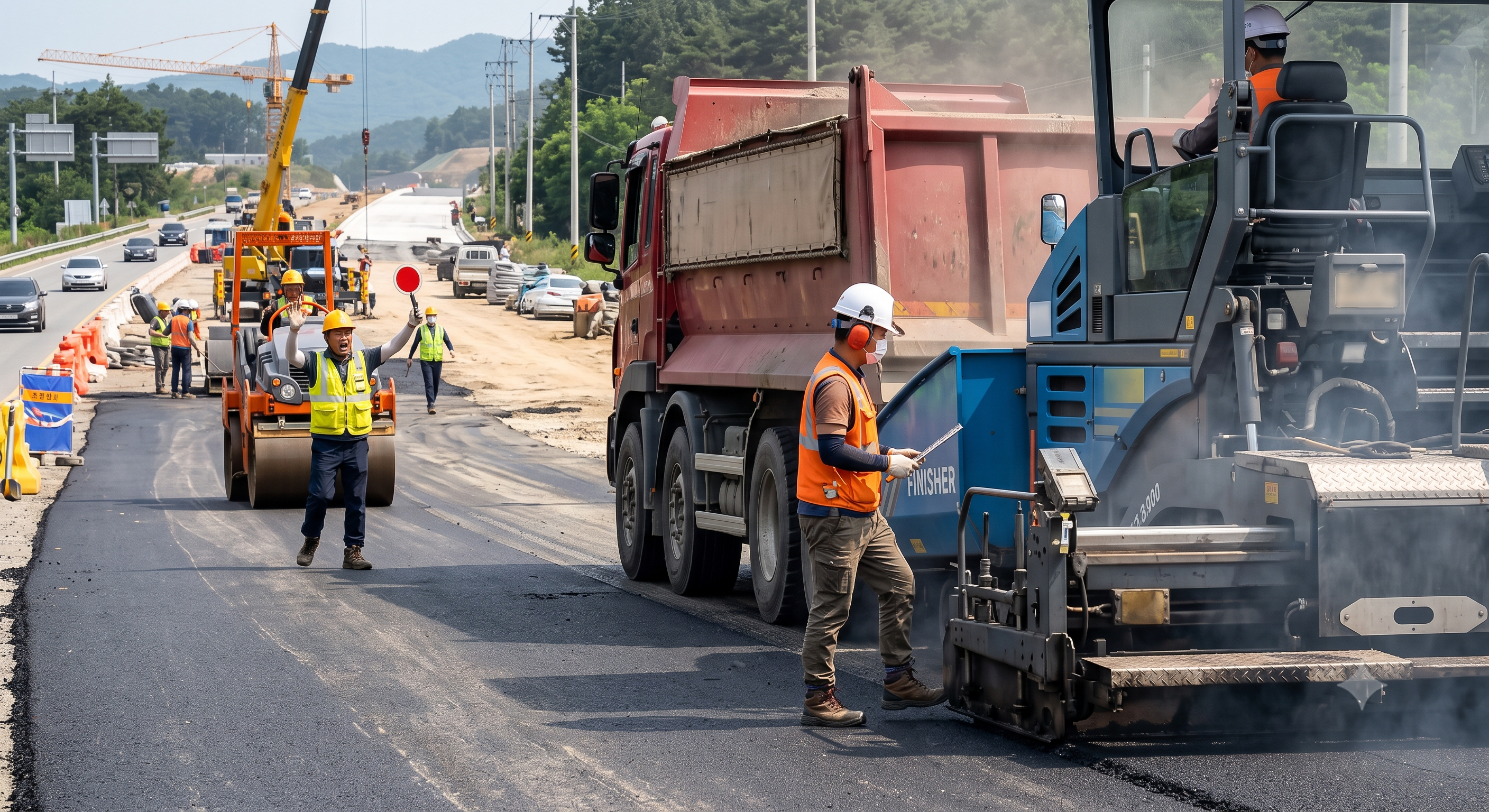
This illustration provides educational context. It is not an actual incident photograph or evidence of equipment suitability; any AI-generated depiction is illustrative only.
The scenario and record comparisons are fictional teaching examples, not records of real incidents, measurements, inspections, signatures or approvals.
| Stage | Fictional situation |
|---|---|
| Initial situation | A worker approaches the mat for a check beside the paver. |
| Changed condition | A delivery truck is reversing; its camera is obscured and radio contact is incomplete. |
| Failure path | The worker assumes all plant movements have stopped. |
| Possible outcome | The worker can enter the crushing gap between truck and paver. |
| Prevention barrier | Hold every conflicting movement, establish clear communication and protected entry, and confirm exit before release. |
Failure mechanisms
The gap between a reversing truck and a moving paver is a crushing zone. Alarms and cameras do not establish that it is clear. Agree a driver-guide signal method, exclude people and stop if contact is lost; do not infer permission from silence.
Mat testing or hand finishing requires a positive hold on every conflicting machine. Agree protected entry and exit, confirm the worker has left, then release movements. A stopped roller alone does not control an approaching truck or paver.
Tipping requires suitable ground, clearance for the raised body and a controlled discharge area. Stuck material can release suddenly; stop and follow the accepted release method instead of jerking the vehicle. Check unsupported edges separately when setting roller routes.
Slow augers and raised screeds remain hazardous. Before clearing or cleaning, isolate and verify all energy, control restart and provide specified mechanical support. Hydraulic pressure and an emergency stop are not substitutes for that support and isolation.
Use actual supplier mix temperatures, extraction and exposure controls. A particulate mask does not automatically protect against vapours. Completion of compaction or density checks does not authorise public traffic: inspect edges, debris, plant and people clearance and release traffic controls in the accepted sequence.
Decision sequence
| Step | Decision |
|---|---|
| Known | Worker entry overlaps truck/paver operation; communication is uncertain. |
| Unknown | Whether each conflicting driver has positively held movement. |
| Hold | Stop entry and plant movements; keep the docking gap clear. |
| Evidence | Named movement controller, confirmed plant holds and protected route. |
| Release | Confirm worker exit and restore the agreed signals before restarting each movement. |
Work sequence: Set traffic layout → Inspect and prepare plant → Reverse and unload → Lay asphalt → Finish and test mat → Compact pavement → Isolate and clean → Load and hand over. This is a teaching flow, not a device drawing or a complete operating procedure.
5. Conditional decisions and common errors
| Situation | Required action | Evidence | Proceed when |
|---|---|---|---|
| Guide contact lost | Stop reversing | Clear zone and restored signals | Driver-guide contact confirmed |
| Mat check required | Hold all conflicting plant | Protected entry and exit arrangement | Movement controller releases |
| Raised screed cleaning | Isolate and support | Energy verification and mechanical support | Intervention released |
| Reopening proposed | Retain traffic controls | Surface, edges, debris and clearance | Road authority/site release accepted |
Similar observations, different decisions
The scenario and record comparisons are fictional teaching examples, not records of real incidents, measurements, inspections, signatures or approvals.
| Observation | Insufficient conclusion | Required distinction |
|---|---|---|
| Camera fitted | Reversing area clear | Verify exclusion and contact |
| Roller stopped | Worker entry safe | Hold every conflicting machine |
| Density passes | Road open to public | Obtain separate inspection and traffic release |
6. Roles and responsibilities
| Role | Responsibility |
|---|---|
| Paving supervisor | Coordinate approved work zone, heat/exposure controls and interfaces. |
| Traffic and movement controller | Maintain protected routes and positive holds, entries, exits and staged releases. |
| Drivers and plant operators | Verify signals, exclusion, ground and machine condition; stop lost contact. |
| Mat inspection and finishing crew | Enter only through the held, protected arrangement and confirm exit. |
| Maintenance and handover authorities | Verify isolation/support and separately release plant, surface and traffic reopening. |
Supervision and handover focus
| Stage | Management action | Evidence |
|---|---|---|
| Set traffic layout | 1. Record road authority plan2. Record pedestrian route3. Record traffic-control briefing | 1. Road authority plan2. Pedestrian route3. Traffic-control briefing |
| Inspect and prepare plant | 1. Record pre-start inspection2. Record heater and fuel condition3. Record guard and stop test | 1. Pre-start inspection2. Heater and fuel condition3. Guard and stop test |
| Lay asphalt | 1. Record guard position2. Record mix and ventilation settings3. Record safe clearing procedure | 1. Guard position2. Mix and ventilation settings3. Safe clearing procedure |
| Finish and test mat | 1. Record plant held for entry2. Record worker exit confirmation3. Record tools and ppe assessment | 1. Plant held for entry2. Worker exit confirmation3. Tools and PPE assessment |
| Isolate and clean | 1. Record energy and restart control2. Record cleaner sds and heat3. Record mechanical supports | 1. Energy and restart control2. Cleaner SDS and heat3. Mechanical supports |
| Load and hand over | 1. Record ramp and trailer check2. Record restraint plan3. Record road handover release | 1. Ramp and trailer check2. Restraint plan3. Road handover release |
7. Hold points and record comparison
| Hold point | Evidence before release | Actual approval |
|---|---|---|
| HP-0 Scope | Set up approved traffic controls, prepare paving plant, receive and lay hot asphalt, perform protected hand finishing and mat checks, compact, isolate and clean plant, and hand over for authorised staged reopening. | |
| HP-1 Inspect and prepare plant | Pre-start inspection; Heater and fuel condition; Guard and stop test; Heat-rest arrangements | |
| HP-2 Lay asphalt | Guard position; Mix and ventilation settings; Safe clearing procedure; Supplier temperature limits | |
| HP-3 Isolate and clean | Energy and restart control; Cleaner SDS and heat; Mechanical supports; Named isolation controller | |
| HP-4 Load and hand over | Ramp and trailer check; Restraint plan; Road handover release; Surface and edge inspection |
Hold points are internal project checks. They are not universal statutory permits and do not grant work permission. Reassess after defects, changed conditions and shift changes.
Record comparison
The scenario and record comparisons are fictional teaching examples, not records of real incidents, measurements, inspections, signatures or approvals.
The boxes are static record prompts, not interactive or saved approvals. A tick does not establish suitability or permission to restart. Record the evidence, person, time and unresolved issues; retain the change history.
| Record | Insufficient record | Record checklist |
|---|---|---|
| Set traffic layout | Only marked “OK” | □ Road authority plan□ Pedestrian route□ Traffic-control briefing□ Lighting at work boundary |
| Lay asphalt | Only marked “OK” | □ Guard position□ Mix and ventilation settings□ Safe clearing procedure□ Supplier temperature limits |
| Isolate and clean | Only marked “OK” | □ Energy and restart control□ Cleaner SDS and heat□ Mechanical supports□ Named isolation controller |
| Load and hand over | Only marked “OK” | □ Ramp and trailer check□ Restraint plan□ Road handover release□ Surface and edge inspection |
8. Site checklist and emergency response
| Site check | Actual result | Person / action |
|---|---|---|
| Set traffic layout: Road authority plan; Pedestrian route; Traffic-control briefing; Lighting at work boundary | ||
| Inspect and prepare plant: Pre-start inspection; Heater and fuel condition; Guard and stop test; Heat-rest arrangements | ||
| Reverse and unload: Driver-guide contact; Discharge area condition; Body and overhead clearance; Stuck-load procedure | ||
| Lay asphalt: Guard position; Mix and ventilation settings; Safe clearing procedure; Supplier temperature limits | ||
| Finish and test mat: Plant held for entry; Worker exit confirmation; Tools and PPE assessment; Wind and worker position | ||
| Compact pavement: Clear roller route; Edge support condition; Belt and protection condition; Noise and communication check | ||
| Isolate and clean: Energy and restart control; Cleaner SDS and heat; Mechanical supports; Named isolation controller | ||
| Load and hand over: Ramp and trailer check; Restraint plan; Road handover release; Surface and edge inspection |
Stop work
Stop on lost communication, pedestrian intrusion, unstable tipping ground, unsupported edges, failed brakes/guards, uncontrolled fumes or heat illness symptoms. Hold hazardous maintenance until isolation and support are verified.
Emergency response
Stop traffic and plant from safe positions, secure the work zone and summon the site emergency team. Call 995 for serious burns, crushing, collapse or suspected heat stroke; begin the site cooling/first-aid response while awaiting help. Do not enter a moving or unsupported plant envelope.
9. Sources and review limits
Public-source access/review: 2026-10-14.
| Official source | Reviewed scope and limits |
|---|---|
| MOM: Risk management | Review paving stages, weather, pedestrians and change of work zone. Official explanation of statutory duties; linked SSO text was not independently read for this item. This is not a legal opinion. |
| WSH Council: Workplace Traffic Safety Management | Separate plant routes and pedestrian access with positive movement control. Guidance does not establish a grader exclusion distance or machine slope limit. |
| LTA: Works on Public Streets, April 2026 | Verify public-street permission and applicable project submission requirements. Official public-street process. Private-premises boundaries and road-specific approvals must be checked; internal JSA hold points are not an LTA permit. |
| LTA: Traffic Control at Work Zone, July 2019 | Review the actual approved traffic layout and physical protection. Official road work-zone requirements; use the road-specific accepted layout and current project conditions. Numeric examples are not universal values; overseas crash-test references appear within LTA guidance, not standalone US law. |
| MOM: Heat stress measures for outdoor work | Apply currently effective heat-stress controls and distinguish future commencement. Future requirements are not described as already mandatory. Actual WBGT, work intensity, symptoms and site conditions require assessment. |
| NIOSH: Engineering control guidelines for hot mix asphalt pavers | Consider source capture as technical guidance and verify actual exposure performance. Foreign technical reference, not Singapore law or proof of actual field exposure control; no laboratory efficiency target adopted. |
| MOM/NEA/SCDF: Revised SS 586 adoption | Use actual mix and cleaner SDS and temperature instructions. Official adoption circular, not full paid SS 586 text or a classification of the actual product; verify current supplier label and SDS. |
| WSH Council: Safe Use of Machinery | Control raised components and all hazardous energy before cleaning. Official guidance; cited paid Singapore Standards were not obtained. No universal wheel test duration or gap is inferred. |
| SCDF: Emergency Medical Services | Use the site emergency plan and 995. Official emergency-response information, not a site-specific rescue plan or authorisation for untrained rescue. |
No actual equipment model, site measurements, design calculations or signed approval was supplied. Check the applicable Singapore requirements and approved safe work procedures against the actual equipment and site before use. Statutory duties, official guidance and manufacturer limits serve different purposes; editorial checks do not establish legal or professional approval.
10. PDF guidance and FAQ
PDF A covers basic task controls; B focuses on technical failures; C covers supervision, records and handover. The article has eight stages with four items per main cell; each PDF has six key stages with three items per main cell. P/S/R/A, measurements, confirmations and signatures remain blank for actual site assessment.
PDFs are complementary six-stage extracts. Apply all eight body stages and the actual equipment/site procedure.
Can workers enter the truck-paver gap when the camera is operating?
No. Keep the docking gap excluded and use the agreed positive movement controls.
Is a stopped roller enough for a mat check?
No. Hold all conflicting plant, control entry and confirm exit before movement release.
Can the raised screed be supported hydraulically for cleaning?
Use the specified mechanical support and verified isolation procedure before intervention.
Do all asphalt mixes use one safe temperature?
No. Follow actual supplier limits, exposure controls and the approved process.
Does satisfactory density authorise reopening?
No. Reopening requires separate surface and clearance checks and the authorised traffic-control release.
Has a professional verified or approved this document?
AI-generated reference material; not professionally verified or approved. Before use, a qualified person must review and adapt it to Singapore requirements, the actual equipment/site and approved safe work procedures.
11. Revision history and authorship
AI-generated reference material; not professionally verified or approved. Before use, a qualified person must review and adapt it to Singapore requirements, the actual equipment/site and approved safe work procedures.
| Date | Version | Change | Review status |
|---|---|---|---|
| 2026-10-14 | SG 1.0 | New Singapore edition from assigned Korean source; task decisions, records and PDFs localized. | AI editorial review; no professional technical approval |
Korean edition revision history: 2026-07-26: earlier published draft/version retained in the source history; 2026-10-04 (v1.1): task decisions, record checklist, JSA and three PDF variants revised. These are editorial records, not professional technical approval. Singapore v1.0 adapts the earlier edition to Singapore requirements and terminology.
Site reviewers must add their actual qualifications, scope, date and approval only after the review occurs.