Correct spacing, cover and lap checks establish reinforcement quality only. They do not establish temporary cage stability. Trace the current load path through braces, connections, foundations and supporting deck, including the stages before and after hook release.
AI-generated reference material; not professionally verified or approved. Before use, a qualified person must review and adapt it to Singapore requirements, the actual equipment/site and approved safe work procedures.
Stop before starting
Stop for uncertain brace/base capacity, uncontrolled lift or deck loading, damaged guarding, exposed fall/impalement hazards or an unreviewed support change. Preserve the current stable arrangement and exclusion pending review.
1. Legal and technical scope
| Basis | Scope and limits |
|---|---|
| Singapore WSH (Construction) Regulations 2007: Regulation 67 | Maintain adequate support through placement, tying, changes and handover. Narrow provision review, not approval of any cage, brace or lifting design; other applicable duties remain. |
| MOM: Risk management | Assess changing cage stability, deck loading and conflicting work. Official explanation of statutory duties; linked SSO text was not independently read for this item. This is not a legal opinion. |
| HSE: Temporary works | Use planned design, installation checks and controlled changes as technical guidance. British technical guidance, not Singapore statutory role requirements or a project design. |
| WSH Council: Planning a Lift | Review cage/bundle mass, rigging, radius and hook-release sequence. Official practical guidance. No assertion that every activity is a crane operation or that this page itself establishes a universal statutory permit. |
| MOM: Register Lifting Equipment | Check the actual lifting equipment registration requirements. Official registration explanation; determine the actual equipment category and applicable exceptions. Registration is not approval of the individual lift. |
| WSH Council: Preventing Falls from Height | Maintain protected access and fall prevention around reinforcement. Official explanatory guidance; the stated PTW scope is not a general exemption from fall controls below that height. Actual premises classification must be checked. |
| WSH Council: Preventing Machine Hazards | Guard cutting/bending and control the full bar sweep. Official practical guidance, not the actual machine isolation procedure or proof of equipment compliance. |
| WSH Council: Safe Use of Machinery | Control unexpected start and stored bar strain before clearing. Official guidance; cited paid Singapore Standards were not obtained. No universal wheel test duration or gap is inferred. |
| SCDF: Emergency Medical Services | Plan collapse and impalement rescue with 995. Official emergency-response information, not a site-specific rescue plan or authorisation for untrained rescue. |
Singapore WSH (Construction) Regulations regulation 67 requires the occupier to ensure steel reinforcement is adequately supported against collapse. Apply risk management, machinery controls, fall prevention and the applicable lifting arrangements. Assess whether the actual high-risk construction work requires a statutory permit. Foreign temporary-works guidance supports planning and change control but does not create a Singapore statutory job title or approve a cage design.
2. Scope and required inputs
Included work
Receive, stack, cut, bend, lift, place, brace and tie reinforcement, using protected access and recording temporary stability separately from reinforcement quality before handover.
Separate assessment
Structural design, special welded or mechanical splices, prestressing, unsupported cage modifications and unplanned lifting arrangements require separate competent design and procedures.
| Required input | Evidence to obtain |
|---|---|
| Plan sequence | Drawing revision; Load allowance; Route plan; Weather limits |
| Receive / store | Bearing checked; Restraint in place; Gear inspected; Stack limit recorded |
| Cut / bend | Guard test; Sweep area clear; Feed support ready; Isolation verified |
| Lift bundles | Lift plan checked; Capacity checked; Signals agreed; Gear compatible |
No actual equipment model, site measurements, design calculations or signed approval was supplied. Check the applicable Singapore requirements and approved safe work procedures against the actual equipment and site before use. Statutory duties, official guidance and manufacturer limits serve different purposes; editorial checks do not establish legal or professional approval.
Singapore site application
Record bar size and geometry in mm and bundle/cage mass in kg against the current drawings. A quality inspection signature does not release temporary works. Coordinate the main contractor, steel fixer, lifting team and formwork trades for every support or access change.
3. Eight-stage JSA
| Job stage | Hazards and effects | Failure factors | Technical and procedural controls | Site verification | P | S | R | A |
|---|---|---|---|---|---|---|---|---|
| 1. Plan sequence | 1. Cage overturn2. Deck overload3. Plant conflict4. Unplanned wind exposure | 1. Missing brace design2. Unknown bundle mass3. Overlapping work4. Outdated drawing | 1. Design temporary support2. Verify deck capacity3. Separate plant routes4. Set design weather limits | 1. Drawing revision2. Load allowance3. Route plan4. Weather limits | ||||
| 2. Receive / store | 1. Rolling bars2. Falling bundles3. Sharp ends4. Vehicle strike | 1. Uneven dunnage2. Cut straps too early3. Hands below load4. Shared unloading lane | 1. Level and chock stacks2. Restrain before unbanding3. Use suitable lifting gear4. Separate people and trucks | 1. Bearing checked2. Restraint in place3. Gear inspected4. Stack limit recorded | ||||
| 3. Cut / bend | 1. Blade contact2. Rotating bar strike3. Flying fragments4. Unexpected restart | 1. Guard bypassed2. Swing area occupied3. Stock unsupported4. Only emergency stop used | 1. Keep guards effective2. Fence bar sweep area3. Support feed stock4. Isolate before clearing | 1. Guard test2. Sweep area clear3. Feed support ready4. Isolation verified | ||||
| 4. Lift bundles | 1. Dropped load2. Cage distortion3. Crushing4. Sling edge damage | 1. Wrong lifting points2. Unknown capacity3. Conflicting signals4. Packing band used to lift | 1. Use designed lift points2. Check load and radius3. One designated signal person4. Protect sling contact | 1. Lift plan checked2. Capacity checked3. Signals agreed4. Gear compatible | ||||
| 5. Access / ends | 1. Fall from edge2. Impalement3. Platform overload4. Fall during cage climbing | 1. Missing edge protection2. Cosmetic caps only3. Stock piled on deck4. Cage used as anchor | 1. Provide protected access2. Fit rated end protection3. Control platform loading4. Use designed anchors only | 1. Access inspected2. Protection verified3. Deck load checked4. Rescue route ready | ||||
| 6. Place / brace | 1. Cage overturn2. Crushed hands3. Brace anchor failure4. Instability in wind | 1. Early hook release2. Hands in pinch point3. Wrong anchor base4. Ties treated as bracing | 1. Install designed braces2. Keep hands clear3. Check brace foundations4. Release hook after checks | 1. Braces installed2. Connections checked3. Release authorised4. Weather acceptable | ||||
| 7. Tie / inspect | 1. Wire cuts2. Awkward posture3. Dropped tools4. Stability lost in changes | 1. Sharp wire tails2. Overreaching3. Loose tools4. Braces removed for access | 1. Turn wire ends inward2. Use safe work platforms3. Secure small tools4. Review changes before work | 1. Tie pattern checked2. Cover checked3. Access clear4. Braces retained | ||||
| 8. Clean / hand over | 1. Trips on offcuts2. Falling scrap3. Exposed bar ends4. Premature brace removal | 1. Waste left on deck2. Throwing scrap3. Removed protection4. No release sequence | 1. Collect wire and offcuts2. Lower waste safely3. Retain end protection4. Retain braces until release | 1. Walkway clear2. Waste contained3. Protection intact4. Handover recorded |
P = likelihood; S = severity; R = risk under the site method; A = site-defined acceptance/authorization. These actual assessment cells are blank. A low score never overrides a missing safeguard or a legal or manufacturer restriction.
4. Fictional scenario and failure mechanisms
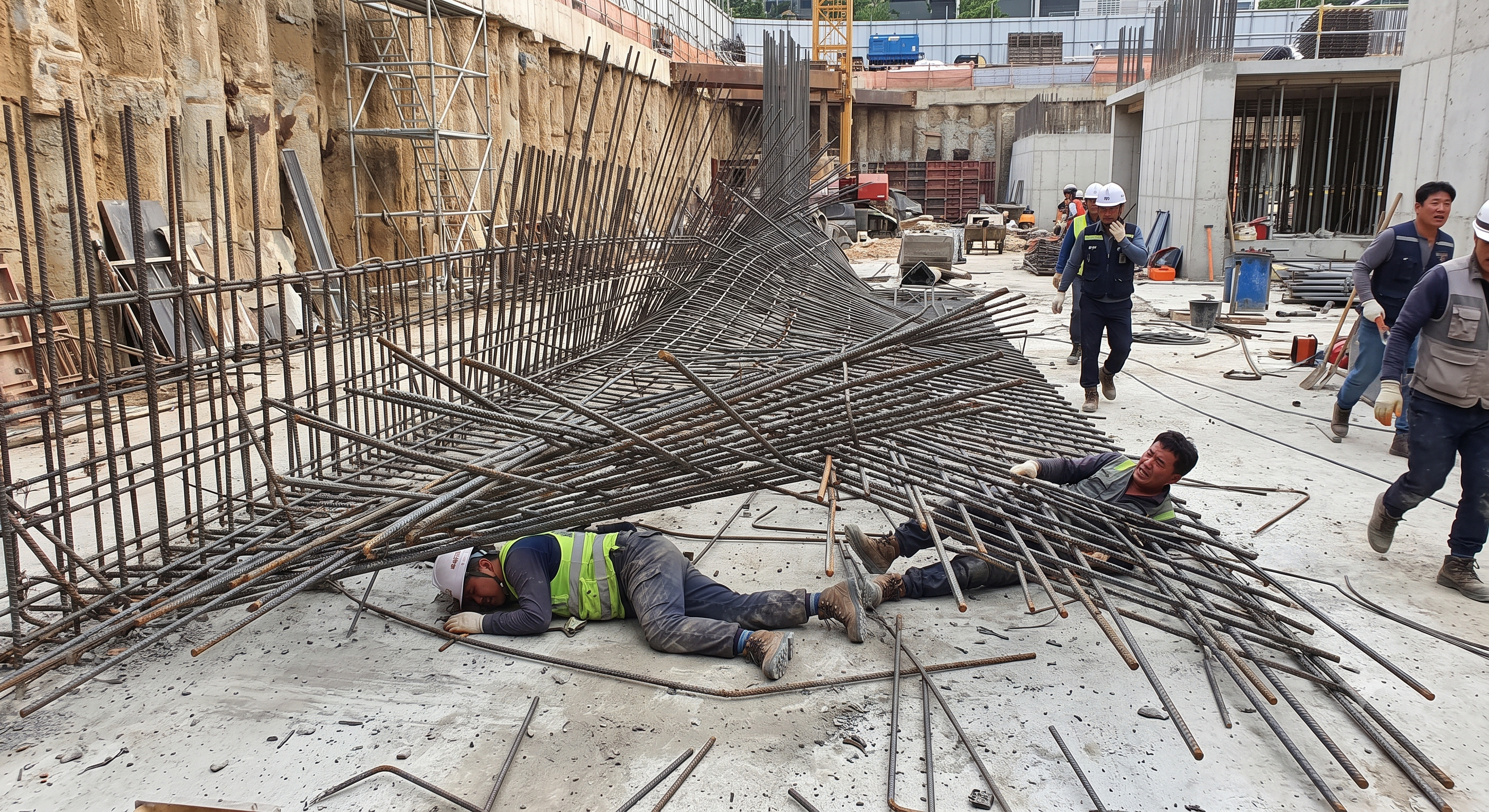
This illustration provides educational context. It is not an actual incident photograph or evidence of equipment suitability; any AI-generated depiction is illustrative only.
The scenario and record comparisons are fictional teaching examples, not records of real incidents, measurements, inspections, signatures or approvals.
| Stage | Fictional situation |
|---|---|
| Initial situation | A cage has passed spacing and cover checks. |
| Changed condition | A crew wants to remove a brace to position a work platform. |
| Failure path | The quality check is treated as permission to alter the temporary support. |
| Possible outcome | The cage can overturn when its load path is interrupted. |
| Prevention barrier | Hold the change until an accepted alternative support and sequence are installed and checked. |
Failure mechanisms
Correct spacing, cover and lap checks establish reinforcement quality only. They do not establish temporary cage stability. Trace the current load path through braces, connections, foundations and supporting deck, including the stages before and after hook release.
Tying wire holds bars in their specified relationship; it is not a substitute for designed temporary bracing. Retain the accepted bracing until the authorised release stage. Where access conflicts with a brace, provide the reviewed alternative support before changing the existing system.
A packing band is not a lifting attachment. Plan the actual bundle or cage mass, configuration, lifting points, equipment capacity at radius and sling contact. Do not impose a generic two-point arrangement on every cage or release the hook on appearance alone.
Small plastic caps may reduce scratches without resisting impalement under a fall. Select protection suitable for the actual exposure and independently prevent falls. Do not climb an unapproved cage or treat it as an anchor.
Long bars sweep well beyond the machine guard during bending. Protect that whole envelope, support feed stock and verify isolation before clearing; the emergency stop does not remove stored electrical, mechanical or bent-bar energy. Select hand protection without creating rotating-machine entanglement.
Decision sequence
| Step | Decision |
|---|---|
| Known | Reinforcement quality checked; access change requires a brace conflict. |
| Unknown | Stability after brace removal and alternative support capacity. |
| Hold | Retain brace and exclusion; do not use tying wire as replacement. |
| Evidence | Reviewed temporary-support change, installed connections and base checks. |
| Release | Record the limited change/release and retain independent quality and stability records. |
Work sequence: Plan sequence → Receive / store → Cut / bend → Lift bundles → Access / ends → Place / brace → Tie / inspect → Clean / hand over. This is a teaching flow, not a device drawing or a complete operating procedure.
5. Conditional decisions and common errors
| Situation | Required action | Evidence | Proceed when |
|---|---|---|---|
| Hook release proposed | Retain lifting control | Brace, base and connection checks | Release authorised |
| Brace blocks access | Hold alteration | Alternative support design and inspection | Change sequence accepted |
| Protruding bars exposed | Restrict exposure | Suitable protection and fall controls | Protection verified |
| Machine jam | Stop and isolate | Residual bar strain and safe state | Clearing authorised |
Similar observations, different decisions
The scenario and record comparisons are fictional teaching examples, not records of real incidents, measurements, inspections, signatures or approvals.
| Observation | Insufficient conclusion | Required distinction |
|---|---|---|
| Spacing and cover correct | Cage stable | Verify temporary support separately |
| Plastic cap fitted | Impalement risk controlled | Check protective performance for the actual fall exposure |
| Emergency stop pressed | Jam safe to clear | Verify isolation and residual energy |
6. Roles and responsibilities
| Role | Responsibility |
|---|---|
| Occupier / site management | Arrange adequate reinforcement support and coordinated controls under applicable Singapore duties. |
| Temporary-support designer/reviewer | Resolve the actual stability system, bases, load cases and changes. |
| Lifting team | Apply the accepted lift and hold the hook until the supported release condition is verified. |
| Steel-fixing supervisor and crew | Maintain braces, protected access, end protection and guarded machine operation. |
| Quality and handover reviewers | Keep reinforcement quality and temporary stability acceptance separate; transfer release restrictions. |
Supervision and handover focus
| Stage | Management action | Evidence |
|---|---|---|
| Plan sequence | 1. Record drawing revision2. Record load allowance3. Record route plan | 1. Drawing revision2. Load allowance3. Route plan |
| Receive / store | 1. Record bearing checked2. Record restraint in place3. Record gear inspected | 1. Bearing checked2. Restraint in place3. Gear inspected |
| Lift bundles | 1. Record lift plan checked2. Record capacity checked3. Record signals agreed | 1. Lift plan checked2. Capacity checked3. Signals agreed |
| Access / ends | 1. Record access inspected2. Record protection verified3. Record deck load checked | 1. Access inspected2. Protection verified3. Deck load checked |
| Tie / inspect | 1. Record tie pattern checked2. Record cover checked3. Record access clear | 1. Tie pattern checked2. Cover checked3. Access clear |
| Clean / hand over | 1. Record walkway clear2. Record waste contained3. Record protection intact | 1. Walkway clear2. Waste contained3. Protection intact |
7. Hold points and record comparison
| Hold point | Evidence before release | Actual approval |
|---|---|---|
| HP-0 Scope | Receive, stack, cut, bend, lift, place, brace and tie reinforcement, using protected access and recording temporary stability separately from reinforcement quality before handover. | |
| HP-1 Receive / store | Bearing checked; Restraint in place; Gear inspected; Stack limit recorded | |
| HP-2 Lift bundles | Lift plan checked; Capacity checked; Signals agreed; Gear compatible | |
| HP-3 Tie / inspect | Tie pattern checked; Cover checked; Access clear; Braces retained | |
| HP-4 Clean / hand over | Walkway clear; Waste contained; Protection intact; Handover recorded |
Hold points are internal project checks. They are not universal statutory permits and do not grant work permission. Reassess after defects, changed conditions and shift changes.
Record comparison
The scenario and record comparisons are fictional teaching examples, not records of real incidents, measurements, inspections, signatures or approvals.
The boxes are static record prompts, not interactive or saved approvals. A tick does not establish suitability or permission to restart. Record the evidence, person, time and unresolved issues; retain the change history.
| Record | Insufficient record | Record checklist |
|---|---|---|
| Plan sequence | Only marked “OK” | □ Drawing revision□ Load allowance□ Route plan□ Weather limits |
| Lift bundles | Only marked “OK” | □ Lift plan checked□ Capacity checked□ Signals agreed□ Gear compatible |
| Tie / inspect | Only marked “OK” | □ Tie pattern checked□ Cover checked□ Access clear□ Braces retained |
| Clean / hand over | Only marked “OK” | □ Walkway clear□ Waste contained□ Protection intact□ Handover recorded |
8. Site checklist and emergency response
| Site check | Actual result | Person / action |
|---|---|---|
| Plan sequence: Drawing revision; Load allowance; Route plan; Weather limits | ||
| Receive / store: Bearing checked; Restraint in place; Gear inspected; Stack limit recorded | ||
| Cut / bend: Guard test; Sweep area clear; Feed support ready; Isolation verified | ||
| Lift bundles: Lift plan checked; Capacity checked; Signals agreed; Gear compatible | ||
| Access / ends: Access inspected; Protection verified; Deck load checked; Rescue route ready | ||
| Place / brace: Braces installed; Connections checked; Release authorised; Weather acceptable | ||
| Tie / inspect: Tie pattern checked; Cover checked; Access clear; Braces retained | ||
| Clean / hand over: Walkway clear; Waste contained; Protection intact; Handover recorded |
Stop work
Stop for uncertain brace/base capacity, uncontrolled lift or deck loading, damaged guarding, exposed fall/impalement hazards or an unreviewed support change. Preserve the current stable arrangement and exclusion pending review.
Emergency response
Stop plant and clear the potential collapse area. Do not enter an unstable cage or remove braces for improvised rescue. Call 995 and the site rescue team for collapse or serious injury; keep impaled persons supported and await trained medical rescue.
9. Sources and review limits
Public-source access/review: 2026-10-14.
| Official source | Reviewed scope and limits |
|---|---|
| Singapore WSH (Construction) Regulations 2007: Regulation 67 | Maintain adequate support through placement, tying, changes and handover. Narrow provision review, not approval of any cage, brace or lifting design; other applicable duties remain. |
| MOM: Risk management | Assess changing cage stability, deck loading and conflicting work. Official explanation of statutory duties; linked SSO text was not independently read for this item. This is not a legal opinion. |
| HSE: Temporary works | Use planned design, installation checks and controlled changes as technical guidance. British technical guidance, not Singapore statutory role requirements or a project design. |
| WSH Council: Planning a Lift | Review cage/bundle mass, rigging, radius and hook-release sequence. Official practical guidance. No assertion that every activity is a crane operation or that this page itself establishes a universal statutory permit. |
| MOM: Register Lifting Equipment | Check the actual lifting equipment registration requirements. Official registration explanation; determine the actual equipment category and applicable exceptions. Registration is not approval of the individual lift. |
| WSH Council: Preventing Falls from Height | Maintain protected access and fall prevention around reinforcement. Official explanatory guidance; the stated PTW scope is not a general exemption from fall controls below that height. Actual premises classification must be checked. |
| WSH Council: Preventing Machine Hazards | Guard cutting/bending and control the full bar sweep. Official practical guidance, not the actual machine isolation procedure or proof of equipment compliance. |
| WSH Council: Safe Use of Machinery | Control unexpected start and stored bar strain before clearing. Official guidance; cited paid Singapore Standards were not obtained. No universal wheel test duration or gap is inferred. |
| SCDF: Emergency Medical Services | Plan collapse and impalement rescue with 995. Official emergency-response information, not a site-specific rescue plan or authorisation for untrained rescue. |
No actual equipment model, site measurements, design calculations or signed approval was supplied. Check the applicable Singapore requirements and approved safe work procedures against the actual equipment and site before use. Statutory duties, official guidance and manufacturer limits serve different purposes; editorial checks do not establish legal or professional approval.
10. PDF guidance and FAQ
PDF A covers basic task controls; B focuses on technical failures; C covers supervision, records and handover. The article has eight stages with four items per main cell; each PDF has six key stages with three items per main cell. P/S/R/A, measurements, confirmations and signatures remain blank for actual site assessment.
PDFs are complementary six-stage extracts. Apply all eight body stages and the actual equipment/site procedure.
May a brace be removed after tying finishes?
Only at the accepted release stage or after a reviewed alternative support arrangement has been installed and checked.
Does tying wire replace bracing?
No. Use the designed temporary stability system.
Is every rebar cap suitable for impalement protection?
No. Confirm the actual protective performance and maintain separate fall prevention.
Must every cage use the same two lifting points?
No. Use the accepted lifting design for its actual mass, stiffness, geometry and equipment.
Has a professional verified or approved this document?
AI-generated reference material; not professionally verified or approved. Before use, a qualified person must review and adapt it to Singapore requirements, the actual equipment/site and approved safe work procedures.
11. Revision history and authorship
AI-generated reference material; not professionally verified or approved. Before use, a qualified person must review and adapt it to Singapore requirements, the actual equipment/site and approved safe work procedures.
| Date | Version | Change | Review status |
|---|---|---|---|
| 2026-10-14 | SG 1.0 | New Singapore edition from assigned Korean source; task decisions, records and PDFs localized. | AI editorial review; no professional technical approval |
Korean edition revision history: 2026-07-22: earlier published draft/version retained in the source history; 2026-10-04 (v1.1): task decisions, record checklist, JSA and three PDF variants revised. These are editorial records, not professional technical approval. Singapore v1.0 adapts the earlier edition to Singapore requirements and terminology.
Site reviewers must add their actual qualifications, scope, date and approval only after the review occurs.