A positive-displacement pump can develop dangerous pressure against a closed discharge even during a brief jog. Trace the protected flow path from the pump through the actual valve lineup and pressure-relief arrangement before any powered check.
AI-generated reference material; not professionally verified or approved. Before use, a qualified person must review and adapt it to Singapore requirements, the actual equipment/site and approved safe work procedures.
Stop before starting
Do not energise with uncertain rating, relief, valve lineup, inlet supply, guarding or electrical release. Stop for leaks, abnormal noise, heat or readings and isolate before any intervention.
1. Legal and technical scope
| Basis | Scope and limits |
|---|---|
| MOM: Risk management | Assess whole-system pressure, fluid, stored energy and interfaces. Official explanation of statutory duties; linked SSO text was not independently read for this item. This is not a legal opinion. |
| WSH Council: Planning a Lift | Plan mass, lifting points and safe landing. Official practical guidance. No assertion that every activity is a crane operation or that this page itself establishes a universal statutory permit. |
| MOM: Register Lifting Equipment | Check registration applicability for the actual lifting equipment. Official registration explanation; determine the actual equipment category and applicable exceptions. Registration is not approval of the individual lift. |
| EMA: Worker licences | Verify electrical worker licence and scope for installation work. Official explanation; does not classify every data connector as electrical installation work. Actual work boundary and licence class require review. |
| MOM: Register a Pressure Vessel | Assess any associated pressure-vessel obligations separately. Actual filter classification and registration status were not determined; registration exemption does not remove safe-maintenance duties. |
| Cat Pumps: Frequently Asked Questions | Distinguish primary regulation, secondary overpressure protection and bypass heat. Manufacturer technical example, not Singapore law. No generic example setting or capacity is adopted for an unidentified pump. |
| WSH Council: Safe Use of Machinery | Verify electrical and fluid energy control at the workpoint. Official guidance; cited paid Singapore Standards were not obtained. No universal wheel test duration or gap is inferred. |
| CDC: Pressure Washer Safety | Treat suspected injection injury as an urgent medical emergency. Foreign technical injury-prevention reference only; local electrical requirements and emergency contacts replace foreign arrangements. No pressure setting inferred. |
| SCDF: Emergency Medical Services | Call 995 for serious injury or emergency assistance. Official emergency-response information, not a site-specific rescue plan or authorisation for untrained rescue. |
Apply Singapore WSH risk management, lifting planning, machine isolation and applicable electrical requirements. Arrange electrical installation work through the appropriately licensed electrical worker within the permitted scope. Check lifting-equipment registration and inspection applicability for the equipment used. Determine separately whether any associated pressure vessel falls under MOM registration or examination requirements; a high-pressure pump label alone does not decide that question. Manufacturer pressure-control guidance is technical reference, not a site design approval.
2. Scope and required inputs
Included work
Receive, lift, position and connect an identified positive-displacement high-pressure plunger pump, verify its pressure protection and electrical release, and perform the permitted initial functional checks before separate test handover.
Separate assessment
Pressure-test design, strength testing, relief-system sizing, live electrical work, pneumatic service and incompatible or hazardous process fluids require separate competent assessment and authorisation.
| Required input | Evidence to obtain |
|---|---|
| Define duty | Model and manual; Pressure and flow limits; Mass and lifting plan; Permit and interfaces |
| Unload pump | Centre of gravity; Rigging identification; Landing condition; Signal arrangements |
| Position and support | Foundation condition; Fixing method; Pipe supports; Alignment record |
| Connect pressure circuit | Assembly specifications; Relief path and setting; Joint assembly record; Gauge suitability |
No actual equipment model, site measurements, design calculations or signed approval was supplied. Check the applicable Singapore requirements and approved safe work procedures against the actual equipment and site before use. Statutory duties, official guidance and manufacturer limits serve different purposes; editorial checks do not establish legal or professional approval.
Singapore site application
Use the actual pressure units consistently (bar, kPa or MPa), flow in L/min and manufacturer temperature limits; verify any conversion. No universal relief-setting ratio is specified. Mechanical completion, electrical release, functional check and pressure-test acceptance are separate records.
3. Eight-stage JSA
| Job stage | Hazards and effects | Failure factors | Technical and procedural controls | Site verification | P | S | R | A |
|---|---|---|---|---|---|---|---|---|
| 1. Define duty | 1. Wrong pump duty2. Excess pressure3. Unplanned lifting4. Conflicting work | 1. Missing model data2. Lowest rating ignored3. Unknown mass4. Unclear interfaces | 1. Confirm pump and medium2. Check whole-system limits3. Plan delivery and lifting4. Coordinate work boundaries | 1. Model and manual2. Pressure and flow limits3. Mass and lifting plan4. Permit and interfaces | ||||
| 2. Unload pump | 1. Falling package2. Swinging load3. Crushed hands4. Unstable vehicle | 1. Wrong lifting point2. Unbalanced rigging3. People under load4. Poor set-down area | 1. Use designated lifting points2. Match rigging to load3. Keep people clear4. Control landing and release | 1. Centre of gravity2. Rigging identification3. Landing condition4. Signal arrangements | ||||
| 3. Position and support | 1. Pump movement2. Trapped fingers3. Pipe strain4. Rotating parts | 1. Weak foundation2. Loose fixings3. Pipe load on ports4. Poor alignment | 1. Level and secure frame2. Use safe positioning tools3. Support pipe independently4. Check alignment and guards | 1. Foundation condition2. Fixing method3. Pipe supports4. Alignment record | ||||
| 4. Connect pressure circuit | 1. Hose whip2. Fluid injection3. Burst fitting4. Stored pressure | 1. Mismatched components2. Blocked relief path3. Wrong seal or bolt4. Residual test energy | 1. Match all component ratings2. Provide specified pressure relief3. Route discharge safely4. Isolate before adjustments | 1. Assembly specifications2. Relief path and setting3. Joint assembly record4. Gauge suitability | ||||
| 5. Connect electricity | 1. Electric shock2. Arc flash3. Unexpected start4. Wet connections | 1. Damaged cable2. No verified isolation3. Wrong protection4. Broken protective earth | 1. Use appropriate licensed worker2. Isolate and prove dead3. Verify earthing and protection4. Protect cables from water | 1. Supply identification2. Isolation verification3. Protection test record4. Cable routing inspection | ||||
| 6. Verify rotation | 1. Coupling entanglement2. Reverse rotation3. Uncontrolled movement4. Dry running | 1. Guard removed2. Wrong phase sequence3. Unsafe jog method4. Missing lubrication | 1. Follow model-specific method2. Keep access controlled3. Restore guards before running4. Check lubrication and supply | 1. Rotation procedure2. Guard inspection3. Lubrication status4. Functional check record | ||||
| 7. Check low-load function | 1. Dead-headed pump2. Cavitation3. Water leak4. Unexpected pressure | 1. Wrong valve lineup2. Insufficient inlet supply3. Trapped air4. Relief not available | 1. Confirm discharge route2. Prime and vent as specified3. Start with controlled load4. Stop on abnormal readings | 1. Valve lineup2. Inlet condition3. Actual pressure and flow4. Separate test authorisation | ||||
| 8. Stop and hand over | 1. Residual pressure2. Restart during work3. Hot liquid4. Unrecorded defect | 1. Gauge path isolated2. Pressure reaccumulation3. Incomplete isolation4. Premature acceptance | 1. Stop and isolate sources2. Release energy safely3. Verify safe state at workpoint4. Record unresolved defects | 1. Isolation register2. Depressurisation evidence3. Defect and repair record4. Handover decision |
P = likelihood; S = severity; R = risk under the site method; A = site-defined acceptance/authorization. These actual assessment cells are blank. A low score never overrides a missing safeguard or a legal or manufacturer restriction.
4. Fictional scenario and failure mechanisms
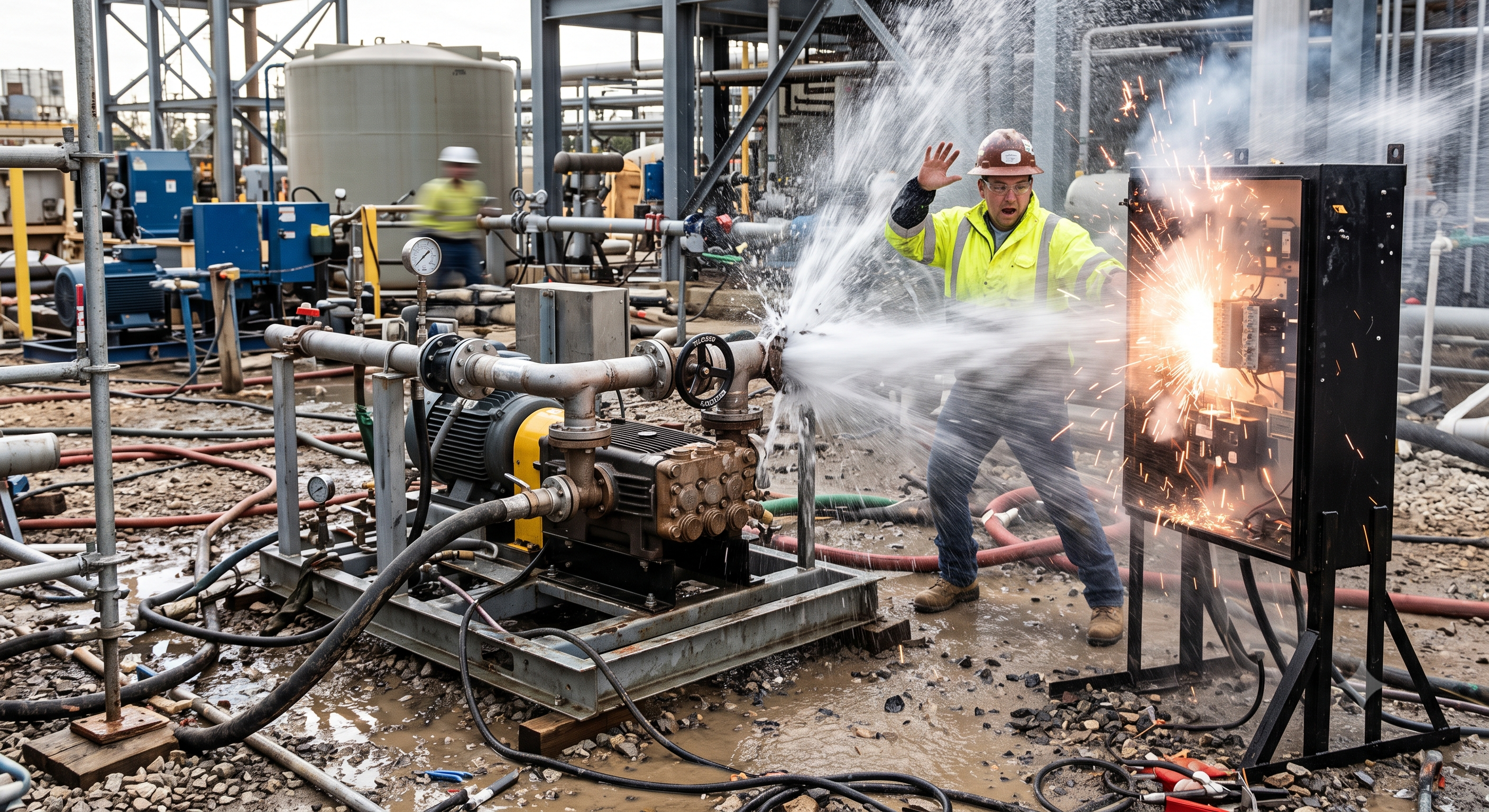
This illustration provides educational context. It is not an actual incident photograph or evidence of equipment suitability; any AI-generated depiction is illustrative only.
The scenario and record comparisons are fictional teaching examples, not records of real incidents, measurements, inspections, signatures or approvals.
| Stage | Fictional situation |
|---|---|
| Initial situation | A newly installed pump is ready for a brief rotation check. |
| Changed condition | The discharge valve is closed and the secondary relief path has not been traced. |
| Failure path | The crew assumes a short jog is harmless; electrical connections are also near a potential leak zone. |
| Possible outcome | Pressure can rise rapidly and a leak can create injection, whip and electrical hazards. |
| Prevention barrier | Hold energisation until pressure protection, valve lineup, guarding and electrical release are verified. |
Failure mechanisms
A positive-displacement pump can develop dangerous pressure against a closed discharge even during a brief jog. Trace the protected flow path from the pump through the actual valve lineup and pressure-relief arrangement before any powered check.
A regulator or unloader is not automatically independent secondary overpressure protection. A competent designer must confirm the required relief location, capacity, setting and safe discharge for the actual pump and weakest rated component; an isolating valve must not defeat the required protection.
Zero on one gauge does not prove every pocket is depressurised. A blocked or isolated gauge, trapped branch or return pressure can conceal stored energy. Isolate all sources and verify the safe state where intervention will occur; do not hand-search leaks or tighten live fittings.
Pump-only lifting eyes may not support a complete motor/skid package. Check the actual lift points and centre of gravity, foundation, independent pipe supports and alignment. Do not draw misaligned flanges together using bolts.
Initial function checks and pressure testing have different release criteria. Follow actual priming, lubrication, rotation and guarded-start instructions; no generic dry jog is assumed safe. Confirm discharge and inlet supply, manage bypass heating and transfer unresolved defects before a separately authorised test.
Decision sequence
| Step | Decision |
|---|---|
| Known | Positive-displacement pump; closed discharge and unverified relief route. |
| Unknown | Whole-system rating, protected flow path and safe electrical condition. |
| Hold | Do not jog or loosen fittings to test for pressure. |
| Evidence | Designer/manufacturer protection basis, valve walkdown and electrical release. |
| Proceed | Perform only the accepted functional check; obtain separate pressure-test authorisation. |
Work sequence: Define duty → Unload pump → Position and support → Connect pressure circuit → Connect electricity → Verify rotation → Check low-load function → Stop and hand over. This is a teaching flow, not a device drawing or a complete operating procedure.
5. Conditional decisions and common errors
| Situation | Required action | Evidence | Proceed when |
|---|---|---|---|
| Relief route unclear | No powered operation | Path, setting, capacity and discharge | Protection verified |
| Gauge reads zero | Retain isolation | Workpoint and trapped-pocket verification | Safe state established |
| Leak observed | Stop and isolate | Component and fluid assessment | Repair and retest authorised |
| Function check passes | Hold test transition | Separate pressure-test procedure | Test release recorded |
Similar observations, different decisions
The scenario and record comparisons are fictional teaching examples, not records of real incidents, measurements, inspections, signatures or approvals.
| Observation | Insufficient conclusion | Required distinction |
|---|---|---|
| Brief jog planned | Pressure cannot build | Closed discharge can rapidly raise pressure |
| Regulator installed | Secondary protection proven | Verify independent required overpressure protection |
| Gauge at zero | All stored pressure gone | Verify gauge communication and every workpoint |
6. Roles and responsibilities
| Role | Responsibility |
|---|---|
| Installation supervisor | Coordinate lifting, foundation, pipe support, interfaces and mechanical completion. |
| Competent pressure-system designer/reviewer | Resolve weakest component, relief capacity/setting/path, discharge and separate test limits. |
| Appropriately licensed electrical worker | Perform and release applicable electrical installation work within licence scope. |
| Commissioning crew | Check actual model procedure, inlet and valve lineup, guarding and readings; stop deviations. |
| Receiving test authority | Accept restrictions and obtain separate pressure-test authorisation before testing. |
Supervision and handover focus
| Stage | Management action | Evidence |
|---|---|---|
| Define duty | 1. Record model and manual2. Record pressure and flow limits3. Record mass and lifting plan | 1. Model and manual2. Pressure and flow limits3. Mass and lifting plan |
| Unload pump | 1. Record centre of gravity2. Record rigging identification3. Record landing condition | 1. Centre of gravity2. Rigging identification3. Landing condition |
| Connect pressure circuit | 1. Record assembly specifications2. Record relief path and setting3. Record joint assembly record | 1. Assembly specifications2. Relief path and setting3. Joint assembly record |
| Connect electricity | 1. Record supply identification2. Record isolation verification3. Record protection test record | 1. Supply identification2. Isolation verification3. Protection test record |
| Check low-load function | 1. Record valve lineup2. Record inlet condition3. Record actual pressure and flow | 1. Valve lineup2. Inlet condition3. Actual pressure and flow |
| Stop and hand over | 1. Record isolation register2. Record depressurisation evidence3. Record defect and repair record | 1. Isolation register2. Depressurisation evidence3. Defect and repair record |
7. Hold points and record comparison
| Hold point | Evidence before release | Actual approval |
|---|---|---|
| HP-0 Scope | Receive, lift, position and connect an identified positive-displacement high-pressure plunger pump, verify its pressure protection and electrical release, and perform the permitted initial functional checks before separate test handover. | |
| HP-1 Unload pump | Centre of gravity; Rigging identification; Landing condition; Signal arrangements | |
| HP-2 Connect pressure circuit | Assembly specifications; Relief path and setting; Joint assembly record; Gauge suitability | |
| HP-3 Check low-load function | Valve lineup; Inlet condition; Actual pressure and flow; Separate test authorisation | |
| HP-4 Stop and hand over | Isolation register; Depressurisation evidence; Defect and repair record; Handover decision |
Hold points are internal project checks. They are not universal statutory permits and do not grant work permission. Reassess after defects, changed conditions and shift changes.
Record comparison
The scenario and record comparisons are fictional teaching examples, not records of real incidents, measurements, inspections, signatures or approvals.
The boxes are static record prompts, not interactive or saved approvals. A tick does not establish suitability or permission to restart. Record the evidence, person, time and unresolved issues; retain the change history.
| Record | Insufficient record | Record checklist |
|---|---|---|
| Define duty | Only marked “OK” | □ Model and manual□ Pressure and flow limits□ Mass and lifting plan□ Permit and interfaces |
| Connect pressure circuit | Only marked “OK” | □ Assembly specifications□ Relief path and setting□ Joint assembly record□ Gauge suitability |
| Check low-load function | Only marked “OK” | □ Valve lineup□ Inlet condition□ Actual pressure and flow□ Separate test authorisation |
| Stop and hand over | Only marked “OK” | □ Isolation register□ Depressurisation evidence□ Defect and repair record□ Handover decision |
8. Site checklist and emergency response
| Site check | Actual result | Person / action |
|---|---|---|
| Define duty: Model and manual; Pressure and flow limits; Mass and lifting plan; Permit and interfaces | ||
| Unload pump: Centre of gravity; Rigging identification; Landing condition; Signal arrangements | ||
| Position and support: Foundation condition; Fixing method; Pipe supports; Alignment record | ||
| Connect pressure circuit: Assembly specifications; Relief path and setting; Joint assembly record; Gauge suitability | ||
| Connect electricity: Supply identification; Isolation verification; Protection test record; Cable routing inspection | ||
| Verify rotation: Rotation procedure; Guard inspection; Lubrication status; Functional check record | ||
| Check low-load function: Valve lineup; Inlet condition; Actual pressure and flow; Separate test authorisation | ||
| Stop and hand over: Isolation register; Depressurisation evidence; Defect and repair record; Handover decision |
Stop work
Do not energise with uncertain rating, relief, valve lineup, inlet supply, guarding or electrical release. Stop for leaks, abnormal noise, heat or readings and isolate before any intervention.
Emergency response
Stop and isolate from outside the jet and hose-sweep zones. Do not touch a leaking fitting. A small suspected high-pressure injection wound needs immediate emergency medical assessment: call 995 and provide the fluid/SDS information. Keep rescue clear of electrical and stored-pressure hazards.
9. Sources and review limits
Public-source access/review: 2026-10-14.
| Official source | Reviewed scope and limits |
|---|---|
| MOM: Risk management | Assess whole-system pressure, fluid, stored energy and interfaces. Official explanation of statutory duties; linked SSO text was not independently read for this item. This is not a legal opinion. |
| WSH Council: Planning a Lift | Plan mass, lifting points and safe landing. Official practical guidance. No assertion that every activity is a crane operation or that this page itself establishes a universal statutory permit. |
| MOM: Register Lifting Equipment | Check registration applicability for the actual lifting equipment. Official registration explanation; determine the actual equipment category and applicable exceptions. Registration is not approval of the individual lift. |
| EMA: Worker licences | Verify electrical worker licence and scope for installation work. Official explanation; does not classify every data connector as electrical installation work. Actual work boundary and licence class require review. |
| MOM: Register a Pressure Vessel | Assess any associated pressure-vessel obligations separately. Actual filter classification and registration status were not determined; registration exemption does not remove safe-maintenance duties. |
| Cat Pumps: Frequently Asked Questions | Distinguish primary regulation, secondary overpressure protection and bypass heat. Manufacturer technical example, not Singapore law. No generic example setting or capacity is adopted for an unidentified pump. |
| WSH Council: Safe Use of Machinery | Verify electrical and fluid energy control at the workpoint. Official guidance; cited paid Singapore Standards were not obtained. No universal wheel test duration or gap is inferred. |
| CDC: Pressure Washer Safety | Treat suspected injection injury as an urgent medical emergency. Foreign technical injury-prevention reference only; local electrical requirements and emergency contacts replace foreign arrangements. No pressure setting inferred. |
| SCDF: Emergency Medical Services | Call 995 for serious injury or emergency assistance. Official emergency-response information, not a site-specific rescue plan or authorisation for untrained rescue. |
No actual equipment model, site measurements, design calculations or signed approval was supplied. Check the applicable Singapore requirements and approved safe work procedures against the actual equipment and site before use. Statutory duties, official guidance and manufacturer limits serve different purposes; editorial checks do not establish legal or professional approval.
10. PDF guidance and FAQ
PDF A covers basic task controls; B focuses on technical failures; C covers supervision, records and handover. The article has eight stages with four items per main cell; each PDF has six key stages with three items per main cell. P/S/R/A, measurements, confirmations and signatures remain blank for actual site assessment.
PDFs are complementary six-stage extracts. Apply all eight body stages and the actual equipment/site procedure.
Can the pump be jogged with the discharge closed?
Do not do so without the actual accepted manufacturer/designer procedure and verified protection; brief duration is not a safeguard.
Does a hose restraint prevent fluid injection?
No. It may limit whip but does not prevent a high-pressure jet; use compatible rated components and pressure controls.
Is zero gauge pressure enough before disconnecting?
No. Verify isolation, gauge communication, trapped branches and the safe condition at the workpoint.
Does a functional run authorise pressure testing?
No. Pressure testing needs its own procedure, limits, exclusion and release.
Has a professional verified or approved this document?
AI-generated reference material; not professionally verified or approved. Before use, a qualified person must review and adapt it to Singapore requirements, the actual equipment/site and approved safe work procedures.
11. Revision history and authorship
AI-generated reference material; not professionally verified or approved. Before use, a qualified person must review and adapt it to Singapore requirements, the actual equipment/site and approved safe work procedures.
| Date | Version | Change | Review status |
|---|---|---|---|
| 2026-10-14 | SG 1.0 | New Singapore edition from assigned Korean source; task decisions, records and PDFs localized. | AI editorial review; no professional technical approval |
Korean edition revision history: 2026-07-21: earlier published draft/version retained in the source history; 2026-10-05 (v1.1): task decisions, record checklist, JSA and three PDF variants revised. These are editorial records, not professional technical approval. Singapore v1.0 adapts the earlier edition to Singapore requirements and terminology.
Site reviewers must add their actual qualifications, scope, date and approval only after the review occurs.