The last uncut bridge can conceal an unsupported offcut. Trace the load path after complete separation: independently support the retained plate and cut piece, keep people out of the drop zone, and define removal before the final cut.
AI-generated reference material; not professionally verified or approved. Before use, a qualified person must review and adapt it to Singapore requirements, the actual equipment/site and approved safe work procedures.
Stop before starting
Hold cutting for uncertain material, support, return, insulation, extraction or fire protection. Reassess any change in cut path, support or work below before restarting.
1. Legal and technical scope
| Basis | Scope and limits |
|---|---|
| MOM: Risk management | Review the changing load path at final separation. Official explanation of statutory duties; linked SSO text was not independently read for this item. This is not a legal opinion. |
| WSH Council: Managing WSH for SMEs in Metalworking | Apply selected metalworking fire, fume and tool-control guidance to the actual task. Official sector guidance and sample controls, not a universal statutory permit rule, a qualified WPS or a current-edition certificate. Linked paid standards were not read; direct SSO General Provisions access returned 403. |
| MOM: Requirements for Hygiene Monitoring | Determine applicable exposure assessment and monitoring. Actual substances, exposure results and legal limits must be established for the site. No concentration or noise result is asserted. |
| Hypertherm: Powermax45 operator reference | Check sound return contact on retained work rather than the falling piece. Selected excerpt only, not complete servicing instructions or approval of the actual machine. Manufacturer instructions for the actual model govern. |
| WSH Council: Safe Use of Machinery | Separate permitted consumable care from internal stored-charge repair. Official guidance; cited paid Singapore Standards were not obtained. No universal wheel test duration or gap is inferred. |
| SCDF: Emergency Medical Services | Use 995 for serious injury or fire/rescue emergency. Official emergency-response information, not a site-specific rescue plan or authorisation for untrained rescue. |
Apply Singapore WSH risk management to hot work, electricity, gas, fumes and falling material. Confirm the site hot-work permit and fire precautions applicable to the actual location. Assess exposure controls and any applicable hygiene monitoring using the identified metal and coating. The selected manufacturer excerpt supports work-return placement only; actual model instructions govern operation and permitted servicing. A work-return lead is not the protective earth.
2. Scope and required inputs
Included work
Identify and cut a known metal plate with a suitable handheld plasma system, including supports for both resulting pieces, return connection, screens, extraction, permitted consumable care and cut-piece handover.
Separate assessment
Unknown containers or piping, confined-space or underwater cutting, automated-machine maintenance and internal power-source repair require separate competent assessment and procedures.
| Required input | Evidence to obtain |
|---|---|
| Plan plate and cut path | Plate and cut-piece IDs; Cut path and final support; Material and coating evidence; Lower-area work boundary |
| Set support and shielding | Support and restraint; Spark-reach inspection; Cable and hose routing; Screens and required PPE |
| Inspect supply and gas | Supply earth and insulation; Work-return connection; Service and energy boundary; Gas hose and filter condition |
| Verify separation support | Piece weight and support; Retained-plate stability; Drop zone and removal method; Return clamp placement |
No actual equipment model, site measurements, design calculations or signed approval was supplied. Check the applicable Singapore requirements and approved safe work procedures against the actual equipment and site before use. Statutory duties, official guidance and manufacturer limits serve different purposes; editorial checks do not establish legal or professional approval.
Singapore site application
Record plate dimensions in mm, mass in kg and model-specific gas/electrical settings with their source. No universal cutting setting, support spacing or fire-watch time is assigned by this article.
3. Eight-stage JSA
| Job stage | Hazards and effects | Failure factors | Technical and procedural controls | Site verification | P | S | R | A |
|---|---|---|---|---|---|---|---|---|
| 1. Plan plate and cut path | 1. Cut-piece fall2. Wrong plate cut3. Hazardous coating fumes4. Person struck below | 1. Final separation unreviewed2. Plate ID confused3. Coating unknown4. Lower work uncoordinated | 1. Review both resulting pieces2. Match plate and cutting layout3. Identify metal and coating4. Coordinate lower exclusion | 1. Plate and cut-piece IDs2. Cut path and final support3. Material and coating evidence4. Lower-area work boundary | ||||
| 2. Set support and shielding | 1. Plate movement crush2. Fire from sparks3. Cable insulation damage4. Nearby arc-eye injury | 1. Support inadequate2. Combustibles below table3. Lead touches hot edge4. Screens incomplete | 1. Secure suitable supports2. Remove or protect combustibles3. Protect lead and hose routes4. Control radiation and access | 1. Support and restraint2. Spark-reach inspection3. Cable and hose routing4. Screens and required PPE | ||||
| 3. Inspect supply and gas | 1. Electrical shock2. Stored-charge injury3. Hose release4. Wrong gas operation | 1. Torch insulation damaged2. Servicing scope confused3. Connection defective4. Gas specification ignored | 1. Inspect torch and leads2. Define isolation and authority3. Check hoses and connections4. Use specified gas conditions | 1. Supply earth and insulation2. Work-return connection3. Service and energy boundary4. Gas hose and filter condition | ||||
| 4. Verify separation support | 1. Cut piece drops2. Retained plate tips3. Molten-metal impact4. Return path interrupted | 1. Support outside final piece2. Sequence not reviewed3. Person below cut4. Clamp on falling piece | 1. Support each resulting piece2. Confirm final cutting sequence3. Exclude below and drop area4. Keep approved return path | 1. Piece weight and support2. Retained-plate stability3. Drop zone and removal method4. Return clamp placement | ||||
| 5. Cut and monitor | 1. Fume inhalation2. Arc-radiation injury3. Fire development4. Hot-torch contact | 1. Extraction fails2. Protection unsuitable3. Sparks reach combustibles4. Nozzle adjusted while active | 1. Maintain specified extraction2. Use correct radiation protection3. Watch exposed areas4. Stop before torch adjustment | 1. Extraction and air conditions2. Screens and filter selection3. Sparks and combustibles4. Settings and cut condition | ||||
| 6. Service and clear pieces | 1. Stored-energy shock2. Gas-pressure release3. Hot-consumable burn4. Sharp-edge cut | 1. Switch off used alone2. Residual gas ignored3. Cooling skipped4. Piece stored unstably | 1. Apply permitted service procedure2. Control supply and residual energy3. Confirm safe handling condition4. Remove pieces by planned method | 1. Isolation and service authority2. Gas and cooling condition3. Compatible consumables4. Stable removed-piece storage | ||||
| 7. Hold and restore controls | 1. Unsupported piece falls2. Damaged torch reused3. Continued fume exposure4. Shock during rework | 1. Support change ignored2. Unstable arc forced3. Extraction not restored4. Stop confused with isolation | 1. Hold affected cutting path2. Inspect isolated equipment3. Restore fume and fire controls4. Review support and return again | 1. Support and cut section2. Torch and return check3. Restored controls4. Restart authorisation | ||||
| 8. Inspect and hand over | 1. Hot-piece burn2. Edge laceration3. Uninspected part used4. Smouldering fire spreads | 1. Heat not identified2. Storage unstable3. Part identity lost4. Post-work watch incomplete | 1. Mark hot and sharp material2. Use stable storage3. Link part and inspection record4. Complete required fire closure | 1. Heat and access limits2. Storage and removal3. Part defects and inspection4. Fire-watch closure |
P = likelihood; S = severity; R = risk under the site method; A = site-defined acceptance/authorization. These actual assessment cells are blank. A low score never overrides a missing safeguard or a legal or manufacturer restriction.
4. Fictional scenario and failure mechanisms
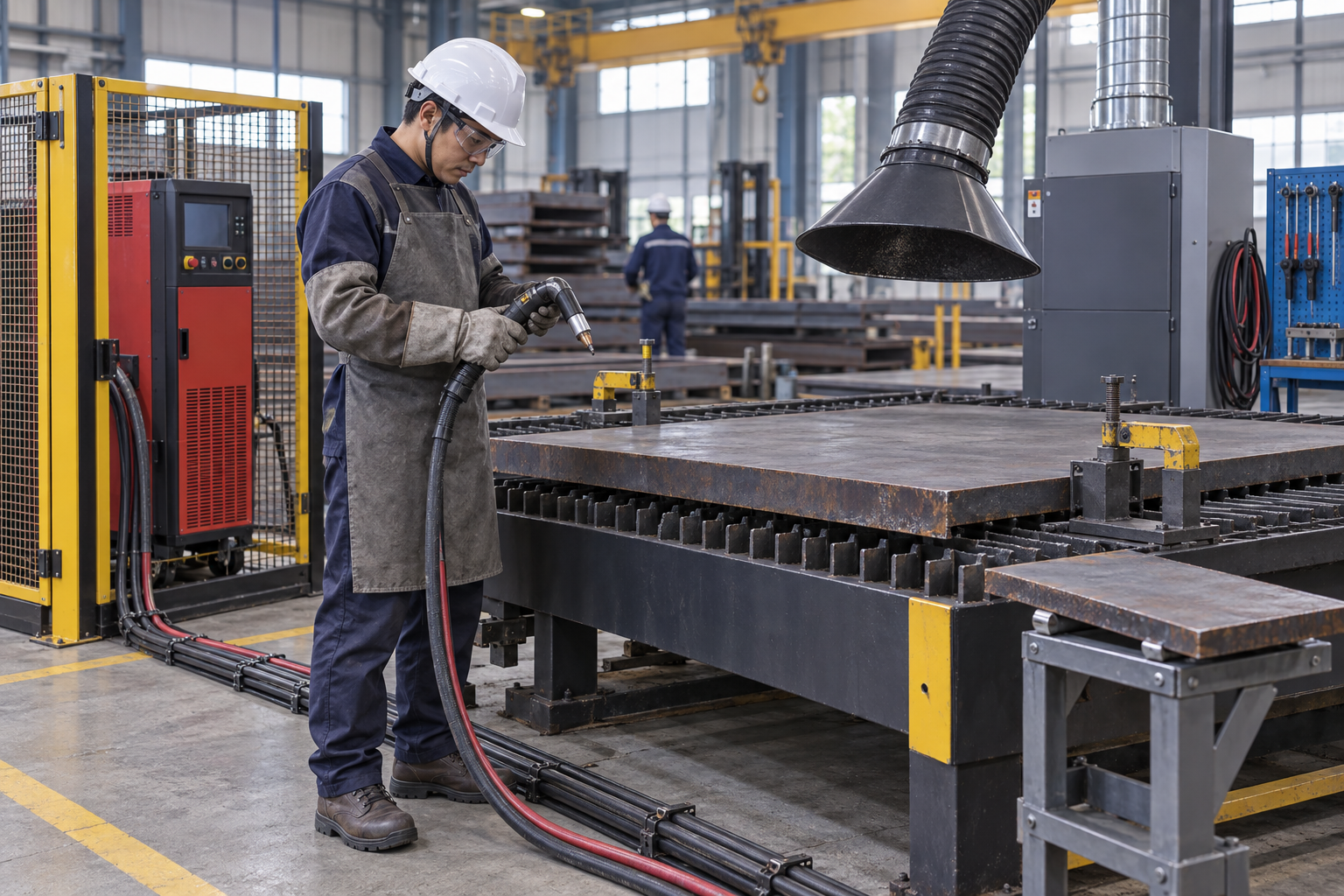
This illustration provides educational context. It is not an actual incident photograph or evidence of equipment suitability; any AI-generated depiction is illustrative only.
The scenario and record comparisons are fictional teaching examples, not records of real incidents, measurements, inspections, signatures or approvals.
| Stage | Fictional situation |
|---|---|
| Initial situation | A supported plate is almost fully cut. |
| Changed condition | The retained plate is stable but the offcut will lose its last support at separation. |
| Failure path | The operator intends to finish while a helper stands near the drop path. |
| Possible outcome | The offcut can fall, tip the remaining plate or interrupt the return connection. |
| Prevention barrier | Hold the final cut until both-piece support, exclusion, return placement and removal are verified. |
Failure mechanisms
The last uncut bridge can conceal an unsupported offcut. Trace the load path after complete separation: independently support the retained plate and cut piece, keep people out of the drop zone, and define removal before the final cut.
Adding a support is not evidence that either resulting piece is stable. Verify mass, centre of gravity, bearing and restraint in the final configuration. Never use a hand to catch the released hot piece.
Place the work return on suitable retained material with the approved connection. Cutting through the remaining bridge can interrupt a return path attached to the offcut. Work return and protective earthing have different functions; verify both.
Arc screens must protect nearby people without defeating extraction. Identify coatings before cutting, assess fume capture and inspect spark travel below and beyond the work. Fire-watch duration and closure follow the applicable site procedure and actual conditions.
Releasing the trigger is not energy isolation. Use the actual model procedure for permitted consumable work, including supply, gas, cooling and residual-energy controls. Internal power-source work is a separate qualified service task because stored electrical energy can remain.
Decision sequence
| Step | Decision |
|---|---|
| Known | Final separation changes the support and electrical return paths. |
| Unknown | Offcut stability, fall path and post-cut removal remain unverified. |
| Hold | Stop before the last bridge; keep hands and people clear. |
| Evidence | Both-piece load/support check, return placement and protected removal plan. |
| Restart | Accept the corrected setup and restore extraction, screening and fire controls before cutting. |
Work sequence: Plan plate and cut path → Set support and shielding → Inspect supply and gas → Verify separation support → Cut and monitor → Service and clear pieces → Hold and restore controls → Inspect and hand over. This is a teaching flow, not a device drawing or a complete operating procedure.
5. Conditional decisions and common errors
| Situation | Required action | Evidence | Proceed when |
|---|---|---|---|
| Unknown coating | Hold cutting | Material/coating and exposure assessment | Controls accepted |
| Final cut unsupported | Hold final bridge | Both-piece support and return check | Stable final configuration |
| Torch fault | Stop and isolate | Model-specific service assessment | Permitted repair completed |
| Work completed | Retain fire control | Hot material and exposed-area checks | Required fire closure accepted |
Similar observations, different decisions
The scenario and record comparisons are fictional teaching examples, not records of real incidents, measurements, inspections, signatures or approvals.
| Observation | Insufficient conclusion | Required distinction |
|---|---|---|
| Plate stable before cut | Offcut will remain stable | Check each piece after separation |
| Return clamp connected | Protective earth verified | Inspect the two separate functions |
| Trigger released | Safe to service | Apply permitted isolation and residual-energy procedure |
6. Roles and responsibilities
| Role | Responsibility |
|---|---|
| Work supervisor | Confirm plate and cut-piece ids and the task scope, resources, interfaces and stop authority. |
| Qualified technical reviewer | Review support and restraint, model limits, compatibility and unresolved technical conditions within assigned competence. |
| Work crew | Apply the listed controls, report changes and stop when evidence or safeguards are missing. |
| Inspector / assessor | Record actual extraction and air conditions and other relevant checks; do not mark unverified conditions as accepted. |
| Handover authority | Reconcile heat and access limits, restrictions and outstanding actions before the next task. Role labels do not establish a legal credential. |
Supervision and handover focus
| Stage | Management action | Evidence |
|---|---|---|
| Plan plate and cut path | 1. Record plate and cut-piece ids2. Record cut path and final support3. Record material and coating evidence | 1. Plate and cut-piece IDs2. Cut path and final support3. Material and coating evidence |
| Set support and shielding | 1. Record support and restraint2. Record spark-reach inspection3. Record cable and hose routing | 1. Support and restraint2. Spark-reach inspection3. Cable and hose routing |
| Verify separation support | 1. Record piece weight and support2. Record retained-plate stability3. Record drop zone and removal method | 1. Piece weight and support2. Retained-plate stability3. Drop zone and removal method |
| Cut and monitor | 1. Record extraction and air conditions2. Record screens and filter selection3. Record sparks and combustibles | 1. Extraction and air conditions2. Screens and filter selection3. Sparks and combustibles |
| Hold and restore controls | 1. Record support and cut section2. Record torch and return check3. Record restored controls | 1. Support and cut section2. Torch and return check3. Restored controls |
| Inspect and hand over | 1. Record heat and access limits2. Record storage and removal3. Record part defects and inspection | 1. Heat and access limits2. Storage and removal3. Part defects and inspection |
7. Hold points and record comparison
| Hold point | Evidence before release | Actual approval |
|---|---|---|
| HP-0 Scope | Identify and cut a known metal plate with a suitable handheld plasma system, including supports for both resulting pieces, return connection, screens, extraction, permitted consumable care and cut-piece handover. | |
| HP-1 Set support and shielding | Support and restraint; Spark-reach inspection; Cable and hose routing; Screens and required PPE | |
| HP-2 Verify separation support | Piece weight and support; Retained-plate stability; Drop zone and removal method; Return clamp placement | |
| HP-3 Hold and restore controls | Support and cut section; Torch and return check; Restored controls; Restart authorisation | |
| HP-4 Inspect and hand over | Heat and access limits; Storage and removal; Part defects and inspection; Fire-watch closure |
Hold points are internal project checks. They are not universal statutory permits and do not grant work permission. Reassess after defects, changed conditions and shift changes.
Record comparison
The scenario and record comparisons are fictional teaching examples, not records of real incidents, measurements, inspections, signatures or approvals.
The boxes are static record prompts, not interactive or saved approvals. A tick does not establish suitability or permission to restart. Record the evidence, person, time and unresolved issues; retain the change history.
| Record | Insufficient record | Record checklist |
|---|---|---|
| Plan plate and cut path | Only marked “OK” | □ Plate and cut-piece IDs□ Cut path and final support□ Material and coating evidence□ Lower-area work boundary |
| Verify separation support | Only marked “OK” | □ Piece weight and support□ Retained-plate stability□ Drop zone and removal method□ Return clamp placement |
| Hold and restore controls | Only marked “OK” | □ Support and cut section□ Torch and return check□ Restored controls□ Restart authorisation |
| Inspect and hand over | Only marked “OK” | □ Heat and access limits□ Storage and removal□ Part defects and inspection□ Fire-watch closure |
8. Site checklist and emergency response
| Site check | Actual result | Person / action |
|---|---|---|
| Plan plate and cut path: Plate and cut-piece IDs; Cut path and final support; Material and coating evidence; Lower-area work boundary | ||
| Set support and shielding: Support and restraint; Spark-reach inspection; Cable and hose routing; Screens and required PPE | ||
| Inspect supply and gas: Supply earth and insulation; Work-return connection; Service and energy boundary; Gas hose and filter condition | ||
| Verify separation support: Piece weight and support; Retained-plate stability; Drop zone and removal method; Return clamp placement | ||
| Cut and monitor: Extraction and air conditions; Screens and filter selection; Sparks and combustibles; Settings and cut condition | ||
| Service and clear pieces: Isolation and service authority; Gas and cooling condition; Compatible consumables; Stable removed-piece storage | ||
| Hold and restore controls: Support and cut section; Torch and return check; Restored controls; Restart authorisation | ||
| Inspect and hand over: Heat and access limits; Storage and removal; Part defects and inspection; Fire-watch closure |
Stop work
Hold cutting for uncertain material, support, return, insulation, extraction or fire protection. Reassess any change in cut path, support or work below before restarting.
Emergency response
Stop from a safe position and isolate the source without entering an electrical or falling-piece hazard. Alert the site emergency team and call 995 for serious injury or fire. Keep hot/sharp material and stored-energy equipment controlled during recovery.
9. Sources and review limits
Public-source access/review: 2026-10-14.
| Official source | Reviewed scope and limits |
|---|---|
| MOM: Risk management | Review the changing load path at final separation. Official explanation of statutory duties; linked SSO text was not independently read for this item. This is not a legal opinion. |
| WSH Council: Managing WSH for SMEs in Metalworking | Apply selected metalworking fire, fume and tool-control guidance to the actual task. Official sector guidance and sample controls, not a universal statutory permit rule, a qualified WPS or a current-edition certificate. Linked paid standards were not read; direct SSO General Provisions access returned 403. |
| MOM: Requirements for Hygiene Monitoring | Determine applicable exposure assessment and monitoring. Actual substances, exposure results and legal limits must be established for the site. No concentration or noise result is asserted. |
| Hypertherm: Powermax45 operator reference | Check sound return contact on retained work rather than the falling piece. Selected excerpt only, not complete servicing instructions or approval of the actual machine. Manufacturer instructions for the actual model govern. |
| WSH Council: Safe Use of Machinery | Separate permitted consumable care from internal stored-charge repair. Official guidance; cited paid Singapore Standards were not obtained. No universal wheel test duration or gap is inferred. |
| SCDF: Emergency Medical Services | Use 995 for serious injury or fire/rescue emergency. Official emergency-response information, not a site-specific rescue plan or authorisation for untrained rescue. |
No actual equipment model, site measurements, design calculations or signed approval was supplied. Check the applicable Singapore requirements and approved safe work procedures against the actual equipment and site before use. Statutory duties, official guidance and manufacturer limits serve different purposes; editorial checks do not establish legal or professional approval.
10. PDF guidance and FAQ
PDF A covers basic task controls; B focuses on technical failures; C covers supervision, records and handover. The article has eight stages with four items per main cell; each PDF has six key stages with three items per main cell. P/S/R/A, measurements, confirmations and signatures remain blank for actual site assessment.
PDFs are complementary six-stage extracts. Apply all eight body stages and the actual equipment/site procedure.
Can the offcut be caught by hand?
No. Plan independent support, exclusion and controlled removal.
Where should the work return connect?
Use the actual manufacturer-approved connection to suitable retained work; do not rely on the piece being cut away.
Is switch-off enough for internal repair?
No. Internal servicing is outside this task and requires the qualified procedure for stored electrical energy.
Is one fixed fire-watch duration used everywhere?
No. Apply the actual permit, site procedure and fire conditions; record the closure decision.
Has a professional verified or approved this document?
AI-generated reference material; not professionally verified or approved. Before use, a qualified person must review and adapt it to Singapore requirements, the actual equipment/site and approved safe work procedures.
11. Revision history and authorship
AI-generated reference material; not professionally verified or approved. Before use, a qualified person must review and adapt it to Singapore requirements, the actual equipment/site and approved safe work procedures.
| Date | Version | Change | Review status |
|---|---|---|---|
| 2026-10-14 | SG 1.0 | New Singapore edition from assigned Korean source; task decisions, records and PDFs localized. | AI editorial review; no professional technical approval |
Korean edition revision history: 2026-09-20 (v1.0): initial article, sources, fictional analysis and PDF editorial checks; 2026-09-23 (v1.1): task decisions, record checklist, JSA and three PDF variants revised. These are editorial records, not professional technical approval. Singapore v1.0 adapts the earlier edition to Singapore requirements and terminology.
Site reviewers must add their actual qualifications, scope, date and approval only after the review occurs.