High socket insertion resistance is a reason to check alignment, cleanliness and gasket position. Increasing pulling force while hands remain near the joint can produce sudden movement and crush injuries without correcting a folded or displaced seal.
This is reference content written and reviced with AI. It has not been verified or approved by a professional. Review by a suitably qualified professional and site authorisation are required before use.
Stop before starting
Stop for changed excavation conditions, unverified protection, water inflow, unstable pipe, damaged rigging, unexpected joining resistance or missing inspection before covering. Keep pressure testing, live tie-ins and entry on separate authorisation.
AI-generated reference material; not professionally verified or approved. Before use, a qualified person must review and adapt it to applicable Singapore requirements, the actual equipment/site and approved safe work procedures.
1. Legal and technical scope
Classify the actual Singapore work as public infrastructure, development sewerage/drainage work or regulated premises plumbing before assigning approvals. PUB identifies QP plan-clearance responsibilities for development works and Licensed Plumber responsibilities for regulated water-service and sanitary plumbing. Neither role description substitutes for the asset-owner conditions or the excavation and lifting safety arrangements.
| Basis | Singapore application |
|---|---|
| Risk management | The employer, self-employed person and principal assess and control work risks. Include preparation, abnormal conditions and maintenance. Coordinate affected trades and communicate controls. |
| Activity-specific guidance | Use PUB sources to allocate the correct submission/plumbing responsibility; BCA guidance for engineered excavation interfaces; WSHC lifting guidance for controlled lowering; and confined-space guidance where actual pipe or chamber access falls within scope. |
| Permits and authority | Select permit requirements for the actual sector and activity. Site hold points and contractor role labels do not create statutory permits or qualifications. |
| Equipment and design | No universal trench-depth trigger, shoring design, pipe insertion force, fusion setting, grade, test pressure or compaction value is supplied. The selected BCA advisory is guidance on ERSS and does not itself establish every current project duty. Full PUB technical codes, approved drawings and actual ground data were not provided. |
2. Scope and required inputs
Included work
Receiving and restraining pipe, preparing an accepted excavation and bedding, lowering and aligning pipe, making the specified material-specific joint, inspecting and handing over for approved backfill.
Separate assessment
Live-system cutover, pressure-test execution, commissioning, entry into pipe or confined spaces, trenchless work and unreviewed excavation repair require separate plans.
| Required input | Evidence to obtain |
|---|---|
| Review route and interfaces | Route and utilities; System isolation; Pipe and joint type; Test and entry exclusions |
| Accept excavation | Competent inspection; Protection and water; Edge loads; Access acceptance |
| Receive and restrain pipe | Pipe weight and condition; Chocks and supports; Rigging and lift points; Storage arrangement |
| Lower to bedding | Lift and exclusion; Bedding condition; Pipe stability; Release authority |
No actual equipment model, SDS, site measurements, design calculations or authorisation record was supplied. Verify actual product limits and applicable Singapore requirements before use. Manufacturer guidance is not government approval.
Singapore site planning
The principal, relevant QP and pipework contractor must reconcile service detection, existing flows, approved route, excavation support and water-control arrangements. Obtain the applicable PUB/asset-owner clearances and coordinate any road interface. Review rainfall, water inflow, adjacent loads and ground movement before access. Match pipe mass in kg, diameter in mm, bedding and rigging to the actual product. Keep people outside the lowering and rolling paths, release joining forces before correcting seals, and record survey levels and joint inspections before covering. Pressure tests, live cutovers and entry require separate releases.
3. Eight-stage JSA
| Job stage | Hazards and effects | Failure factors | Technical and procedural controls | Site verification | P | S | R | A |
|---|---|---|---|---|---|---|---|---|
| 1. Review route and interfaces | 1. Utility strike2. Unexpected inflow3. Wrong pipe4. Unsafe test boundary | 1. Survey incomplete2. Live tie-in missed3. Material confused4. Testing combined | 1. Locate services2. Control existing flows3. Match pipe design4. Separate testing scope | 1. Route/services and PUB scope2. System isolation3. Pipe and joint type4. Test and entry exclusions | ||||
| 2. Accept excavation | 1. Cave-in2. Water rise3. Equipment surcharge4. Blocked escape | 1. Protection inadequate2. Water change ignored3. Loads near edge4. Access omitted | 1. Use accepted protective system2. Control water3. Manage edge loads4. Inspect access and ground | 1. Competent inspection2. Protection and water3. Edge loads4. Access acceptance | ||||
| 3. Receive and restrain pipe | 1. Rolling pipe strike2. Rigging failure3. Stack collapse4. Socket damage | 1. Chocks absent2. Lift point improvised3. Stack unsupported4. Handling impacts | 1. Chock stored pipe2. Use approved rigging3. Follow stacking limits4. Protect ends and joints | 1. Pipe mass/kg and condition2. Chocks and supports3. Rigging and lift points4. Storage arrangement | ||||
| 4. Lower to bedding | 1. Suspended-load strike2. Pipe roll3. Hand crush4. Trench instability | 1. People under load2. Bedding uneven3. Hands guide gap4. Signal unclear | 1. Clear lowering zone2. Use one agreed signal3. Land on accepted bedding4. Verify restraint before approach | 1. Lift and exclusion2. Bedding condition3. Pipe stability4. Release authority | ||||
| 5. Align and join | 1. Pinch injury2. Sudden pipe motion3. Seal damage4. Process burn | 1. Hands in gap2. Excess force3. Gasket displaced4. Method mismatched | 1. Use suitable alignment tools2. Keep clear of loaded path3. Inspect seal and surfaces4. Follow material-specific method | 1. Alignment and grade2. Force or resistance change3. Seal and insertion4. Joint procedure record | ||||
| 6. Inspect and prepare handoff | 1. Hidden leak path2. Wrong gradient3. Pressure-thrust injury4. Unauthorised entry | 1. Joint not checked2. Survey omitted3. Test caps improvised4. Pipe entered casually | 1. Inspect before covering2. Record grade and location3. Separate test authorisation4. Prevent unplanned entry | 1. Joint inspection2. Survey/level and units3. Test-plan boundary4. Entry controls | ||||
| 7. Hold movement or fault | 1. Excavation collapse2. Pipe release3. Residual-pressure injury4. Repeat joint defect | 1. Ground change ignored2. Supports disturbed3. Energy assumed absent4. Seal forced again | 1. Secure area and pipe2. Review changed support3. Control residual energy4. Inspect accepted correction | 1. Fault and location2. Ground and pipe support3. Energy safe state4. Correction and release | ||||
| 8. Backfill and transfer | 1. Pipe distortion2. Pipe float3. Hidden defect4. Future utility strike | 1. One-sided compaction2. Water unmanaged3. Hold covered4. As-built absent | 1. Use approved material sequence2. Maintain balanced support3. Keep held joints exposed4. Record final location | 1. Backfill and compaction2. Water and pipe movement3. As-built depth and route4. Recipient and holds |
P = likelihood; S = severity; R = risk using the site method; A = site acceptance/authorisation. Complete after actual assessment; no score overrides an unresolved hold point or equipment limit.
4. Fictional scenario and failure mechanisms
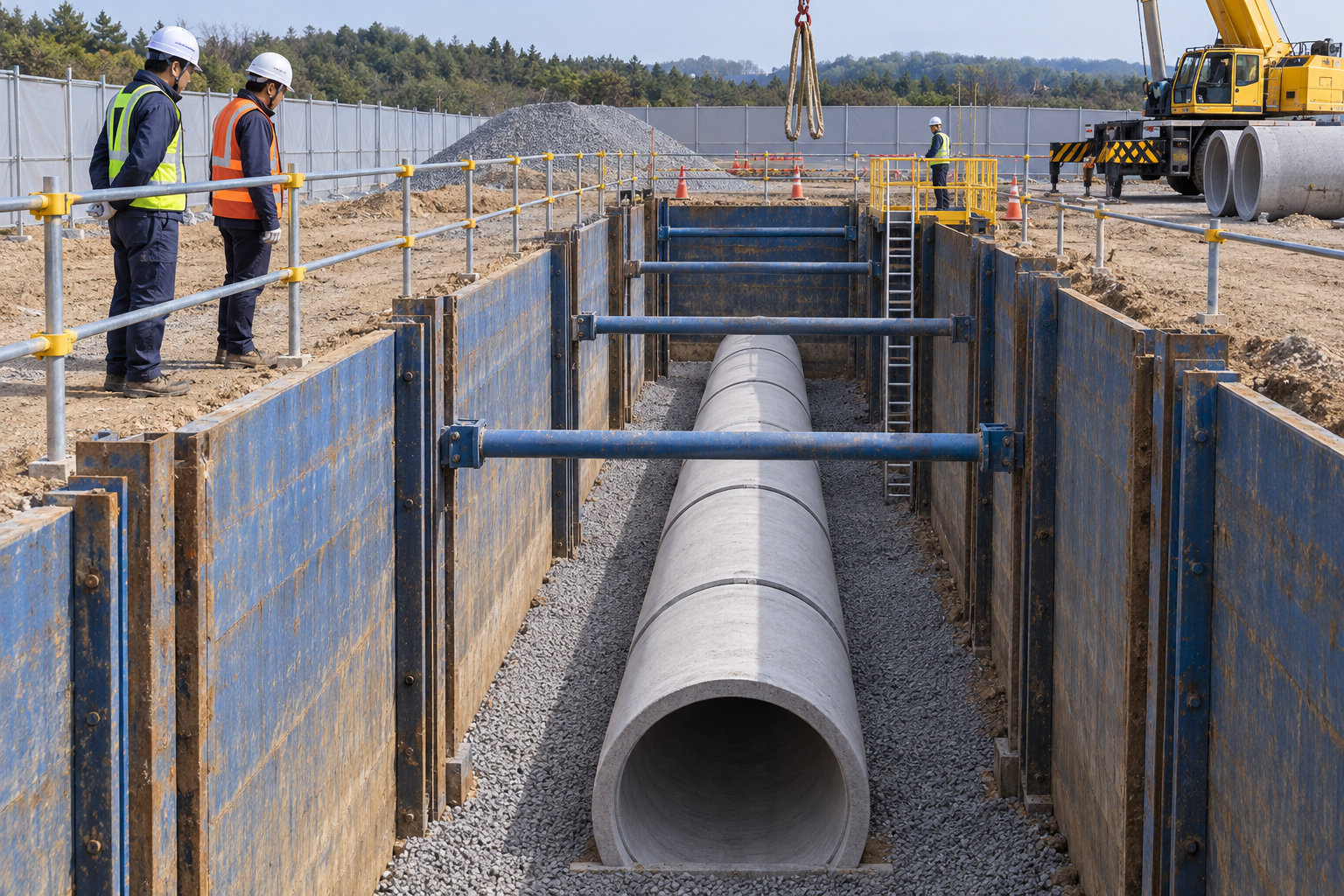
This illustration provides educational context. It is not an actual incident photograph or evidence of equipment suitability; any AI-generated depiction is illustrative only.
The scenario and record comparisons are fictional teaching examples, not records of real incidents, measurements, inspections, signatures or approvals.
| Stage | Fictional situation |
|---|---|
| Initial situation | A fictional crew encounters unusually high resistance while joining a pipe. |
| Changed condition | A helper reaches toward the seal while the pulling tool remains loaded. |
| Failure path | The crew applies more force without reviewing alignment and gasket condition. |
| Possible outcome | The pipe could jump, crush a hand and leave a concealed joint defect. |
| Prevention barrier | Stop applying force, secure the pipe and release stored energy by the accepted method before inspecting and correcting the joint. |
Failure mechanisms
High socket insertion resistance is a reason to check alignment, cleanliness and gasket position. Increasing pulling force while hands remain near the joint can produce sudden movement and crush injuries without correcting a folded or displaced seal.
A pipe can roll after the lifting equipment sets it down. Bedding and positive restraint must establish stability before people approach or rigging is released. Do not lift from a socket or attachment that the approved method does not permit.
A visually complete joint does not authorize pressure testing. Test boundaries, caps, thrust restraint, stored energy and exclusion require a separate reviewed test plan. Before covering, record alignment, grade and joint disposition; controlled backfill on both sides helps avoid displacement and distortion.
Work sequence: Review route and interfaces → Accept excavation → Receive and restrain pipe → Lower to bedding → Align and join → Inspect and prepare handoff → Hold movement or fault → Backfill and transfer. This is a teaching flow, not a device drawing or a complete operating procedure.
5. Conditional decisions and common errors
| Situation | Required action | Evidence | Proceed when |
|---|---|---|---|
| Ground or water changes | Clear affected excavation | Competent inspection and support plan | Excavation accepted |
| Pipe remains unstable | Keep people clear | Bedding and rolling restraint | Pipe stable |
| Joint resists insertion | Stop applied force | Alignment, seal and cleanliness | Joint method restored |
| Backfill requested | Inspect before covering | Grade, joints and survey records | Covering released |
Similar observations, different decisions
The scenario and record comparisons are fictional teaching examples, not records of real incidents, measurements, inspections, signatures or approvals.
| Observation | Insufficient conclusion | Required distinction |
|---|---|---|
| Pipe landed | Hoist no longer moving | Rolling stability separate |
| Joint looks complete | External appearance | Pressure-test readiness separate |
| One side compacted | Some backfill placed | Balanced support unproved |
6. Roles and responsibilities
| Role | Responsibility |
|---|---|
| Work supervisor | Confirm route and utilities and the task scope, resources, interfaces and stop authority. |
| Qualified technical reviewer | Review competent inspection, model limits, compatibility and unresolved technical conditions within assigned competence. |
| Work crew | Apply the listed controls, report changes and stop when evidence or safeguards are missing. |
| Inspector / assessor | Record actual alignment and grade and other relevant checks; do not mark unverified conditions as accepted. |
| Handover authority | Reconcile backfill and compaction, restrictions and outstanding actions before the next task. Role labels do not establish a legal credential. |
The principal and employers coordinate the risk assessment and safe work procedures. These role labels allocate work; verify any qualifications and statutory appointments required for the actual Singapore activity. The receiving person must be given restrictions and unresolved defects before handover.
Record and handover perspective
| Stage | Record controls | Verification |
|---|---|---|
| Review route and interfaces | 1. Record route/services and pub scope2. Record system isolation3. Record pipe and joint type | 1. System isolation2. Pipe and joint type3. Test and entry exclusions |
| Receive and restrain pipe | 1. Record pipe mass/kg and condition2. Record chocks and supports3. Record rigging and lift points | 1. Chocks and supports2. Rigging and lift points3. Storage arrangement |
| Lower to bedding | 1. Record lift and exclusion2. Record bedding condition3. Record pipe stability | 1. Bedding condition2. Pipe stability3. Release authority |
| Align and join | 1. Record alignment and grade2. Record force or resistance change3. Record seal and insertion | 1. Force or resistance change2. Seal and insertion3. Joint procedure record |
| Hold movement or fault | 1. Record fault and location2. Record ground and pipe support3. Record energy safe state | 1. Ground and pipe support2. Energy safe state3. Correction and release |
| Backfill and transfer | 1. Record backfill and compaction2. Record water and pipe movement3. Record as-built depth and route | 1. Water and pipe movement2. As-built depth and route3. Recipient and holds |
7. Hold points and record comparison
| Hold point | Evidence before release | Actual record |
|---|---|---|
| HP-0 Start | Task boundary, site RA, SWP, responsibilities and emergency arrangements | |
| HP-1 Accept excavation | Competent inspection; Protection and water; Edge loads; Access acceptance | |
| HP-2 Receive and restrain pipe | Pipe mass/kg and condition; Chocks and supports; Rigging and lift points; Storage arrangement | |
| HP-3 Inspect and prepare handoff | Joint inspection; Survey/level and units; Test-plan boundary; Entry controls | |
| HP-4 Backfill and transfer | Backfill and compaction; Water and pipe movement; As-built depth and route; Recipient and holds |
Hold points are internal project checks. They are not universal statutory permits and do not grant work permission. Reassess after defects, changed conditions and shift changes.
Record comparison
The scenario and record comparisons are fictional teaching examples, not records of real incidents, measurements, inspections, signatures or approvals.
The boxes are static record prompts, not interactive or saved approvals. A tick does not establish suitability or permission to restart. Record the evidence, person, time and unresolved issues; retain the change history.
| Record | Insufficient record | Record checklist |
|---|---|---|
| Review route and interfaces | Only marked “OK” | □ Route and utilities□ System isolation□ Pipe and joint type□ Test and entry exclusions |
| Lower to bedding | Only marked “OK” | □ Lift and exclusion□ Bedding condition□ Pipe stability□ Release authority |
| Hold movement or fault | Only marked “OK” | □ Fault and location□ Ground and pipe support□ Energy safe state□ Correction and release |
| Backfill and transfer | Only marked “OK” | □ Backfill and compaction□ Water and pipe movement□ As-built depth and route□ Recipient and holds |
Hold points are internal checks. Determine separately whether Singapore statutory or site permit requirements apply to this work. Leave confirmation, measurements and approval records blank until the authorised site process is completed.
8. Site checklist and emergency response
| Site check | Actual result | Person / action |
|---|---|---|
| Review route and interfaces: Route and utilities; System isolation; Pipe and joint type; Test and entry exclusions | ||
| Accept excavation: Competent inspection; Protection and water; Edge loads; Access acceptance | ||
| Receive and restrain pipe: Pipe weight and condition; Chocks and supports; Rigging and lift points; Storage arrangement | ||
| Lower to bedding: Lift and exclusion; Bedding condition; Pipe stability; Release authority | ||
| Align and join: Alignment and grade; Force or resistance change; Seal and insertion; Joint procedure record | ||
| Inspect and prepare handoff: Joint inspection; Survey and elevation; Test-plan boundary; Entry controls | ||
| Hold movement or fault: Fault and location; Ground and pipe support; Energy safe state; Correction and release | ||
| Backfill and transfer: Backfill and compaction; Water and pipe movement; As-built depth and route; Recipient and holds |
Stop work
Stop for changed excavation conditions, unverified protection, water inflow, unstable pipe, damaged rigging, unexpected joining resistance or missing inspection before covering. Keep pressure testing, live tie-ins and entry on separate authorisation.
Emergency response
Evacuate the affected excavation and keep others clear of unstable ground, suspended or rolling pipe and pressurised components. Activate site rescue; do not enter a collapsed trench or a pipe to attempt an improvised rescue.
9. Sources and review limits
Official public sources read for this Singapore edition on 2026-10-14. Guidance, statutory explanations and manufacturer limits have different roles; no source provider has approved this JSA.
| Source | Read scope and application limits |
|---|---|
| MOM — Risk management | Official explanation: employer, self-employed person and principal responsibilities; routine and non-routine risk assessment; hierarchy of controls; multidisciplinary assessment team. Official explanation of risk-management duties; no claim of reading the full linked statute. It does not specify task-specific equipment limits. Assess water and sewer pipe installation with employers, principal and affected contractors; resolve the inputs in section 2. |
| MOM — When should my company review its risk assessment? | Review every three years, after significant changes, new machinery/substances/procedures, hazard-related injury or incident, and when assessment is inadequate. General review guidance. A review interval does not permit continued operation after a known hazard or change. Reassess this operation after changes, defects, incidents or an inadequate assessment; do not wait for a scheduled review. |
| MOM — Permit-to-Work Systems | Formal work authorisation and coordination; OPEC tripartite guidance and competent permit authority with authority to reject work. OPEC-focused guidance page; not evidence of a blanket statutory permit requirement for every task. Determine permits for this actual activity and workplace; distinguish the section 7 internal hold points from statutory or site permits. |
| PUB — Building Plan Submission Process Flow | Overview: QP plan clearances for sewerage, sanitary and drainage works; simplified-submission conditions and deviation pathway noted. Submission overview, not full technical codes or actual project clearance. The relevant project category and asset-owner requirements must be established. Use PUB sources to allocate the correct submission/plumbing responsibility; BCA guidance for engineered excavation interfaces; WSHC lifting guidance for controlled lowering; and confined-space guidance where actual pipe or chamber access falls within scope. |
| PUB — Plumbing Works | Types of premises plumbing, regulated water-service/sanitary work and Licensed Plumber responsibility; distinction from listed simple works. Premises plumbing scope must not be applied indiscriminately to public infrastructure or industrial process pipes. No actual contractor licence or installation acceptance checked. Use PUB sources to allocate the correct submission/plumbing responsibility; BCA guidance for engineered excavation interfaces; WSHC lifting guidance for controlled lowering; and confined-space guidance where actual pipe or chamber access falls within scope. |
| BCA — Advisory Note 1/09 on Earth Retaining or Stabilising Structures | Note introduction and site-investigation section; staged-construction approval and monitoring record forms on PDF pages 15 and 21–22. Currently linked by the BCA structural-plan guidance page. 2009 advisory, read in the stated sections only. Check later circulars and project conditions with the appointed QP; no anchor design load, creep criterion or generic excavation depth is prescribed here. Use PUB sources to allocate the correct submission/plumbing responsibility; BCA guidance for engineered excavation interfaces; WSHC lifting guidance for controlled lowering; and confined-space guidance where actual pipe or chamber access falls within scope. |
| WSH Council — Planning a Lift | Lift planning documents, load/equipment/crew/method/site information, complex-lift engineering, and stopping when site conditions differ from the approved plan. Official practical guidance, with crane-oriented examples. Statutory appointments and permit applicability depend on the equipment and activity; not an issued permit or support design. Use PUB sources to allocate the correct submission/plumbing responsibility; BCA guidance for engineered excavation interfaces; WSHC lifting guidance for controlled lowering; and confined-space guidance where actual pipe or chamber access falls within scope. |
| WSH Council — Technical Advisory on Working Safely in Confined Spaces (2010) | Definitions in section 3; CO/toxic atmosphere explanation in section 6.3; entry permit, isolation, monitoring and rescue information in sections 7.1–7.4. Search excerpt also reviewed for assessor evaluation and authorised-manager issuance. Older advisory and selected sections only; not a full current statutory audit. The newer topics PDF could not be fetched. Confirm current regulations, applicable entry conditions and appointments; no generic exposure value or rescue authorisation is inferred. Use PUB sources to allocate the correct submission/plumbing responsibility; BCA guidance for engineered excavation interfaces; WSHC lifting guidance for controlled lowering; and confined-space guidance where actual pipe or chamber access falls within scope. |
No universal trench-depth trigger, shoring design, pipe insertion force, fusion setting, grade, test pressure or compaction value is supplied. The selected BCA advisory is guidance on ERSS and does not itself establish every current project duty. Full PUB technical codes, approved drawings and actual ground data were not provided.
Actual site measurements, equipment instructions, engineering checks and signed approval records were not supplied. A qualified person must resolve these before use.
10. PDF guidance and FAQ
PDF A covers basic task controls; B focuses on technical failures; C covers supervision, records and handover. The article has eight stages with four items per main cell; each PDF has six key stages with three items per main cell. P/S/R/A, measurements, confirmations and signatures remain blank for actual site assessment.
PDFs are complementary six-stage extracts. Apply all eight body stages and the actual equipment/site procedure.
Should additional force overcome a resistant joint?
Hold and inspect the specified alignment, seal and joining conditions first; keep hands out of loaded gaps.
Does this JSA authorize pressure testing?
No. Use a separate approved test plan addressing pressure thrust, restraints, isolation and stored energy.
When may the pipe be covered?
After the required survey, bedding, joint and inspection records are accepted and the backfill sequence is released.
Has a professional verified or approved this document?
No. Public sources and editorial, layout and consistency checks were reviewed using AI. No site inspection or professional technical approval has been performed. Obtain appropriate professional review before use.
Does a completed joint release entry into the pipe?
No. Entry has separate access, atmosphere, isolation, permit and rescue requirements wherever applicable. Installation progress or a photograph does not establish entry safety.
11. Revision history and authorship
AI-generated reference material; not professionally verified or approved. Before use, a qualified person must review and adapt it to applicable Singapore requirements, the actual equipment/site and approved safe work procedures.
This Singapore edition was adapted from the Korean original and its assigned US technical reference. Earlier source revisions are archival editorial history, not Singapore technical approval.
| Date | Edition | Change | Review status |
|---|---|---|---|
| 2026-09-19 | Korean source v1.0 | Source editorial publication or revision; retained as provenance of the Korean edition. | Editorial record only; no professional technical approval recorded. |
| 2026-09-30 | Korean source v1.1 | Source editorial publication or revision; retained as provenance of the Korean edition. | Editorial record only; no professional technical approval recorded. |
| 2026-10-14 | 1.0 en-SG | Singapore legal scope, local planning, responsibility interfaces and SI terminology; new PDF A/B/C. | AI editorial and visual review only; no professional approval. |