Install and inspect specified hangers, supports and anchors, adjust cold positions and transfer an identified pipe load from temporary to permanent support in the reviewed sequence.
Hold drilling or attachment for unknown loads, substrate, embedded services or support function. Stop transfer for sag, anchor movement, weld defects or unstable temporary support.
AI-generated reference material. It has not been professionally verified or approved. Before use, a suitably qualified person must review and adapt it to applicable Singapore requirements, the actual equipment and site, and approved safe work procedures.
1. Legal and technical scope
Apply Singapore WSH risk assessment to work at height, falling objects, drilling exposure and any permitted hot work. WSHC access and chemical guidance and MOM construction fire guidance inform those controls; assess hygiene-monitoring duties where relevant. Engineering acceptance must cover the actual support load path and structure. Coordinate installation with the testing and operations teams so a fill, insulation or operating-state change cannot silently invalidate a transfer decision.
Assess the actual activity under the applicable Singapore WSH requirements. Statutory duties, official guidance, manufacturer instructions and approved project documents have distinct roles. A site hold point is not automatically a statutory permit. Use competent local review to resolve the applicable industry, installation, access and permit requirements.
| Basis | Application and limits |
|---|---|
| MOM risk management | Official explanation: risk assessment, control, monitoring and communication for routine and non-routine work, including maintenance; reviewed 14 October 2026. |
| WSHC Preventing Falls from Heights | Official explanation of access, fall-prevention plans, hazardous-WAH permits in factories and supervisor/assessor/authorised-manager roles. General fall controls are not limited to the permit threshold. |
| WSHC Preventing Chemical Hazards | Official guidance on chemical risk assessment, safe work procedures, exposure routes, hazard communication and exposure-dependent monitoring; not product certification. |
| MOM requirements for hygiene monitoring | Official toxic-substance and noise monitoring guidance: competent personnel, exposure-dependent requirements, records, worker information and reporting. No site exposure result is asserted. |
| MOM safe storage of combustible materials in construction | Two-page 2016 circular reviewed: elevated hot-work sparks can reach combustible material below; separate ignition sources, control storage and maintain protective covering/SWP. Historical examples are not the fictional case in this article. |
| WSHC electrical safety | Official guidance: maintenance energy isolation, stored-energy control, verification and reinstatement; electrical scope still requires applicable EMA authorisation. |
| Spirax Sarco pipe expansion and support | Selected expansion, fixed/sliding support and support-spacing discussion. Tutorial numbers and overseas standard references are not design values or Singapore compliance approval. |
| SCDF emergency medical services | Official 995 emergency ambulance service information; use emergency services for actual emergencies. |
2. Scope and required inputs
Included: Install and inspect specified hangers, supports and anchors, adjust cold positions and transfer an identified pipe load from temporary to permanent support in the reviewed sequence.
Separate review: Unplanned support removal from operating pipes, unauthorised structural drilling/welding, arbitrary spring settings and pressure testing/hot operation are excluded.
| Input | Required evidence |
|---|---|
| Plan load and function | Test/operating loads; Structure/anchor basis; Fixed/guide/spring detail; Current support state |
| Inspect base and parts | Anchor/substrate match; Material and defects; Embedded conflicts; Location approval |
| Assemble and adjust | Hands/body position; Temporary stability; Parts retention; Height/contact/load share |
| Transfer operating limits | Test/additional loads; Anchor/weld records; Settings/restrictions; Area and receiver |
Obtain support drawings and functions, pipe contents and all applicable load states, structural and anchor details, product installation/cure requirements, weld inspections and temporary-support sequence. No universal spacing, anchor torque, cure duration or spring-lock setting is supplied.
3. Eight-stage JSA
P = likelihood; S = severity; R = risk under the site method; A = acceptance or authorization as defined by the site. Leave these blank until actual assessment and control verification. A low score does not override a legal requirement, product limit or unreleased hold point.
| Job stage | Hazards and effects | Failure factors | Required controls | Site verification | P | S | R | A |
|---|---|---|---|---|---|---|---|---|
| 1. Plan load and function | 1. Pipe falls2. Substrate fails3. Expansion restrained4. Existing support collapses | 1. Test water omitted2. Structure data absent3. Support types confused4. Current path unknown | 1. Review all load states2. Verify complete load path3. Identify support functions4. Inspect existing condition | 1. Test/operating loads2. Structure/anchor basis3. Fixed/guide/spring detail4. Current support state | ||||
| 2. Control access and energy | 1. Fall from height2. Hot-pipe burn3. Dropped object strike4. Unexpected process force | 1. Platform absent2. Pressure/temp unknown3. Work below overlaps4. Isolation omitted | 1. Provide safe access2. Verify pipe energy state3. Exclude area below4. Apply required isolation | 1. Platform/fall controls2. Fluid/pressure/temperature3. Exclusion zone4. Isolation evidence | ||||
| 3. Inspect base and parts | 1. Anchor pulls out2. Member breaks3. Embedded service hit4. Sharp-edge cut | 1. Wrong anchor/substrate2. Mixed hardware3. Rebar/services unlocated4. Damaged part used | 1. Match anchor to design2. Verify identified components3. Confirm drilling location4. Inspect edges/tools | 1. Anchor/substrate match2. Material and defects3. Embedded conflicts4. Location approval | ||||
| 4. Drill weld and attach | 1. Silica exposure2. Spark fire3. Electric shock4. Bracket falls | 1. Dust controls inadequate2. Combustibles exposed3. Welding return unsuitable4. Temporary support absent | 1. Use assessed drilling dust controls2. Apply hot-work precautions3. Verify welding circuit4. Support bracket during fixing | 1. Dust-control method2. Fire/watch conditions3. Welding/return setup4. Temporary support | ||||
| 5. Assemble and adjust | 1. Finger crush2. Pipe shifts3. Parts fall4. Unequal support load | 1. Hands align gap2. Temporary support removed3. Loose hardware above people4. Height sequence changed | 1. Align using suitable tools2. Retain temporary support3. Secure loose components4. Follow reviewed adjustment | 1. Hands/body position2. Temporary stability3. Parts retention4. Height/contact/load share | ||||
| 6. Inspect and transfer | 1. Connection fails2. Pipe sags3. Thermal movement blocked4. Spring set incorrectly | 1. Cure/check incomplete2. Contact gap missed3. Slide clamped rigid4. Lock sequence wrong | 1. Verify anchor/weld evidence2. Transfer in measured stages3. Check movement function4. Match spring/lock procedure | 1. Inspection/cure records2. Transfer movement/sag3. Guide/slide clearance4. Spring setting/locks | ||||
| 7. Hold shift or changed load | 1. Pipe collapse2. Stored stress release3. Smouldering fire4. Unauthorised restart | 1. Load state unknown2. Supports removed together3. Fire watch ended early4. Isolation not handed over | 1. Keep stable support2. Review changed load/sequence3. Complete fire precautions4. Control restoration authority | 1. Current load/change2. Temporary support plan3. Fire-watch disposition4. Isolation/restart record | ||||
| 8. Transfer operating limits | 1. Added-load overload2. Hidden joint defect3. Lost movement function4. Unprotected access | 1. Fill/insulation omitted2. Inspection record lost3. Lock status unknown4. Barrier removed early | 1. Specify later load limits2. Link connection evidence3. Record movement/lock state4. Restore safe work area | 1. Test/additional loads2. Anchor/weld records3. Settings/restrictions4. Area and receiver |
4. Hypothetical scenario and failure mechanisms
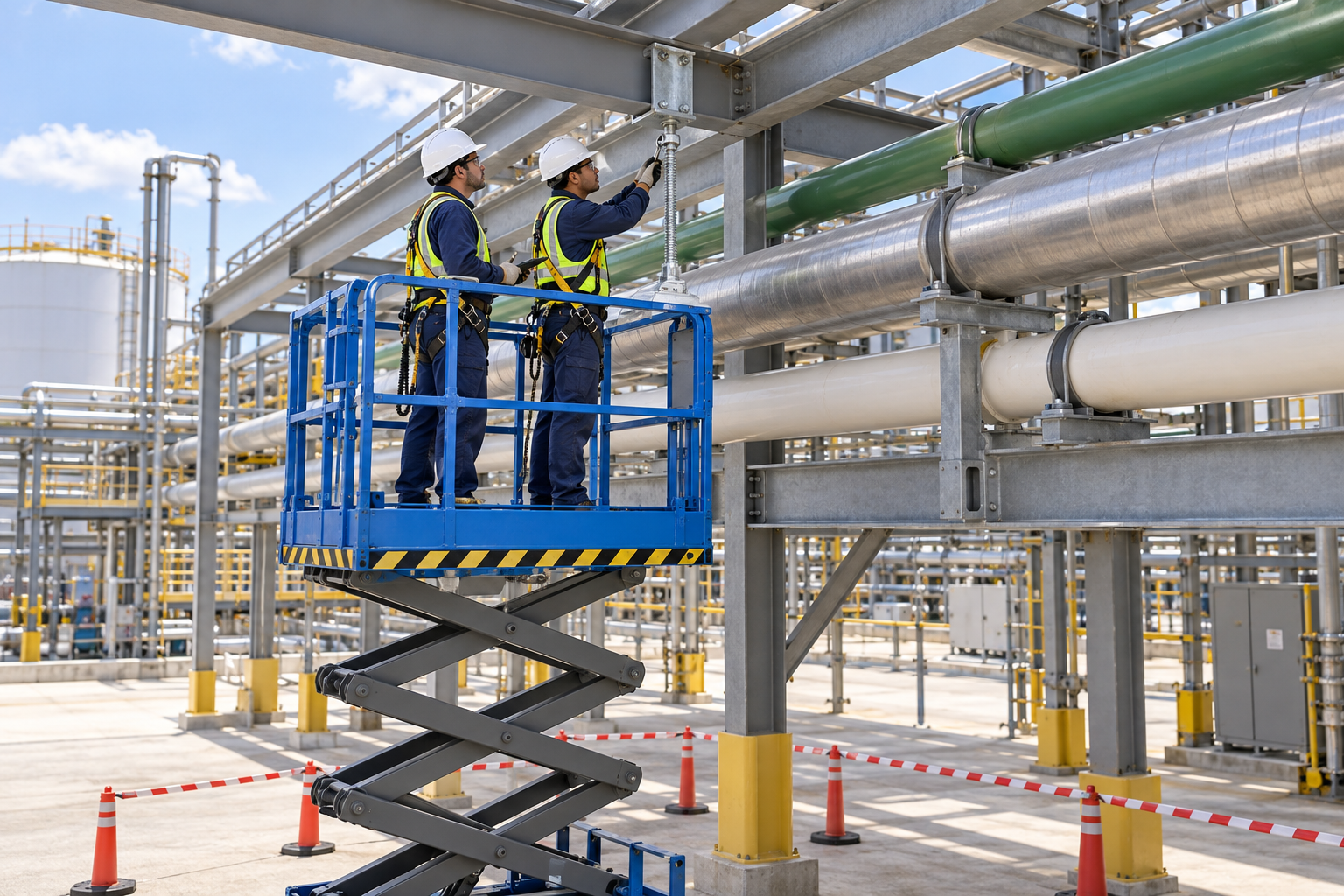 Retained source illustration: an AI-generated educational concept, not a real incident photograph or evidence of equipment suitability.
The following scenario, comparisons and example records are hypothetical teaching material. They do not reproduce actual incidents, measurements, signatures or approvals.
| Item | Hypothetical situation |
|---|---|
| Initial state | Hangers are being installed beneath an empty pipe. |
| Change | A separate crew fills the pipe for a test before temporary supports are released. |
| Failure path | The installation crew continues using its empty-pipe load assessment. |
| Possible harm | A support or anchor can fail during transfer of the larger load. |
| Barrier | Retain stable temporary support, communicate the fill state and obtain engineering review of the complete load path and transfer conditions. |
Empty, water-filled test, insulated and operating pipe states can impose different weight and movement. Coordinate filling and other work with the installation crew instead of relying on the earlier empty-pipe assessment.
An installed anchor or finished weld is not evidence that inspection and required cure conditions have passed. Transfer load in the reviewed stages while checking contact, movement and load sharing.
Fixed points, guides, slides and spring supports have different functions. Rigidly tying every support can defeat designed thermal movement; shipping/test locks follow the actual spring-support procedure.
Moving a hole around reinforcing steel changes edge distances, anchor geometry and the load path. Stop for design review instead of selecting a nearby location by convenience.
| Decision | Reason and evidence |
|---|---|
| Known facts | A separate crew fills the pipe for a test before temporary supports are released. |
| Unresolved | The installation crew continues using its empty-pipe load assessment. |
| Hold reason | Hold drilling or attachment for unknown loads, substrate, embedded services or support function. Stop transfer for sag, anchor movement, weld defects or unstable temporary support. |
| Evidence needed | Inspection/cure records; Transfer movement/sag; Guide/slide clearance; Spring setting/locks. |
| Next decision | Retain stable temporary support, communicate the fill state and obtain engineering review of the complete load path and transfer conditions. |
5. Conditional decisions and common errors
| Condition | Action | Evidence | Proceed when |
|---|---|---|---|
| Pipe filled for test | Hold load transfer | Current contents and design load | Changed load checked |
| Anchor/substrate unknown | Do not drill/attach | Actual product and structure evidence | Attachment accepted |
| Temporary support removal | Check inspection/cure first | Load sharing and transfer sequence | Transfer released |
| Guide movement blocked | Hold operating handover | Movement and lock instructions | Designed function restored |
| Comparison | Situation A | Situation B |
|---|---|---|
| Anchor installed | Attachment work is present | Cure, inspection and capacity unproved |
| Empty pipe supported | That load state was supported | Test/operating states need review |
6. Roles and responsibilities
| Role | Responsibility |
|---|---|
| Work supervisor | Confirm scope, task sequence, exclusion and stop authority. Coordinate plan load and function with affected operations. |
| Technical reviewer | Resolve the actual design and equipment limits: Test/operating loads; Structure/anchor basis; Fixed/guide/spring detail; Current support state. |
| Work crew | Perform inspect base and parts using the approved procedure; report any mismatch before proceeding. |
| Inspector / assessor | Verify Inspection/cure records; Transfer movement/sag; Guide/slide clearance; Spring setting/locks. Record what was actually checked and what remains unresolved. |
| Release / receiving authority | Confirm Test/additional loads; Anchor/weld records; Settings/restrictions; Area and receiver. Transfer restrictions and the next permitted stage. |
These are responsibility examples, not invented statutory credentials. Meet the actual training, competent-person, qualified-person and licensing requirements for the assigned work. Anyone may raise a hazard and request a stop; only the designated authority may release the affected stage after evidence is reviewed.
7. Hold points and record comparison
| Hold point | Evidence before release | Confirmation / approval |
|---|---|---|
| HP-0 Start | Scope, jurisdiction, equipment identity, responsible people and emergency arrangements. | |
| HP-1 Plan load and function | Test/operating loads; Structure/anchor basis; Fixed/guide/spring detail; Current support state | |
| HP-2 Inspect base and parts | Anchor/substrate match; Material and defects; Embedded conflicts; Location approval | |
| HP-3 Inspect and transfer | Inspection/cure records; Transfer movement/sag; Guide/slide clearance; Spring setting/locks | |
| HP-4 Transfer operating limits | Test/additional loads; Anchor/weld records; Settings/restrictions; Area and receiver |
Hold points are internal evidence gates. They do not replace statutory permits or actual signatures. Recheck affected gates after a change, abnormal event or shift transfer. The blank record must identify the evidence, person, time, limits and release scope.
| Record | Insufficient record | Record checklist |
|---|---|---|
| Loads | Empty pipe held | □ Test/operating loads□ Structure/anchor basis□ Fixed/guide/spring detail□ Current support state |
| Anchors | Installed | □ Dust-control method□ Fire/watch conditions□ Welding/return setup□ Temporary support |
| Transfer | Tightened | □ Inspection/cure records□ Transfer movement/sag□ Guide/slide clearance□ Spring setting/locks |
| Operation | All fixed | □ Test/additional loads□ Anchor/weld records□ Settings/restrictions□ Area and receiver |
The □ boxes are static prompts, not saved or interactive approvals. Each checks one record element. A tick alone does not establish suitability or permission to restart. Link equipment IDs and supporting records; retain unresolved matters and the earlier record when conditions change.
8. Site checklist and emergency response
| Check item | Result | Person / action |
|---|---|---|
| Test/operating loads | ||
| Platform/fall controls | ||
| Anchor/substrate match | ||
| Dust-control method | ||
| Hands/body position | ||
| Inspection/cure records | ||
| Current load/change | ||
| Test/additional loads | ||
| Emergency arrangements and unresolved restrictions communicated |
Stop work: Hold drilling or attachment for unknown loads, substrate, embedded services or support function. Stop transfer for sag, anchor movement, weld defects or unstable temporary support.
Emergency response: Stop loading or transfer and clear the area below and beside a shifting pipe. Do not body-brace it or remove another support to relieve stress. Arrange designed temporary stabilization and process isolation from safe positions. For falling pipe, hot-fluid release, fire or serious injury, activate the site response and call SCDF 995 as needed. Keep the current load and isolation state documented for recovery personnel.
9. Sources and review limits
Official-source review date: October 14, 2026. The following review is limited to the public provisions or selected manufacturer material identified below. It does not establish that any authority approved this article or the actual installation.
- MOM risk management: Official explanation: risk assessment, control, monitoring and communication for routine and non-routine work, including maintenance; reviewed 14 October 2026.
- WSHC Preventing Falls from Heights: Official explanation of access, fall-prevention plans, hazardous-WAH permits in factories and supervisor/assessor/authorised-manager roles. General fall controls are not limited to the permit threshold.
- WSHC Preventing Chemical Hazards: Official guidance on chemical risk assessment, safe work procedures, exposure routes, hazard communication and exposure-dependent monitoring; not product certification.
- MOM requirements for hygiene monitoring: Official toxic-substance and noise monitoring guidance: competent personnel, exposure-dependent requirements, records, worker information and reporting. No site exposure result is asserted.
- MOM safe storage of combustible materials in construction: Two-page 2016 circular reviewed: elevated hot-work sparks can reach combustible material below; separate ignition sources, control storage and maintain protective covering/SWP. Historical examples are not the fictional case in this article.
- WSHC electrical safety: Official guidance: maintenance energy isolation, stored-energy control, verification and reinstatement; electrical scope still requires applicable EMA authorisation.
- Spirax Sarco pipe expansion and support: Selected expansion, fixed/sliding support and support-spacing discussion. Tutorial numbers and overseas standard references are not design values or Singapore compliance approval.
- SCDF emergency medical services: Official 995 emergency ambulance service information; use emergency services for actual emergencies.
Paid consensus standards and site-specific calculations, manuals, inspection records and product certificates were not independently obtained or verified unless specifically identified. Korean and overseas legal references are source history, not Singapore statutory duties. Singapore Standards and model-specific limits were not read in full unless expressly identified.
10. PDF guidance and FAQ
PDF A covers basic task controls; B examines technical failures; C focuses on supervision, evidence and handover. Each has six rows and three items per main cell. They are complementary extracts: apply all eight body stages and the applicable site procedure. An omitted stage is not permission to omit its controls. PDF HP-0 through HP-4 are worksheet labels; match the event, evidence and authority rather than assuming they match another permit by number.
P/S/R/A, actual measurements, confirmations and signatures remain blank. The PDFs are uncompleted reference worksheets, not issued work permits.
Content group ID: jsa-pipehanger-installation
Does support of empty pipe prove test-water capacity?
No. Evaluate the full test-water and other applicable loads through the complete support path.
Can temporary supports come out after tightening?
Only after required inspection, cure and staged transfer conditions are verified.
Should every support prevent all movement?
No. Preserve the designed fixed, guide, sliding and spring functions.
Are spring shipping locks always removed immediately?
Follow the model-specific installation, test and operating transition sequence.
Has a professional verified or approved this document?
AI-generated reference material. It has not been professionally verified or approved. Before use, a suitably qualified person must review and adapt it to applicable Singapore requirements, the actual equipment and site, and approved safe work procedures.
11. Revision history and authorship
AI-generated reference material. It has not been professionally verified or approved. Before use, a suitably qualified person must review and adapt it to applicable Singapore requirements, the actual equipment and site, and approved safe work procedures.
This system has not physically inspected the equipment, structures, ground, atmosphere or worksite. The document does not replace legal advice, manufacturer procedures, engineering design, inspection certificates, qualification evidence, the site risk assessment or an actual work permit.
Before use, a suitably qualified and authorized person must review the actual equipment, loads, methods, protection, inspection and emergency arrangements and resolve open issues. Record the real reviewer, organization, qualifications, delegated authority, reviewed documents, date, signature, exclusions and conditions of approval separately.
| Date | Version | Change | Review status |
|---|---|---|---|
| 2026-09-19 | 1.1 | Korean source revision retained in the source snapshot. | Historical editorial status; not Singapore professional approval. |
| 2026-09-26 | 1.2 | Korean source revision retained in the source snapshot. | Historical editorial status; not Singapore professional approval. |
| 2026-10-14 | SG 1.0 | Singapore localisation of the Korean source with its assigned US technical reference; local applicability, task controls and sources reviewed. | AI-assisted editorial work; professional approval not performed. |