Keep the operator in control of both the process and foot switch. Never tie down or bypass the switch. Verify stop response before processing pipe; a helper must not run the switch for someone touching the work.
AI-generated reference material; not professionally verified or approved. Before use, a qualified person must review and adapt it to Singapore requirements, the actual equipment/site and approved safe work procedures.
Stop before starting
Do not start without verified foot-stop response, chuck engagement, full pipe support and rotation-area control. Stop and isolate for wobble, slipping stock, damaged dies, interrupted oil or any unexpected control response.
1. Legal and technical scope
| Basis | Scope and limits |
|---|---|
| MOM: Risk management | Assess full pipe length, handling, oil and changing work arrangements. Official explanation of statutory duties; linked SSO text was not independently read for this item. This is not a legal opinion. |
| WSH Council: Preventing Machine Hazards | Guard rotating hazards and prevent unintended access/start. Official practical guidance, not the actual machine isolation procedure or proof of equipment compliance. |
| WSH Council: Safe Use of Machinery | Control and verify energy isolation before hazardous intervention. Official guidance; cited paid Singapore Standards were not obtained. No universal wheel test duration or gap is inferred. |
| RIDGID: 300 Compact/1233 manual, REV D | Retain single-operator foot control and no-contact rotation principles. Manufacturer technical example, not Singapore law or approval of an unidentified machine. Actual model, controls, support and supply instructions govern. |
| MOM/NEA/SCDF: Revised SS 586 adoption | Identify cutting oil and its actual SDS precautions. Official adoption circular, not full paid SS 586 text or a classification of the actual product; verify current supplier label and SDS. |
| SCDF: Emergency Medical Services | Connect machine rescue and 995. Official emergency-response information, not a site-specific rescue plan or authorisation for untrained rescue. |
Apply Singapore WSH risk management and machine-safety controls to rotating pipe, chucks, cutting tools and unexpected starting. Use a verified isolation procedure for setup, cleaning, tool change and fault recovery; the foot switch is an operating control, not an energy isolator. The selected RIDGID manual is a model-specific technical example. Confirm the actual machine, supply, guarding, supports and trained operator before use.
2. Scope and required inputs
Included work
Use an identified bench/stand-mounted threading machine to cut, ream and externally thread permitted detached steel pipe, then inspect it at full stop.
Separate assessment
Rotating installed piping, handheld threaders, grooving, bolt threading, pressure testing and pipe with flammable residues require separate procedures.
| Required input | Evidence to obtain |
|---|---|
| Match pipe and tooling | Pipe and thread IDs; Die size and state; Oil identification; Inspection criteria |
| Set machine and supports | Stand and fixing; Front rear supports; Full-length boundary; Stock stability |
| Chuck and set tools | Isolation state; Chuck and pipe contact; Die settings; Clothing and hand clearance |
| Verify startup controls | Foot-stop response; Operator position; People and clothing; Chuck and support test |
No actual equipment model, site measurements, design calculations or signed approval was supplied. Check the applicable Singapore requirements and approved safe work procedures against the actual equipment and site before use. Statutory duties, official guidance and manufacturer limits serve different purposes; editorial checks do not establish legal or professional approval.
Singapore site application
Confirm actual pipe and thread specification: nominal pipe size, outside diameter in mm and BSPT/NPT designation are different data. Do not choose dies from appearance or assume every Singapore installation uses one thread system. Record the actual gauge criteria and stock disposition.
The freshly accessed RIDGID reference is revision D; selected operating safety and setup sections were read. Verify the actual nameplate supply and manufacturer instructions. Gloves for handling safely isolated sharp stock must not be carried into a rotating operation where they create entanglement. Collect chips and spent cutting oil under the site waste procedure.
3. Eight-stage JSA
| Job stage | Hazards and effects | Failure factors | Technical and procedural controls | Site verification | P | S | R | A |
|---|---|---|---|---|---|---|---|---|
| 1. Match pipe and tooling | 1. Die breaks2. Bad thread leaks3. Wrong stock rotates4. Oil exposure | 1. Thread misidentified2. Material unknown3. Die mismatch4. Oil unsuitable | 1. Match thread instruction2. Verify pipe material3. Select correct dies4. Check oil and SDS | 1. Pipe and thread IDs2. Die size and state3. Oil identification4. Inspection criteria | ||||
| 2. Set machine and supports | 1. Machine tips2. Rear pipe whips3. Bystander struck4. Stock rolls | 1. Stand unstable2. Support omitted3. Rear path open4. Pipe unsecured | 1. Secure machine stand2. Support full pipe length3. Barricade rotation area4. Control stock storage | 1. Stand and fixing2. Front rear supports3. Full-length boundary4. Stock stability | ||||
| 3. Chuck and set tools | 1. Pipe slips2. Hand entangles3. Tool falls4. Unexpected start | 1. Poor jaw contact2. Loose clothing3. Head unsecured4. Control energised | 1. Isolate for setup2. Verify chuck engagement3. Secure selected tooling4. Prepare fitted clothing | 1. Isolation state2. Chuck and pipe contact3. Die settings4. Clothing and hand clearance | ||||
| 4. Verify startup controls | 1. Unstopped rotation2. Wrong-person start3. Entanglement4. Pipe strike | 1. Switch tied on2. Two operators3. Gloves at rotation4. Setup unchecked | 1. Test foot release2. Use single operator3. Follow no-glove warning4. Clear before startup | 1. Foot-stop response2. Operator position3. People and clothing4. Chuck and support test | ||||
| 5. Cut ream and thread | 1. Chip injury2. Entanglement3. Tool breaks4. Pipe whips | 1. Hands steady pipe2. Excess feed3. Oil flow lost4. Support shifts | 1. Use specified controls2. Keep clear of rotation3. Maintain correct oil flow4. Stop abnormal motion | 1. Cut and die response2. Oil supply3. Pipe stability4. Hand and tool position | ||||
| 6. Stop and inspect | 1. Residual motion injury2. Chip cut3. Bad thread accepted4. Oil slip | 1. Measured rotating2. Chips hand-picked3. No gauge4. Floor oily | 1. Wait full stop2. Isolate for cleaning3. Use specified gauge4. Contain and clean oil | 1. Stopped condition2. Thread gauge result3. Chip tools4. Floor condition | ||||
| 7. Hold abnormalities | 1. Pipe escapes2. Repeat defect3. Unsafe reversal4. Unexpected motion | 1. Chuck fault ignored2. Die damaged3. Reverse used for rescue4. Foot control trusted | 1. Stop and isolate2. Investigate die and chuck3. Use planned recovery4. Verify energy control | 1. Slip and wobble record2. Chuck die correction3. Recovery boundary4. Retest release | ||||
| 8. Unload and handover | 1. Pipe drops2. Hand pinch3. Rejected stock mixed4. Sharp end injury | 1. Chuck released early2. No unloading support3. No disposition mark4. Threads unprotected | 1. Support before release2. Use planned stock handling3. Separate rejected stock4. Protect thread ends | 1. Unload supports2. Stock identification3. Inspection disposition4. Receiver and limits |
P = likelihood; S = severity; R = risk under the site method; A = site-defined acceptance/authorization. These actual assessment cells are blank. A low score never overrides a missing safeguard or a legal or manufacturer restriction.
4. Fictional scenario and failure mechanisms
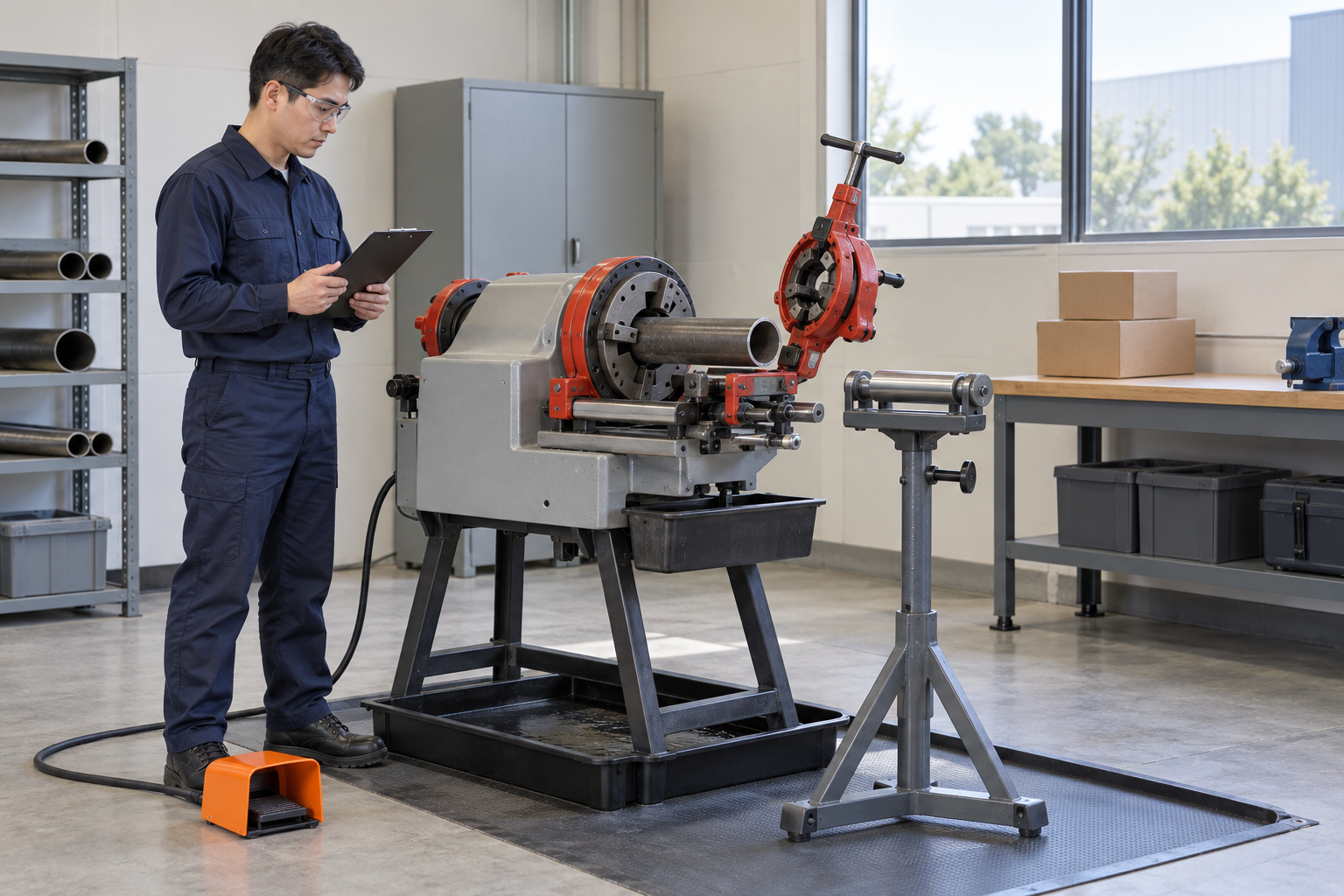
This illustration provides educational context. It is not an actual incident photograph or evidence of equipment suitability; any AI-generated depiction is illustrative only.
The scenario and record comparisons are fictional teaching examples, not records of real incidents, measurements, inspections, signatures or approvals.
| Stage | Fictional situation |
|---|---|
| Initial situation | A long pipe projects behind the machine. |
| Changed condition | A helper holds the rear pipe while another person operates the foot switch. |
| Failure path | Pipe support and immediate stop control are split between two people. |
| Possible outcome | The helper can be entangled or struck when the pipe whips. |
| Prevention barrier | Hold startup, fit suitable supports and exclusion, then verify chucking and single-operator stop control. |
Failure mechanisms
Keep the operator in control of both the process and foot switch. Never tie down or bypass the switch. Verify stop response before processing pipe; a helper must not run the switch for someone touching the work.
The pipe behind the chuck rotates too. Set supports and an exclusion boundary for the full length. Do not catch or steady a whipping pipe by hand. The reference manual prohibits gloves and loose clothing during operation because they can entangle; handling sharp stock after safe isolation is a different exposure.
A fitting screwing onto the thread is not the specified gauge inspection. Stop completely before measuring or touching pipe, isolate before cleaning or changing tools and segregate rejected threads from accepted stock.
Decision sequence
| Step | Decision |
|---|---|
| Known | Long pipe extends into a route; one person holds it while another operates the pedal. |
| Unknown | Suitable supports, clear rotating envelope and direct stop control are unverified. |
| Hold | Do not start; hands are not rotating-pipe supports. |
| Evidence | Pipe/stand alignment, full-length exclusion, chucking and tested single-operator stop response. |
| Restart | Record corrected setup and release; isolate again for cleaning or fault work. |
Work sequence: Match pipe and tooling → Set machine and supports → Chuck and set tools → Verify startup controls → Cut ream and thread → Stop and inspect → Hold abnormalities → Unload and handover. This is a teaching flow, not a device drawing or a complete operating procedure.
5. Conditional decisions and common errors
| Situation | Required action | Evidence | Proceed when |
|---|---|---|---|
| Stop response fails | Remove machine from use | Foot control repair and test | Stop function verified |
| Pipe wobbles | Stop and isolate | Chuck support and pipe check | Stable setup verified |
| Oil flow lost | Hold processing | Oil type supply and die check | Flow restored |
| Thread completed | Stop and gauge | Specified thread inspection | Stock disposition recorded |
Similar observations, different decisions
The scenario and record comparisons are fictional teaching examples, not records of real incidents, measurements, inspections, signatures or approvals.
| Observation | Insufficient conclusion | Required distinction |
|---|---|---|
| Support at pipe end | Whole pipe stable | Check full rotating length, alignment and exclusion |
| Foot switch released | Machine isolated | Wait for stop and verify the separate energy isolation for intervention |
| Mating fitting turns on | Thread accepted | Use specified thread gauge and inspection criteria |
6. Roles and responsibilities
| Role | Responsibility |
|---|---|
| Work supervisor | Confirm pipe and thread ids and the task scope, resources, interfaces and stop authority. |
| Qualified technical reviewer | Review stand and fixing, model limits, compatibility and unresolved technical conditions within assigned competence. |
| Work crew | Apply the listed controls, report changes and stop when evidence or safeguards are missing. |
| Inspector / assessor | Record actual cut and die response and other relevant checks; do not mark unverified conditions as accepted. |
| Handover authority | Reconcile unload supports, restrictions and outstanding actions before the next task. Role labels do not establish a legal credential. |
Supervision and handover focus
| Stage | Management action | Evidence |
|---|---|---|
| Match pipe and tooling | 1. Record pipe and thread ids2. Record die size and state3. Record oil identification | 1. Pipe and thread IDs2. Die size and state3. Oil identification |
| Set machine and supports | 1. Record stand and fixing2. Record front rear supports3. Record full-length boundary | 1. Stand and fixing2. Front rear supports3. Full-length boundary |
| Verify startup controls | 1. Record foot-stop response2. Record operator position3. Record people and clothing | 1. Foot-stop response2. Operator position3. People and clothing |
| Cut ream and thread | 1. Record cut and die response2. Record oil supply3. Record pipe stability | 1. Cut and die response2. Oil supply3. Pipe stability |
| Hold abnormalities | 1. Record slip and wobble record2. Record chuck die correction3. Record recovery boundary | 1. Slip and wobble record2. Chuck die correction3. Recovery boundary |
| Unload and handover | 1. Record unload supports2. Record stock identification3. Record inspection disposition | 1. Unload supports2. Stock identification3. Inspection disposition |
7. Hold points and record comparison
| Hold point | Evidence before release | Actual approval |
|---|---|---|
| HP-0 Scope | Use an identified bench/stand-mounted threading machine to cut, ream and externally thread permitted detached steel pipe, then inspect it at full stop. | |
| HP-1 Set machine and supports | Stand and fixing; Front rear supports; Full-length boundary; Stock stability | |
| HP-2 Verify startup controls | Foot-stop response; Operator position; People and clothing; Chuck and support test | |
| HP-3 Hold abnormalities | Slip and wobble record; Chuck die correction; Recovery boundary; Retest release | |
| HP-4 Unload and handover | Unload supports; Stock identification; Inspection disposition; Receiver and limits |
Hold points are internal project checks. They are not universal statutory permits and do not grant work permission. Reassess after defects, changed conditions and shift changes.
Record comparison
The scenario and record comparisons are fictional teaching examples, not records of real incidents, measurements, inspections, signatures or approvals.
The boxes are static record prompts, not interactive or saved approvals. A tick does not establish suitability or permission to restart. Record the evidence, person, time and unresolved issues; retain the change history.
| Record | Insufficient record | Record checklist |
|---|---|---|
| Match pipe and tooling | Only marked “OK” | □ Pipe and thread IDs□ Die size and state□ Oil identification□ Inspection criteria |
| Verify startup controls | Only marked “OK” | □ Foot-stop response□ Operator position□ People and clothing□ Chuck and support test |
| Hold abnormalities | Only marked “OK” | □ Slip and wobble record□ Chuck die correction□ Recovery boundary□ Retest release |
| Unload and handover | Only marked “OK” | □ Unload supports□ Stock identification□ Inspection disposition□ Receiver and limits |
8. Site checklist and emergency response
| Site check | Actual result | Person / action |
|---|---|---|
| Match pipe and tooling: Pipe and thread IDs; Die size and state; Oil identification; Inspection criteria | ||
| Set machine and supports: Stand and fixing; Front rear supports; Full-length boundary; Stock stability | ||
| Chuck and set tools: Isolation state; Chuck and pipe contact; Die settings; Clothing and hand clearance | ||
| Verify startup controls: Foot-stop response; Operator position; People and clothing; Chuck and support test | ||
| Cut ream and thread: Cut and die response; Oil supply; Pipe stability; Hand and tool position | ||
| Stop and inspect: Stopped condition; Thread gauge result; Chip tools; Floor condition | ||
| Hold abnormalities: Slip and wobble record; Chuck die correction; Recovery boundary; Retest release | ||
| Unload and handover: Unload supports; Stock identification; Inspection disposition; Receiver and limits |
Stop work
Do not start without verified foot-stop response, chuck engagement, full pipe support and rotation-area control. Stop and isolate for wobble, slipping stock, damaged dies, interrupted oil or any unexpected control response.
Emergency response
Stop from a safe control position and isolate power. Do not catch rotating pipe, use reversal as improvised rescue or release unsupported stock. Call 995 and the site rescue team for serious injury; retain isolation and exclusion during controlled recovery.
9. Sources and review limits
Public-source access/review: 2026-10-14.
| Official source | Reviewed scope and limits |
|---|---|
| MOM: Risk management | Assess full pipe length, handling, oil and changing work arrangements. Official explanation of statutory duties; linked SSO text was not independently read for this item. This is not a legal opinion. |
| WSH Council: Preventing Machine Hazards | Guard rotating hazards and prevent unintended access/start. Official practical guidance, not the actual machine isolation procedure or proof of equipment compliance. |
| WSH Council: Safe Use of Machinery | Control and verify energy isolation before hazardous intervention. Official guidance; cited paid Singapore Standards were not obtained. No universal wheel test duration or gap is inferred. |
| RIDGID: 300 Compact/1233 manual, REV D | Retain single-operator foot control and no-contact rotation principles. Manufacturer technical example, not Singapore law or approval of an unidentified machine. Actual model, controls, support and supply instructions govern. |
| MOM/NEA/SCDF: Revised SS 586 adoption | Identify cutting oil and its actual SDS precautions. Official adoption circular, not full paid SS 586 text or a classification of the actual product; verify current supplier label and SDS. |
| SCDF: Emergency Medical Services | Connect machine rescue and 995. Official emergency-response information, not a site-specific rescue plan or authorisation for untrained rescue. |
No actual equipment model, site measurements, design calculations or signed approval was supplied. Check the applicable Singapore requirements and approved safe work procedures against the actual equipment and site before use. Statutory duties, official guidance and manufacturer limits serve different purposes; editorial checks do not establish legal or professional approval.
10. PDF guidance and FAQ
PDF A covers basic task controls; B focuses on technical failures; C covers supervision, records and handover. The article has eight stages with four items per main cell; each PDF has six key stages with three items per main cell. P/S/R/A, measurements, confirmations and signatures remain blank for actual site assessment.
PDFs are complementary six-stage extracts. Apply all eight body stages and the actual equipment/site procedure.
Can the foot switch be tied on?
No. Retain immediate operator stop control and verify release response.
Can a helper hold the rear pipe?
No. Use suitable supports and a controlled rotation area.
Should gloves be worn while threading?
The cited RIDGID operating instructions prohibit gloves because of entanglement; check the actual model and separate isolated sharp-stock handling.
Does a mating fitting prove the thread is acceptable?
No. Use the specified gauge, condition and inspection method.
Has a professional verified or approved this document?
AI-generated reference material; not professionally verified or approved. Before use, a qualified person must review and adapt it to Singapore requirements, the actual equipment/site and approved safe work procedures.
11. Revision history and authorship
AI-generated reference material; not professionally verified or approved. Before use, a qualified person must review and adapt it to Singapore requirements, the actual equipment/site and approved safe work procedures.
| Date | Version | Change | Review status |
|---|---|---|---|
| 2026-10-14 | SG 1.0 | New Singapore edition from assigned Korean source; task decisions, records and PDFs localized. | AI editorial review; no professional technical approval |
Korean edition revision history: 2026-09-26 (v1.0): initial article, sources, fictional analysis and PDF editorial checks. These are editorial records, not professional technical approval. Singapore v1.0 adapts the earlier edition to Singapore requirements and terminology.
Site reviewers must add their actual qualifications, scope, date and approval only after the review occurs.