An industrial maintenance crew must establish the applicable employer energy-control procedure before breaking a pipe flange. This revision separates initial isolation from blind installation, then follows pipe support, gasket handling, bolting and a separately authorised test and return to service.
Verify the safe condition before any bolt is loosened
This is reference content written and reviced with AI. It has not been verified or approved by a professional. Review by a suitably qualified professional and site authorisation are required before use.
Stop work
Stop for unknown contents, unverified isolation, blocked drains, rising pressure, unexpected discharge, unstable supports, gasket material uncertainty or a changed boundary. Do not tighten or alter a pressurised joint. Keep exclusion in place and obtain a fresh release after correction.
AI-generated reference material; not professionally verified or approved. Before use, a qualified person must review and adapt it to applicable Singapore requirements, the actual equipment/site and approved safe work procedures.
1. Legal and technical scope
Apply Singapore risk assessment, coordinated energy isolation and chemical controls to intrusive line opening. Use the facility permit system for the actual activity; the reviewed permit guidance is sector-specific and is not a blanket statutory permit rule for every flange. If legacy gasket material may contain asbestos, stop disturbance and refer it for competent assessment and the required approved removal arrangements.
| Basis | Singapore application |
|---|---|
| Risk management | The employer, self-employed person and principal assess and control work risks. Include preparation, abnormal conditions and maintenance. Coordinate affected trades and communicate controls. |
| Activity-specific guidance | Use machinery guidance for hazardous energy, chemical guidance for fluid exposure, sector permit guidance for coordination where applicable, and MOM asbestos guidance for competent survey/removal responsibilities. Preserve separate verification of pressure, mechanical support and final restoration. |
| Permits and authority | Select permit requirements for the actual sector and activity. Site hold points and contractor role labels do not create statutory permits or qualifications. |
| Equipment and design | No fixed opening order, tightening percentages, torque, non-sparking-tool rule or nitrogen test is prescribed. Full joint-specific standards and actual gasket history were not provided. MOM asbestos guidance establishes a specialist responsibility pathway; this document is not an asbestos survey or removal plan. |
2. Scope and required inputs
Included scope
Planned opening of an identified industrial pipe flange, gasket replacement and reassembly after isolation, cooling and draining. Record the line contents, every feed and bypass, gravity head, access, pipe supports, waste route and the boundary of the separate leak test.
Separate review
Live line breaking, hot tapping, confined-space entry, unidentified asbestos, unplanned chemical cleaning and pneumatic testing are outside this generic release. Obtain a separate assessed procedure and competent authorisation where applicable.
| Required input | What to verify |
|---|---|
| Identify joint | Joint identifier · Drawing revision · Fluid and SDS · Permit reference |
| Prepare access | Access inspection · Lift arrangement · Support locations · Strain assessment |
| Isolate energy | Isolation drawing · Lock register · Feed inventory · Verification record |
| Drain and verify | Drain route · Pressure and time · Temperature record · Atmosphere results |
| Reassemble | Gasket specification · Bolt and lubricant · Torque procedure · Assembly record |
| Test and return | Test procedure · Actual test record · Blind reconciliation · Return approval |
The actual joint design, manufacturer instructions, site isolation standard and applicable joint-assembly standard full text were not reviewed. Select gasket, bolts, lubricant, opening order and torque from the approved joint-specific procedure. No universal 30/60/100 sequence or automatic nitrogen test is established. Verification must cover relevant pockets; stop if drain or gauge communication cannot be proved.
Choose eye/face, skin, hand, hearing and respiratory protection from the actual fluid, SDS, temperature and exposure assessment. Nitrile is not universally suitable. Filter respirators do not supply oxygen. Use collective fall protection first; any personal fall system needs suitable anchorage and rescue planning. PPE does not authorise opening an unverified line.
Singapore site planning
The operating owner and maintenance contractor must reconcile the physical joint, drawing revision, fluid/SDS, every feed and bypass, gravity head and trapped sections. Verify that test and drain paths communicate with the work boundary; a zero gauge or dry drain is not sufficient alone. Plan initial safe isolation before any intrusive blind insertion, and separately accept support and residual strain. Record pressure with its basis and units and temperature in °C. Link gasket/bolt/lubricant identity and tightening instructions to the joint, then obtain a separate test and restoration release.
3. Eight-stage JSA
| Job stage | Hazards and effects | Failure factors | Technical and procedural controls | Site verification | P | S | R | A |
|---|---|---|---|---|---|---|---|---|
| 1. Identify joint | 1. Wrong line2. Hot residue3. Toxic vapour4. Shared work | 1. Tag mismatch2. Old drawing3. Unknown contents4. Permit conflict | 1. Trace line at site2. Confirm fluid and SDS3. Define safe boundary4. Coordinate permits | 1. Joint identifier2. Drawing revision3. Fluid and SDS4. Permit reference | ||||
| 2. Prepare access | 1. Falls2. Dropped blind3. Pipe weight4. Pinch points | 1. Poor platform2. Unrated lifting3. Unsupported spool4. Stored pipe strain | 1. Use guarded access2. Plan rated lifting3. Support pipe loads4. Assess residual strain | 1. Access inspection2. Lift arrangement3. Support locations4. Strain assessment | ||||
| 3. Isolate energy | 1. Process feed2. Bypass flow3. Gravity head4. Actuator movement | 1. Passing valve2. Missed branch3. Remote restart4. Incomplete lockout | 1. Isolate all sources2. Secure locks and tags3. Control gravity feeds4. Verify before opening | 1. Isolation drawing2. Lock register3. Feed inventory4. Verification record | ||||
| 4. Drain and verify | 1. Trapped pressure2. Hot pockets3. Residual chemicals4. Low oxygen | 1. Blocked drain2. Isolated gauge3. Pressure rebuild4. Unsafe nitrogen purge | 1. Drain by safe route2. Prove test points clear3. Check pressure and heat4. Recheck isolation | 1. Drain route2. Pressure basis/units and time3. Temperature/°C record4. Atmosphere results | ||||
| 5. First opening | 1. Fluid jet2. Pipe movement3. Heavy blind4. Crushed fingers | 1. Hidden pressure2. Loaded bolts3. Wrong opening order4. Unsecured spreader | 1. Use approved opening plan2. Keep out of release path3. Secure pipe and tools4. Stop unexpected release | 1. Opening authority2. Containment setup3. Support check4. Blind register | ||||
| 6. Remove gasket | 1. Harmful residue2. Suspect asbestos3. Ignition source4. Damaged faces | 1. Dry scraping2. Unknown gasket3. Tool incompatibility4. Hands in joint | 1. Identify gasket material2. Apply exposure controls3. Use compatible tools4. Keep hands outside gap | 1. Material identity2. Material/exposure review3. Tool selection4. Face inspection | ||||
| 7. Reassemble | 1. Wrong gasket2. Bolt overload3. Pipe strain4. Pinched hands | 1. Mixed fasteners2. Wrong lubricant3. Forced alignment4. Generic torque rule | 1. Match joint specification2. Follow bolting plan3. Align without bolt force4. Verify assembly sequence | 1. Gasket specification2. Bolt and lubricant3. Torque procedure4. Assembly record | ||||
| 8. Test and return | 1. Test pressure2. Gas stored energy3. Residual blinds4. Premature restart | 1. Unplanned gas test2. People in test zone3. Incomplete handover4. Leaks after start | 1. Authorise separate test2. Prefer safe test method3. Reconcile blinds and locks4. Restart under control | 1. Test procedure2. Actual test record3. Blind reconciliation4. Return approval |
P = likelihood; S = severity; R = risk using the site method; A = site acceptance/authorisation. Complete after actual assessment; no score overrides an unresolved hold point or equipment limit.
4. Fictional scenario and failure mechanisms
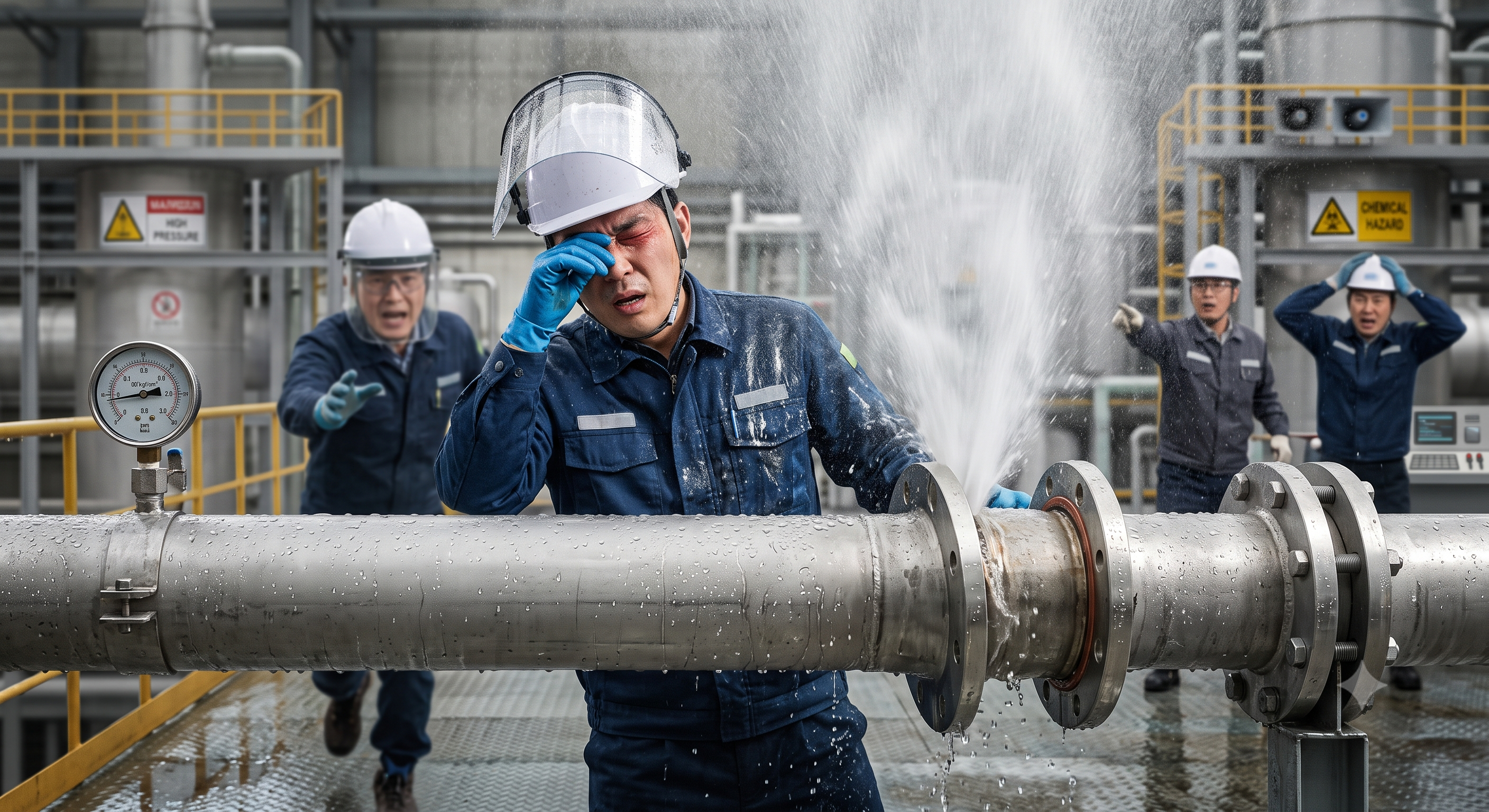
Retained AI-generated educational illustration; not an actual incident photograph.
The scenario and record comparisons are fictional teaching examples, not records of real incidents, measurements, inspections, signatures or approvals.
| Item | Fictional scenario |
|---|---|
| Initial situation | A maintenance team prepares to replace a gasket on an isolated process branch. |
| Changed condition | The local gauge reads zero, but the drain has not been proved clear and a connected valve may pass. |
| Failure path | A blocked drain or replenishing feed can leave pressure at the flange despite the displayed zero. |
| Possible outcome | Loosening loaded bolts could release fluid and allow the pipe to move; no actual injury outcome is asserted. |
| Prevention barrier | Keep the joint closed, reassess the isolation and obtain a documented safe-condition release before opening. |
Failure mechanisms
Pressure can be supplied by process feeds, bypasses, gravity or thermal expansion of trapped liquid. A valve position is not proof of isolation. A zero instrument reading is insufficient if its sensing path is blocked or isolated; use the planned independent verification and recheck where pressure can return.
Inserting a blind is itself intrusive work. Establish and verify the initial safe isolation before loosening the joint to insert it. A generic far-side-first or hinge instruction cannot replace a joint-specific opening plan. Never crack a flange to test whether pressure remains; unexpected release means stop and withdraw safely.
Pipe weight and residual strain can move the faces when bolts are removed. Design the supports, lifting and compatible spreading arrangement; keep hands out of the gap. Identify legacy gasket material before disturbance. Suspected asbestos requires the applicable survey and controlled removal plan, not dry scraping.
Use the specified new gasket, fastener condition and lubricant, with the approved tightening sequence and calibrated equipment as required. Bolts must not pull a misaligned pipe into place. Treat leak testing as a separate release: gas stores energy and nitrogen can displace oxygen. Reconcile blinds, locks, tools and people before controlled restoration.
Decision sequence
| Decision stage | What to verify |
|---|---|
| Known facts | Identify the joint and every possible feed. |
| Unresolved matters | Check whether the drain and pressure indication communicate with the work boundary. |
| Reason to hold | Hold if readings conflict, the path is blocked or the fluid is unknown. |
| Required evidence | Redesign and verify the isolation with the responsible operations team. |
| Restart decision | Record real measurements, time and authorisation; reverify after any change. |
5. Conditional decisions and common errors
| Condition | Action | Evidence | Proceed when |
|---|---|---|---|
| No discharge at drain | Prove the drain path; recheck isolation | Drain route and pressure checks | Path clear; safe condition verified |
| Gauge reads zero | Check connection, range and residual pressure | Gauge connection and verification record | Pressure independently verified |
| Gasket material unknown | Identify material; prepare exposure controls | Material record and exposure plan | Material identified; controls ready |
| Nitrogen test proposed | Assess gas energy and oxygen hazards | Test procedure and exclusion plan | Separate test authorised |
Similar situations, different decisions
The scenario and record comparisons are fictional teaching examples, not records of real incidents, measurements, inspections, signatures or approvals.
| Comparison | Situation A | Situation B |
|---|---|---|
| Isolation | Valve marked closed only | Sources isolated and verified at the boundary |
| Opening | PPE treated as permission | Safe condition verified before intrusive work |
| Return | Pump started after assembly | Test, blind reconciliation and handover recorded |
6. Roles and responsibilities
| Role | Responsibility |
|---|---|
| Work supervisor | Confirm scope, permit interfaces and the isolation design with operations. Confirm the applicable Singapore workplace, process and permit requirements for this isolation and pipe-opening task. |
| Technical reviewer | Trace, secure and verify energy sources; record any reaccumulation checks. |
| Work crew | Inspect access, lifting and supports; follow the approved opening and bolting plans. |
| Inspector / assessor | Witness required hold points and evaluate exposure controls and emergency arrangements. |
| Release / handover authority | Accept only actual test results and a reconciled blind/lock register before restart. |
The principal and employers coordinate the risk assessment and safe work procedures. These role labels allocate work; verify any qualifications and statutory appointments required for the actual Singapore activity. The receiving person must be given restrictions and unresolved defects before handover.
Record and handover perspective
| Stage | Record controls | Verification |
|---|---|---|
| Identify joint | 1. Record joint identifier2. Record drawing revision3. Record fluid and sds | 1. Drawing revision2. Fluid and SDS3. Permit reference |
| Isolate energy | 1. Record isolation drawing2. Record lock register3. Record feed inventory | 1. Lock register2. Feed inventory3. Verification record |
| Drain and verify | 1. Record drain route2. Record pressure basis/units and time3. Record temperature/°c record | 1. Pressure basis/units and time2. Temperature/°C record3. Atmosphere results |
| First opening | 1. Record opening authority2. Record containment setup3. Record support check | 1. Containment setup2. Support check3. Blind register |
| Reassemble | 1. Record gasket specification2. Record bolt and lubricant3. Record torque procedure | 1. Bolt and lubricant2. Torque procedure3. Assembly record |
| Test and return | 1. Record test procedure2. Record actual test record3. Record blind reconciliation | 1. Actual test record2. Blind reconciliation3. Return approval |
7. Hold points and record comparison
| Hold point | Evidence before release | Actual record |
|---|---|---|
| HP-0 Start | Task boundary, site RA, SWP, responsibilities and emergency arrangements | |
| HP-1 Prepare access | Access inspection; Lift arrangement; Support locations; Strain assessment | |
| HP-2 Isolate energy | Isolation drawing; Lock register; Feed inventory; Verification record | |
| HP-3 Remove gasket | Material identity; Material/exposure review; Tool selection; Face inspection | |
| HP-4 Test and return | Test procedure; Actual test record; Blind reconciliation; Return approval |
Complete after actual checks. Recheck after changes, defects or shift handover.
Record comparison examples
The scenario and record comparisons are fictional teaching examples, not records of real incidents, measurements, inspections, signatures or approvals.
The boxes are static record prompts, not interactive or saved approvals. A tick does not establish suitability or permission to restart. Record the evidence, person, time and unresolved issues; retain the change history.
| Record type | Insufficient record | Record checklist |
|---|---|---|
| Boundary | Only marked OK | □ Joint identifier□ Drawing revision□ Fluid and SDS□ Permit reference |
| Drain | Only marked OK | □ Drain route□ Pressure and time□ Temperature record□ Atmosphere results |
| Opening | Only marked OK | □ Opening authority□ Containment setup□ Support check□ Blind register |
| Return | Only marked OK | □ Test procedure□ Actual test record□ Blind reconciliation□ Return approval |
Hold points are internal checks. Determine separately whether Singapore statutory or site permit requirements apply to this work. Leave confirmation, measurements and approval records blank until the authorised site process is completed.
8. Site checklist and emergency response
| Check item | Result | Person / action |
|---|---|---|
| □ Identify joint: Joint identifier | ||
| □ Prepare access: Access inspection | ||
| □ Isolate energy: Isolation drawing | ||
| □ Drain and verify: Drain route | ||
| □ First opening: Opening authority | ||
| □ Remove gasket: Material identity | ||
| □ Reassemble: Gasket specification | ||
| □ Test and return: Test procedure | ||
| □ Release / handover authority |
Stop work
Stop for unknown contents, unverified isolation, blocked drains, rising pressure, unexpected discharge, unstable supports, gasket material uncertainty or a changed boundary. Do not tighten or alter a pressurised joint. Keep exclusion in place and obtain a fresh release after correction.
Emergency response
Withdraw from the release path, raise the site alarm and stop the source from a safe location if possible. Use the SDS exposure response and site emergency plan. Do not enter an oxygen-deficient area for an improvised rescue. Treat suspected pressure injection as urgent medical injury and report the medium.
9. Sources and review limits
Official public sources read for this Singapore edition on 2026-10-14. Guidance, statutory explanations and manufacturer limits have different roles; no source provider has approved this JSA.
| Source | Read scope and application limits |
|---|---|
| MOM — Risk management | Official explanation: employer, self-employed person and principal responsibilities; routine and non-routine risk assessment; hierarchy of controls; multidisciplinary assessment team. Official explanation of risk-management duties; no claim of reading the full linked statute. It does not specify task-specific equipment limits. Assess pipe flange opening and gasket replacement with employers, principal and affected contractors; resolve the inputs in section 2. |
| MOM — When should my company review its risk assessment? | Review every three years, after significant changes, new machinery/substances/procedures, hazard-related injury or incident, and when assessment is inadequate. General review guidance. A review interval does not permit continued operation after a known hazard or change. Reassess this operation after changes, defects, incidents or an inadequate assessment; do not wait for a scheduled review. |
| MOM — Permit-to-Work Systems | Formal work authorisation and coordination; OPEC tripartite guidance and competent permit authority with authority to reject work. OPEC-focused guidance page; not evidence of a blanket statutory permit requirement for every task. Determine permits for this actual activity and workplace; distinguish the section 7 internal hold points from statutory or site permits. |
| WSH Council — Guidelines on Safe Use of Machinery | Sections 1.1 and 1.3: scope and explanation of safeguarding/LOTO duties. Sections 4.3–4.4.3: training, maintenance, specified replacement parts and isolation of all energy sources; commissioning safety-device checks. Official practical guidance and explanation; complete current subsidiary legislation and every annex were not read. Actual manufacturer isolation and restoration instructions remain necessary. Use machinery guidance for hazardous energy, chemical guidance for fluid exposure, sector permit guidance for coordination where applicable, and MOM asbestos guidance for competent survey/removal responsibilities. Preserve separate verification of pressure, mechanical support and final restoration. |
| WSH Council — Preventing Chemical Hazards | Chemical exposure routes, employer/employee roles, risk assessment, safe work procedures, communication, SDS, exposure monitoring and substance-dependent health surveillance. Official overview; linked exposure schedules and medical examination regulations were not read in full. Do not infer a numerical exposure limit or a universal medical examination duty. Use machinery guidance for hazardous energy, chemical guidance for fluid exposure, sector permit guidance for coordination where applicable, and MOM asbestos guidance for competent survey/removal responsibilities. Preserve separate verification of pressure, mechanical support and final restoration. |
| MOM — Permit-to-Work Systems | Formal work authorisation and coordination; OPEC tripartite guidance and competent permit authority with authority to reject work. OPEC-focused guidance page; not evidence of a blanket statutory permit requirement for every task. Determine permits for this actual activity and workplace; distinguish the section 7 internal hold points from statutory or site permits. |
| MOM — Employer, Principal and Occupier Duties in Asbestos-related Work | Complete FAQ role table: competent person for a required survey and occupier responsibility to use an approved asbestos-removal contractor. MOM contractor-approval overview also read. Role guidance, not an actual material survey, removal plan or complete statute review. No asbestos content or removal clearance is asserted for an unidentified gasket. Use machinery guidance for hazardous energy, chemical guidance for fluid exposure, sector permit guidance for coordination where applicable, and MOM asbestos guidance for competent survey/removal responsibilities. Preserve separate verification of pressure, mechanical support and final restoration. |
No fixed opening order, tightening percentages, torque, non-sparking-tool rule or nitrogen test is prescribed. Full joint-specific standards and actual gasket history were not provided. MOM asbestos guidance establishes a specialist responsibility pathway; this document is not an asbestos survey or removal plan.
Actual site measurements, equipment instructions, engineering checks and signed approval records were not supplied. A qualified person must resolve these before use.
10. PDF guidance and FAQ
PDF A covers basic task controls; B focuses on technical failures; C covers supervision, records and handover. The article has eight stages with four items per main cell; each PDF has six key stages with three items per main cell. P/S/R/A, measurements, confirmations and signatures remain blank for actual site assessment.
Content group ID
jsa-pipe-disassembly
Can a closed valve prove the line is safe?
No. Establish the required isolation and verify the work boundary, including trapped pressure and possible replenishment.
Can the flange be cracked to prove zero pressure?
No. Use planned test points and verified drain paths before loosening; unexplained release requires stopping.
Is nitrogen a default leak-test medium?
No. The separate test plan must justify medium, pressure, stored energy, exclusion and oxygen controls.
Are non-sparking tools sufficient to prevent ignition?
No. Tool compatibility is one measure; assess the atmosphere and control all relevant ignition sources.
Has a professional verified or approved this document?
No. Public sources and editorial, layout and consistency checks were reviewed using AI. No site inspection or professional technical approval has been performed. Obtain appropriate professional review before use.
11. Revision history and authorship
AI-generated reference material; not professionally verified or approved. Before use, a qualified person must review and adapt it to applicable Singapore requirements, the actual equipment/site and approved safe work procedures.
This Singapore edition was adapted from the Korean original and its assigned US technical reference. Earlier source revisions are archival editorial history, not Singapore technical approval.
| Date | Edition | Change | Review status |
|---|---|---|---|
| 2026-06-28 | Korean source | Source editorial publication or revision; retained as provenance of the Korean edition. | Editorial record only; no professional technical approval recorded. |
| 2026-10-05 | Korean source v1.1 | Source editorial publication or revision; retained as provenance of the Korean edition. | Editorial record only; no professional technical approval recorded. |
| 2026-10-14 | 1.0 en-SG | Singapore legal scope, local planning, responsibility interfaces and SI terminology; new PDF A/B/C. | AI editorial and visual review only; no professional approval. |