Plan the selected piling method, verify services and platform, assemble the rig and perform the applicable drilling, grout or driven-pile branch; control pile-head work and the next rig movement.
Stop for unknown services, platform settlement or cracking, changed drainage or route, faulty brakes or guards, uncontrolled pile movement, hose defects or an unprotected bore.
AI-generated reference material. It has not been professionally verified or approved. Before use, a suitably qualified person must review and adapt it to applicable Singapore requirements, the actual equipment and site, and approved safe work procedures.
1. Legal and technical scope
Apply Singapore WSH risk management and the site construction arrangements to the selected piling method and contractor interfaces. MOM lists piling frames and machines within lifting-equipment registration; verify actual registration and AE examination records. MOM piling guidance highlights swing-brake control and requires employers and principals to brief operators not to leave an operating rig. Assign competent engineering responsibility for the actual platform and temporary works; this article does not claim a universal platform certification or permit rule.
Assess the actual activity under the applicable Singapore WSH requirements. Statutory duties, official guidance, manufacturer instructions and approved project documents have distinct roles. A site hold point is not automatically a statutory permit. Use competent local review to resolve the applicable industry, installation, access and permit requirements.
| Basis | Application and limits |
|---|---|
| MOM risk management | Official explanation: risk assessment, control, monitoring and communication for routine and non-routine work, including maintenance; reviewed 14 October 2026. |
| WSHC Planning a Lift | Official lifting guidance: risk-supported lift plan, safe work procedure, permit arrangements, load/equipment/crew/environment details and stop when conditions differ. Confirm the applicable statutory permit scope separately. |
| MOM register lifting equipment | Official equipment categories including overhead cranes and piling machines; owner engages an AE for required tests, examination and registration. Lifting gear registration is a separate documented process. |
| MOM regular lifting-equipment inspections | Official regular examination requirement for lifting equipment and applicable AE scope. No common inspection interval is inferred for every component. |
| MOM safe operation of piling machines | Full one-page circular dated 14 March 2012: operator attendance, swing-brake function and employer/principal briefing duties. Its accident is not presented as this article hypothetical scenario. |
| WSHC preventing machine hazards | Official guidance: hierarchy of controls, guarding, competent operators and maintenance LOTO. It is not a model-specific isolation instruction. |
| WSHC Preventing Falls from Heights | Official explanation of access, fall-prevention plans, hazardous-WAH permits in factories and supervisor/assessor/authorised-manager roles. General fall controls are not limited to the permit threshold. |
| WSHC Preventing Chemical Hazards | Official guidance on chemical risk assessment, safe work procedures, exposure routes, hazard communication and exposure-dependent monitoring; not product certification. |
| MOM requirements for hygiene monitoring | Official toxic-substance and noise monitoring guidance: competent personnel, exposure-dependent requirements, records, worker information and reporting. No site exposure result is asserted. |
| SCDF emergency medical services | Official 995 emergency ambulance service information; use emergency services for actual emergencies. |
2. Scope and required inputs
Included: Plan the selected piling method, verify services and platform, assemble the rig and perform the applicable drilling, grout or driven-pile branch; control pile-head work and the next rig movement.
Separate review: The drilling, grouting and driving branches are alternatives or project-specific combinations, not compulsory sequential steps. Jack-in piling, pile load testing, blasting and unplanned rig recovery require their own method review.
| Input | Required evidence |
|---|---|
| Plan and locate | Owner responses; Method and rig limits; Exclusion layout; Service and overhead-line restrictions |
| Assemble and test | Pins and retainers; Brake and limit checks; Energy isolation; Fall protection and rescue |
| Pump concrete or grout | Couplings and restraints; Pressure limits; Wash and spill provisions; Leak isolation procedure |
| Park and hand over | Parking configuration; Openings and stored tools; Next-shift restrictions; Route handed to next operator |
Obtain utility-owner information and verification, actual rig reactions for assembly, travel, slewing and piling, ground/platform design, manufacturer limits, lifting details and method-specific bore or grout controls. No universal ground pressure, slope, wire-rope factor, mat thickness or set-up distance is supplied.
3. Eight-stage JSA
P = likelihood; S = severity; R = risk under the site method; A = acceptance or authorization as defined by the site. Leave these blank until actual assessment and control verification. A low score does not override a legal requirement, product limit or unreleased hold point.
| Job stage | Hazards and effects | Failure factors | Required controls | Site verification | P | S | R | A |
|---|---|---|---|---|---|---|---|---|
| 1. Plan and locate | 1. Utility strike2. Overhead contact3. Public intrusion4. Uncoordinated adjacent work | 1. Unproved service route2. Wrong rig configuration3. Shared access uncontrolled4. Unresolved asset-owner conditions | 1. Verify services before penetration2. Select the actual piling method3. Separate plant and pedestrian routes4. Confirm overhead-line arrangements | 1. Owner responses2. Method and rig limits3. Exclusion layout4. Service and overhead-line restrictions | ||||
| 2. Release platform | 1. Rig overturn2. Track punch-through3. Edge collapse4. Unreviewed travel loading | 1. Design omits operating loads2. Soft patch beneath mats3. Drainage or edge altered4. Mat layout changed without review | 1. Use site-specific platform design2. Inspect travel and setup areas3. Reassess after ground changes4. Control platform repairs and edges | 1. Rig load cases2. Platform condition3. Drainage and boundaries4. Repair record and release | ||||
| 3. Assemble and test | 1. Falling mast2. Hammer descent3. Stored-energy release4. Missing assembly retainer | 1. Temporary pins missing2. Hoist or brake defect3. Unsupported raised parts4. Unsafe access for connection work | 1. Follow erection sequence2. Test guards and safety functions3. Block and isolate for access4. Provide protected mast access | 1. Pins and retainers2. Brake and limit checks3. Energy isolation4. Fall protection and rescue | ||||
| 4. Drill and clear spoil | 1. Auger entanglement2. Flying spoil3. Fall into bore4. Unsafe spoil clearance | 1. Reach into rotating flights2. Unsafe spin-off method3. Open bore left unguarded4. Emergency stop mistaken for isolation | 1. Prevent access to rotation2. Use specified spoil removal3. Guard unattended bores4. Isolate before tool changes | 1. Guard function2. Spoil discharge zone3. Bore protection4. Residual motion controlled | ||||
| 5. Pump concrete or grout | 1. Hose whip2. Pressure injection3. Cement burns4. Trapped blockage pressure | 1. Mismatched line components2. Coupling opened under pressure3. Blockage cleared unsafely4. Hands used to find pressure leak | 1. Use rated compatible lines2. Isolate and verify zero pressure3. Follow pump clearing procedure4. Keep hands away from suspected leaks | 1. Couplings and restraints2. Pressure limits3. Wash and spill provisions4. Leak isolation procedure | ||||
| 6. Pitch and drive piles | 1. Dropped pile2. Crushing at leader3. Flying fragments and noise4. Uncontrolled rig slew | 1. Wrong lifting attachment2. Pile unstable before release3. Damaged cap or cushion4. Operator leaves operating rig | 1. Use planned pile lifting points2. Secure pile before unhooking3. Monitor driving and isolate zone4. Maintain attendance and swing control | 1. Rigging and pile support2. Hammer blocks and stops3. Alignment and vibration4. Operator and swing-brake state | ||||
| 7. Crop and handle heads | 1. Falling cut-off2. Silica and fragments3. Crushing by cutter4. Sharp rebar injury | 1. Section not supported2. Driving continues nearby3. People enter cropper envelope4. Unsupported debris removal | 1. Support section before severing2. Suspend conflicting driving3. Control dust and debris4. Plan reinforcement and sharp-end protection | 1. Lift and cut sequence2. Drive stop confirmation3. Cutter condition4. Rebar and fragment controls | ||||
| 8. Park and hand over | 1. Unsecured bore2. Unexpected movement3. Unsafe next setup4. Unreleased next movement | 1. Hammer left unsupported2. Platform damage unreported3. Stored tools can roll4. Move started without route release | 1. Secure hammer and attachments2. Protect bores and travel route3. Record defects before handover4. Reassess the next travel route | 1. Parking configuration2. Openings and stored tools3. Next-shift restrictions4. Route handed to next operator |
4. Hypothetical scenario and failure mechanisms
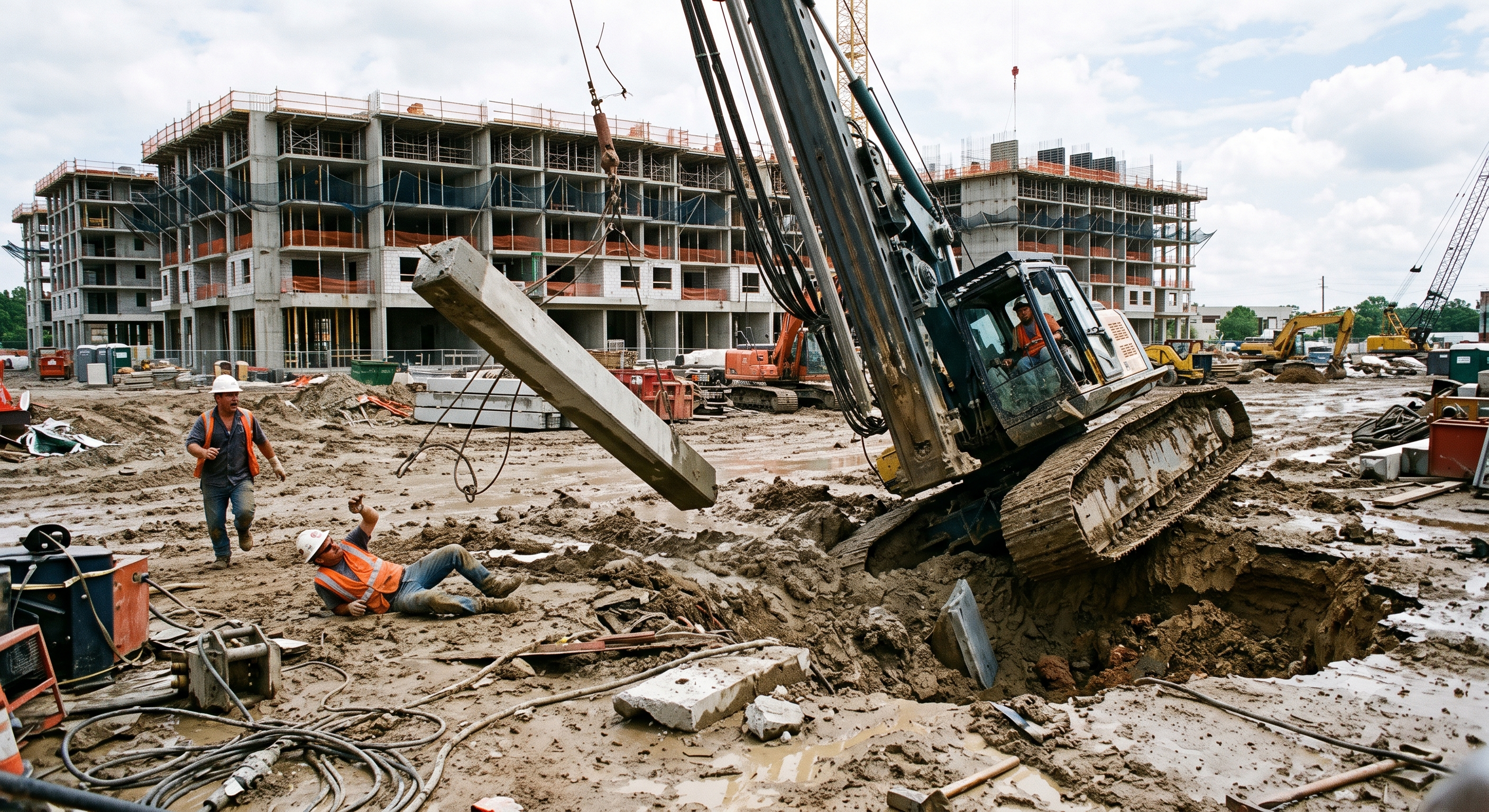 Retained source illustration: an AI-generated educational concept, not a real incident photograph or evidence of equipment suitability.
The following scenario, comparisons and example records are hypothetical teaching material. They do not reproduce actual incidents, measurements, signatures or approvals.
| Item | Hypothetical situation |
|---|---|
| Initial state | One pile has been completed successfully. |
| Change | The next rig position lies over a backfilled drain after rain. |
| Failure path | The previous platform release and a steel plate are treated as sufficient evidence. |
| Possible harm | The track can punch through weakened or unsupported ground and overturn the rig. |
| Barrier | Hold the move; review the actual route, subsurface condition and rig load cases with the designated engineering team, repair as designed and record the new release. |
Level appearance is not bearing-capacity evidence. A plate can distribute load but does not by itself repair a void or weak buried drain. Verify the full travel and setup route, drainage, edges and changes after rain.
Mast, attachment, suspended pile and slew position change the rig reactions. Review the actual configurations for assembly, movement and work rather than relying only on the empty-machine mass.
Separate drilling and driven-pile branches. Prevent access to rotating augers and isolate before clearing or changing tools; for driving, secure the pile before releasing lifting gear and keep people outside the leader and hammer danger zone.
For grout or concrete pumping, confirm compatible pressure-rated components and a safe clearing procedure. A zero gauge may coexist with a blockage and trapped pressure; do not loosen a coupling or feel for a pressurised leak.
Secure the rig under its actual parking and swing-brake procedure. Operators must not leave a rig operating; a successful previous pile does not release the next move or excuse unattended operation.
| Decision | Reason and evidence |
|---|---|
| Known facts | The next rig position lies over a backfilled drain after rain. |
| Unresolved | The previous platform release and a steel plate are treated as sufficient evidence. |
| Hold reason | Stop for unknown services, platform settlement or cracking, changed drainage or route, faulty brakes or guards, uncontrolled pile movement, hose defects or an unprotected bore. |
| Evidence needed | Rigging and pile support; Hammer blocks and stops; Alignment and vibration; Operator and swing-brake state. |
| Next decision | Hold the move; review the actual route, subsurface condition and rig load cases with the designated engineering team, repair as designed and record the new release. |
5. Conditional decisions and common errors
| Condition | Action | Evidence | Proceed when |
|---|---|---|---|
| Ground changes | Hold travel and operation. | Platform and current reactions. | Engineering disposition accepted. |
| Service uncertain | Do not penetrate. | Owner and locating evidence. | Work boundary released. |
| Hose blockage | Stop and isolate pressure. | Safe clearing and verification. | Line safe before opening. |
| Next pile ready | Review the route anew. | Drainage ground and configuration. | Next move authorised. |
| Comparison | Situation A | Situation B |
|---|---|---|
| Ground looks level | Surface geometry observed. | Bearing and buried voids remain unproved. |
| Previous pile complete | That operation ended. | The next route and position still need review. |
6. Roles and responsibilities
| Role | Responsibility |
|---|---|
| Work supervisor | Confirm scope, task sequence, exclusion and stop authority. Coordinate plan and locate with affected operations. |
| Technical reviewer | Resolve the actual design and equipment limits: Owner responses; Method and rig limits; Exclusion layout; Service and overhead-line restrictions. |
| Work crew | Perform assemble and test using the approved procedure; report any mismatch before proceeding. |
| Inspector / assessor | Verify Rigging and pile support; Hammer blocks and stops; Alignment and vibration; Operator and swing-brake state. Record what was actually checked and what remains unresolved. |
| Release / receiving authority | Confirm Parking configuration; Openings and stored tools; Next-shift restrictions; Route handed to next operator. Transfer restrictions and the next permitted stage. |
These are responsibility examples, not invented statutory credentials. Meet the actual training, competent-person, qualified-person and licensing requirements for the assigned work. Anyone may raise a hazard and request a stop; only the designated authority may release the affected stage after evidence is reviewed.
7. Hold points and record comparison
| Hold point | Evidence before release | Confirmation / approval |
|---|---|---|
| HP-0 Start | Scope, jurisdiction, equipment identity, responsible people and emergency arrangements. | |
| HP-1 Plan and locate | Owner responses; Method and rig limits; Exclusion layout; Service and overhead-line restrictions | |
| HP-2 Release platform | Rig load cases; Platform condition; Drainage and boundaries; Repair record and release | |
| HP-3 Assemble and test | Pins and retainers; Brake and limit checks; Energy isolation; Fall protection and rescue | |
| HP-4 Park and hand over | Parking configuration; Openings and stored tools; Next-shift restrictions; Route handed to next operator |
Hold points are internal evidence gates. They do not replace statutory permits or actual signatures. Recheck affected gates after a change, abnormal event or shift transfer. The blank record must identify the evidence, person, time, limits and release scope.
| Record | Insufficient record | Record checklist |
|---|---|---|
| Services | Map checked | □ Owner responses□ Method and rig limits□ Exclusion layout□ Service and overhead-line restrictions |
| Platform | Looks level | □ Rig load cases□ Platform condition□ Drainage and boundaries□ Repair record and release |
| Operation | Last pile fine | □ Rigging and pile support□ Hammer blocks and stops□ Alignment and vibration□ Operator and swing-brake state |
| Move | Plate laid | □ Parking configuration□ Openings and stored tools□ Next-shift restrictions□ Route handed to next operator |
The □ boxes are static prompts, not saved or interactive approvals. Each checks one record element. A tick alone does not establish suitability or permission to restart. Link equipment IDs and supporting records; retain unresolved matters and the earlier record when conditions change.
8. Site checklist and emergency response
| Check item | Result | Person / action |
|---|---|---|
| Owner responses | ||
| Rig load cases | ||
| Pins and retainers | ||
| Guard function | ||
| Couplings and restraints | ||
| Rigging and pile support | ||
| Lift and cut sequence | ||
| Parking configuration | ||
| Emergency arrangements and unresolved restrictions communicated |
Stop work: Stop for unknown services, platform settlement or cracking, changed drainage or route, faulty brakes or guards, uncontrolled pile movement, hose defects or an unprotected bore.
Emergency response: Stop from a safe position and clear the rig, pile, bore and hose danger zones. Do not approach an overturning rig or enter a bore for improvised rescue. Activate the site response and call SCDF 995 for serious injury or urgent rescue. Recovery requires the actual ground, stored-energy and structural conditions.
9. Sources and review limits
Official-source review date: October 14, 2026. The following review is limited to the public provisions or selected manufacturer material identified below. It does not establish that any authority approved this article or the actual installation.
- MOM risk management: Official explanation: risk assessment, control, monitoring and communication for routine and non-routine work, including maintenance; reviewed 14 October 2026.
- WSHC Planning a Lift: Official lifting guidance: risk-supported lift plan, safe work procedure, permit arrangements, load/equipment/crew/environment details and stop when conditions differ. Confirm the applicable statutory permit scope separately.
- MOM register lifting equipment: Official equipment categories including overhead cranes and piling machines; owner engages an AE for required tests, examination and registration. Lifting gear registration is a separate documented process.
- MOM regular lifting-equipment inspections: Official regular examination requirement for lifting equipment and applicable AE scope. No common inspection interval is inferred for every component.
- MOM safe operation of piling machines: Full one-page circular dated 14 March 2012: operator attendance, swing-brake function and employer/principal briefing duties. Its accident is not presented as this article hypothetical scenario.
- WSHC preventing machine hazards: Official guidance: hierarchy of controls, guarding, competent operators and maintenance LOTO. It is not a model-specific isolation instruction.
- WSHC Preventing Falls from Heights: Official explanation of access, fall-prevention plans, hazardous-WAH permits in factories and supervisor/assessor/authorised-manager roles. General fall controls are not limited to the permit threshold.
- WSHC Preventing Chemical Hazards: Official guidance on chemical risk assessment, safe work procedures, exposure routes, hazard communication and exposure-dependent monitoring; not product certification.
- MOM requirements for hygiene monitoring: Official toxic-substance and noise monitoring guidance: competent personnel, exposure-dependent requirements, records, worker information and reporting. No site exposure result is asserted.
- SCDF emergency medical services: Official 995 emergency ambulance service information; use emergency services for actual emergencies.
Paid consensus standards and site-specific calculations, manuals, inspection records and product certificates were not independently obtained or verified unless specifically identified. Korean and overseas legal references are source history, not Singapore statutory duties. Singapore Standards and model-specific limits were not read in full unless expressly identified.
10. PDF guidance and FAQ
PDF A covers basic task controls; B examines technical failures; C focuses on supervision, evidence and handover. Each has six rows and three items per main cell. They are complementary extracts: apply all eight body stages and the applicable site procedure. An omitted stage is not permission to omit its controls. PDF HP-0 through HP-4 are worksheet labels; match the event, evidence and authority rather than assuming they match another permit by number.
P/S/R/A, actual measurements, confirmations and signatures remain blank. The PDFs are uncompleted reference worksheets, not issued work permits.
Content group ID: jsa-pile-driving
Must every job drill then grout then drive?
No. Identify the actual method and use only the applicable reviewed branches.
Does a steel plate prove a sound platform?
No. Confirm supporting ground and the designed load distribution.
May the operator leave during hammer operation?
No. Apply the attendance and shutdown procedure; the cited MOM circular specifically warns against leaving an operating piling rig.
Has a professional verified or approved this document?
AI-generated reference material. It has not been professionally verified or approved. Before use, a suitably qualified person must review and adapt it to applicable Singapore requirements, the actual equipment and site, and approved safe work procedures.
11. Revision history and authorship
AI-generated reference material. It has not been professionally verified or approved. Before use, a suitably qualified person must review and adapt it to applicable Singapore requirements, the actual equipment and site, and approved safe work procedures.
This system has not physically inspected the equipment, structures, ground, atmosphere or worksite. The document does not replace legal advice, manufacturer procedures, engineering design, inspection certificates, qualification evidence, the site risk assessment or an actual work permit.
Before use, a suitably qualified and authorized person must review the actual equipment, loads, methods, protection, inspection and emergency arrangements and resolve open issues. Record the real reviewer, organization, qualifications, delegated authority, reviewed documents, date, signature, exclusions and conditions of approval separately.
| Date | Version | Change | Review status |
|---|---|---|---|
| 2026-07-21 | Unmarked | Korean source revision retained in the source snapshot. | Historical editorial status; not Singapore professional approval. |
| 2026-10-04 | 1.1 | Korean source revision retained in the source snapshot. | Historical editorial status; not Singapore professional approval. |
| 2026-10-14 | SG 1.0 | Singapore localisation of the Korean source with its assigned US technical reference; local applicability, task controls and sources reviewed. | AI-assisted editorial work; professional approval not performed. |