Check oxygen cleanliness separately from leak tightness. Hold oily or suspect equipment for supplier or qualified service disposition, and secure both the retained member and the offcut before ignition.
AI-generated reference material. It has not been verified or approved by a professional. Before use, a qualified person must review and adapt it to applicable Singapore requirements, the actual equipment and site, and approved safe work procedures.
1. Singapore legal and technical basis
Apply Singapore WSH risk management and fire controls to the actual cutting location, gas equipment and exposed areas. WSHC marine guidance distinguishes non-return and flashback protection and contains sector-specific requirements; confirm those if the workplace is a shipyard or ship in harbour. Do not extend that sector guidance into universal inspection intervals or torch settings.
| Source category | Task application and limit |
|---|---|
| MOM - Risk management | Assess gas, material history, offcut support and abnormal events. Official explanation of WSH Risk Management duties, not a complete consolidated statutory text. |
| MOM - Safe storage of combustible materials in construction | Control combustible material and hidden spark destinations. Construction circular explaining relevant duties and precautions. No universal fire-watch duration or blanket hot-work permit is inferred. |
| WSHC - Workplace Safety and Health Manual for Marine Industries | Distinguish device functions and determine whether marine-sector provisions apply. Older marine-sector guidance text only, not a current consolidated legal review or the whole manual. Sector-specific inspection intervals and device requirements are not applied as universal rules to other workplaces. |
| MOM - Requirements for hygiene monitoring | Assess actual coating and fume exposure. Material-specific exposure and actual monitoring frequency have not been determined. No workplace measurement is supplied. |
Use Singapore requirements and SI units. Manufacturer limits apply to the actual model. Foreign technical examples do not establish Singapore statutory duties. A job safety analysis or completed checklist is not a permit or approval.
2. Scope and required inputs
Included: Planned cutting of identified material with a cylinder-supplied oxygen and acetylene torch, including gas-system inspection, supported cutting, controlled shutdown and fire-watch handover.
Separate review: Acetylene generators, manifold installation or modification, unknown used containers or piping and confined-space cutting require separate procedures. Oxygen is not used for ventilation or cleaning.
| Input | Required evidence |
|---|---|
| Plan target and authority | Target and permitted scope; History and isolation boundary; Coating and ventilation basis; Authorization and response plan |
| Inspect gas equipment | Gas and component IDs; Cleanliness and contamination; Protection device configuration; Leak method and results |
| Ignite and cut | Tip and pressure basis; Hose and flame direction; Flame and equipment condition; Operator and nearby protection |
| Close and transfer | Fire-watch release basis; Supply and residual-gas state; Offcut location and heat; Receiving owner and holds |
Identify gases by cylinder markings and SDS, and match regulators, hoses, torch, tip and protective devices to the actual service. Use the model procedures for leak testing, purging, ignition, shutdown and abnormal events. Use the actual model operating limits within applicable Singapore requirements; a maximum rating is not a torch setting. Establish fire-watch requirements, fumes controls and post-cut piece support.
Singapore application
Record the workplace sector and applicable hot-work permit arrangements. Match regulator, torch, hose, protective devices and tip to the actual gases and model. The supplier procedure and applicable Singapore requirements determine pressure limits; neither a catalogue maximum nor a foreign legal limit is an operating setting.
3. Eight-stage JSA
| Job stage | Hazards and effects | Failure factors | Controls | Site verification | P | S | R | A |
|---|---|---|---|---|---|---|---|---|
| 1. Plan target and authority | 1. Residue explosion2. Wrong-member cutting3. Toxic fume exposure4. Delayed emergency response | 1. Service history unknown2. Cut drawing confused3. Coating unidentified4. Shutdown roles absent | 1. Confirm material and history2. Match member and cut plan3. Assess coating and fumes4. Assign emergency responsibilities | 1. Target and permitted scope2. History and isolation boundary3. Coating and ventilation basis4. Sector and hot-work release | ||||
| 2. Arrange cylinders and zone | 1. Cylinder overturn2. Hose damage3. Spark ignition4. Falling-piece strike | 1. Cylinders unsecured2. Hoses cross sharp traffic path3. Openings unprotected4. Lower area occupied | 1. Secure suitable cylinder setup2. Protect and separate hoses3. Control all spark destinations4. Exclude people below | 1. Cylinder location and restraint2. Hose route and identification3. Opposite side and openings4. Fire watch and lower boundary | ||||
| 3. Inspect gas equipment | 1. Oxygen-system fire2. Fuel-gas leak3. Reverse flow4. Flashback propagation | 1. Oil or grease suspected2. Wrong gas components3. Protection mismatch4. Leak checks incomplete | 1. Keep oxygen equipment clean2. Match gas-rated components3. Verify specified safeguards4. Perform approved leak checks | 1. Gas and component IDs2. Cleanliness and contamination3. Protection device configuration4. Leak method and results | ||||
| 4. Support cut material | 1. Offcut fall2. Residual-material explosion3. Fire spread4. Fume inhalation | 1. Post-cut support absent2. Unknown vessel accepted3. Hidden combustibles retained4. Extraction inappropriate | 1. Support retained and cut pieces2. Hold unknown-history items3. Shield or remove combustibles4. Provide material-specific controls | 1. Support and cut sequence2. History and exclusion scope3. Fire precautions and watch4. Fume control and protection | ||||
| 5. Ignite and cut | 1. Flame burns2. Hose burn-through3. Continuing flashback4. Eye injury | 1. Model sequence ignored2. Hose crosses cut path3. Abnormal sound ignored4. Filter protection unsuitable | 1. Use actual torch procedure2. Keep hoses clear of heat3. Stop for abnormal behavior4. Use suitable eye and body PPE | 1. Tip and pressure basis2. Hose and flame direction3. Flame and equipment condition4. Operator and nearby protection | ||||
| 6. Shut down supply | 1. Residual-gas release2. Smoldering fire3. Hot-piece burns4. Defective part reuse | 1. Shutdown steps omitted2. Watch ends too early3. Hot pieces unmarked4. Abnormal equipment retained | 1. Follow model shutdown2. Control supply and residual gas3. Maintain required fire watch4. Identify hot or defective items | 1. Valve and pressure condition2. Hose storage and protection3. Watch duration and release4. Hot-piece and defect status | ||||
| 7. Hold abnormal system | 1. Oxygen ignition2. Repeated flashback3. Cylinder rupture4. Contaminated-part reuse | 1. Suspect part wiped and reused2. Cause not investigated3. Heat exposure ignored4. Service history missing | 1. Isolate suspect equipment2. Follow safe emergency response3. Evacuate heated-cylinder area4. Require qualified disposition | 1. Part ID and contamination2. Leak flame and sound facts3. Heat exposure and notifications4. Service and restart evidence | ||||
| 8. Close and transfer | 1. Delayed fire2. Uncontrolled gas supply3. Hot-material contact4. Quarantined item reuse | 1. Watch release unrecorded2. Cylinder status unclear3. Offcuts poorly stored4. Restrictions left verbal | 1. Verify all exposed areas2. Record completed shutdown3. Mark and secure hot materials4. Transfer defects and limits | 1. Fire-watch release basis2. Supply and residual-gas state3. Offcut location and heat4. Watch and equipment owners |
P/S/R/A and actual measurements, checks, names and signatures remain blank for the site assessment. A score cannot waive a required control.
4. Hypothetical scenario and failure mechanisms
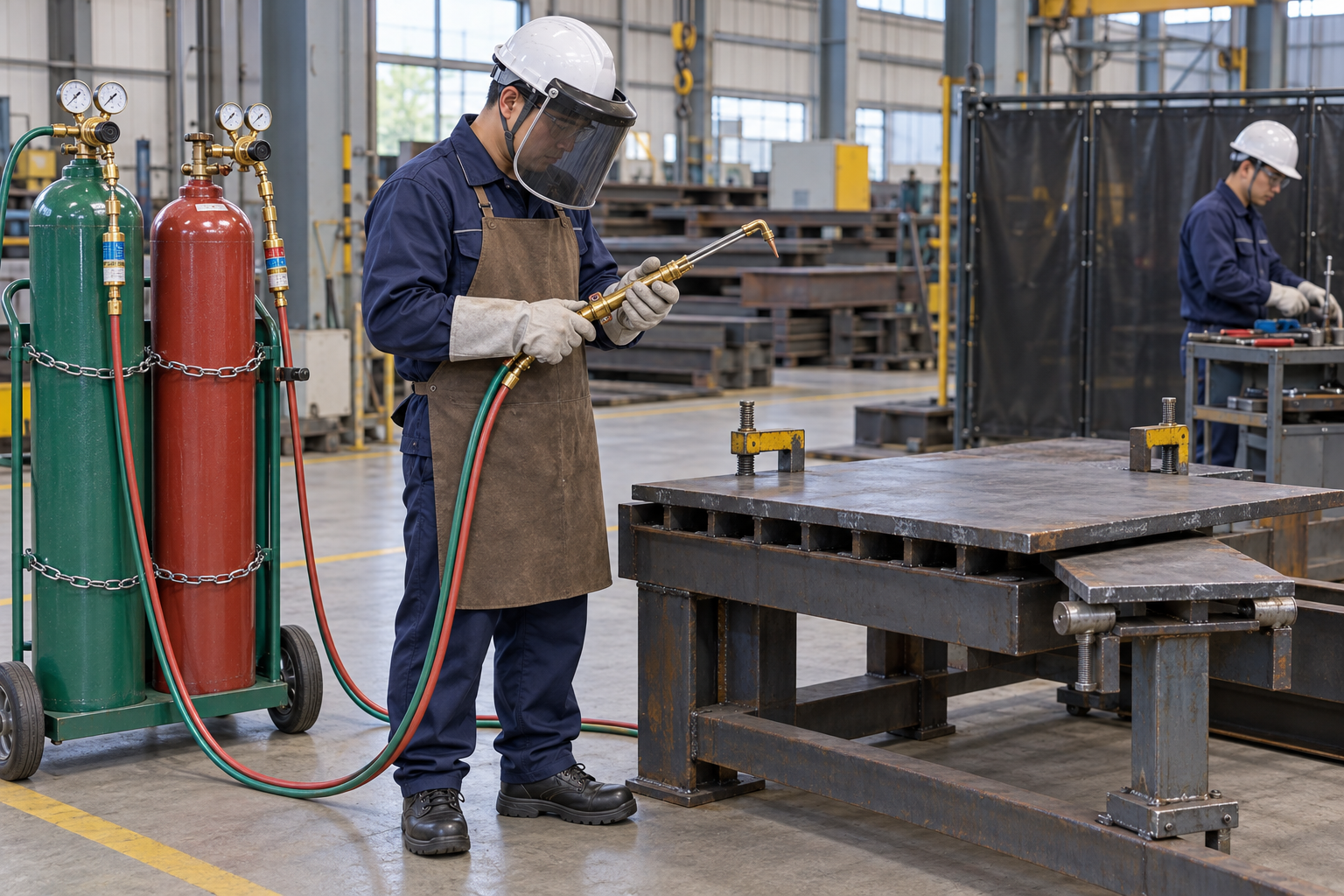
The following scenario, comparisons and example records are hypothetical teaching material. They do not reproduce actual incidents, measurements, signatures or approvals.
| Item | Hypothetical situation |
|---|---|
| Initial state | The crew inspects an oxygen regulator before lighting a cutting torch. |
| Change | An oily-looking mark is found at the connection. |
| Failure path | A bubble-free leak check is offered as proof that the assembly can be used. |
| Possible harm | Leak tightness does not establish oxygen-compatible cleanliness; contamination can intensify ignition and burning. |
| Barrier | Hold ignition, identify and isolate the suspected parts, obtain supplier or qualified service disposition and verify suitable replacement equipment before restart. |
Oxygen supports combustion. Cleanliness and leakage are separate acceptance questions, so a passed leak check cannot clear a contamination concern. Do not apply ordinary lubricant or improvise cleaning of oxygen-service components.
Reverse gas flow and flame propagation are different hazards. Verify the actual required check-valve and flashback-protection functions and installation conditions. Protective devices do not replace proper gas identification, tip condition, pressure selection and hose inspection.
Cutting changes the support condition as the kerf progresses. Plan the retained member and offcut separately and keep hands and people out of the falling-piece zone. Review openings and the opposite side for both sparks and conducted heat.
A short abnormal torch sound, sustained internal burning and a fire-heated cylinder require different responses. Follow the actual emergency instructions from a safe position; do not investigate or relight merely because the sound has stopped. Continue required fire surveillance after the flame is extinguished.
| Decision | Reason and evidence |
|---|---|
| Known facts | An oily-looking mark is found at the connection. |
| Unresolved | A bubble-free leak check is offered as proof that the assembly can be used. |
| Hold reason | Stop for leaks, suspected oil or grease on oxygen equipment, damaged hoses, flashback indications, unsupported cut pieces or uncontrolled fire exposure. Evacuate for a heated or fire-exposed acetylene cylinder and notify emergency responders and the supplier. |
| Evidence needed | Valve and pressure condition; Hose storage and protection; Watch duration and release; Hot-piece and defect status. |
| Next decision | Hold ignition, identify and isolate the suspected parts, obtain supplier or qualified service disposition and verify suitable replacement equipment before restart. |
5. Hold and proceed decisions
| Condition | Action | Evidence | Proceed when |
|---|---|---|---|
| Oily oxygen part | Hold use and obtain qualified disposition. | Part ID and contamination record. | Suitable clean equipment accepted. |
| Unknown contents | Exclude from routine cutting. | Separate history and preparation review. | Separate procedure authorised. |
| Flashback indication | Stop using the actual emergency procedure. | Equipment effects and service record. | Cause resolved. |
| Cylinder heated | Evacuate and notify responders and supplier. | Observed heat or fire exposure. | Responder-controlled recovery. |
| Comparison | Situation A | Situation B |
|---|---|---|
| Leak test passed | Oxygen compatibility and cleanliness are separately accepted. | Oil contamination is dismissed because no bubbles appear. |
| Flame extinguished | Gas shutdown and required fire surveillance are complete. | Work is released while hidden embers remain possible. |
6. Roles and supervision
| Role | Responsibility |
|---|---|
| Work supervisor | Confirm scope, task sequence, exclusion and stop authority. Coordinate plan target and authority with affected operations. |
| Technical reviewer | Resolve the actual design and equipment limits: Target and permitted scope; History and isolation boundary; Coating and ventilation basis; Authorization and response plan. |
| Work crew | Perform inspect gas equipment using the approved procedure; report any mismatch before proceeding. |
| Inspector / assessor | Verify Valve and pressure condition; Hose storage and protection; Watch duration and release; Hot-piece and defect status. Record what was actually checked and what remains unresolved. |
| Release / receiving authority | Confirm Fire-watch release basis; Supply and residual-gas state; Offcut location and heat; Receiving owner and holds. Transfer restrictions and the next permitted stage. |
These are responsibility examples, not invented statutory credentials. Meet the actual training, competent-person, qualified-person and licensing requirements for the assigned work. Anyone may raise a hazard and request a stop; only the designated authority may release the affected stage after evidence is reviewed.
Singapore application
The hot-work supervisor coordinates nearby trades and both sides of the cut. The designated fire watcher records monitored areas and the basis for release; the gas-equipment owner controls contaminated or heat-exposed items. These are separate handover decisions.
7. Hold points and record quality
| Hold point | Evidence before release | Confirmation / approval |
|---|---|---|
| HP-0 Start | Scope, jurisdiction, equipment identity, responsible people and emergency arrangements. | |
| HP-1 Inspect gas equipment | Gas and component IDs; Cleanliness and contamination; Protection device configuration; Leak method and results | |
| HP-2 Support cut material | Support and cut sequence; History and exclusion scope; Fire precautions and watch; Fume control and protection | |
| HP-3 Ignite and cut | Tip and pressure basis; Hose and flame direction; Flame and equipment condition; Operator and nearby protection | |
| HP-4 Shut down supply | Valve and pressure condition; Hose storage and protection; Watch duration and release; Hot-piece and defect status |
Hold points are internal evidence gates. They do not replace statutory permits or actual signatures. Recheck affected gates after a change, abnormal event or shift transfer. The blank record must identify the evidence, person, time, limits and release scope.
| Record | Insufficient record | Record checklist |
|---|---|---|
| System | Gas connected | □ Gas and component IDs□ Cleanliness and contamination□ Protection device configuration□ Leak method and results |
| Cut readiness | Area looks clear | □ Support and cut sequence□ History and exclusion scope□ Fire precautions and watch□ Fume control and protection |
| Shutdown | Flame is out | □ Valve and pressure condition□ Hose storage and protection□ Watch duration and release□ Hot-piece and defect status |
| Restart | Noise stopped | □ Part ID and contamination□ Leak flame and sound facts□ Heat exposure and notifications□ Service and restart evidence |
The □ boxes are static prompts, not saved or interactive approvals. Each checks one record element. A tick alone does not establish suitability or permission to restart. Link equipment IDs and supporting records; retain unresolved matters and the earlier record when conditions change.
8. Pre-work checks and emergency response
| Check item | Result | Person / action |
|---|---|---|
| Target and permitted scope | ||
| Cylinder location and restraint | ||
| Gas and component IDs | ||
| Support and cut sequence | ||
| Tip and pressure basis | ||
| Valve and pressure condition | ||
| Part ID and contamination | ||
| Fire-watch release basis | ||
| Emergency arrangements and unresolved restrictions communicated |
Stop work: Stop for leaks, suspected oil or grease on oxygen equipment, damaged hoses, flashback indications, unsupported cut pieces or uncontrolled fire exposure. Evacuate for a heated or fire-exposed acetylene cylinder and notify emergency responders and the supplier.
Emergency response: Withdraw, prevent access and contact the site emergency responders for fire, serious injury or a heated acetylene cylinder. Supply shutdown is only for a designated person who can do so safely under the actual procedure. Do not approach, move or reuse a fire-exposed cylinder; give responders and the supplier its location and exposure history.
9. Sources and review limits
Public-source review: 14 October 2026. Only the material and limits identified below were reviewed.
| Source | Reviewed material | Task application |
|---|---|---|
| MOM - Risk management | Responsibilities; routine and non-routine work; hierarchy of control and risk assessment team. Official explanation of WSH Risk Management duties, not a complete consolidated statutory text. | Assess gas, material history, offcut support and abnormal events. |
| MOM - Safe storage of combustible materials in construction | Two-page 2016 circular: ignition separation, hot-work sparks above combustible materials, protective covers, storage quantities and safe procedures. Construction circular explaining relevant duties and precautions. No universal fire-watch duration or blanket hot-work permit is inferred. | Control combustible material and hidden spark destinations. |
| WSHC - Workplace Safety and Health Manual for Marine Industries | PDF page 47, sections 8.3-8.9: hoses, gas-compatible equipment, non-return/flashback devices, breaks, inspection and ventilation. Older marine-sector guidance text only, not a current consolidated legal review or the whole manual. Sector-specific inspection intervals and device requirements are not applied as universal rules to other workplaces. | Distinguish device functions and determine whether marine-sector provisions apply. |
| MOM - Requirements for hygiene monitoring | Main requirements: competent monitoring personnel, toxic substances, results and reporting, recommended frequency table and noise applicability. Material-specific exposure and actual monitoring frequency have not been determined. No workplace measurement is supplied. | Assess actual coating and fume exposure. |
Selected public official sources were reviewed on 14 October 2026 within the recorded scope. No full consolidated legal audit, paid Singapore Standard, actual model manual, site inspection, engineering calculation or professional approval is claimed. Verify current detailed requirements and actual equipment/site records before use.
AI-generated reference material. It has not been verified or approved by a professional. Before use, a qualified person must review and adapt it to applicable Singapore requirements, the actual equipment and site, and approved safe work procedures.
10. PDF use and frequently asked questions
PDF A covers basic task controls; B examines technical failures; C focuses on supervision, evidence and handover. Each has six rows and three items per main cell. They are complementary extracts: apply all eight body stages and the applicable site procedure. An omitted stage is not permission to omit its controls. PDF HP-0 through HP-4 are worksheet labels; match the event, evidence and authority rather than assuming they match another permit by number.
P/S/R/A, actual measurements, confirmations and signatures remain blank. The PDFs are uncompleted reference worksheets, not issued work permits.
Content group ID: jsa-oxyacetylene-cutting
Does a passed leak check clear oily oxygen parts?
No. Cleanliness and oxygen suitability need separate acceptance.
Are check valves and flashback arrestors identical?
No. Confirm the required reverse-flow and flame-arrest functions for the actual equipment.
Can an apparently empty drum be cut?
Not under this scope. Its history, cleaning, isolation and atmosphere require a separate approved procedure.
Is the maximum acetylene rating the cutting setting?
No. Select the actual tip and manufacturer conditions within all applicable limits; never use the maximum as a default setting.
Has a professional verified or approved this document?
No. This is AI-assisted reference material. Editorial and layout checks are not a physical inspection or professional technical approval. Obtain qualified professional review and required site approval before use.
Singapore application
Read A, B and C together with all eight JSA stages and the approved work procedure. The sheets are complementary extracts, not separate work authorisations.
11. Authorship and revision history
AI-generated reference material. It has not been verified or approved by a professional. Before use, a qualified person must review and adapt it to applicable Singapore requirements, the actual equipment and site, and approved safe work procedures.
| Date / edition | Authorship and scope | Professional approval |
|---|---|---|
| 2026-09-20 / Korean source | Original topic and educational illustration retained as references. Source content is unchanged. | Not asserted |
| 14 October 2026 / Singapore 1.0 | Added Singapore sector applicability and fire/exposure controls; removed the inherited foreign legal-maximum framing. | Not performed |
Source topic: https://smartjsabridge.com/ko/case-study/jsa-oxyacetylene-cutting