Coordinate services and inspections before closing the second face. A straight finished surface does not prove that concealed wiring, stud connections or required fire details have been accepted.
AI-generated reference material. It has not been verified or approved by a professional. Before use, a qualified person must review and adapt it to applicable Singapore requirements, the actual equipment and site, and approved safe work procedures.
1. Singapore legal and technical basis
Apply Singapore WSH controls to sharp metal, panel handling, temporary stability and access. SCDF Fire Code distinguishes material properties from the performance required of a wall assembly. The project QP and approved system details determine applicable fire and building requirements; not every gypsum partition has the same fire rating.
| Source category | Task application and limit |
|---|---|
| MOM - Risk management | Assess cutting, handling and closing interfaces. Official explanation of WSH Risk Management duties, not a complete consolidated statutory text. |
| WSHC - Design for Safety guidelines | Plan temporary stability and information needed by following trades. Design guidance and review questions. This review does not establish whether the Design for Safety Regulations apply to every particular project. |
| SCDF Fire Code - Materials for Construction | Confirm wall use and required material/assembly performance with the project team. Selected clauses only; referenced classification tables, complete assembly evidence and project applicability need QP review. No universal fire rating is prescribed here. |
| EMA - Engaging Licensed Electrical Workers | Arrange electrical wiring and concealed-work acceptance through the responsible electrical team. Installation, repair or modification of wiring and supply equipment is distinguished from routine operation of an intact appliance. Licence scope must match the installation. |
Use Singapore requirements and SI units. Manufacturer limits apply to the actual model. Foreign technical examples do not establish Singapore statutory duties. A job safety analysis or completed checklist is not a permit or approval.
2. Scope and required inputs
Included
Install the specified metal track/stud system, transport and knife-cut new gypsum panels, support them during positioning and screw fastening, and hand over for finishing.
Separate assessment
Ceilings, loadbearing/shaft-wall design, suspect asbestos demolition, powder-actuated fastening, large powered panel cutting, joint compound and sanding are excluded.
| Input | Evidence needed |
|---|---|
| Review wall and services | Wall drawing/revision; Substrate/service evidence; Openings/reinforcement; System/performance detail |
| Receive and store panels | Panel/cart condition; Route and turns; Storage support/load; Restraint and access |
| Knife-cut panels | Bench and blade; Hand/blade route; Panel condition; Dust/scrap controls |
| Clean and transfer | Scrap/blade disposal; Access condition; Inspection/holds; Finishing receiver |
Select task-appropriate eye, hand, foot, skin and hearing protection from the exposure assessment. Where respiratory protection is necessary, use the applicable respiratory-protection program; PPE does not replace isolation, guarding, support or ventilation.
Singapore application
Record whether the wall forms a fire compartment, occupied-area A&A separation or ordinary internal division. Obtain the applicable approved assembly details, including head, perimeter and service penetrations. Do not replace specified components by visual similarity.
3. Eight-stage JSA
| Job stage | Hazards and effects | Failure factors | Controls | Site verification | P | S | R | A |
|---|---|---|---|---|---|---|---|---|
| 1. Review wall and services | 1. Hidden service strike2. Wrong wall system3. Opening defect4. Unsuitable fixing | 1. Drawings not matched2. Substrate unknown3. Services omitted4. Design detail copied | 1. Match wall/system ID2. Verify fixing locations3. Coordinate openings/services4. Use specified assembly | 1. Wall drawing/revision2. Substrate/service evidence3. Openings/reinforcement4. Wall use and approved system | ||||
| 2. Receive and store panels | 1. Panel overturns2. Back/shoulder strain3. Floor overload4. Blocked passage | 1. Unsecured leaning stack2. Forced narrow-route carry3. Stack load unreviewed4. Cart parked in exit | 1. Plan cart/lifter route2. Use stable storage method3. Check floor/stack limits4. Keep passages clear | 1. Panel/cart condition2. Route and turns3. Storage support/load4. Restraint and access | ||||
| 3. Prepare track and studs | 1. Sharp-edge cuts2. Frame falls3. Flying offcut4. Wrong support | 1. Cut pieces scattered2. Temporary bracing absent3. Tool unsuitable4. Fasteners mismatched | 1. Control edges/offcuts2. Follow fixing sequence3. Use suitable cutting tools4. Keep frame stable | 1. Member/fastener identity2. Track/stud support3. Edge/tool condition4. Temporary stability | ||||
| 4. Knife-cut panels | 1. Blade cut2. Panel breaks3. Dust/eye irritation4. Uncontrolled offcut | 1. Hand in blade path2. Unsupported edge3. Dust unmanaged4. Scrap left underfoot | 1. Mark on stable support2. Keep hands clear3. Control task dust4. Collect offcuts safely | 1. Bench and blade2. Hand/blade route3. Panel condition4. Dust/scrap controls | ||||
| 5. Position and fasten | 1. Panel topples2. Hand pinch3. Platform fall4. Frame moves | 1. Panel unsupported2. Hands behind panel3. Overreaching4. Fixing order changed | 1. Support before fastening2. Use positioning aids3. Use accepted access platform4. Follow system fixing order | 1. Panel/frame stability2. Hand and aid position3. Screw/edge detail4. Platform/stance | ||||
| 6. Inspect before closure | 1. Hidden wiring defect2. Damaged frame concealed3. Missing reinforcement4. Wrong fire/acoustic detail | 1. Trade check absent2. Crack ignored3. Opening detail missed4. Appearance accepted | 1. Obtain trade handover2. Inspect frame/panels3. Verify openings/reinforcement4. Check specified assembly | 1. Concealment records2. Damage/fixing checks3. Service/opening detail4. Service and closure release | ||||
| 7. Hold movement or damage | 1. Further panel fall2. Repeated fixing failure3. Unsafe recovery4. Defect remains hidden | 1. Worker braces panel2. Cause ignored3. Support improvised4. Closure continues | 1. Stop and exclude area2. Restore designed support3. Review affected frame/panels4. Reinspect before closure | 1. Affected wall ID2. Support/cause findings3. Replacement/correction4. Inspection and release | ||||
| 8. Clean and transfer | 1. Sharp scrap injury2. Trip/fall3. Uninspected wall finished4. Lost restriction | 1. Blades mixed with waste2. Offcuts in passage3. Hold not marked4. Receiver unknown | 1. Use tools for sharp scrap2. Clear route3. Mark unfinished/held sections4. Handover before finishing | 1. Scrap/blade disposal2. Access condition3. Inspection/holds4. Finishing receiver |
P/S/R/A and actual measurements, checks, names and signatures remain blank for the site assessment. A score cannot waive a required control.
4. Hypothetical scenario and failure mechanisms
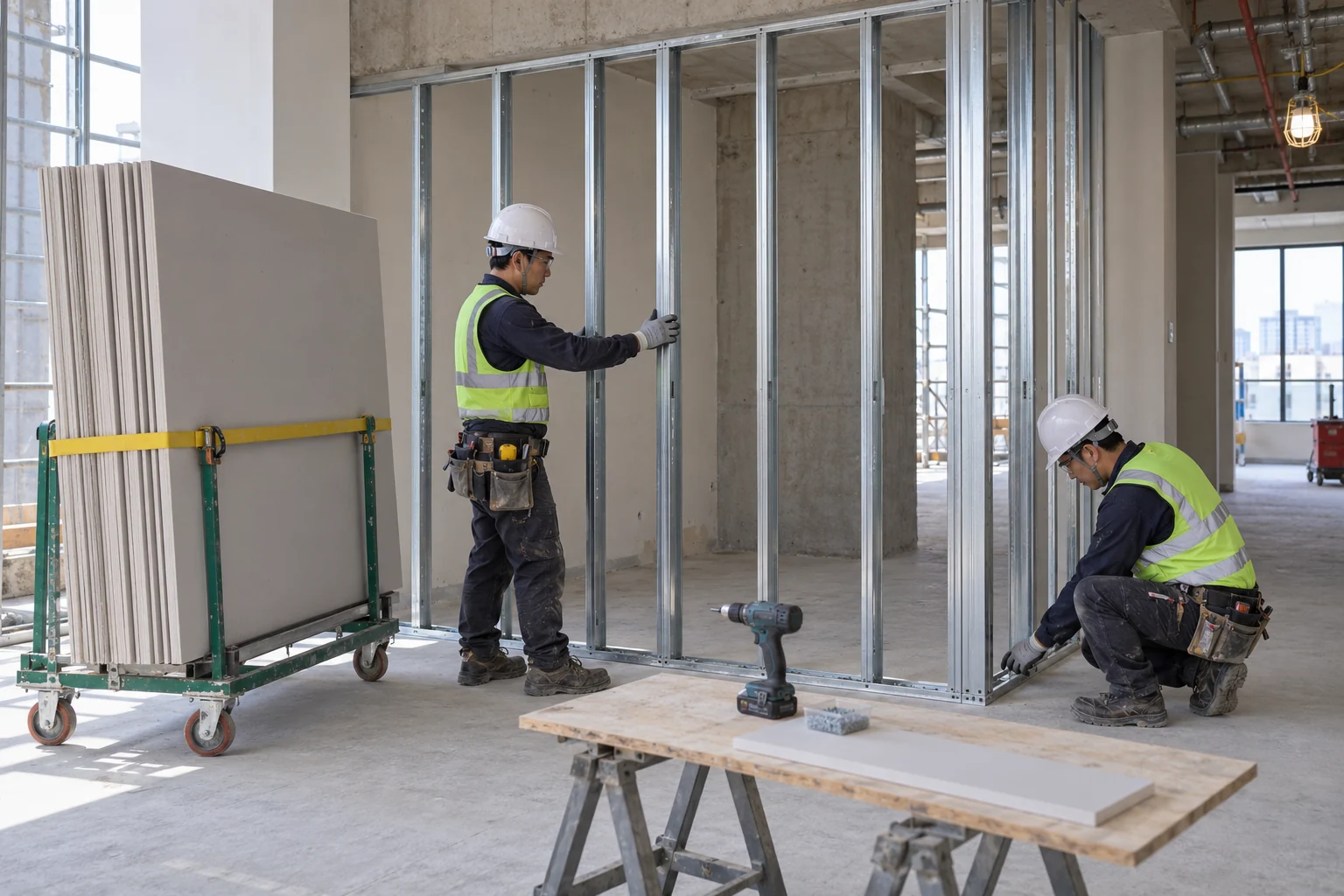
The retained illustration is an AI-generated educational image from the Korean source. It is not an actual incident photograph, approved drawing, equipment certification or proof that the depicted arrangement is safe.
Two workers are not a universal handling solution. First plan delivery, storage, doorway turns and suitable carts/lifters. Any team handling needs agreed roles, signals and a stable landing place.
The panel and receiving frame must be stable before the first screw is driven. Keep assisting hands out of the panel/frame pinch space and use suitable supports; standing upright alone is not secure support.
Visible screws cannot demonstrate hidden wiring, reinforcement or framing details. Complete the relevant trade inspections before covering them and keep panel installation separate from authorisation to finish the joints.
Hypothetical decision example
Hypothetical example: the crew is ready to close the second face, but the wiring inspection is missing and one stud moves under hand pressure. Closure is held while framing and electrical personnel inspect their respective work and record corrections.
The example is fictional; no incident, measurement, inspection or approval is asserted.
Task flow: Review wall and services → Receive and store panels → Prepare track and studs → Knife-cut panels → Position and fasten → Inspect before closure → Hold movement or damage → Clean and transfer
Singapore application
If a stud moves while another trade adjusts a concealed service, hold closure and recheck the affected connections and routing. Earlier inspection evidence does not cover a later change.
5. Hold and proceed decisions
| Condition | Action | Evidence | Proceed when |
|---|---|---|---|
| Frame moves | Hold panel installation | Fixings and temporary stability | Frame stable |
| Concealment check absent | Leave section open | Relevant trade inspection record | Closure released |
| Panel handling uncontrolled | Set down safely; revise plan | Route, aids and support method | Handling controlled |
| Hidden service uncertain | Do not drill | Location and substrate verification | Fixing location accepted |
Similar observation, different conclusion
| Observation | Supported conclusion | What remains unresolved |
|---|---|---|
| Panel stands upright | It is in position | Stable support/fastening unproved |
| Screws visible | Fasteners are present | Hidden services and assembly details unproved |
6. Roles and supervision
| Role | Responsibility |
|---|---|
| Work supervisor | Coordinate review wall and services, affected operations, stop signals and stage transitions. |
| Technical/equipment reviewer | Verify Wall drawing/revision, Substrate/service evidence, actual instructions and unresolved technical limits. |
| Task crew | Apply the stated controls, report changes and keep actual checks and signatures factual. |
| Inspector/test lead | Connect Concealment records, Damage/fixing checks to the required acceptance criteria. |
| Receiving authority | Accept the recorded restrictions, Inspection/holds, Finishing receiver, and follow-up ownership. |
These are responsibility examples, not invented statutory credentials. Verify actual competence, training and authority for the assigned work.
Supervision and handover controls
| Stage | Management controls | Evidence |
|---|---|---|
| Plan review | 1. Assign technical owner2. Close task-specific questions3. Match wall/system ID | 1. Wall drawing/revision2. Substrate/service evidence3. System/performance detail |
| Competence | 1. Verify required competence2. Assign stop authority3. Plan cart/lifter route | 1. Panel/cart condition2. Training and task briefing3. Restraint and access |
| Prestart evidence | 1. Inspect actual equipment2. Link evidence to this stage3. Mark on stable support | 1. Bench and blade2. Hand/blade route3. Dust/scrap controls |
| Change control | 1. Stop and secure the area2. Review affected controls3. Stop and exclude area | 1. Affected wall ID2. Support/cause findings3. Inspection and release |
| Shift handover | 1. Identify remaining restrictions2. Confirm receiving responsibility3. Use tools for sharp scrap | 1. Scrap/blade disposal2. Access condition3. Finishing receiver |
| Closeout | 1. Record defect disposition2. Archive factual evidence3. Use tools for sharp scrap | 1. Scrap/blade disposal2. Access condition3. Finishing receiver |
Singapore application
The partition supervisor maintains temporary supports and panel handling controls. Each service trade accepts its concealed work; the responsible QP or inspection authority resolves required assembly details. Photograph and identify the agreed inspection points before closure.
7. Hold points and record quality
| Hold point | Evidence before release | Actual record |
|---|---|---|
| HP-0 Start | Install the specified metal track/stud system, transport and knife-cut new gypsum panels, support them during positioning and screw fastening, and hand over for finishing. | |
| HP-1 Receive and store panels | Panel/cart condition; Route and turns; Storage support/load; Restraint and access | |
| HP-2 Knife-cut panels | Bench and blade; Hand/blade route; Panel condition; Dust/scrap controls | |
| HP-3 Hold movement or damage | Affected wall ID; Support/cause findings; Replacement/correction; Inspection and release | |
| HP-4 Clean and transfer | Scrap/blade disposal; Access condition; Inspection/holds; Finishing receiver |
Hold points are internal evidence gates. They do not establish that a statutory permit exists or has been approved. Recheck affected gates after changes, faults and shift handover.
Record comparison - hypothetical templates
The 16 boxes below identify record elements, not completed checks or approvals. They are static symbols. Link equipment/location, date, actual findings and the separate record reference; preserve unresolved items.
| Record | Insufficient entry | Required record elements |
|---|---|---|
| Review wall and services | "Checked" without supporting facts | □ Wall drawing/revision□ Substrate/service evidence□ Openings/reinforcement□ System/performance detail |
| Prepare track and studs | "Checked" without supporting facts | □ Member/fastener identity□ Track/stud support□ Edge/tool condition□ Temporary stability |
| Position and fasten | "Checked" without supporting facts | □ Panel/frame stability□ Hand and aid position□ Screw/edge detail□ Platform/stance |
| Hold movement or damage | "Checked" without supporting facts | □ Affected wall ID□ Support/cause findings□ Replacement/correction□ Inspection and release |
8. Pre-work checks and emergency response
| Check required | Result | Checker/action |
|---|---|---|
| Review wall and services: Wall drawing/revision | ||
| Receive and store panels: Panel/cart condition | ||
| Prepare track and studs: Member/fastener identity | ||
| Knife-cut panels: Bench and blade | ||
| Position and fasten: Panel/frame stability | ||
| Inspect before closure: Concealment records | ||
| Hold movement or damage: Affected wall ID | ||
| Clean and transfer: Scrap/blade disposal |
Stop work
Hold for leaning unsecured panels, moving studs or temporary braces, unverified drilling locations, damaged blades, cracked panels or a missing inspection before closure.
Emergency response
Stop and clear the fall area if a panel, stack or frame shifts; do not catch or body-brace it. Arrange stable support and recovery without putting hands between the panel and framing. For serious crush, cut or fall injury, contact the site emergency responders and activate site first aid/rescue. If a fixing contacts an electrical service, keep people clear and have the supply safely controlled before approach.
9. Sources and review limits
Public-source review: 14 October 2026. Only the material and limits identified below were reviewed.
| Source | Reviewed material | Task application |
|---|---|---|
| MOM - Risk management | Responsibilities; routine and non-routine work; hierarchy of control and risk assessment team. Official explanation of WSH Risk Management duties, not a complete consolidated statutory text. | Assess cutting, handling and closing interfaces. |
| WSHC - Design for Safety guidelines | Annex E, printed pages 33-35: maintenance access, materials, temporary instability, bracing, sequence, adjacent works and information transfer. Design guidance and review questions. This review does not establish whether the Design for Safety Regulations apply to every particular project. | Plan temporary stability and information needed by following trades. |
| SCDF Fire Code - Materials for Construction | Clauses 3.15.1, 3.15.12 and 3.15.16: material/performance distinction, internal non-load-bearing walls and separation of occupied A&A areas. Selected clauses only; referenced classification tables, complete assembly evidence and project applicability need QP review. No universal fire rating is prescribed here. | Confirm wall use and required material/assembly performance with the project team. |
| EMA - Engaging Licensed Electrical Workers | Overview, examples of wiring and circuit work, licence classes and verification of valid licences. Installation, repair or modification of wiring and supply equipment is distinguished from routine operation of an intact appliance. Licence scope must match the installation. | Arrange electrical wiring and concealed-work acceptance through the responsible electrical team. |
Selected public official sources were reviewed on 14 October 2026 within the recorded scope. No full consolidated legal audit, paid Singapore Standard, actual model manual, site inspection, engineering calculation or professional approval is claimed. Verify current detailed requirements and actual equipment/site records before use.
AI-generated reference material. It has not been verified or approved by a professional. Before use, a qualified person must review and adapt it to applicable Singapore requirements, the actual equipment and site, and approved safe work procedures.
10. PDF use and frequently asked questions
PDF A summarizes core controls; B emphasizes technical failures; C covers supervision, records and handover. Each uses six stages from or aligned with the eight-stage body. All actual risk, measurement, check and signature fields are blank. Use a separate linked record where more space is needed.
Can panels lean against an unfinished wall?
Use the product storage method and verified stable support; do not rely on an unstable wall or obstructed passage.
Are two people enough for every board?
No. Assess panel size, route, height and repetition and select suitable handling aids.
Can stud spacing be copied from another job?
Use the specified system, wall height, openings and performance details.
May the second side close immediately?
Only after framing, services and reinforcement receive the required inspections and handover.
Has a professional approved this JSA?
This is reference content written and revised with AI. It has not been verified or approved by a professional. Review by a suitably qualified professional and required site authorisation are necessary before use.
Singapore application
Read A, B and C together with all eight JSA stages and the approved work procedure. The sheets are complementary extracts, not separate work authorisations.
11. Authorship and revision history
AI-generated reference material. It has not been verified or approved by a professional. Before use, a qualified person must review and adapt it to applicable Singapore requirements, the actual equipment and site, and approved safe work procedures.
| Date / edition | Authorship and scope | Professional approval |
|---|---|---|
| 2026-10-08 / Korean source | Original topic and educational illustration retained as references. Source content is unchanged. | Not asserted |
| 14 October 2026 / Singapore 1.0 | Added Singapore wall-use and fire-performance review, occupied-area separation and coordinated concealed-service release. | Not performed |
Source topic: https://smartjsabridge.com/ko/case-study/jsa-metal-stud-gypsum-partition