Trade size alone does not establish a permissible bender and conduit combination. Match conduit type, wall and actual tool rating. Substituted conduit requires another check, even when a fitting accepts its end.
This reference material was written and reviced with AI. It has not been verified or approved by a professional. Review by a suitably qualified professional and required site approval are necessary before field use.
Stop before proceeding
Hold for unknown conduit/tool compatibility, unverified supports or access, slipping tube, damaged blades, cracked or flattened bends, suspected concealed services or moving joints. Do not force a damaged tube into a fitting.
AI-generated reference material; not professionally verified or approved. Before use, a qualified person must review and adapt it to applicable Singapore requirements, the actual equipment/site and approved safe work procedures.
1. Legal and technical scope
Coordinate the conduit installation with the responsible Singapore LEW and the approved electrical design. Match the actual conduit, fittings and tool system; a foreign trade designation or product listing alone does not establish local installation acceptance. Work-at-height controls apply to the actual elevated access and falling-object exposure.
| Basis | Singapore application |
|---|---|
| Risk management | The employer, self-employed person and principal assess and control work risks. Include preparation, abnormal conditions and maintenance. Coordinate affected trades and communicate controls. |
| Activity-specific guidance | Use EMA guidance for electrical-work responsibility, WSHC height guidance for access and lower-area protection, and ergonomics guidance for long material handling. Actual drawings and product instructions establish conduit and fixing acceptance. |
| Permits and authority | Select permit requirements for the actual sector and activity. Site hold points and contractor role labels do not create statutory permits or qualifications. |
| Equipment and design | No universal support interval, bending radius, torque, allowable flattening or electrical continuity value is supplied. Full Singapore electrical standards and the actual product instructions were not read. Elevated work requires its own suitable platform, protection and any applicable Singapore permit process. |
2. Scope and required inputs
Included scope
Match specified conduit and compatible hand tools, cut with a hand hacksaw, deburr, hand-bend and install exposed conduit route into planned supports, fittings and boxes. Elevated access must be separately selected and inspected.
Separate assessment
Wire pulling, live circuits, alterations to existing energised systems, powered benders, pipe threaders, abrasive saws, core drilling and hazardous-location installations are separate scopes.
| Input | Evidence needed |
|---|---|
| Match route and tube | Drawing and route; Type wall and size; Nearby circuits; Fitting instructions. |
| Cut and deburr | Blade and grip; Inside outside edges; Offcut support; Hand clearance. |
| Install supports | Supports and boxes; Joint assembly; Access and reach; Below-work exclusion. |
| Clean and handoff | Clean work area; Inspection record; Route and receiver; Open-end protection. |
No site measurements, equipment manuals for the actual installation, inspection records or signed technical approvals were supplied. Confirm the applicable requirements and actual product instructions before use; record each criterion with its units, source and equipment or work-area ID.
Singapore site planning
The electrical contractor must confirm route, nearby circuits, concealed services and authorised work boundary before material handling or drilling associated supports. Compare conduit outside diameter, wall and nominal designation with the hand bender instructions; record dimensional checks in mm. Keep the full tube sweep clear and use a vice and offcut supports. The LEW or assigned competent electrical inspector must resolve bonding/earthing and route acceptance before handover for separate wire pulling. Avoid substituting the support spacing from another conduit system.
3. Eight-stage JSA
| Job stage | Hazards and effects | Failure factors | Technical and procedural controls | Site verification | P | S | R | A |
|---|---|---|---|---|---|---|---|---|
| 1. Match route and tube | 1. Electrical contact2. Wrong tube breaks3. Service damage4. Wrong fitting | 1. Circuit misidentified2. Type unchecked3. Hidden services4. Trade size assumed | 1. Verify route boundary2. Match conduit type3. Locate services4. Match approved fittings | 1. Drawing and route2. Type, wall and size/mm3. Nearby circuits4. Fitting instructions | ||||
| 2. Prepare bench and move | 1. Long tube strikes2. Tube rolls3. Offcut drops4. Hand strain | 1. Ends uncontrolled2. Bench unstable3. No end support4. Awkward carry | 1. Plan full swing path2. Secure bench and vice3. Support tube ends4. Use handling aid | 1. Travel and swing2. Vice condition3. Support positions4. Tube length and weight | ||||
| 3. Cut and deburr | 1. Saw cut injury2. Burr puncture3. Eye injury4. Tube slips | 1. Hand at cut2. Inside burr missed3. Chips exposed4. Loose clamping | 1. Clamp and support2. Deburr both edges3. Use eye protection4. Check blade and vice | 1. Blade and grip2. Inside outside edges3. Offcut support4. Hand clearance | ||||
| 4. Hand bend | 1. Tube end strikes2. Tube splits3. Worker falls4. Bend collapses | 1. Swing path occupied2. Wrong bender3. Poor footing4. Force correction | 1. Clear full radius2. Use matched bender3. Keep stable stance4. Inspect bend shape | 1. Tool tube match2. Swing exclusion3. Footing and handle4. Flattening and cracks | ||||
| 5. Install supports | 1. Conduit falls2. Finger pinched3. Access fall4. Box joint fails | 1. Support removed early2. Joint hand-held3. Overreach4. Fixing unverified | 1. Maintain tube support2. Keep pinch clearance3. Use planned access4. Verify fixing substrate | 1. Supports and boxes2. Joint assembly3. Access and reach4. Below-work exclusion | ||||
| 6. Inspect conduit route | 1. Insulation damage2. Bond path lost3. Wrong route4. Water ingress | 1. Burr overlooked2. Joint loose3. Drawing ignored4. Entry incomplete | 1. Inspect bore and ends2. Check required bonding3. Match route drawing4. Finish suitable entries | 1. Bore and bends2. Fittings/earthing inspection3. Route acceptance4. Entry protection | ||||
| 7. Hold deformation | 1. Defect concealed2. Tube drops3. Repeated damage4. Live exposure | 1. Tube forced straight2. Support unresolved3. Tool not changed4. Circuit assumed dead | 1. Identify held section2. Restore support safely3. Correct tool match4. Reassess circuit boundary | 1. Bend fault cause2. Support correction3. Replacement record4. Electrical access state | ||||
| 8. Clean and handoff | 1. Offcut puncture2. Unapproved pulling3. Label lost4. Exposed sharp end | 1. Chips left2. Hold not conveyed3. Route ID absent4. End unprotected | 1. Collect with tools2. Transfer inspection holds3. Identify route4. Protect open ends | 1. Clean work area2. Inspection record3. Route and receiver4. Open-end protection |
P = likelihood; S = severity; R = risk using the site method; A = site acceptance/authorisation. Complete after actual assessment; no score overrides an unresolved hold point or equipment limit.
4. Fictional scenario and failure mechanisms
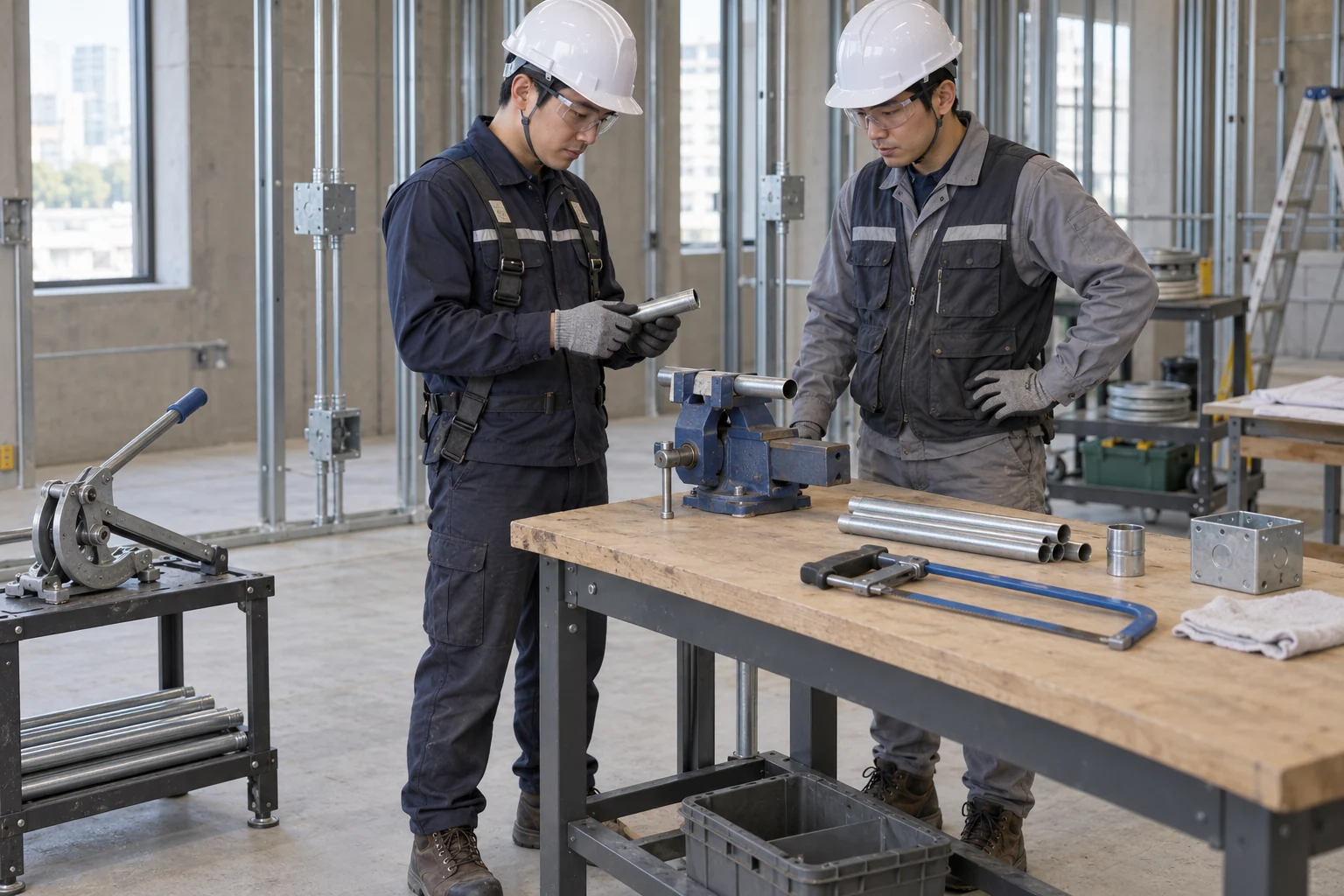
Retained AI-generated educational illustration from the source edition; not a real incident photograph, approved installation drawing or evidence of equipment suitability.
The scenario and record comparisons are fictional teaching examples, not records of real incidents, measurements, inspections, signatures or approvals.
| Item | Fictional scenario |
|---|---|
| Initial | A hand-bent conduit is ready for installation. |
| Change | The inside of the bend is visibly flattened. |
| Failure | The installer accepts it because the end fits the coupling. |
| Outcome | A damaged conduit route may injure conductors or fail the installation criteria. |
| Barrier | Hold and identify the tube, verify conduit/tool compatibility and replace or remake it to the applicable acceptance criteria. |
Why the controls matter
Trade size alone does not establish a permissible bender and conduit combination. Match conduit type, wall and actual tool rating. Substituted conduit requires another check, even when a fitting accepts its end.
A helper hand is not an offcut support. Secure the tube and support the cut end before sawing. Keep people clear of the full long-tube swing path during handling and bending.
Inspect inside and outside cut edges, bend shape, joints and box entries before wire pulling. A straight appearance does not demonstrate electrical continuity or acceptable bonding. Transfer inspection results and held sections to the electrical receiver.
Decision sequence
| Step | Decision |
|---|---|
| Known | The inside of the bend is visibly flattened. |
| Unknown | Actual condition, extent of damage and suitability of supports and boxes, joint assembly remain to be established. |
| Hold | The installer accepts it because the end fits the coupling. |
| Evidence | Link supports and boxes, joint assembly, access and reach, below-work exclusion, bend fault cause, support correction to the affected equipment or work area. |
| Next | Hold and identify the tube, verify conduit/tool compatibility and replace or remake it to the applicable acceptance criteria. |
5. Conditional decisions and common errors
| Condition | Action | Evidence | Proceed when |
|---|---|---|---|
| Tool mismatch | Hold bending | Conduit and tool identification | Combination permitted |
| Flattened bend | Segregate tube | Bend acceptance review | Accepted replacement |
| Loose support | Maintain temporary support | Substrate and fixing check | Load path verified |
| Ready for pulling | Inspect full route | Burr joint and bonding record | Route released |
Similar appearance, different evidence
The scenario and record comparisons are fictional teaching examples, not records of real incidents, measurements, inspections, signatures or approvals.
| Comparison | Supported decision | Insufficient basis |
|---|---|---|
| Condition | Conduit and tool identification | Tool mismatch has not been resolved. |
| Evidence | Substrate and fixing check | A photograph or a completed-looking task without the relevant inspection record. |
| Release | Route released | Completion of one step does not release the excluded tasks in section 2. |
6. Roles and responsibilities
| Role | Responsibility |
|---|---|
| Work supervisor | Assign the task boundary, stop authority, interfaces and emergency communication for manual metal conduit cutting, bending and installation. |
| Technical lead | Confirm Drawing and route; Type wall and size; Nearby circuits; Fitting instructions. Resolve design and manufacturer limits before work. |
| Authorised crew | Apply Blade and grip; Inside outside edges; Offcut support; Hand clearance. Stop when the working arrangement changes. |
| Inspector / receiving lead | Review Supports and boxes; Joint assembly; Access and reach; Below-work exclusion. Transfer Clean work area; Inspection record; Route and receiver; Open-end protection. |
Role labels allocate responsibilities; they do not confer a legal qualification. Verify the competence, training and authority required for the actual task.
The principal and employers coordinate the risk assessment and safe work procedures. These role labels allocate work; verify any qualifications and statutory appointments required for the actual Singapore activity. The receiving person must be given restrictions and unresolved defects before handover.
Record and handover perspective
| Stage | Record controls | Verification |
|---|---|---|
| Match route and tube | 1. Record drawing and route2. Record type, wall and size/mm3. Record nearby circuits | 1. Type, wall and size/mm2. Nearby circuits3. Fitting instructions |
| Cut and deburr | 1. Record blade and grip2. Record inside outside edges3. Record offcut support | 1. Inside outside edges2. Offcut support3. Hand clearance |
| Hand bend | 1. Record tool tube match2. Record swing exclusion3. Record footing and handle | 1. Swing exclusion2. Footing and handle3. Flattening and cracks |
| Install supports | 1. Record supports and boxes2. Record joint assembly3. Record access and reach | 1. Joint assembly2. Access and reach3. Below-work exclusion |
| Hold deformation | 1. Record bend fault cause2. Record support correction3. Record replacement record | 1. Support correction2. Replacement record3. Electrical access state |
| Clean and handoff | 1. Record clean work area2. Record inspection record3. Record route and receiver | 1. Inspection record2. Route and receiver3. Open-end protection |
7. Hold points and record comparison
| Hold point | Evidence before release | Actual record |
|---|---|---|
| HP-0 Start | Task boundary, site RA, SWP, responsibilities and emergency arrangements | |
| HP-1 Prepare bench and move | Travel and swing; Vice condition; Support positions; Tube length and weight | |
| HP-2 Cut and deburr | Blade and grip; Inside outside edges; Offcut support; Hand clearance | |
| HP-3 Inspect conduit route | Bore and bends; Fittings/earthing inspection; Route acceptance; Entry protection | |
| HP-4 Clean and handoff | Clean work area; Inspection record; Route and receiver; Open-end protection |
These are internal hold points, not issued permits. Recheck affected points after a change, fault or shift handoff; link the actual approval record.
Record comparison
The scenario and record comparisons are fictional teaching examples, not records of real incidents, measurements, inspections, signatures or approvals.
The boxes are static record prompts, not interactive or saved approvals. A tick does not establish suitability or permission to restart. Record the evidence, person, time and unresolved issues; retain the change history.
| Record | Insufficient | Record checklist |
|---|---|---|
| Match route and tube | "Checked" without target, criteria or result | □ Drawing and route□ Type wall and size□ Nearby circuits□ Fitting instructions |
| Cut and deburr | "Checked" without target, criteria or result | □ Blade and grip□ Inside outside edges□ Offcut support□ Hand clearance |
| Install supports | "Checked" without target, criteria or result | □ Supports and boxes□ Joint assembly□ Access and reach□ Below-work exclusion |
| Clean and handoff | "Checked" without target, criteria or result | □ Clean work area□ Inspection record□ Route and receiver□ Open-end protection |
Hold points are internal checks. Determine separately whether Singapore statutory or site permit requirements apply to this work. Leave confirmation, measurements and approval records blank until the authorised site process is completed.
8. Site checklist and emergency response
| Check | Result | Person / action |
|---|---|---|
| □ Match route and tube: Drawing and route | ||
| □ Prepare bench and move: Travel and swing | ||
| □ Cut and deburr: Blade and grip | ||
| □ Hand bend: Tool tube match | ||
| □ Install supports: Supports and boxes | ||
| □ Inspect conduit route: Bore and bends | ||
| □ Hold deformation: Bend fault cause | ||
| □ Clean and handoff: Clean work area | ||
| □ Emergency access and handoff restrictions |
Stop work
Hold for unknown conduit/tool compatibility, unverified supports or access, slipping tube, damaged blades, cracked or flattened bends, suspected concealed services or moving joints. Do not force a damaged tube into a fitting.
Emergency response
Keep people clear of fallen or electrically suspect conduit. Request safe shutdown and isolation by authorised electrical personnel. Do not touch a person or tube still exposed to electricity; activate site response and call the site emergency service as required.
9. Sources and review limits
Official public sources read for this Singapore edition on 2026-10-14. Guidance, statutory explanations and manufacturer limits have different roles; no source provider has approved this JSA.
| Source | Read scope and application limits |
|---|---|
| MOM — Risk management | Official explanation: employer, self-employed person and principal responsibilities; routine and non-routine risk assessment; hierarchy of controls; multidisciplinary assessment team. Official explanation of risk-management duties; no claim of reading the full linked statute. It does not specify task-specific equipment limits. Assess manual metal-conduit installation with employers, principal and affected contractors; resolve the inputs in section 2. |
| MOM — When should my company review its risk assessment? | Review every three years, after significant changes, new machinery/substances/procedures, hazard-related injury or incident, and when assessment is inadequate. General review guidance. A review interval does not permit continued operation after a known hazard or change. Reassess this operation after changes, defects, incidents or an inadequate assessment; do not wait for a scheduled review. |
| MOM — Permit-to-Work Systems | Formal work authorisation and coordination; OPEC tripartite guidance and competent permit authority with authority to reject work. OPEC-focused guidance page; not evidence of a blanket statutory permit requirement for every task. Determine permits for this actual activity and workplace; distinguish the section 7 internal hold points from statutory or site permits. |
| EMA — Engaging Licensed Electrical Workers | Overview and licence-class table: electrical wiring, circuit breaker and control-unit work carried out or superviced by a Licensed Electrical Worker; check valid licence and class for installation load/voltage. Official consumer overview, not a detailed installation standard or design approval. The actual installation conditions and LEW licence restrictions remain to be verified. Use EMA guidance for electrical-work responsibility, WSHC height guidance for access and lower-area protection, and ergonomics guidance for long material handling. Actual drawings and product instructions establish conduit and fixing acceptance. |
| WSH Council — Preventing Falls from Height | Employer access/protection controls, workplace-dependent fall prevention plan, hazardous work at height PTW applicability and supervisor/assessor/authorised-manager process. Official overview, not a full reading of the WAH Regulations or linked codes. PTW threshold does not mean lower falls are safe; actual anchorage, access and rescue require assessment. Use EMA guidance for electrical-work responsibility, WSHC height guidance for access and lower-area protection, and ergonomics guidance for long material handling. Actual drawings and product instructions establish conduit and fixing acceptance. |
| WSH Council — Improving Ergonomics in the Workplace (2014) | Introduction and section 4.1 excerpts: force, duration, repetition/posture, bulky and unstable loads, smaller packages, dry clear paths, coordinated handling and suitable mechanical aids. Selected guidance sections only, not a universal lifting-weight rule or current statutory audit. Actual task, worker capability, route and frequency must be assessed. Use EMA guidance for electrical-work responsibility, WSHC height guidance for access and lower-area protection, and ergonomics guidance for long material handling. Actual drawings and product instructions establish conduit and fixing acceptance. |
No universal support interval, bending radius, torque, allowable flattening or electrical continuity value is supplied. Full Singapore electrical standards and the actual product instructions were not read. Elevated work requires its own suitable platform, protection and any applicable Singapore permit process.
Actual site measurements, equipment instructions, engineering checks and signed approval records were not supplied. A qualified person must resolve these before use.
10. PDF guidance and FAQ
PDF A covers basic task controls; B focuses on technical failures; C covers supervision, records and handover. The article has eight stages with four items per main cell; each PDF has six key stages with three items per main cell. P/S/R/A, measurements, confirmations and signatures remain blank for actual site assessment.
Content group
jsa-metal-conduit-cut-bend-install
Does matching trade size prove compatibility?
No. Match conduit type and wall with the actual tool instructions.
Can wire pulling remove burrs?
No. Remove and inspect burrs before pulling conductors.
Is one support spacing universal?
No. Use the actual conduit route system, design and applicable code/product requirements.
Does fitting engagement prove bonding?
No. Verify permitted fittings, assembly and the required continuity/bonding inspection.
Has a professional approved this JSA?
This reference material was written and reviced with AI. It has not been verified or approved by a professional. Review by a suitably qualified professional and required site approval are necessary before field use.
11. Revision history and authorship
AI-generated reference material; not professionally verified or approved. Before use, a qualified person must review and adapt it to applicable Singapore requirements, the actual equipment/site and approved safe work procedures.
This Singapore edition was adapted from the Korean original and its assigned US technical reference. Earlier source revisions are archival editorial history, not Singapore technical approval.
| Date | Edition | Change | Review status |
|---|---|---|---|
| 2026-10-08 | Korean source v1.0 | Source editorial publication or revision; retained as provenance of the Korean edition. | Editorial record only; no professional technical approval recorded. |
| 2026-10-14 | 1.0 en-SG | Singapore legal scope, local planning, responsibility interfaces and SI terminology; new PDF A/B/C. | AI editorial and visual review only; no professional approval. |