The ability to lift a pallet does not establish that a person can safely start, steer and stop it. Assess load stability, wheels, floor and handling effort together.
This is reference content written and reviced with AI. It has not been verified or approved by a professional. Review by a suitably qualified professional and required site authorisation are necessary before use.
Stop conditions first
Hold for unknown load or pallet suitability, hydraulic leakage, unintended lowering, stuck wheels, blocked visibility or excessive start/stop effort. Do not use body momentum or a foot against a wheel to overcome the problem.
AI-generated reference material; not professionally verified or approved. Before use, a qualified person must review and adapt it to applicable Singapore requirements, the actual equipment/site and approved safe work procedures.
1. Singapore legal and technical basis
Apply Singapore risk assessment to the complete handling cycle and actual route. A manual pallet truck reduces lifting but can still require excessive starting, turning or stopping force. Its equipment rating does not establish a safe manual-handling demand for an individual worker.
| Basis | Singapore application |
|---|---|
| Risk management | The employer, self-employed person and principal assess and control work risks. Include preparation, abnormal conditions and maintenance. Coordinate affected trades and communicate controls. |
| Activity-specific guidance | Use WSHC ergonomics guidance for force, repetition, route and handling aids, and machinery guidance for intended use, inspection and defect control. Do not transfer powered-forklift licensing assumptions to this manual device. |
| Permits and authority | Select permit requirements for the actual sector and activity. Site hold points and contractor role labels do not create statutory permits or qualifications. |
| Equipment and design | This scope remains one low-lift manual truck on a level indoor route. No universal push/pull direction, manual force limit, maximum person-specific mass or ramp permission is given. The actual truck manual and measured route/handling demands were not supplied. |
2. Scope and required inputs
Included
Move one suitable pallet with a low-lift manual hydraulic pallet truck on a firm, level indoor route and lower it at a prepared destination.
Separate assessment
Ramps, docks, truck beds, lifts, stairs, riding, powered trucks and high-lift equipment are excluded.
| Input | Evidence needed |
|---|---|
| Identify load and truck | Load ID/weight basis; Truck/model limits; Effort and route plan; Pallet condition |
| Inspect route | Floor/joints; Crossing controls; Surface condition; Destination/turn space |
| Insert forks | Pallet underside; Insertion and balance; Foot/hand position; Load security |
| Park and transfer faults | Parked fork position; Wheel/hydraulic fault; Spill and route status; Follow-up owner |
No actual equipment model, SDS, site measurements, design calculations or authorisation record was supplied. Verify actual product limits and applicable Singapore requirements before use. Manufacturer guidance is not government approval.
Select task-appropriate eye, hand, foot, skin and hearing protection from the exposure assessment. Where respiratory protection is necessary, use the applicable respiratory-protection program; PPE does not replace isolation, guarding, support or ventilation.
Singapore site planning
The warehouse employer must link load identity and mass in kg to the actual truck model, fork dimensions, pallet structure and route. Inspect unloaded functions, wheels, hydraulic leakage and controlled lowering. Assess floor joints, turning clearance, travel distance, frequency and recovery. If a wheel catches or the load sways, stop jerking and reassess in a stable condition; change the route, load size or handling equipment where necessary. Powered assistance introduces a different operation and requires its own assessment and competence.
3. Eight-stage JSA
| Job stage | Hazards and effects | Failure factors | Technical and procedural controls | Site verification | P | S | R | A |
|---|---|---|---|---|---|---|---|---|
| 1. Identify load and truck | 1. Overload2. Load overturns3. Excessive exertion4. Pallet breaks | 1. Weight unknown2. Centre off-balance3. Rating used as effort limit4. Pallet structure weak | 1. Verify load and rating2. Check centre/stability3. Assess actual handling effort4. Match pallet and forks | 1. Load ID and mass/kg basis2. Truck/model limits3. Effort and route plan4. Pallet condition | ||||
| 2. Inspect route | 1. Wheel catches2. Pedestrian collision3. Lost control4. Body trapped | 1. Floor joint damaged2. Blind crossing3. Surface contaminated4. Turn too narrow | 1. Select level sound route2. Separate pedestrians3. Remove floor hazards4. Allow steering/escape room | 1. Floor/joints2. Crossing controls3. Surface condition4. Turn and destination space | ||||
| 3. Check unloaded truck | 1. Unintended lowering2. Poor steering3. Hand/foot pinch4. Load instability | 1. Hydraulic leak2. Wheel debris/damage3. Handle fault4. Fork damage | 1. Check model functions2. Inspect wheels and handle3. Remove defective truck4. Verify controlled lowering | 1. Lift/neutral/lower response2. Wheels/forks3. Leaks and handle4. Defect disposition | ||||
| 4. Insert forks | 1. Pallet splits2. Foot crushed3. Load tilts4. Finger trapped | 1. Fork fit wrong2. Feet by wheels3. Uneven insertion4. Pallet shifted by hand | 1. Match fork engagement2. Keep feet clear3. Centre balanced support4. Reposition with safe tools | 1. Pallet underside2. Insertion and balance3. Foot/hand position4. Load security | ||||
| 5. Start and travel | 1. Back/shoulder strain2. Load shifts3. Person struck4. Wheel stops abruptly | 1. Truck jerked2. Poor visibility3. Excess pace4. Floor defect ignored | 1. Follow model handling method2. Maintain sightline3. Move at controlled pace4. Stop excessive effort/catching | 1. Start/stop control2. Load stability3. Travel visibility4. Wheel/floor response | ||||
| 6. Turn and stop | 1. Handle-wall crush2. Load swings3. Foot runover4. Destination collision | 1. Escape room absent2. Sharp turn3. Body too near wheels4. Stopping distance short | 1. Maintain safe body space2. Turn smoothly3. Keep feet outside path4. Stop with adequate clearance | 1. Handle sweep/escape2. Load response3. Foot clearance4. Pedestrians/stop location | ||||
| 7. Lower and withdraw | 1. Foot under pallet2. Unstable landing3. Pallet dragged4. Fork strikes person | 1. Landing uneven2. People not cleared3. Forks withdrawn loaded4. Retreat path occupied | 1. Prepare stable landing2. Clear lowering area3. Confirm full support4. Withdraw forks carefully | 1. Floor/support state2. Hands/feet clear3. Pallet self-support4. Fork exit route | ||||
| 8. Park and transfer faults | 1. Defective truck reused2. Trip over forks3. Oil slip4. Unresolved load hold | 1. Fault unmarked2. Forks left raised3. Leak not contained4. Receiver uninformed | 1. Lower in designated place2. Mark defects for service3. Control spill safely4. Transfer load restrictions | 1. Parked fork position2. Wheel/hydraulic fault3. Spill and route status4. Follow-up owner |
P = likelihood; S = severity; R = risk using the site method; A = site acceptance/authorisation. Complete after actual assessment; no score overrides an unresolved hold point or equipment limit.
4. Failure mechanisms and hypothetical case
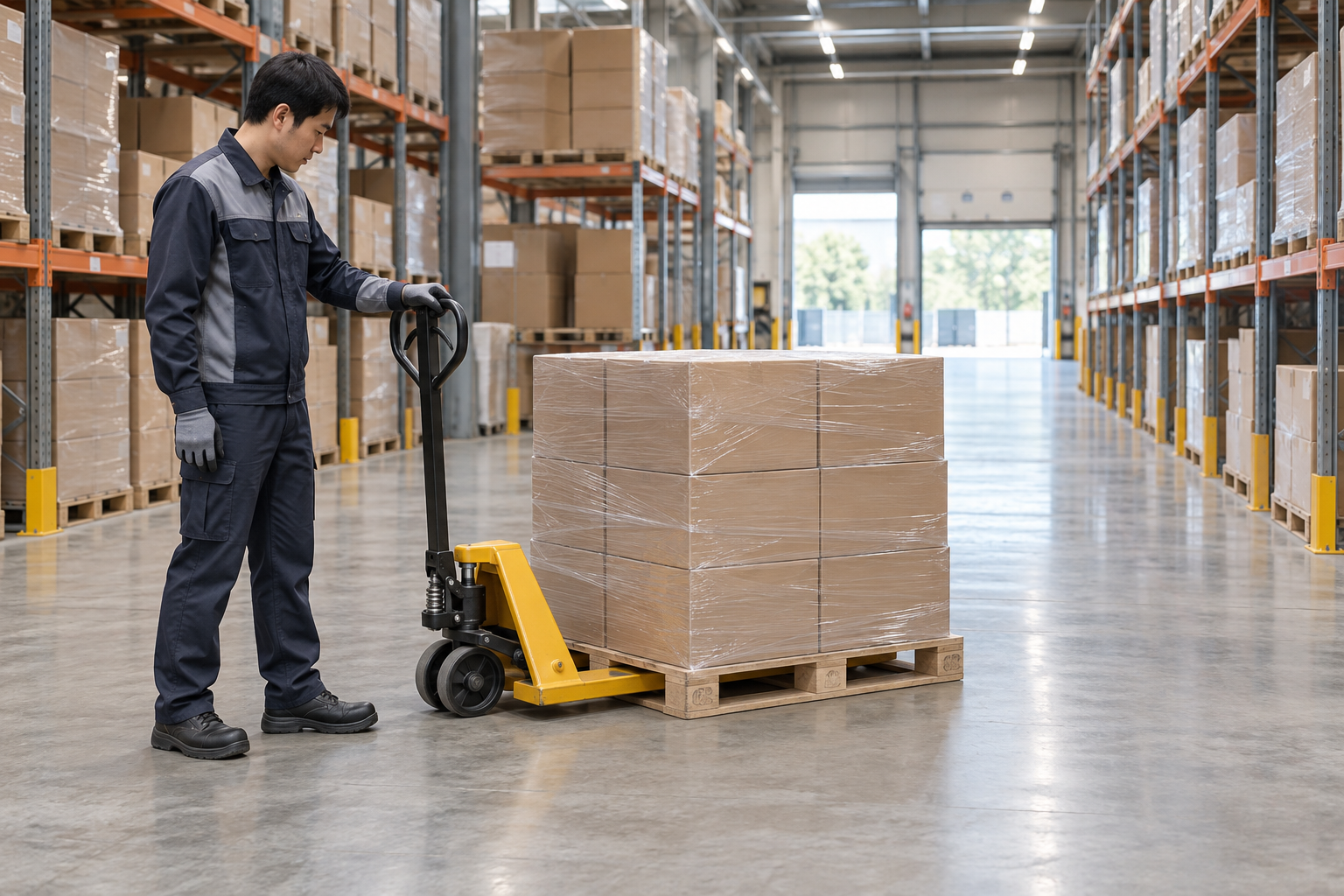
The retained illustration is an AI-generated educational image from the Korean source. It is not an actual incident photograph, approved drawing, equipment certification or proof that the depicted arrangement is safe.
Rated capacity concerns the equipment limits. Actual starting and stopping effort also depends on wheel condition, floor joints, distance, repetition and load distribution. Change the route, divide the load or select suitable powered assistance when the task cannot be controlled.
Do not copy a universal push-or-pull rule from another cart. Follow the actual truck instructions while preserving sightlines, foot clearance, steering room and an escape route.
A raised pallet may still be damaged, unevenly engaged or unstable. Inspect its lower structure and confirm fork fit and balanced support before moving.
Hypothetical decision example
Hypothetical example: a pallet is within truck capacity, but a wheel catches at a floor joint. Repeated jerking makes the upper load sway. Movement stops and access is controlled while the route, wheels and load are assessed in a stable condition.
The example is fictional; no incident, measurement, inspection or approval is asserted.
Task flow: Identify load and truck → Inspect route → Check unloaded truck → Insert forks → Start and travel → Turn and stop → Lower and withdraw → Park and transfer faults
5. Hold and proceed decisions
| Condition | Action | Evidence | Proceed when |
|---|---|---|---|
| Wheel catches | Stop; do not jerk | Floor, wheel and load assessment | Route/equipment corrected |
| Excess effort | Change handling method | Start/stop demands and alternatives | Task controllable |
| Pallet damaged | Hold lifting | Pallet structure and load support | Suitable pallet used |
| Load lowered | Check stable support | Floor contact and fork clearance | Forks clear safely |
Similar observation, different conclusion
| Observation | Supported conclusion | What remains unresolved |
|---|---|---|
| Forks rise | Lifting function responded | Whole-route handling remains unproved |
| Load below rating | One equipment limit met | Effort, centre and pallet still matter |
6. Roles and supervision
| Role | Responsibility |
|---|---|
| Work supervisor | Coordinate identify load and truck, affected operations, stop signals and stage transitions. |
| Technical/equipment reviewer | Verify Load ID/weight basis, Truck/model limits, actual instructions and unresolved technical limits. |
| Task crew | Apply the stated controls, report changes and keep actual checks and signatures factual. |
| Inspector/test lead | Connect Handle sweep/escape, Load response to the required acceptance criteria. |
| Receiving authority | Accept the recorded restrictions, Spill and route status, Follow-up owner, and follow-up ownership. |
These are responsibility examples, not invented statutory credentials. Verify actual competence, training and authority for the assigned work.
The principal and employers coordinate the risk assessment and safe work procedures. These role labels allocate work; verify any qualifications and statutory appointments required for the actual Singapore activity. The receiving person must be given restrictions and unresolved defects before handover.
Record and handover perspective
| Stage | Record controls | Verification |
|---|---|---|
| Identify load and truck | 1. Record load id and mass/kg basis2. Record truck/model limits3. Record effort and route plan | 1. Truck/model limits2. Effort and route plan3. Pallet condition |
| Check unloaded truck | 1. Record lift/neutral/lower response2. Record wheels/forks3. Record leaks and handle | 1. Wheels/forks2. Leaks and handle3. Defect disposition |
| Insert forks | 1. Record pallet underside2. Record insertion and balance3. Record foot/hand position | 1. Insertion and balance2. Foot/hand position3. Load security |
| Start and travel | 1. Record start/stop control2. Record load stability3. Record travel visibility | 1. Load stability2. Travel visibility3. Wheel/floor response |
| Lower and withdraw | 1. Record floor/support state2. Record hands/feet clear3. Record pallet self-support | 1. Hands/feet clear2. Pallet self-support3. Fork exit route |
| Park and transfer faults | 1. Record parked fork position2. Record wheel/hydraulic fault3. Record spill and route status | 1. Wheel/hydraulic fault2. Spill and route status3. Follow-up owner |
7. Hold points and record quality
| Hold point | Evidence before release | Actual record |
|---|---|---|
| HP-0 Start | Task boundary, site RA, SWP, responsibilities and emergency arrangements | |
| HP-1 Inspect route | Floor/joints; Crossing controls; Surface condition; Turn and destination space | |
| HP-2 Check unloaded truck | Lift/neutral/lower response; Wheels/forks; Leaks and handle; Defect disposition | |
| HP-3 Turn and stop | Handle sweep/escape; Load response; Foot clearance; Pedestrians/stop location | |
| HP-4 Park and transfer faults | Parked fork position; Wheel/hydraulic fault; Spill and route status; Follow-up owner |
Hold points are internal evidence gates. They do not establish that a statutory permit exists or has been approved. Recheck affected gates after changes, faults and shift handover.
Record comparison - hypothetical templates
The 16 boxes below identify record elements, not completed checks or approvals. They are static symbols. Link equipment/location, date, actual findings and the separate record reference; preserve unresolved items.
| Record | Insufficient entry | Required record elements |
|---|---|---|
| Identify load and truck | "Checked" without supporting facts | □ Load ID/weight basis□ Truck/model limits□ Effort and route plan□ Pallet condition |
| Check unloaded truck | "Checked" without supporting facts | □ Lift/neutral/lower response□ Wheels/forks□ Leaks and handle□ Defect disposition |
| Start and travel | "Checked" without supporting facts | □ Start/stop control□ Load stability□ Travel visibility□ Wheel/floor response |
| Lower and withdraw | "Checked" without supporting facts | □ Floor/support state□ Hands/feet clear□ Pallet self-support□ Fork exit route |
Hold points are internal checks. Determine separately whether Singapore statutory or site permit requirements apply to this work. Leave confirmation, measurements and approval records blank until the authorised site process is completed.
8. Pre-work checks and emergency response
| Check required | Result | Checker/action |
|---|---|---|
| Identify load and truck: Load ID/weight basis | ||
| Inspect route: Floor/joints | ||
| Check unloaded truck: Lift/neutral/lower response | ||
| Insert forks: Pallet underside | ||
| Start and travel: Start/stop control | ||
| Turn and stop: Handle sweep/escape | ||
| Lower and withdraw: Floor/support state | ||
| Park and transfer faults: Parked fork position |
Stop work
Hold for unknown load or pallet suitability, hydraulic leakage, unintended lowering, stuck wheels, blocked visibility or excessive start/stop effort. Do not use body momentum or a foot against a wheel to overcome the problem.
Emergency response
Keep people clear of a rolling, tilting or falling pallet. Do not catch the load, body-brace the handle against a wall or stop a wheel with a foot. If safely possible, use the normal controls to stop and lower the load onto a stable surface. Call the site emergency service for serious crushing injury and arrange a controlled recovery with suitable equipment; do not pull a trapped person from under an unsupported pallet.
9. Official sources and review limits
Official public sources read for this Singapore edition on 2026-10-14. Guidance, statutory explanations and manufacturer limits have different roles; no source provider has approved this JSA.
| Source | Read scope and application limits |
|---|---|
| MOM — Risk management | Official explanation: employer, self-employed person and principal responsibilities; routine and non-routine risk assessment; hierarchy of controls; multidisciplinary assessment team. Official explanation of risk-management duties; no claim of reading the full linked statute. It does not specify task-specific equipment limits. Assess manual pallet-truck transport with employers, principal and affected contractors; resolve the inputs in section 2. |
| MOM — When should my company review its risk assessment? | Review every three years, after significant changes, new machinery/substances/procedures, hazard-related injury or incident, and when assessment is inadequate. General review guidance. A review interval does not permit continued operation after a known hazard or change. Reassess this operation after changes, defects, incidents or an inadequate assessment; do not wait for a scheduled review. |
| MOM — Permit-to-Work Systems | Formal work authorisation and coordination; OPEC tripartite guidance and competent permit authority with authority to reject work. OPEC-focused guidance page; not evidence of a blanket statutory permit requirement for every task. Determine permits for this actual activity and workplace; distinguish the section 7 internal hold points from statutory or site permits. |
| WSH Council — Improving Ergonomics in the Workplace (2014) | Introduction and section 4.1 excerpts: force, duration, repetition/posture, bulky and unstable loads, smaller packages, dry clear paths, coordinated handling and suitable mechanical aids. Selected guidance sections only, not a universal lifting-weight rule or current statutory audit. Actual task, worker capability, route and frequency must be assessed. Use WSHC ergonomics guidance for force, repetition, route and handling aids, and machinery guidance for intended use, inspection and defect control. Do not transfer powered-forklift licensing assumptions to this manual device. |
| WSH Council — Guidelines on Safe Use of Machinery | Sections 1.1 and 1.3: scope and explanation of safeguarding/LOTO duties. Sections 4.3–4.4.3: training, maintenance, specified replacement parts and isolation of all energy sources; commissioning safety-device checks. Official practical guidance and explanation; complete current subsidiary legislation and every annex were not read. Actual manufacturer isolation and restoration instructions remain necessary. Use WSHC ergonomics guidance for force, repetition, route and handling aids, and machinery guidance for intended use, inspection and defect control. Do not transfer powered-forklift licensing assumptions to this manual device. |
This scope remains one low-lift manual truck on a level indoor route. No universal push/pull direction, manual force limit, maximum person-specific mass or ramp permission is given. The actual truck manual and measured route/handling demands were not supplied.
Actual site measurements, equipment instructions, engineering checks and signed approval records were not supplied. A qualified person must resolve these before use.
10. PDF use and frequently asked questions
PDF A summarizes core controls; B emphasizes technical failures; C covers supervision, records and handover. Each uses six stages from or aligned with the eight-stage body. All actual risk, measurement, check and signature fields are blank. Use a separate linked record where more space is needed.
Does the rated load establish a one-person limit?
No. Assess actual starting, turning and stopping demands and use an appropriate alternative when needed.
Can a threshold be crossed by jerking harder?
Stop and correct the route or equipment choice; do not repeatedly shock the load.
Must every pallet truck be pushed?
Use the model-specific instructions and safe sightline, steering and body position for the route.
Can this JSA authorize a ramp?
No. This scope is level indoor transport; slopes require a separate equipment and control plan.
Has a professional approved this JSA?
This is reference content written and reviced with AI. It has not been verified or approved by a professional. Review by a suitably qualified professional and required site authorisation are necessary before use.
11. Authorship and revision history
AI-generated reference material; not professionally verified or approved. Before use, a qualified person must review and adapt it to applicable Singapore requirements, the actual equipment/site and approved safe work procedures.
This Singapore edition was adapted from the Korean original and its assigned US technical reference. Earlier source revisions are archival editorial history, not Singapore technical approval.
| Date | Edition | Change | Review status |
|---|---|---|---|
| 2026-09-25 | Korean source v1.0 | Source editorial publication or revision; retained as provenance of the Korean edition. | Editorial record only; no professional technical approval recorded. |
| 2026-10-14 | 1.0 en-SG | Singapore legal scope, local planning, responsibility interfaces and SI terminology; new PDF A/B/C. | AI editorial and visual review only; no professional approval. |