Sort returns before immersion and measure the specified water conditions. Thick gloves do not make hidden shards safe to retrieve, and visibly clean dishes still need the separate establishment hygiene release.
AI-generated reference material. It has not been verified or approved by a professional. Before use, a qualified person must review and adapt it to applicable Singapore requirements, the actual equipment and site, and approved safe work procedures.
1. Singapore legal and technical basis
Apply Singapore WSH risk management to sharps, chemical handling, hot water and wet work. SFA guidance distinguishes washing from sanitising and hygienic storage. SFA also distinguishes dishwashers who do not prepare food from food handlers; assess actual duties rather than assigning food-handler certification solely from a kitchen job title.
| Source category | Task application and limit |
|---|---|
| MOM - Risk management | Assess changing water conditions, sharp-item segregation and repeated wet work. Official explanation of WSH Risk Management duties, not a complete consolidated statutory text. |
| SFA - Food Handler Handbook, utensils | Link washing to the specified separate sanitising and storage steps; reject damaged crockery. Direct PDF fetch unavailable; only this indexed extract was read. Thermal sanitising examples are not adopted for manual hand immersion. Product/site sanitising requirements remain separate. |
| SFA - Requirements for Food Handlers | Distinguish washing-only duties from any actual food preparation assignment. Applies to actual food-handling duties in SFA-licensed establishments. A training record is not proof of knife competence or workplace safety acceptance. |
| MOM - Requirements for hygiene monitoring | Assess the actual wash products and any applicable exposure monitoring. Material-specific exposure and actual monitoring frequency have not been determined. No workplace measurement is supplied. |
Use Singapore requirements and SI units. Manufacturer limits apply to the actual model. Foreign technical examples do not establish Singapore statutory duties. A job safety analysis or completed checklist is not a permit or approval.
2. Scope and required inputs
Included: Sorting ordinary returned dishes, manual scraping and washing, controlled rinsing, safe rack handling and drying-area transfer in an identified food-service wash station. Required food-hygiene sanitizing and release follow the separately specified local procedure.
Separate review: Knife and powered-blade cleaning, dishwasher maintenance, boiling-water or steam sanitizing, oversized heavy cookware and unknown chemical mixtures require separate controls.
| Input | Required evidence |
|---|---|
| Sort returned dishes | Dish and sharp-item check; Return container load; Rejected item location; Receiving area condition |
| Prepare station and PPE | Floor and standing surface; Eye hand and body protection; Glove fit and condition; Reach and rack arrangement |
| Rinse and separate | Water and rinse process; Remaining hygiene stages; Dirty-clean separation; Rack stability and load |
| Close and transfer | Floor drainage and footing; Product closure and storage; No retained sharp debris; Next-shift acceptance |
Identify the wash product, label and SDS, permitted dilution, measured water conditions, dish and rack loads, sink access and drainage. Select hand, eye, body and footwear protection for actual chemical, thermal and cut hazards. Resolve sanitizing method and food-contact acceptance under the establishment procedure and applicable Singapore requirements; washing alone does not establish hygiene release.
Singapore application
Agree the establishment cleaning and sanitising sequence before setting up the sink. This manual washing task excludes boiling-water or steam sanitising; any required thermal process needs suitable equipment and a separate safe method, not hand immersion.
3. Eight-stage JSA
| Job stage | Hazards and effects | Failure factors | Controls | Site verification | P | S | R | A |
|---|---|---|---|---|---|---|---|---|
| 1. Sort returned dishes | 1. Hidden-shard cuts2. Knife puncture3. Dropped-load injury4. Dirty-clean mixup | 1. Items submerged unsorted2. Sharp tools mixed in3. Return bin overloaded4. Routes not separated | 1. Inspect and sort returns2. Divert excluded sharps3. Use manageable batches4. Separate dirty and clean flow | 1. Dish and sharp-item check2. Return container load3. Rejected item location4. Receiving area condition | ||||
| 2. Set product and water | 1. Chemical burns2. Hot-water scald3. Toxic mixture exposure4. Skin irritation | 1. Cleaner unidentified2. Temperature tested by hand3. Products mixed4. Dilution guessed from foam | 1. Check label and SDS2. Measure water as specified3. Keep chemicals separate4. Use approved dispensing | 1. Product and dilution method2. Measured water condition3. No incompatible products4. Dispenser condition | ||||
| 3. Prepare station and PPE | 1. Slip and fall2. Chemical splash3. Glove exposure4. Awkward-reach strain | 1. Drainage blocked2. Eye protection unsuitable3. Gloves damaged or wet4. Sink layout overcrowded | 1. Maintain drainage and footing2. Use assessed splash protection3. Inspect suitable gloves4. Arrange close stable access | 1. Floor and standing surface2. Eye hand and body protection3. Glove fit and condition4. Reach and rack arrangement | ||||
| 4. Scrape and wash | 1. Hidden-edge cuts2. Repeated-grip strain3. Splash exposure4. Dropped slippery dishes | 1. Blind hand search2. Large batch held long3. Aggressive splashing4. Poor grip or unstable load | 1. Keep hands clear of sharps2. Use manageable work cycles3. Use controlled washing motion4. Support dishes and racks | 1. Clear item visibility2. Batch weight and posture3. Splash and skin condition4. Stable grip and support | ||||
| 5. Rinse and separate | 1. Hot-water contact2. Chemical residue exposure3. Cross-contamination4. Rack overload | 1. Water condition changes2. Rinse method unclear3. Clean items mixed back4. Rack filled beyond safe load | 1. Verify rinse conditions2. Follow specified sequence3. Maintain separate flow4. Limit rack loading | 1. Water and rinse process2. SFA hygiene-stage handover3. Dirty-clean separation4. Rack stability and load | ||||
| 6. Dry and stack | 1. Falling-dish cuts2. Shoulder strain3. Unstable stack collapse4. Food-hygiene failure | 1. Wet racks slip2. High reach required3. Mixed shapes stack poorly4. Wash mistaken for release | 1. Use stable drying supports2. Keep handling within safe reach3. Stack compatible items safely4. Apply hygiene release procedure | 1. Rack and shelf condition2. Handling height and load3. Stack stability4. Required sanitizing status | ||||
| 7. Hold breakage or exposure | 1. Deep cuts2. Thermal injury3. Chemical injury4. Repeated contamination | 1. Fragments searched by hand2. Hot sink reused immediately3. Symptoms ignored4. Affected items not held | 1. Stop incoming returns2. Control drain and cooling3. Remove shards with tools4. Hold affected dishes | 1. Breakage and affected area2. Safe sink recovery method3. Exposure response4. Inspection before restart | ||||
| 8. Close and transfer | 1. Slip from residual water2. Chemical storage exposure3. Hidden-fragment injury4. Lost defect information | 1. Floor left wet2. Containers unlabelled3. Sink not inspected4. Next shift unbriefed | 1. Drain and clean station safely2. Close labelled products3. Inspect sink and collection tools4. Transfer defects and restrictions | 1. Floor drainage and footing2. Product closure and storage3. No retained sharp debris4. Next shift and hygiene holds |
P/S/R/A and actual measurements, checks, names and signatures remain blank for the site assessment. A score cannot waive a required control.
4. Hypothetical scenario and failure mechanisms
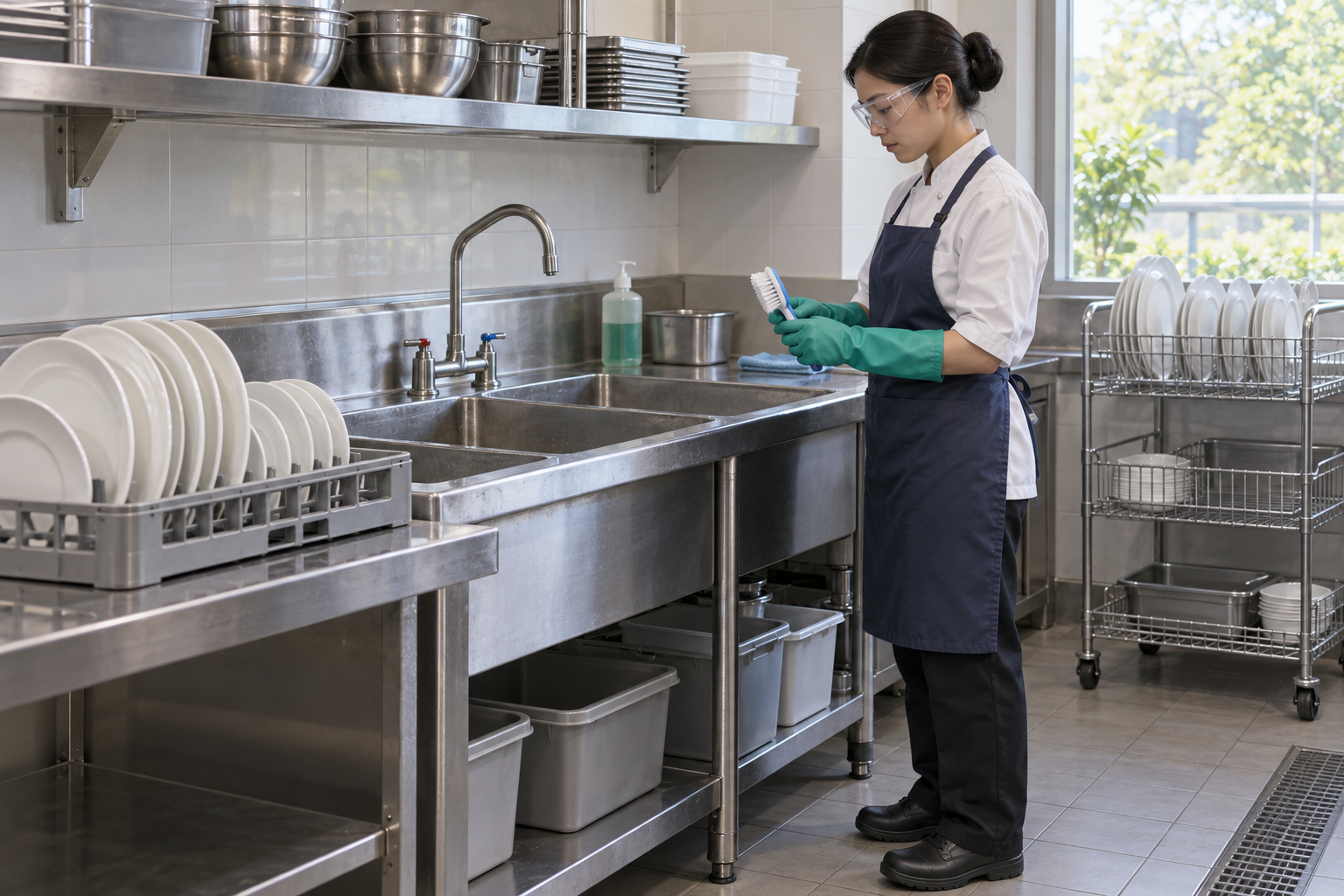
The following scenario, comparisons and example records are hypothetical teaching material. They do not reproduce actual incidents, measurements, signatures or approvals.
| Item | Hypothetical situation |
|---|---|
| Initial state | An operator washes dishes in cloudy sink water. |
| Change | A glass breaks and the water temperature unexpectedly rises. |
| Failure path | Thick gloves are treated as permission to reach into the sink for fragments. |
| Possible harm | Hidden shards can penetrate or cut gloves while hot water and trapped liquid increase injury. |
| Barrier | Stop returns, control and safely drain or cool the sink, remove fragments with suitable tools and inspect the affected area before resetting the measured wash conditions. |
Cloudy water hides broken edges and knives. Sort incoming items before immersion and keep excluded sharp tools on a separate controlled route. If breakage occurs, hold affected dishes and remove fragments with suitable tools rather than blind hand searching.
Gloves have limits for heat, chemicals and cuts. Select them for the actual exposure and duration, inspect before use and replace damaged or internally wet gloves. Reduced sensation is not proof that the water is safe; use the specified measuring method.
Cleaner concentration must follow the actual dispensing or measuring method. Foam volume does not prove correct dilution. Keep products identified, never mix incompatible cleaners, and provide immediate access to the required emergency flushing arrangements.
Wet work combines repeated grip, awkward reach and slippery loads. Keep manageable batches near the body, use a stable rack and suitable working height, and coordinate breaks or task rotation. Maintain drainage and a safe standing surface while keeping dirty and clean flows distinct.
| Decision | Reason and evidence |
|---|---|
| Known facts | A glass breaks and the water temperature unexpectedly rises. |
| Unresolved | Thick gloves are treated as permission to reach into the sink for fragments. |
| Hold reason | Stop for broken dishes or hidden sharps, unexpected water temperature, unknown cleaner or concentration, damaged gloves, chemical symptoms, unstable stacks or uncontrolled wet-floor conditions. |
| Evidence needed | Breakage and affected area; Safe sink recovery method; Exposure response; Inspection before restart. |
| Next decision | Stop returns, control and safely drain or cool the sink, remove fragments with suitable tools and inspect the affected area before resetting the measured wash conditions. |
Singapore application
Provide safe storage for concentrated products away from food and clean utensils. A change in dispenser, product strength or hot-water supply requires the settings and worker protection checked again.
5. Hold and proceed decisions
| Condition | Action | Evidence | Proceed when |
|---|---|---|---|
| Broken item found | Stop and hold the affected sink and dishes. | Tool-assisted removal and inspection. | Fragments controlled. |
| Water changes | Hold contact and check measured conditions. | Temperature and supply correction. | Conditions accepted. |
| Glove damaged or wet | Stop exposure and replace protection. | Product suitability and skin condition. | Protection restored. |
| Wash complete | Apply remaining hygiene stages separately. | Sanitizing and release record. | Hygiene criteria met. |
| Comparison | Situation A | Situation B |
|---|---|---|
| Gloves feel comfortable | Product suitability, condition and water measurement are checked. | Reduced heat sensation is treated as proof of protection. |
| Dishes look clean | Required hygiene stages and release are completed separately. | Washing is treated as sanitizing acceptance. |
6. Roles and supervision
| Role | Responsibility |
|---|---|
| Work supervisor | Confirm scope, task sequence, exclusion and stop authority. Coordinate sort returned dishes with affected operations. |
| Technical reviewer | Resolve the actual design and equipment limits: Dish and sharp-item check; Return container load; Rejected item location; Receiving area condition. |
| Work crew | Perform prepare station and ppe using the approved procedure; report any mismatch before proceeding. |
| Inspector / assessor | Verify Rack and shelf condition; Handling height and load; Stack stability; Required sanitizing status. Record what was actually checked and what remains unresolved. |
| Release / receiving authority | Confirm Floor drainage and footing; Product closure and storage; No retained sharp debris; Next-shift acceptance. Transfer restrictions and the next permitted stage. |
These are responsibility examples, not invented statutory credentials. Meet the actual training, competent-person, qualified-person and licensing requirements for the assigned work. Anyone may raise a hazard and request a stop; only the designated authority may release the affected stage after evidence is reviewed.
Singapore application
The wash-station supervisor controls dosing, incoming returns and broken-item holds. The kitchen food-safety lead accepts the required hygiene stages and affected crockery. If a dishwasher is reassigned to preparing food, verify the food-handler requirements before that work begins.
7. Hold points and record quality
| Hold point | Evidence before release | Confirmation / approval |
|---|---|---|
| HP-0 Start | Scope, jurisdiction, equipment identity, responsible people and emergency arrangements. | |
| HP-1 Set product and water | Product and dilution method; Measured water condition; No incompatible products; Dispenser condition | |
| HP-2 Prepare station and PPE | Floor and standing surface; Eye hand and body protection; Glove fit and condition; Reach and rack arrangement | |
| HP-3 Hold breakage or exposure | Breakage and affected area; Safe sink recovery method; Exposure response; Inspection before restart | |
| HP-4 Close and transfer | Floor drainage and footing; Product closure and storage; No retained sharp debris; Next-shift acceptance |
Hold points are internal evidence gates. They do not replace statutory permits or actual signatures. Recheck affected gates after a change, abnormal event or shift transfer. The blank record must identify the evidence, person, time, limits and release scope.
| Record | Insufficient record | Record checklist |
|---|---|---|
| Setup | Water feels warm | □ Product and dilution method□ Measured water condition□ No incompatible products□ Dispenser condition |
| Protection | Thick gloves worn | □ Floor and standing surface□ Eye hand and body protection□ Glove fit and condition□ Reach and rack arrangement |
| Recovery | Glass picked out | □ Breakage and affected area□ Safe sink recovery method□ Exposure response□ Inspection before restart |
| Transfer | Dishes look clean | □ Floor drainage and footing□ Product closure and storage□ No retained sharp debris□ Next-shift acceptance |
The □ boxes are static prompts, not saved or interactive approvals. Each checks one record element. A tick alone does not establish suitability or permission to restart. Link equipment IDs and supporting records; retain unresolved matters and the earlier record when conditions change.
8. Pre-work checks and emergency response
| Check item | Result | Person / action |
|---|---|---|
| Dish and sharp-item check | ||
| Product and dilution method | ||
| Floor and standing surface | ||
| Clear item visibility | ||
| Water and rinse process | ||
| Rack and shelf condition | ||
| Breakage and affected area | ||
| Floor drainage and footing | ||
| Emergency arrangements and unresolved restrictions communicated |
Stop work: Stop for broken dishes or hidden sharps, unexpected water temperature, unknown cleaner or concentration, damaged gloves, chemical symptoms, unstable stacks or uncontrolled wet-floor conditions.
Emergency response: Stop work for a cut, scald or chemical exposure and follow the site first-aid plan and actual product SDS. Use the required immediate flushing facilities for chemical splashes; do not mix neutralizing chemicals. Contact the site emergency responders for severe injury, breathing difficulty or other urgent symptoms, and keep the affected station out of use until its hazards are resolved.
9. Sources and review limits
Public-source review: 14 October 2026. Only the material and limits identified below were reviewed.
| Source | Reviewed material | Task application |
|---|---|---|
| MOM - Risk management | Responsibilities; routine and non-routine work; hierarchy of control and risk assessment team. Official explanation of WSH Risk Management duties, not a complete consolidated statutory text. | Assess changing water conditions, sharp-item segregation and repeated wet work. |
| SFA - Food Handler Handbook, utensils | Indexed printed page 11, sections 4.1-4.5: cleaning/sanitising, separated stages, clean raised storage and rejecting damaged crockery. Direct PDF fetch unavailable; only this indexed extract was read. Thermal sanitising examples are not adopted for manual hand immersion. Product/site sanitising requirements remain separate. | Link washing to the specified separate sanitising and storage steps; reject damaged crockery. |
| SFA - Requirements for Food Handlers | Food-handler definition, cleaner/dishwasher exclusion, FSC Level 1, retraining and licensee registration requirements, June 2026 page. Applies to actual food-handling duties in SFA-licensed establishments. A training record is not proof of knife competence or workplace safety acceptance. | Distinguish washing-only duties from any actual food preparation assignment. |
| MOM - Requirements for hygiene monitoring | Main requirements: competent monitoring personnel, toxic substances, results and reporting, recommended frequency table and noise applicability. Material-specific exposure and actual monitoring frequency have not been determined. No workplace measurement is supplied. | Assess the actual wash products and any applicable exposure monitoring. |
Selected public official sources were reviewed on 14 October 2026 within the recorded scope. No full consolidated legal audit, paid Singapore Standard, actual model manual, site inspection, engineering calculation or professional approval is claimed. Verify current detailed requirements and actual equipment/site records before use.
AI-generated reference material. It has not been verified or approved by a professional. Before use, a qualified person must review and adapt it to applicable Singapore requirements, the actual equipment and site, and approved safe work procedures.
10. PDF use and frequently asked questions
PDF A covers basic task controls; B examines technical failures; C focuses on supervision, evidence and handover. Each has six rows and three items per main cell. They are complementary extracts: apply all eight body stages and the applicable site procedure. An omitted stage is not permission to omit its controls. PDF HP-0 through HP-4 are worksheet labels; match the event, evidence and authority rather than assuming they match another permit by number.
P/S/R/A, actual measurements, confirmations and signatures remain blank. The PDFs are uncompleted reference worksheets, not issued work permits.
Content group ID: jsa-manual-dishwashing
Can thick gloves make hidden glass safe to retrieve?
No. Stop, control the sink and use suitable tools and inspection instead of reaching blindly.
Can water temperature be checked by hand?
Use the specified measuring method. Glove insulation and skin sensation do not establish an acceptable condition.
Does more foam prove correct cleaner concentration?
No. Follow the product label and approved dosing method.
Does this JSA define a universal sanitizing temperature?
No. Use the establishment hygiene procedure, actual product or equipment instructions and applicable Singapore food-hygiene requirements.
Has a professional verified or approved this document?
No. This is AI-assisted reference material. Editorial and layout checks are not a physical inspection or professional technical approval. Obtain qualified professional review and required site approval before use.
Singapore application
Read A, B and C together with all eight JSA stages and the approved work procedure. The sheets are complementary extracts, not separate work authorisations.
11. Authorship and revision history
AI-generated reference material. It has not been verified or approved by a professional. Before use, a qualified person must review and adapt it to applicable Singapore requirements, the actual equipment and site, and approved safe work procedures.
| Date / edition | Authorship and scope | Professional approval |
|---|---|---|
| 2026-10-04 / Korean source | Original topic and educational illustration retained as references. Source content is unchanged. | Not asserted |
| 14 October 2026 / Singapore 1.0 | Added Singapore SFA hygiene stages and the dishwasher/food-handler role distinction; retained measured water conditions and separate worker-safety and dish-hygiene release. | Not performed |
Source topic: https://smartjsabridge.com/ko/case-study/jsa-manual-dishwashing