A newly assembled manhole may receive water, gases or exhaust through pipes or the opening. Air can vary by depth, work location and time; sampling must cover the actual hazards.
AI-generated reference material; not professionally verified or approved. Before use, a qualified person must review and adapt it to Singapore requirements, the actual equipment/site and approved safe work procedures.
Stop before starting
Exit immediately for gas alarms, ventilation or communication loss, or changing inflow. Do not enter during block lowering or with unstable support or unverified rescue arrangements.
1. Legal and technical scope
| Basis | Scope and limits |
|---|---|
| MOM: Risk management | Assess non-entry alternatives, inflow, atmosphere, lifting and closure separately. Official explanation of statutory duties; linked SSO text was not independently read for this item. This is not a legal opinion. |
| WSH Council: Working Safely in Confined Spaces | Establish the entry permit and actual supervisor/CSSA/manager/attendant responsibilities. Official explanatory guidance; actual classification, current regulations and site conditions must be resolved. |
| WSH Council: Technical Advisory on Working Safely in Confined Spaces | Plan suitable instruments, work-zone sampling, monitoring, continuous ventilation and re-certification after unsafe changes. Selected sections, not entire 48-spread PDF. No sample permit values/signatures copied; numeric entry criteria require current statutory and substance-specific confirmation by CSSA. |
| WSH Council: Excavation accident advisory, 11 December 2018 | Provide actual excavation support, access, water control and relevant permit. Dated official guidance, not a full reading of current Construction Regulations or SS 562. Actual statutory exceptions, PE/design and BCA submission requirements require project review; incident details are not reused as the fictional case. |
| WSH Council: Planning a Lift | Control precast lifting points, rigging, signals and people below. Official practical guidance. No assertion that every activity is a crane operation or that this page itself establishes a universal statutory permit. |
| MOM/NEA/SCDF: Revised SS 586 adoption | Assess finishing-material hazards using the actual label and SDS. Official adoption circular, not full paid SS 586 text or a classification of the actual product; verify current supplier label and SDS. |
Apply Singapore WSH risk management separately to excavation, block lifting and entry. Assess the manhole under the WSH (Confined Spaces) framework even when newly built. Covered entry requires the supervisor’s application, assessment/testing by the confined space safety assessor (CSSA), authorisation by the authorised manager and an appointed attendant, with isolation, ventilation and prepared rescue. Coordinate the applicable excavation permit and lifting plan separately; a lowered and joined block is not an entry permit.
2. Scope and required inputs
Included work
Prepare the foundation, lift and join precast manhole sections, evaluate and authorise any interior finishing, monitor entry, exit, close and hand over the installation.
Separate assessment
Live sewer changeovers, high-pressure cleaning, diving and emergency entry into an unsafe atmosphere require separate specialized procedures. Prefer non-entry assembly and inspection where feasible.
| Required input | Evidence to obtain |
|---|---|
| Evaluate location | Connections and inflows; Work and space classification; Non-entry alternatives; Rescue capability |
| Protect excavation | Competent inspection; Rain and groundwater; Opening and traffic barrier; Access arrangement |
| Inspect blocks | Block ID and condition; Insert and rigging fit; Weight and crane plan; Level and bearing |
| Lower and join | Personnel clear; Joint and alignment; Stable support; Rigging release criteria |
No actual equipment model, site measurements, design calculations or signed approval was supplied. Check the applicable Singapore requirements and approved safe work procedures against the actual equipment and site before use. Statutory duties, official guidance and manufacturer limits serve different purposes; editorial checks do not establish legal or professional approval.
Singapore site application
Coordinate the builder, manhole/service owner and affected utilities; control rain, groundwater, connected pipes and nearby engine exhaust. Prefer non-entry assembly/inspection. The CSSA selects gases, instruments and locations for the actual space, rather than treating one oxygen result at the cover as entry clearance.
Record gas values with actual units (% volume, %LEL or ppm as appropriate), instrument checks, location/depth/time, assessor and permit reference. Keep results blank here. Maintain suitable monitoring and ventilation; follow the CSSA’s retest/re-entry plan and authorised-manager review after breaks or changes.
3. Eight-stage JSA
| Job stage | Hazards and effects | Failure factors | Technical and procedural controls | Site verification | P | S | R | A |
|---|---|---|---|---|---|---|---|---|
| 1. Evaluate location | 1. Excavation collapse2. Engulfment3. Oxygen deficiency4. Toxic gas exposure | 1. Pipe links unknown2. Inflow overlooked3. New-space assumption4. Exhaust path missed | 1. Assess soil and utilities2. Map and control inflows3. Evaluate entry and alternatives4. Prepare entry and rescue plan | 1. Connections and inflows2. Work and space classification3. Non-entry alternatives4. Rescue capability | ||||
| 2. Protect excavation | 1. Sidewall collapse2. Opening fall3. Vehicle strike4. Unsafe access | 1. Support inadequate2. Guard removed3. Traffic not separated4. Ladder unsecured | 1. Verify protective system2. Guard openings3. Separate equipment and people4. Provide secure access | 1. Competent inspection2. Rain and groundwater3. Opening and traffic barrier4. Access arrangement | ||||
| 3. Inspect blocks | 1. Dropped section2. Stack overturn3. Insert failure4. Foundation settlement | 1. Cracked block2. Weak storage3. Wrong lifting insert4. Uneven base | 1. Match weight and rigging2. Inspect lifting points3. Stabilise storage4. Verify foundation | 1. Block ID and condition2. Insert and rigging fit3. Weight and crane plan4. Level and bearing | ||||
| 4. Lower and join | 1. Worker crushed2. Joint pinch3. Block movement4. Rigging release | 1. Person inside2. Hand alignment3. Support incomplete4. Tension released early | 1. Clear inside and below2. Use alignment tools3. Check full bearing and joint4. Release by planned sequence | 1. Personnel clear2. Joint and alignment3. Stable support4. Rigging release criteria | ||||
| 5. Authorise entry | 1. Hazardous air2. Rescue delay3. Unexpected inflow4. Entrant isolated | 1. Opening-only test2. Rescue unprepared3. Isolation incomplete4. No attendant | 1. Test actual work locations2. Verify ventilation and rescue3. Control incoming hazards4. Establish attendant and contact | 1. CSSA gas test/results2. Authorised entry permit3. Ventilation and isolation4. Attendant contact and rescue | ||||
| 6. Finish and monitor | 1. Changing atmosphere2. Material exposure3. Exhaust ingress4. Lost communication | 1. Monitoring inadequate2. Wrong coating3. Engine moved4. Contact interrupted | 1. Maintain required monitoring2. Control finishing materials3. Keep intake air clean4. Exit on unsafe change | 1. Work-zone measurements2. Material and ventilation3. External inflow sources4. Attendant and communication | ||||
| 7. Evacuate and respond | 1. Rescuer overcome2. Retrieval injury3. Extra fall4. Delayed response | 1. Impulsive entry2. Unplanned retrieval3. Opening unguarded4. No capable service | 1. Exit and raise alarm2. Use prepared rescue system3. Keep unauthorised people out4. Activate designated responders | 1. Entrant accountability2. Retrieval limits3. Rescue access and equipment4. Response contact | ||||
| 8. Close and handover | 1. Entrant trapped2. Cover displaced3. Tool falls4. Flow restored early | 1. People not counted2. Fixing unchecked3. Tools left4. Sequence confused | 1. Account for people and tools2. Secure cover and barriers3. Check interior status4. Authorise staged restoration | 1. Exit and tool count2. Cover and traffic state3. Flow restoration sequence4. Future entry restrictions |
P = likelihood; S = severity; R = risk under the site method; A = site-defined acceptance/authorization. These actual assessment cells are blank. A low score never overrides a missing safeguard or a legal or manufacturer restriction.
4. Fictional scenario and failure mechanisms
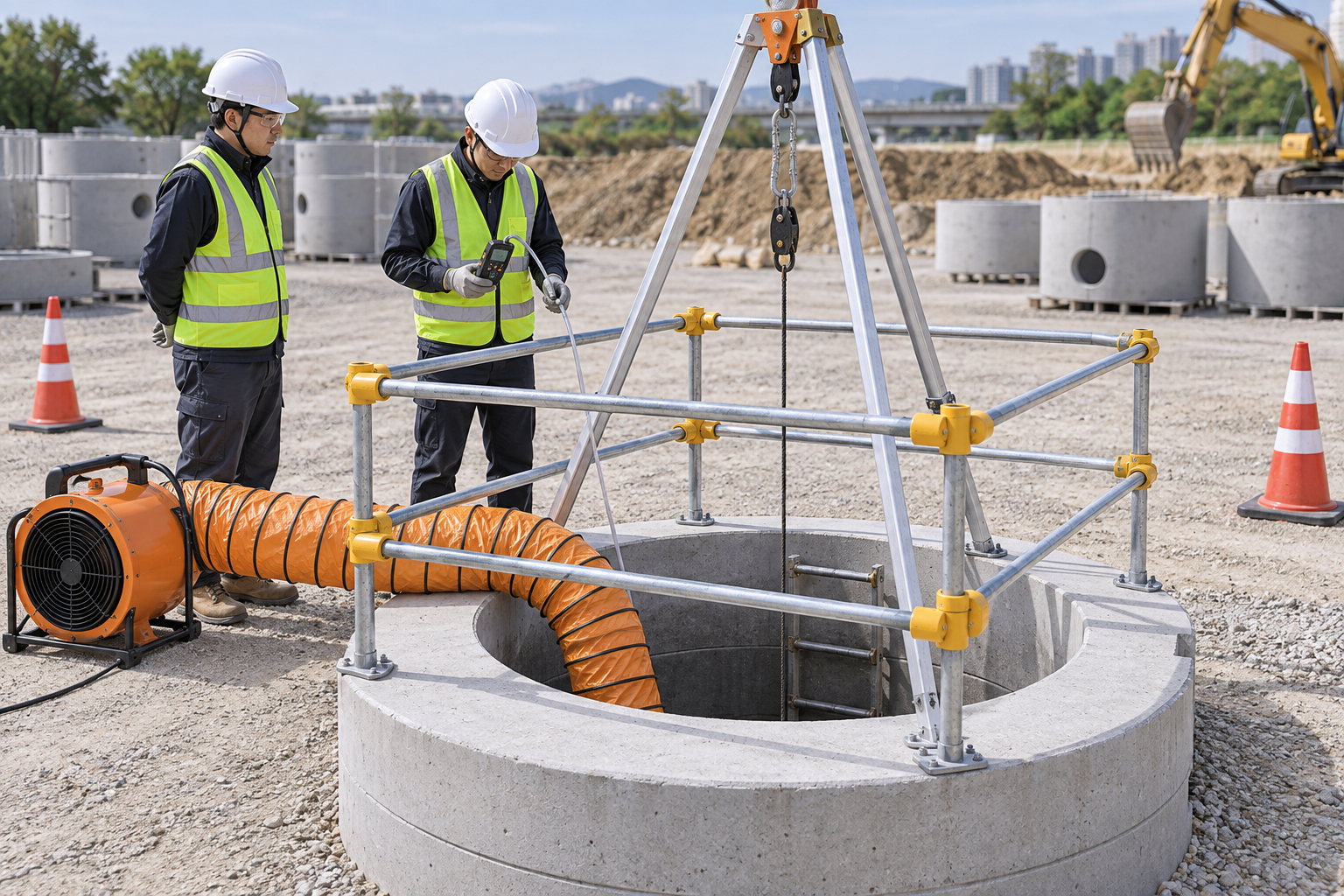
This illustration provides educational context. It is not an actual incident photograph or evidence of equipment suitability; any AI-generated depiction is illustrative only.
The scenario and record comparisons are fictional teaching examples, not records of real incidents, measurements, inspections, signatures or approvals.
| Stage | Fictional situation |
|---|---|
| Initial situation | Interior finishing is planned in a newly assembled manhole. |
| Changed condition | Only the opening was sampled; then the duct moves and a nearby engine directs exhaust toward it. |
| Failure path | The crew relies on the old opening result and the fact that the structure is new. |
| Possible outcome | Workers can be exposed to hazardous air and an impulsive rescuer can become another casualty. |
| Prevention barrier | Hold or evacuate entry, control incoming hazards and verify current work-zone air, ventilation, communication and rescue readiness. |
Failure mechanisms
A newly assembled manhole may receive water, gases or exhaust through pipes or the opening. Air can vary by depth, work location and time; sampling must cover the actual hazards.
Blower sound does not prove clean air at the worker. Verify intake quality, duct location and delivery with suitable gas testing/monitoring; ventilation cannot substitute for measurement.
Assembly support release and human entry need separate decisions. Keep everyone outside during lowering; later verify atmosphere, inflow isolation, access, communication, permit and rescue before entry.
Plan capable rescue before entry, including retrieval limits and access. An emergency number alone is not a rescue arrangement. The attendant must not enter impulsively; a dust respirator cannot protect against oxygen deficiency.
Decision sequence
| Step | Decision |
|---|---|
| Known | Only the opening was sampled; duct position and nearby engine exhaust then changed. |
| Unknown | Current work-zone atmosphere, ventilation and contaminant inflow are unresolved. |
| Hold | Withhold entry or evacuate; do not reuse the earlier result as current clearance. |
| Evidence | Link source control, ventilation layout, CSSA tests/monitoring, communication and rescue to the permit. |
| Release | Permit parties reassess/re-certify and authorise re-entry; maintain monitoring and exit on unsafe change. |
Work sequence: Evaluate location → Protect excavation → Inspect blocks → Lower and join → Authorise entry → Finish and monitor → Evacuate and respond → Close and handover. This is a teaching flow, not a device drawing or a complete operating procedure.
5. Conditional decisions and common errors
| Situation | Required action | Evidence | Proceed when |
|---|---|---|---|
| Only opening sampled | Hold entry | Work-zone gas assessment | Entry conditions verified |
| Ventilation or contact lost | Exit immediately | People accounted and re-evaluation | Re-entry authorised |
| Inflow changes | Exit and control source | Line, rainfall and exhaust review | Inflow controlled |
| Entrant collapses | Activate prepared rescue | Rescue team and equipment | No improvised entry |
Similar observations, different decisions
The scenario and record comparisons are fictional teaching examples, not records of real incidents, measurements, inspections, signatures or approvals.
| Observation | Insufficient conclusion | Required distinction |
|---|---|---|
| Manhole is new | Atmospheric entry controls are unnecessary. | Assess its geometry, connections and actual/potential hazards. |
| Blower runs | Work-zone air is safe. | Verify clean intake, delivery and current gas assessment. |
| Block supported | Workers may enter. | Complete the independent confined-space entry decision. |
6. Roles and responsibilities
| Role | Responsibility |
|---|---|
| Site/lifting supervisor | Coordinate excavation, block lowering, entry timing and service-owner interfaces. |
| Entry supervisor | Apply for the permit, brief entrants and maintain controls and posted entry status. |
| Confined space safety assessor | Assess atmosphere and entry hazards, test/record and recommend conditions. |
| Authorised manager | Review evidence, issue/review/revoke the entry permit as required. |
| Attendant and prepared rescue team | Maintain accountability/contact and initiate planned response without impulsive entry. |
| Entrants and closure recipient | Follow exit criteria and reconcile people, tools, covers and staged flow restoration. |
Supervision and handover focus
| Stage | Management action | Evidence |
|---|---|---|
| Evaluate location | 1. Record connections and inflows2. Record work and space classification3. Record non-entry alternatives | 1. Connections and inflows2. Work and space classification3. Non-entry alternatives |
| Lower and join | 1. Record personnel clear2. Record joint and alignment3. Record stable support | 1. Personnel clear2. Joint and alignment3. Stable support |
| Authorise entry | 1. Record cssa gas test/results2. Record authorised entry permit3. Record ventilation and isolation | 1. CSSA gas test/results2. Authorised entry permit3. Ventilation and isolation |
| Finish and monitor | 1. Record work-zone measurements2. Record material and ventilation3. Record external inflow sources | 1. Work-zone measurements2. Material and ventilation3. External inflow sources |
| Evacuate and respond | 1. Record entrant accountability2. Record retrieval limits3. Record rescue access and equipment | 1. Entrant accountability2. Retrieval limits3. Rescue access and equipment |
| Close and handover | 1. Record exit and tool count2. Record cover and traffic state3. Record flow restoration sequence | 1. Exit and tool count2. Cover and traffic state3. Flow restoration sequence |
7. Hold points and record comparison
| Hold point | Evidence before release | Actual approval |
|---|---|---|
| HP-0 Scope | Prepare the foundation, lift and join precast manhole sections, evaluate and authorise any interior finishing, monitor entry, exit, close and hand over the installation. | |
| HP-1 Lower and join | Personnel clear; Joint and alignment; Stable support; Rigging release criteria | |
| HP-2 Authorise entry | CSSA gas test/results; Authorised entry permit; Ventilation and isolation; Attendant contact and rescue | |
| HP-3 Finish and monitor | Work-zone measurements; Material and ventilation; External inflow sources; Attendant and communication | |
| HP-4 Close and handover | Exit and tool count; Cover and traffic state; Flow restoration sequence; Future entry restrictions |
Hold points are internal project checks. They are not universal statutory permits and do not grant work permission. Reassess after defects, changed conditions and shift changes.
Record comparison
The scenario and record comparisons are fictional teaching examples, not records of real incidents, measurements, inspections, signatures or approvals.
The boxes are static record prompts, not interactive or saved approvals. A tick does not establish suitability or permission to restart. Record the evidence, person, time and unresolved issues; retain the change history.
| Record | Insufficient record | Record checklist |
|---|---|---|
| Evaluate location | Only marked “OK” | □ Connections and inflows□ Work and space classification□ Non-entry alternatives□ Rescue capability |
| Lower and join | Only marked “OK” | □ Personnel clear□ Joint and alignment□ Stable support□ Rigging release criteria |
| Evacuate and respond | Only marked “OK” | □ Entrant accountability□ Retrieval limits□ Rescue access and equipment□ Response contact |
| Close and handover | Only marked “OK” | □ Exit and tool count□ Cover and traffic state□ Flow restoration sequence□ Future entry restrictions |
8. Site checklist and emergency response
| Site check | Actual result | Person / action |
|---|---|---|
| Evaluate location: Connections and inflows; Work and space classification; Non-entry alternatives; Rescue capability | ||
| Protect excavation: Competent inspection; Rain and groundwater; Opening and traffic barrier; Access arrangement | ||
| Inspect blocks: Block ID and condition; Insert and rigging fit; Weight and crane plan; Level and bearing | ||
| Lower and join: Personnel clear; Joint and alignment; Stable support; Rigging release criteria | ||
| Authorise entry: CSSA gas test/results; Authorised entry permit; Ventilation and isolation; Attendant contact and rescue | ||
| Finish and monitor: Work-zone measurements; Material and ventilation; External inflow sources; Attendant and communication | ||
| Evacuate and respond: Entrant accountability; Retrieval limits; Rescue access and equipment; Response contact | ||
| Close and handover: Exit and tool count; Cover and traffic state; Flow restoration sequence; Future entry restrictions |
Stop work
Exit immediately for gas alarms, ventilation or communication loss, or changing inflow. Do not enter during block lowering or with unstable support or unverified rescue arrangements.
Emergency response
Evacuate on an alarm, symptoms, loss of ventilation/contact or unsafe inflow; raise the alarm and activate the prepared capable rescue team, with 995 for emergency assistance. Keep the attendant outside and prevent unauthorised entry. Maintain opening protection and control inflows; dust masks do not provide oxygen.
9. Sources and review limits
Public-source access/review: 2026-10-14.
| Official source | Reviewed scope and limits |
|---|---|
| MOM: Risk management | Assess non-entry alternatives, inflow, atmosphere, lifting and closure separately. Official explanation of statutory duties; linked SSO text was not independently read for this item. This is not a legal opinion. |
| WSH Council: Working Safely in Confined Spaces | Establish the entry permit and actual supervisor/CSSA/manager/attendant responsibilities. Official explanatory guidance; actual classification, current regulations and site conditions must be resolved. |
| WSH Council: Technical Advisory on Working Safely in Confined Spaces | Plan suitable instruments, work-zone sampling, monitoring, continuous ventilation and re-certification after unsafe changes. Selected sections, not entire 48-spread PDF. No sample permit values/signatures copied; numeric entry criteria require current statutory and substance-specific confirmation by CSSA. |
| WSH Council: Excavation accident advisory, 11 December 2018 | Provide actual excavation support, access, water control and relevant permit. Dated official guidance, not a full reading of current Construction Regulations or SS 562. Actual statutory exceptions, PE/design and BCA submission requirements require project review; incident details are not reused as the fictional case. |
| WSH Council: Planning a Lift | Control precast lifting points, rigging, signals and people below. Official practical guidance. No assertion that every activity is a crane operation or that this page itself establishes a universal statutory permit. |
| MOM/NEA/SCDF: Revised SS 586 adoption | Assess finishing-material hazards using the actual label and SDS. Official adoption circular, not full paid SS 586 text or a classification of the actual product; verify current supplier label and SDS. |
No actual equipment model, site measurements, design calculations or signed approval was supplied. Check the applicable Singapore requirements and approved safe work procedures against the actual equipment and site before use. Statutory duties, official guidance and manufacturer limits serve different purposes; editorial checks do not establish legal or professional approval.
10. PDF guidance and FAQ
PDF A covers basic task controls; B focuses on technical failures; C covers supervision, records and handover. The article has eight stages with four items per main cell; each PDF has six key stages with three items per main cell. P/S/R/A, measurements, confirmations and signatures remain blank for actual site assessment.
PDFs are complementary six-stage extracts. Apply all eight body stages and the actual equipment/site procedure.
Does a newly built manhole avoid confined-space review?
No. Assess its configuration and actual or potential hazards, not only its age.
Is a normal oxygen reading enough?
No. Assess relevant toxic/flammable hazards, inflow, access, ventilation, monitoring and rescue conditions.
Can the morning reading be reused after a break?
Confirm current conditions and changes under the entry procedure before re-entry; maintain the required monitoring during work.
Should the attendant immediately climb down to a fallen coworker?
No improvised entry. Activate the prepared rescue arrangement and keep unauthorised people out.
Has a professional verified or approved this document?
AI-generated reference material; not professionally verified or approved. Before use, a qualified person must review and adapt it to Singapore requirements, the actual equipment/site and approved safe work procedures.
11. Revision history and authorship
AI-generated reference material; not professionally verified or approved. Before use, a qualified person must review and adapt it to Singapore requirements, the actual equipment/site and approved safe work procedures.
| Date | Version | Change | Review status |
|---|---|---|---|
| 2026-10-14 | SG 1.0 | New Singapore edition from assigned Korean source; task decisions, records and PDFs localized. | AI editorial review; no professional technical approval |
Korean edition revision history: 2026-09-19 (v1.0): earlier published draft/version retained in the source history; 2026-09-30 (v1.1): task decisions, record checklist, JSA and three PDF variants revised. These are editorial records, not professional technical approval. Singapore v1.0 adapts the earlier edition to Singapore requirements and terminology.
Site reviewers must add their actual qualifications, scope, date and approval only after the review occurs.