Continuity concerns electrical connection between chosen test points. It does not prove protection coverage or the adequacy of separation, bonding, supports and earth termination for lightning current. Record test scope and unverified conditions.
AI-generated reference material; not professionally verified or approved. Before use, a qualified person must review and adapt it to Singapore requirements, the actual equipment/site and approved safe work procedures.
Stop before starting
Hold for unclear design, roof support, fall protection, material compatibility or route conflict. Stop for lightning threat, unsafe wind, insecure terminals or damaged supports; withdraw under the site plan without delaying to finish a joint.
1. Legal and technical scope
| Basis | Scope and limits |
|---|---|
| MOM: Risk management | Assess temporary support, conductive paths, weather and changes around rooftop services. Official explanation of statutory duties; linked SSO text was not independently read for this item. This is not a legal opinion. |
| WSH Council: Preventing Falls from Height | Verify roof/access support, independent fall protection, rescue and applicable permit process. Official explanatory guidance; the stated PTW scope is not a general exemption from fall controls below that height. Actual premises classification must be checked. |
| BCA: Submission of Lightning Protection System Plans | Confirm actual project plan-approval scope and use reviewed SS555 design details. Direct PDF returned 404; selected indexed official text only. Full SS555 and project transitional status not reviewed. Check current phase and actual eligibility with the QP. |
| BCA: Application for TOP/CSC | Transfer as-built routes, tests and supervision records to the project QP. Completion-document guidance does not approve this installation or replace project-specific submissions. |
| Meteorological Service Singapore: Weather Systems—Lightning | Use official Singapore weather/lightning information within the site warning and shelter plan. Information service is an input to the site weather plan, not work clearance or a universal safe-radius rule. |
Apply Singapore WSH risk management and the applicable fall-prevention/WAH permit system to installation access. BCA identifies SS555 Parts 1–3 and minimum Class III LPS in its acceptable-solution explanation; the full standard has not been reviewed here. The project QP must determine current LPS plan-submission and transitional requirements before works, including phased 1 April 2026 arrangements. As-built plans, test reports and the LPS supervision certificate form part of relevant TOP/CSC documents. Continuity does not replace design acceptance or these project records.
2. Scope and required inputs
Included work
Prepare protected access, install specified air terminals, downconductors, supports and connections along reviewed routes, then perform designated inspection/tests and transfer installation records.
Separate assessment
New protection-zone design/calculation, unreviewed routing/bonding changes, using LPS components as assumed fall anchors and exposed work during lightning danger are outside this installation procedure.
| Required input | Evidence to obtain |
|---|---|
| Review system route | Drawing/revision; Route and metal interfaces; Bonding/separation detail; Test/acceptance plan |
| Check materials and base | Base/anchor detail; Material compatibility; Support layout; Weather work plan |
| Establish safe access | Access and roof condition; Independent fall system; Drop zone; Weather/retreat readiness |
| Set air terminals | Temporary stability; Position/alignment; Fastening evidence; Area below |
No actual equipment model, site measurements, design calculations or signed approval was supplied. Check the applicable Singapore requirements and approved safe work procedures against the actual equipment and site before use. Statutory duties, official guidance and manufacturer limits serve different purposes; editorial checks do not establish legal or professional approval.
Singapore site application
The first LPS-plan phase concerns qualifying developments of at least 30,000 m², with planning-submission and transition conditions; one-for-one reinstatement/repair has a stated limited exclusion. The QP must confirm the actual case and later phases, rather than treating every repair as a new-plan submission. No exemption removes safe installation or design conformity.
Coordinate the LPS technical/design owner with roof-access supervision and affected service owners. Record route/separation in mm/m, supports, connection IDs, test points/instrument and criteria. Do not invent universal earth resistance, bend radius, support interval or lightning clearance distance.
3. Eight-stage JSA
| Job stage | Hazards and effects | Failure factors | Technical and procedural controls | Site verification | P | S | R | A |
|---|---|---|---|---|---|---|---|---|
| 1. Review system route | 1. Ineffective protection2. Unwanted flashover3. Wrong current path4. Unplanned change | 1. Route drawing missing2. Nearby metal ignored3. Bonding undefined4. Test scope unclear | 1. Match reviewed drawings2. Identify nearby services3. Confirm bonding/separation design4. Define inspection limits | 1. Drawing/revision2. Route and metal interfaces3. Bonding/separation detail4. Test/acceptance plan | ||||
| 2. Check materials and base | 1. Terminal overturns2. Anchor pulls out3. Galvanic damage4. Conductor falls | 1. Substrate unknown2. Anchor detail wrong3. Metals incompatible4. Support spacing guessed | 1. Verify substrate/detail2. Use specified anchors3. Match compatible materials4. Plan weight support | 1. Base/anchor detail2. Material compatibility3. Support layout4. Weather work plan | ||||
| 3. Establish safe access | 1. Roof fall2. Fragile-surface collapse3. Dropped object strike4. Blocked retreat | 1. Edge protection absent2. Roof strength unknown3. Lower zone open4. Shelter inaccessible | 1. Use planned fall protection2. Verify roof/access support3. Exclude area below4. Keep shelter route clear | 1. Access and roof condition2. Independent fall system3. Drop zone4. Weather/retreat readiness | ||||
| 4. Set air terminals | 1. Falling terminal2. Hand crush3. Dropped fastener4. Incomplete anchorage | 1. Temporary support weak2. Hands in pinch point3. Loose tools above people4. Fixing sequence changed | 1. Support before release2. Control positioning3. Secure tools/materials4. Follow fastening detail | 1. Temporary stability2. Position/alignment3. Fastening evidence4. Area below | ||||
| 5. Route downconductors | 1. Conductor falls2. Connection overloaded3. Changed flashover path4. Corrosion | 1. Weight hung on joint2. Sharp detour improvised3. Duct clearance reduced4. Dissimilar metals mixed | 1. Use specified supports2. Follow reviewed route3. Hold obstructions for review4. Use designed connections | 1. Route/dimensions2. Support/weight transfer3. Adjacent metal relationship4. Material/connection detail | ||||
| 6. Connect and inspect | 1. Incomplete bonding2. Misleading test pass3. Test link left open4. Wrong completion claim | 1. Connection hidden early2. Continuity scope overstated3. Restoration omitted4. Design changes unreviewed | 1. Inspect designated joints2. Record test points/method3. Restore test links4. Check route/bonding scope | 1. Connection inspection2. Test values and limits3. Link restoration4. Outstanding design issues | ||||
| 7. Hold change or weather | 1. Lightning exposure2. Unstable temporary work3. Unreviewed detour4. Premature restart | 1. Thunder ignored2. Loose section abandoned3. Extra bond improvised4. Old release reused | 1. Stop and seek shelter2. Secure only when safe3. Review changed design4. Recheck affected work gates | 1. Weather/retreat facts2. Temporary stability3. Change review evidence4. Restart conditions | ||||
| 8. Close and transfer | 1. Hidden incomplete joint2. Falling leftovers3. Unverified section used4. Missing maintenance record | 1. As-built absent2. Tools left on roof3. Hold omitted4. Test scope lost | 1. Record actual route2. Clear loose materials3. Transfer excluded sections4. Link inspection and limits | 1. As-built/photos2. Roof and debris check3. Restored links/holds4. Inspection scope/receiver |
P = likelihood; S = severity; R = risk under the site method; A = site-defined acceptance/authorization. These actual assessment cells are blank. A low score never overrides a missing safeguard or a legal or manufacturer restriction.
4. Fictional scenario and failure mechanisms
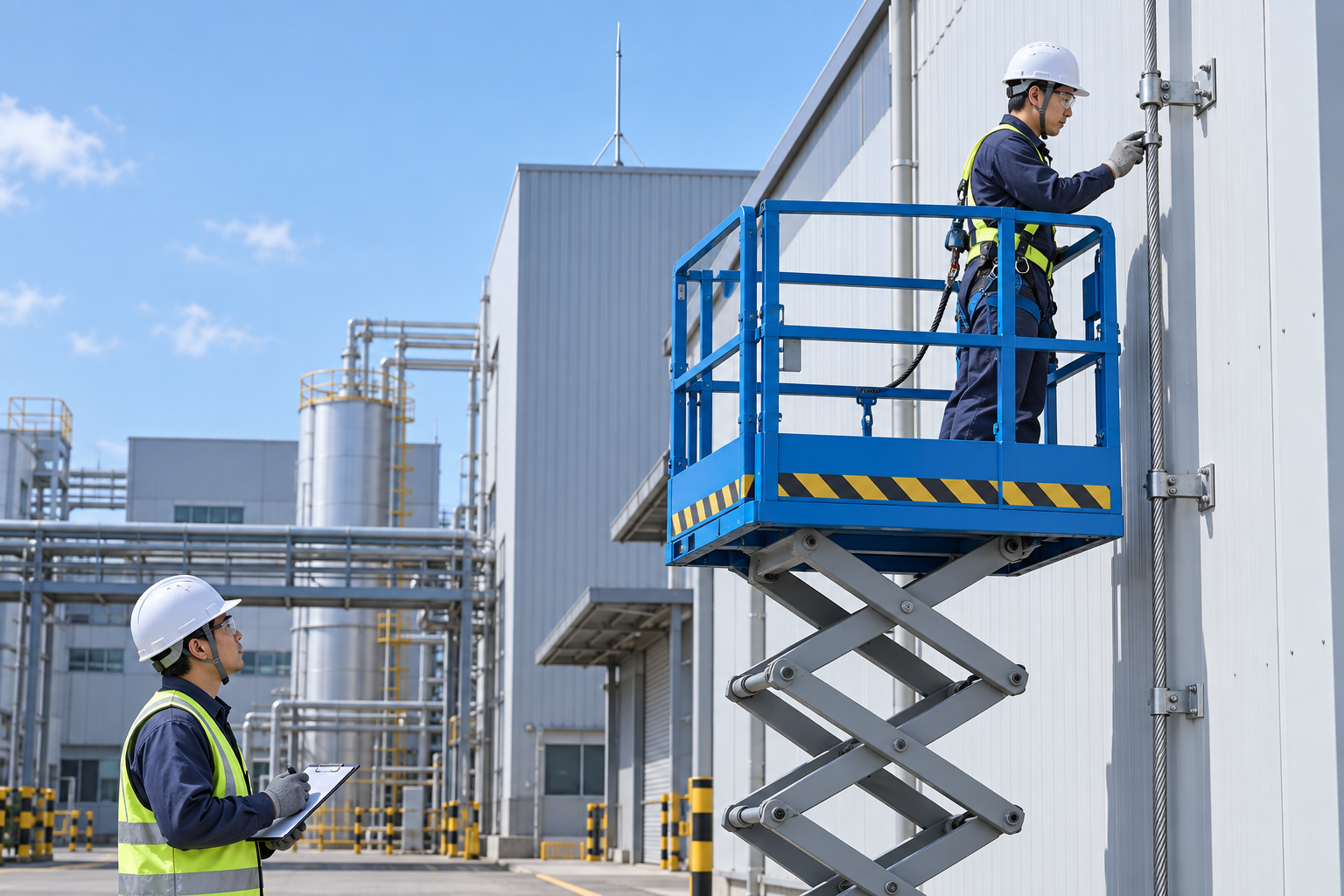
This illustration provides educational context. It is not an actual incident photograph or evidence of equipment suitability; any AI-generated depiction is illustrative only.
The scenario and record comparisons are fictional teaching examples, not records of real incidents, measurements, inspections, signatures or approvals.
| Stage | Fictional situation |
|---|---|
| Initial situation | A fictional team installs an approved downconductor route. |
| Changed condition | A metal duct obstructs it and a detour is proposed close to the duct. |
| Failure path | A continuity pass is treated as proof that the changed route is acceptable. |
| Possible outcome | The altered separation and current path could permit unwanted flashover or dangerous potential differences. |
| Prevention barrier | Hold the changed section for design review of dimensions, support, surrounding metal and bonding before acceptance. |
Failure mechanisms
Continuity concerns electrical connection between chosen test points. It does not prove protection coverage or the adequacy of separation, bonding, supports and earth termination for lightning current. Record test scope and unverified conditions.
A detour changes length and the relationship to metal and electrical services. The LPS design owner must resolve separation or designed bonding; an improvised extra bond can create an unintended current path.
Air-terminal temporary support and final anchorage serve different stages. Support conductor weight through specified details and maintain independent fall protection; a lightning rod or downconductor is not an assumed personal anchor.
An installed LPS does not make outdoor work safe during a storm. Assign weather monitoring, warning, timely retreat and suitable shelter; do not delay withdrawal to finish a connection or use a detector display as work clearance.
Decision sequence
| Step | Decision |
|---|---|
| Known | A duct conflicts with the planned conductor route. |
| Unknown | Changed separation, route length, supports and bonding suitability remain unreviewed. |
| Hold | Do not accept the detour from continuity alone or add an improvised bond. |
| Evidence | Link before/after drawings, dimensions/photos, adjacent services and design disposition plus inspection plan. |
| Release | Install the reviewed route and record specified tests/restoration; keep unresolved sections outside acceptance. |
Work sequence: Review system route → Check materials and base → Establish safe access → Set air terminals → Route downconductors → Connect and inspect → Hold change or weather → Close and transfer. This is a teaching flow, not a device drawing or a complete operating procedure.
5. Conditional decisions and common errors
| Situation | Required action | Evidence | Proceed when |
|---|---|---|---|
| Duct conflict | Hold section | Changed route/design review | Design accepted |
| Roof/anchor uncertain | Stop access | Roof and fall-system evidence | Access protected |
| Lightning threat | Stop and shelter | Weather and retreat state | Site restart criteria met |
| Continuity passes | Complete remaining checks | Route/bonding/support records | Scope accepted |
Similar observations, different decisions
The scenario and record comparisons are fictional teaching examples, not records of real incidents, measurements, inspections, signatures or approvals.
| Observation | Insufficient conclusion | Required distinction |
|---|---|---|
| Continuity passes | The entire LPS is suitable. | Check coverage, route, separation, bonding and earth termination within the design scope. |
| Air terminal installed | It is a fall anchor or storm shelter. | Provide independent fall protection and designated shelter. |
| Conductor rerouted neatly | The change is acceptable. | Obtain design review and revised as-built/testing records. |
6. Roles and responsibilities
| Role | Responsibility |
|---|---|
| Work supervisor / applicable WAH permit parties | Control roof access, fragile areas, dropped objects, fall protection and rescue. |
| Project QP and competent LPS design/supervision parties | Resolve BCA/SS555 project requirements and approve changes within their authority. |
| Installation crew | Use identified materials and reviewed supports; hold conflicts and weather danger. |
| Inspection / receiving team | Link test limits, restored links, as-builts and unresolved sections to completion records. |
Supervision and handover focus
| Stage | Management action | Evidence |
|---|---|---|
| Review system route | 1. Record drawing/revision2. Record route and metal interfaces3. Record bonding/separation detail | 1. Drawing/revision2. Route and metal interfaces3. Bonding/separation detail |
| Check materials and base | 1. Record base/anchor detail2. Record material compatibility3. Record support layout | 1. Base/anchor detail2. Material compatibility3. Support layout |
| Set air terminals | 1. Record temporary stability2. Record position/alignment3. Record fastening evidence | 1. Temporary stability2. Position/alignment3. Fastening evidence |
| Route downconductors | 1. Record route/dimensions2. Record support/weight transfer3. Record adjacent metal relationship | 1. Route/dimensions2. Support/weight transfer3. Adjacent metal relationship |
| Hold change or weather | 1. Record weather/retreat facts2. Record temporary stability3. Record change review evidence | 1. Weather/retreat facts2. Temporary stability3. Change review evidence |
| Close and transfer | 1. Record as-built/photos2. Record roof and debris check3. Record restored links/holds | 1. As-built/photos2. Roof and debris check3. Restored links/holds |
7. Hold points and record comparison
| Hold point | Evidence before release | Actual approval |
|---|---|---|
| HP-0 Scope | Prepare protected access, install specified air terminals, downconductors, supports and connections along reviewed routes, then perform designated inspection/tests and transfer installation records. | |
| HP-1 Establish safe access | Access and roof condition; Independent fall system; Drop zone; Weather/retreat readiness | |
| HP-2 Set air terminals | Temporary stability; Position/alignment; Fastening evidence; Area below | |
| HP-3 Route downconductors | Route/dimensions; Support/weight transfer; Adjacent metal relationship; Material/connection detail | |
| HP-4 Close and transfer | As-built/photos; Roof and debris check; Restored links/holds; Inspection scope/receiver |
Hold points are internal project checks. They are not universal statutory permits and do not grant work permission. Reassess after defects, changed conditions and shift changes.
Record comparison
The scenario and record comparisons are fictional teaching examples, not records of real incidents, measurements, inspections, signatures or approvals.
The boxes are static record prompts, not interactive or saved approvals. A tick does not establish suitability or permission to restart. Record the evidence, person, time and unresolved issues; retain the change history.
| Record | Insufficient record | Record checklist |
|---|---|---|
| Review system route | Only marked “OK” | □ Drawing/revision□ Route and metal interfaces□ Bonding/separation detail□ Test/acceptance plan |
| Set air terminals | Only marked “OK” | □ Temporary stability□ Position/alignment□ Fastening evidence□ Area below |
| Hold change or weather | Only marked “OK” | □ Weather/retreat facts□ Temporary stability□ Change review evidence□ Restart conditions |
| Close and transfer | Only marked “OK” | □ As-built/photos□ Roof and debris check□ Restored links/holds□ Inspection scope/receiver |
8. Site checklist and emergency response
| Site check | Actual result | Person / action |
|---|---|---|
| Review system route: Drawing/revision; Route and metal interfaces; Bonding/separation detail; Test/acceptance plan | ||
| Check materials and base: Base/anchor detail; Material compatibility; Support layout; Weather work plan | ||
| Establish safe access: Access and roof condition; Independent fall system; Drop zone; Weather/retreat readiness | ||
| Set air terminals: Temporary stability; Position/alignment; Fastening evidence; Area below | ||
| Route downconductors: Route/dimensions; Support/weight transfer; Adjacent metal relationship; Material/connection detail | ||
| Connect and inspect: Connection inspection; Test values and limits; Link restoration; Outstanding design issues | ||
| Hold change or weather: Weather/retreat facts; Temporary stability; Change review evidence; Restart conditions | ||
| Close and transfer: As-built/photos; Roof and debris check; Restored links/holds; Inspection scope/receiver |
Stop work
Hold for unclear design, roof support, fall protection, material compatibility or route conflict. Stop for lightning threat, unsafe wind, insecure terminals or damaged supports; withdraw under the site plan without delaying to finish a joint.
Emergency response
Stop exposed work and move to designated shelter when lightning threatens. Control the area below unstable terminals/conductors. Call 995 for a strike, fall or serious injury and activate trained first aid and the planned fall-rescue response; do not expose more people to uncontrolled roof or electrical hazards.
9. Sources and review limits
Public-source access/review: 2026-10-14.
| Official source | Reviewed scope and limits |
|---|---|
| MOM: Risk management | Assess temporary support, conductive paths, weather and changes around rooftop services. Official explanation of statutory duties; linked SSO text was not independently read for this item. This is not a legal opinion. |
| WSH Council: Preventing Falls from Height | Verify roof/access support, independent fall protection, rescue and applicable permit process. Official explanatory guidance; the stated PTW scope is not a general exemption from fall controls below that height. Actual premises classification must be checked. |
| BCA: Submission of Lightning Protection System Plans | Confirm actual project plan-approval scope and use reviewed SS555 design details. Direct PDF returned 404; selected indexed official text only. Full SS555 and project transitional status not reviewed. Check current phase and actual eligibility with the QP. |
| BCA: Application for TOP/CSC | Transfer as-built routes, tests and supervision records to the project QP. Completion-document guidance does not approve this installation or replace project-specific submissions. |
| Meteorological Service Singapore: Weather Systems—Lightning | Use official Singapore weather/lightning information within the site warning and shelter plan. Information service is an input to the site weather plan, not work clearance or a universal safe-radius rule. |
No actual equipment model, site measurements, design calculations or signed approval was supplied. Check the applicable Singapore requirements and approved safe work procedures against the actual equipment and site before use. Statutory duties, official guidance and manufacturer limits serve different purposes; editorial checks do not establish legal or professional approval.
10. PDF guidance and FAQ
PDF A covers basic task controls; B focuses on technical failures; C covers supervision, records and handover. The article has eight stages with four items per main cell; each PDF has six key stages with three items per main cell. P/S/R/A, measurements, confirmations and signatures remain blank for actual site assessment.
PDFs are complementary six-stage extracts. Apply all eight body stages and the actual equipment/site procedure.
Can a downconductor be a lifeline anchor?
Do not assume it can; use independently reviewed anchorage.
Can nearby metal simply be bonded?
Follow the reviewed LPS design; do not improvise a new lightning-current path.
Does low resistance accept a route change?
No. The design owner must resolve geometry, separation, bonding and inspection scope.
Can a connection be finished during approaching thunder?
Follow the stop/retreat plan and seek shelter promptly; do not extend exposure to finish work.
Has a professional verified or approved this document?
AI-generated reference material; not professionally verified or approved. Before use, a qualified person must review and adapt it to Singapore requirements, the actual equipment/site and approved safe work procedures.
11. Revision history and authorship
AI-generated reference material; not professionally verified or approved. Before use, a qualified person must review and adapt it to Singapore requirements, the actual equipment/site and approved safe work procedures.
| Date | Version | Change | Review status |
|---|---|---|---|
| 2026-10-14 | SG 1.0 | New Singapore edition from assigned Korean source; task decisions, records and PDFs localized. | AI editorial review; no professional technical approval |
Korean edition revision history: 2026-09-20 (v1.0): initial article, sources, fictional analysis and PDF editorial checks; 2026-09-23 (v1.1): task decisions, record checklist, JSA and three PDF variants revised. These are editorial records, not professional technical approval. Singapore v1.0 adapts the earlier edition to Singapore requirements and terminology.
Site reviewers must add their actual qualifications, scope, date and approval only after the review occurs.