Provide verified protection for the installers before installing the new lifeline. The unfinished system cannot be its own sole safeguard, and a product load rating does not establish the strength of its supporting structure.
AI-generated reference material. It has not been verified or approved by a professional. Before use, a qualified person must review and adapt it to applicable Singapore requirements, the actual equipment and site, and approved safe work procedures.
1. Singapore legal and technical basis
Singapore WSH work-at-height controls start with avoiding the fall exposure and suitable collective protection. WSHC anchorage guidance supports a complete compatible system, substrate assessment, installation evidence and user limits. The actual design, manufacturer conditions and applicable current requirements govern; the older guide is not a universal proof-load or clearance prescription.
| Source category | Task application and limit |
|---|---|
| MOM - Risk management | Assess installation, inspection, rescue and later alterations. Official explanation of WSH Risk Management duties, not a complete consolidated statutory text. |
| MOM - Work at Heights amendment factsheet | Apply the relevant work-at-height planning and permit arrangements to the actual workplace. Official 2014 explanatory factsheet accessed now. Consolidated SSO fetch returned 403; full current statutory text not verified. Course names and detailed permit arrangements need current confirmation. |
| WSHC - Anchorage, lifelines and temporary edge protection | Check substrate, compatible components, deflection, use limits and installation evidence. Selected guidance text, not complete paid standards or visual diagrams. Older standard editions and numerical examples are not treated as current universal statutory design values; confirm actual system/current specification. |
| MOM - Requirements for hygiene monitoring | Control anchor-drilling dust and assess actual exposure where applicable. Material-specific exposure and actual monitoring frequency have not been determined. No workplace measurement is supplied. |
Use Singapore requirements and SI units. Manufacturer limits apply to the actual model. Foreign technical examples do not establish Singapore statutory duties. A job safety analysis or completed checklist is not a permit or approval.
2. Scope and required inputs
Included scope
Prepare, install, inspect and hand over designed horizontal or vertical lifelines and personal fall protection anchorages, with independently verified protection for the installation crew.
Separate assessment
Rope access, complete scaffold/temporary-structure design, material lifting and product certification testing are separate scopes. A connected rope is not an approved personal fall arrest system.
| Input | Evidence needed |
|---|---|
| Select system | Use and work path; Users span and load; Clearance and swing; Permitted combination. |
| Inspect components | Product and lot; Wear and corrosion; History and restrictions; Tool condition. |
| Install lifeline | Span supports and tension; Rope grab direction; Continuous protected path; Connector and edge fit. |
| Recheck changes | Pre-use inspection; Impact and repair history; Before-after design; Competent review record. |
No site measurements, equipment manuals for the actual installation, inspection records or signed technical approvals were supplied. Confirm the applicable requirements and actual product instructions before use; record each criterion with its units, source and equipment or work-area ID.
Singapore application
Ask the designer and supplier to confirm outdoor exposure, rainwater, corrosion and product life for the actual location. WSHC guidance specifically flags climate suitability of chemically bonded anchors; do not assume a resin anchor is suitable because its catalogue capacity is high.
3. Eight-stage JSA
| Job stage | Hazards and effects | Failure factors | Controls | Site verification | P | S | R | A |
|---|---|---|---|---|---|---|---|---|
| 1. Select system | 1. Unarrested fall2. Lower-level impact3. Anchor overload4. Connector release | 1. Restraint confused2. Clearance omitted3. Users uncounted4. Mixed components | 1. Review collective protection2. Define restraint or arrest3. Design complete system4. Verify component compatibility | 1. Use and work path2. Users span and load3. Clearance and swing4. Permitted combination | ||||
| 2. Protect installers | 1. Substrate failure2. Utility drilling3. Installer fall4. Dropped tool | 1. Cladding treated as structure2. No service scan3. Unfinished line used4. No lower exclusion | 1. Verify structure and load path2. Locate concealed services3. Provide independent protection4. Prepare rescue and exclusion | 1. Substrate and climate review2. Anchor location and edges3. Installer protection4. Rescue access | ||||
| 3. Inspect components | 1. Rope rupture2. Lock failure3. Untraceable damage4. Poor fastening | 1. History unknown2. Damaged connector3. Missing ID4. Wrong tools | 1. Inspect and identify parts2. Check locking action3. Quarantine doubtful items4. Use specified tools | 1. Product and lot2. Wear and corrosion3. History and restrictions4. Tool condition | ||||
| 4. Install anchorages | 1. Anchor pullout2. Concrete failure3. Dust exposure4. Uncured anchor loaded | 1. Wrong substrate2. Edge condition missed3. Uncontrolled drilling4. Cure not complete | 1. Follow approved detail2. Match substrate limits3. Control drilling hazards4. Observe cure and inspection | 1. Hole and cleaning2. Edge and embedment3. Temperature and cure4. Fastening inspection | ||||
| 5. Install lifeline | 1. Stored tension release2. End slips3. Unprotected transfer4. Edge damage | 1. Excess tension2. Wrong termination3. Route discontinuity4. Incompatible device | 1. Set designed line condition2. Use specified end fittings3. Plan protected transitions4. Check orientation and edges | 1. Span supports and tension2. Rope grab direction3. Continuous protected path4. Connector and edge fit | ||||
| 6. Inspect completed system | 1. Unverified use2. Test damage3. Lower obstruction hit4. Wrong section released | 1. Appearance-only acceptance2. Improvised drop test3. Dynamic clearance ignored4. Boundary unclear | 1. Follow inspection plan2. Use only approved tests3. Verify full clearance4. Identify accepted sections | 1. Installer and test evidence2. Test need and criteria3. Clearance basis4. Section release record | ||||
| 7. Train and handoff | 1. Too many users2. Wrong connection3. Rescue delayed4. Unapproved span used | 1. Label missing2. User uninformed3. Rescue not ready4. Handoff incomplete | 1. Label user and span limits2. Train intended connections3. Verify prompt rescue4. Restrict unapproved sections | 1. System ID and users2. Transfer procedure3. Rescue means and contact4. Authorised use scope | ||||
| 8. Recheck changes | 1. Impact-damaged reuse2. Changed system overload3. Corrosion failure4. Unauthorised relocation | 1. Fall history hidden2. Span changed3. Pre-use check missed4. Anchor moved | 1. Inspect before each use2. Remove impact-loaded system3. Review every change4. Follow reuse criteria | 1. Pre-use inspection2. Impact and repair history3. Before-after design4. System owner review record |
P/S/R/A and actual measurements, checks, names and signatures remain blank for the site assessment. A score cannot waive a required control.
4. Hypothetical scenario and failure mechanisms
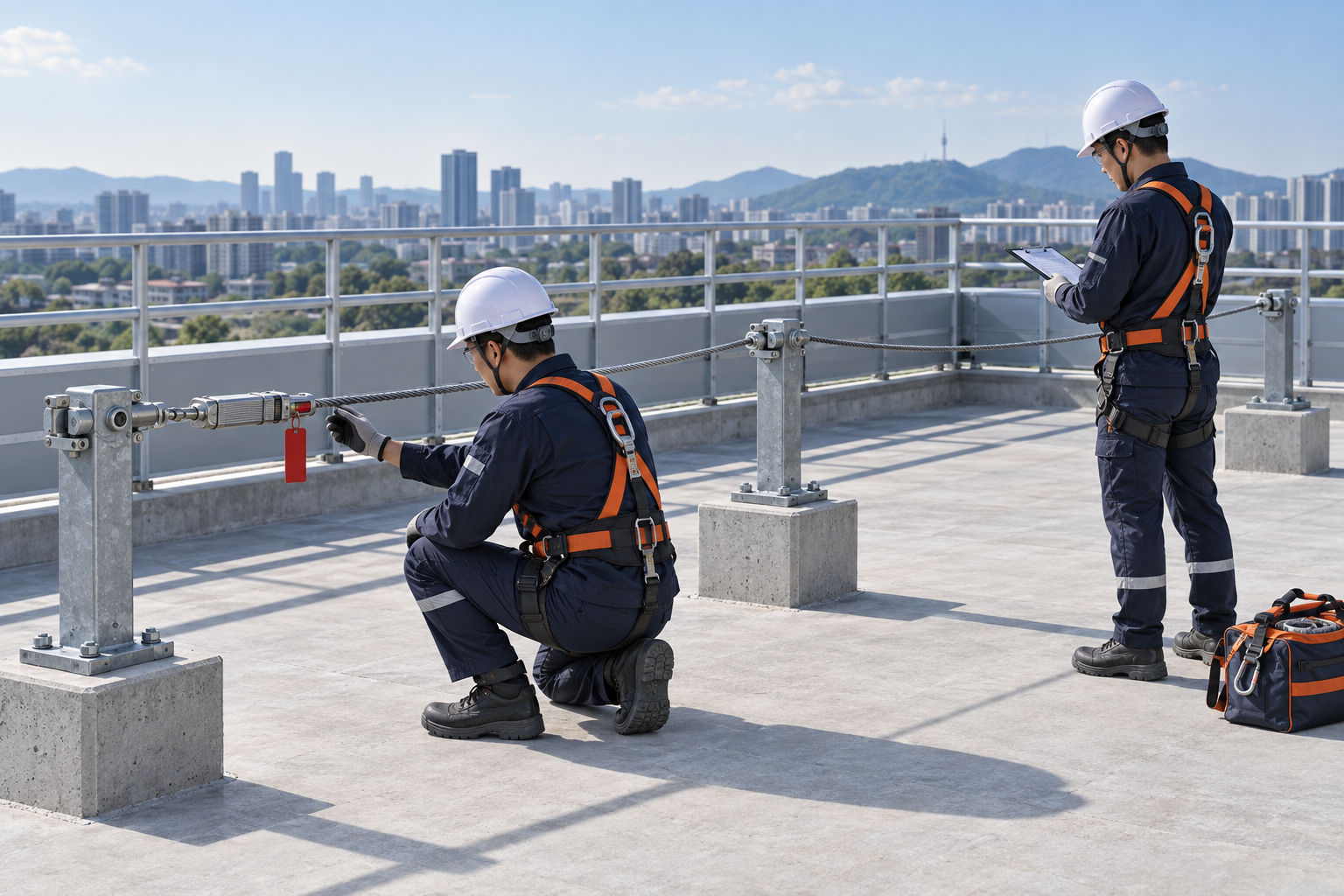
Retained AI-generated educational illustration from the source edition; not a real incident photograph, approved installation drawing or evidence of equipment suitability.
The scenario and record comparisons are fictional teaching examples, not records of real incidents, measurements, inspections, signatures or approvals.
| Item | Fictional scenario |
|---|---|
| Initial | A worker is installing a new lifeline. |
| Change | The worker clips to the new rope before its anchors and ends are inspected. |
| Failure | The item being installed is mistaken for the existing installer protection. |
| Outcome | A fall could load unfinished connections or an unverified substrate. |
| Barrier | Provide independently verified protection, finish the approved installation and release only inspected system sections. |
Why the controls matter
Choose collective protection where feasible and distinguish fall restraint from fall arrest. Installer protection must already be effective before relying on the new system; unfinished anchors and terminations cannot be its only protection.
Horizontal-line sag, span and user loading affect anchor reactions and fall clearance. Tighter is not automatically safer. Verify the complete structural load path, not just an anchor product rating.
Use the manufacturer reference points when checking deployment, system deflection, harness movement, user conditions, swing fall and lower obstructions. Do not mix distances from unrelated manuals or improvise drop tests. Vertical rope-grab orientation and permitted rope/connector combinations are system-specific.
Decision sequence
| Step | Decision |
|---|---|
| Known | The worker clips to the new rope before its anchors and ends are inspected. |
| Unknown | Actual condition, extent of damage and suitability of span supports and tension, rope grab direction remain to be established. |
| Hold | The item being installed is mistaken for the existing installer protection. |
| Evidence | Link span supports and tension, rope grab direction, continuous protected path, connector and edge fit, system id and users, transfer procedure to the affected equipment or work area. |
| Next | Provide independently verified protection, finish the approved installation and release only inspected system sections. |
5. Hold and proceed decisions
| Condition | Action | Evidence | Proceed when |
|---|---|---|---|
| Substrate unknown | Hold drilling and use | Structure and load-path review | Substrate accepted |
| Cure incomplete | Keep system unloaded | Product temperature/time data | Cure criteria met |
| Mixed parts | Verify complete combination | Manufacturer and design evidence | Combination permitted |
| Impact history | Remove from service | Competent review and instructions | Reuse or replacement resolved |
Similar appearance, different evidence
The scenario and record comparisons are fictional teaching examples, not records of real incidents, measurements, inspections, signatures or approvals.
| Comparison | Supported decision | Insufficient basis |
|---|---|---|
| Condition | Structure and load-path review | Substrate unknown has not been resolved. |
| Evidence | Manufacturer and design evidence | A photograph or a completed-looking task without the relevant inspection record. |
| Release | Reuse or replacement resolved | Completion of one step does not release the excluded tasks in section 2. |
6. Roles and supervision
| Role | Responsibility |
|---|---|
| Work supervisor | Assign the task boundary, stop authority, interfaces and emergency communication for lifeline and fall protection anchorage installation. |
| Technical lead | Confirm Use and work path; Users span and load; Clearance and swing; Permitted combination. Resolve design and manufacturer limits before work. |
| Authorised crew | Apply Product and lot; Wear and corrosion; History and restrictions; Tool condition. Stop when the working arrangement changes. |
| Inspector / receiving lead | Review Span supports and tension; Rope grab direction; Continuous protected path; Connector and edge fit. Transfer Pre-use inspection; Impact and repair history; Before-after design; Competent review record. |
Role labels allocate responsibilities; they do not confer a legal qualification. Verify the competence, training and authority required for the actual task.
Record and handoff perspective
| Stage | Record controls | Verification |
|---|---|---|
| Select system | 1. Record use and work path2. Record users span and load3. Record clearance and swing | 1. Users span and load2. Clearance and swing3. Permitted combination |
| Inspect components | 1. Record product and lot2. Record wear and corrosion3. Record history and restrictions | 1. Wear and corrosion2. History and restrictions3. Tool condition |
| Install anchorages | 1. Record hole and cleaning2. Record edge and embedment3. Record temperature and cure | 1. Edge and embedment2. Temperature and cure3. Fastening inspection |
| Install lifeline | 1. Record span supports and tension2. Record rope grab direction3. Record continuous protected path | 1. Rope grab direction2. Continuous protected path3. Connector and edge fit |
| Train and handoff | 1. Record system id and users2. Record transfer procedure3. Record rescue means and contact | 1. Transfer procedure2. Rescue means and contact3. Authorised use scope |
| Recheck changes | 1. Record pre-use inspection2. Record impact and repair history3. Record before-after design | 1. Impact and repair history2. Before-after design3. Competent review record |
Singapore application
The design owner identifies the complete structural load path and permitted users. The installer supplies the required installation and test evidence; the designated inspector and release authority resolve acceptance before users connect. The building operator retains system ID, location, inspection schedule and impact history.
7. Hold points and record quality
| Hold point | Evidence before release | Actual record |
|---|---|---|
| HP-0 Start | Prepare, install, inspect and hand over designed horizontal or vertical lifelines and personal fall protection anchorages, with independently verified protection for the installation crew. | |
| HP-1 Protect installers | Substrate condition; Anchor location and edges; Installer protection; Rescue access | |
| HP-2 Install anchorages | Hole and cleaning; Edge and embedment; Temperature and cure; Fastening inspection | |
| HP-3 Inspect completed system | Installer and inspector; Test need and criteria; Clearance basis; Section release record | |
| HP-4 Train and handoff | System ID and users; Transfer procedure; Rescue means and contact; Authorised use scope |
These are internal hold points, not issued permits. Recheck affected points after a change, fault or shift handoff; link the actual approval record.
Record comparison
The scenario and record comparisons are fictional teaching examples, not records of real incidents, measurements, inspections, signatures or approvals.
The boxes are static record prompts, not interactive or saved approvals. A tick does not establish suitability or permission to restart. Record the evidence, person, time and unresolved issues; retain the change history.
| Record | Insufficient | Record checklist |
|---|---|---|
| Select system | "Checked" without target, criteria or result | □ Use and work path□ Users span and load□ Clearance and swing□ Permitted combination |
| Inspect components | "Checked" without target, criteria or result | □ Product and lot□ Wear and corrosion□ History and restrictions□ Tool condition |
| Install lifeline | "Checked" without target, criteria or result | □ Span supports and tension□ Rope grab direction□ Continuous protected path□ Connector and edge fit |
| Recheck changes | "Checked" without target, criteria or result | □ Pre-use inspection□ Impact and repair history□ Before-after design□ Competent review record |
8. Pre-work checks and emergency response
| Check | Result | Person / action |
|---|---|---|
| □ Select system: Use and work path | ||
| □ Protect installers: Substrate condition | ||
| □ Inspect components: Product and lot | ||
| □ Install anchorages: Hole and cleaning | ||
| □ Install lifeline: Span supports and tension | ||
| □ Inspect completed system: Installer and inspector | ||
| □ Train and handoff: System ID and users | ||
| □ Recheck changes: Pre-use inspection | ||
| □ Emergency access and handoff restrictions |
Stop work
Hold installation or use if the substrate, components, history, installer protection, clearance or rescue plan is unverified. Isolate any damaged, changed or impact-loaded system pending the required assessment.
Emergency response
Activate the preplanned prompt-rescue procedure immediately after a fall and contact the site emergency responders/site responders. Do not connect additional rescuers to an unverified or impact-loaded system. Control access while the designated trained team applies the planned rescue method.
9. Sources and review limits
Public-source review: 14 October 2026. Only the material and limits identified below were reviewed.
| Source | Reviewed material | Task application |
|---|---|---|
| MOM - Risk management | Responsibilities; routine and non-routine work; hierarchy of control and risk assessment team. Official explanation of WSH Risk Management duties, not a complete consolidated statutory text. | Assess installation, inspection, rescue and later alterations. |
| MOM - Work at Heights amendment factsheet | Pages 1-4, particularly Annex A questions 1-3 on factories, hazardous height and effective protection; training/role explanations. Official 2014 explanatory factsheet accessed now. Consolidated SSO fetch returned 403; full current statutory text not verified. Course names and detailed permit arrangements need current confirmation. | Apply the relevant work-at-height planning and permit arrangements to the actual workplace. |
| WSHC - Anchorage, lifelines and temporary edge protection | Printed pages 3-7 hierarchy/substrate/climate; 14-17 identification, installation evidence and compatible systems; 24-27 deflection/clearance and SRL restrictions. Selected guidance text, not complete paid standards or visual diagrams. Older standard editions and numerical examples are not treated as current universal statutory design values; confirm actual system/current specification. | Check substrate, compatible components, deflection, use limits and installation evidence. |
| MOM - Requirements for hygiene monitoring | Main requirements: competent monitoring personnel, toxic substances, results and reporting, recommended frequency table and noise applicability. Material-specific exposure and actual monitoring frequency have not been determined. No workplace measurement is supplied. | Control anchor-drilling dust and assess actual exposure where applicable. |
Selected public official sources were reviewed on 14 October 2026 within the recorded scope. No full consolidated legal audit, paid Singapore Standard, actual model manual, site inspection, engineering calculation or professional approval is claimed. Verify current detailed requirements and actual equipment/site records before use.
AI-generated reference material. It has not been verified or approved by a professional. Before use, a qualified person must review and adapt it to applicable Singapore requirements, the actual equipment and site, and approved safe work procedures.
10. PDF use and frequently asked questions
PDF A covers basic task controls; B focuses on technical failures; C covers supervision, records and handover. The article has eight stages with four items per main cell; each PDF has six key stages with three items per main cell. P/S/R/A, measurements, confirmations and signatures remain blank for actual site assessment.
Content group
jsa-lfl-ins
May installers clip to an unfinished line?
No. Establish verified protection independent of the uncompleted system.
Is tighter cable always safer?
No. Follow the designed tension, sag, span and user conditions.
Is one proof-test load valid for every anchor?
No. Required testing, loads, methods and acceptance must come from the applicable approved plan and product instructions.
Can an impact-loaded system be reused if it looks good?
Remove it from service pending the required competent-person assessment and manufacturer inspection/replacement criteria.
Has a professional approved this JSA?
This reference material was written and revised with AI. It has not been verified or approved by a professional. Review by a suitably qualified professional and required site approval are necessary before field use.
Singapore application
A device permitted on a vertical line is not automatically permitted horizontally or attached to a horizontal lifeline. Confirm the complete combination, including edge behaviour and rescue loading, before release. Read A, B and C together with all eight JSA stages and the approved work procedure. The sheets are complementary extracts, not separate work authorisations.
11. Authorship and revision history
AI-generated reference material. It has not been verified or approved by a professional. Before use, a qualified person must review and adapt it to applicable Singapore requirements, the actual equipment and site, and approved safe work procedures.
| Date / edition | Authorship and scope | Professional approval |
|---|---|---|
| 2026-09-19 / Korean source | Original topic and educational illustration retained as references. Source content is unchanged. | Not asserted |
| 14 October 2026 / Singapore 1.0 | Added Singapore anchorage guidance, local climate suitability and installed-system evidence while preserving independent installer protection and no improvised drop tests. | Not performed |
Source topic: https://smartjsabridge.com/ko/case-study/jsa-lfl-ins